Chess without Queen

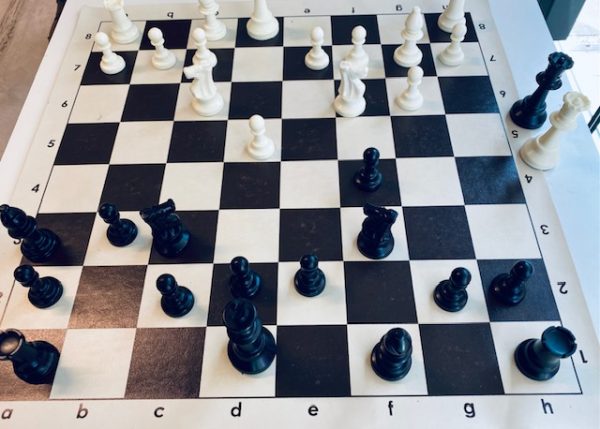
It is perfectly possible to play chess without a player having a queen on the chessboard. This certainly gives an advantage to the opponent, but in case of a lack of an adequate strategy or being overly confident to win, the advantage can be compensated by the party who does not have a queen in the arsenal of weapons. The paper by Lissner & Warden (2026, p.109) on the new way of war following the Russian invasion of Ukraine in 2022-2-24 states that “nuclear weapons have not given Moscow the coercive leverage many assumed they would.” Nuclear weapons hit the civilian population without differentiation the hardest, just as much as taking nuclear power plants as strategic war targets would do. What we have seen so far in Russia’s strategy is to use civil infrastructures of water and heating as targets within Ukraine as part of a kind of psychological warfare against the Ukrainian civil population. The more committed Ukrainian soldiers, even with the lack of a nuclear weapon, seem to hold the line against the Russian aggressor that so far has restrained from the nuclear option, if the Tschernobyl disaster has not been a precursor of a weaponisation of nuclear infrastructure.
Future Conflicts

Since 2014-2-27 Russia has occupied the Crimean peninsula. This invasion had started with an undercover mission of unmarked soldiers to take full control of Crimea about 3 weeks later. Russia did not officially declare a war, although the intentions were identical to a land grabbing war. The western world did not react much to this violation of international law. Apparently, this contributed to the next cynical “special operation” by the Russian army to fully invade Ukraine on 2022-2-24 in a failed “Blitzkrieg”, a rapid invasion, which attempted and failed to annex the whole of Ukraine. According to Lissner & Warden (2026) the Russian invasion of Ukraine bears 4 lessons for future conflicts: (1) the risk of using nuclear weapons is real, (2) in addition to nuclear options, prolonged and very destructive conventional wars remain an option, (3) escalation thresholds emerge and evolve over the duration of the conflict, (4) allies and partners in war keep adjusting their risk tolerance as well as escalation options. The authors argue from a US perspective and add a practical comment: “The USA cannot go this alone, but should coordinate closely with allies and partners in time before another conflict arises. Multilateralism seems a valid option and even more so as we move into a multipolar power play on the global scale propelled by AI.
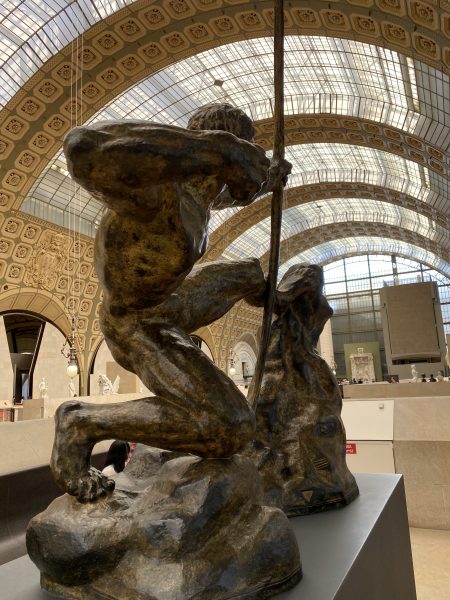
(Image: Musée Orsay, Paris – Archer, Bogenspannende)

Peace and war again

“If you want peace, prepare for war”. This is one of the famous citations from Vegetius an early Roman general. For centuries we have been aware that peace and war are not opposites in a broader sense. Preparation for war can resemble war, if a country’s economy is already heavily turning towards production of weapons and intensifies research in dual use technologies. Political terminologies that shift to a vocabulary using more belligerent language may also be interpreted as a early signs of a shift in balance between peace and and early warnings on war. 4 years of the war of Russia on Ukraine territory have left traces in our vocabulary as well as budgets devoted to the preparation of a defense in Europe.
More countries of the EU state openly what is in their “national interest”, as if they were ready to go to war (Charap & Haukkala 2026) to in case major elements of the national interest were endangered. In going back to Clausewitz’s writing, a long historical line can be drawn from the Crimean War(s) to Putin’s imperialist war of 2014 and 2022 trying to capture Ukrainian territory, irrespective of enormous human losses.
Another lesson from these historical events might be: Let’s not forget to prepare for peace during the hot conflict.

External-Internal Threat

In a time perspective of at least since the German unification of 1990, we have to reconsider the perception of what constitutes an external versus an internal threat. Prior to the implosion of the Soviet Union and the Glasnost years, the external Russian threat has been transformed across the globe into more hybrid threats coming from internal forces which have been “instrumentalized” by external forces. In an essay by Valentine Faure (Le Monde 2026-2-21) this twist to internal politics has been described as a form of new forms of interference of external forces into European internal political, economic and social affairs. In fact the basic strategy is as old as the famous Trojan horse, but the strategy has been refined and to work over much longer time spans as well as in other scientific applications. Any form of powerful, interested party would rather use the soft power of persuasion than brutal force to reach political objectives. Corruption and buying votes, directly or indirectly, has become a legitimate way in this hybrid or open use of power from the inside of a society than through a more traditional external affairs strategy. The confrontation of the bipolar world made it easy to put emphasis on external military power. A multilateral as well as more multilayered international political arena precludes to some extent the bipolar confrontation as conflicts on several frontiers  increases risks exponentially. In search of other strategies it seems plausible to turn to hybrid as well as disguised external force. Europe and democratic systems in general are more vulnerable than autocratic states, because the belief in an open form of society is part of its DNA. Open societies shall have to sharpen their sensory systems to transformed external to internal threats.

EU Presidencies Review

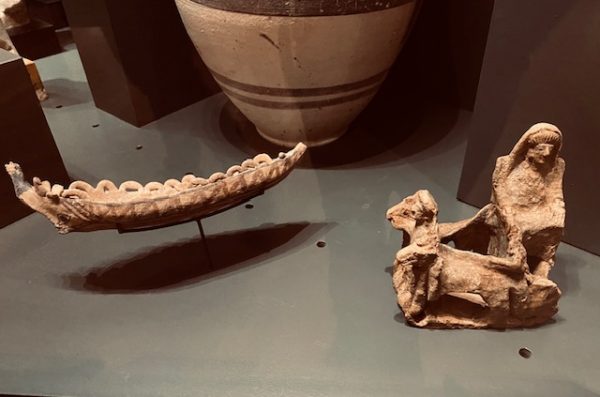
There is a turnover at the EU presidency every 6 months. A full cycle of all presidencies takes 13 and a half years as each presidency lasts the same length irrespective of country size. CY 2026 is the current one, where CY does not only stand for “see you” in smartphone slang, but for Cyprus in 2026. The procedure to determine a working program for the Council presidency is well established and unresolved matters keep coming back in regular time intervals. The big overarching topic in 2026 is EU autonomy facing up to new challenges of the multilateral world. In the EU presidencies small countries can showcase their concerns and demonstrate what their preferred topics and proposals of solutions are. It is also a chance to make people aware of why they have been eager to join a political, cultural and economic union in the first place. Already in the founding documents the issue of security and defense were addressed. They are again on the top of the agenda in the enlarged EU. The multi-ethnic and multi- religious experience of Cyprus, a country that has lived through multiple strategic dominations over centuries, can probably teach us a lot about how difficult it is to be autonomous if other more powerful countries have put an eye on your territory. Choose your allies wisely. (Image: exhibits Cyprus at BNF 2026, CY2026EU) 

Rule and divide leadership

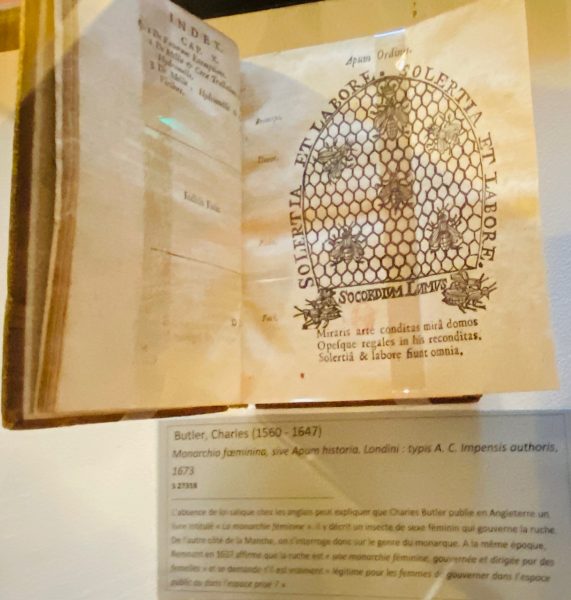
We have known the leadership style, which has been coined as “rule and divide”, at least since the Roman imperial period.  In conquered countries it was a strategy to rule by way of creating divides between peoples or regions within a conquered country. The struggle for power within a country is likely to avoid that a powerful opposition to the occupant can build up. What is well researched in the history of international politics, has also been applied to the realm of management strategies. Anthony Galluzzo demonstrates that the strategies of management often attempt to split the workforce in at least 2 different camps in order to better keep employees and their trade unions under some sort of control. For society as a whole, so-called dual labor market theories have hypothesized the existence of such management strategies since the 1980s. With the labor practices in food and grocery deliveries as well as in taxi services such management strategies are applied again. “Old wine in new bottles”, but still seems to sell and catch on. (Image: extract from Butler Charles, 1637, Monarchia faeminina)


Multilateral world

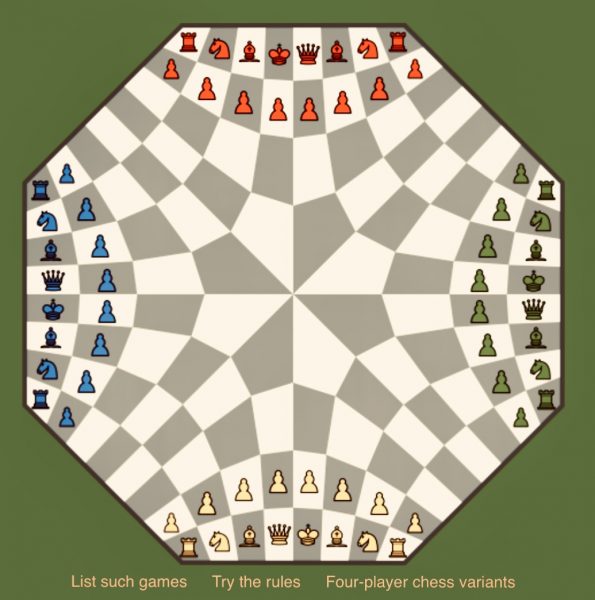
In the relatively brave new world of 21st century, it is not only a question of how the super powers like the USA, China and Russia shall push their strategic goals, but also what role so-called „Middle Powers“ will play. Europe and the European Union will have to make up their minds, whether they want to belong to one or the group, individually or jointly. New as well as shifting alliances seem to be a realistic scenario. Coalitions of middle powers will be effective counterparts to the threat of domination by a single or joint brutal force of superpowers. The power of interference of middle powers in the confrontation of superpowers is considerably higher if they were to collaborate more effectively than with each of the superpowers previously in a simple 2 opponents game of chess, much more familiar to us so far. (Image: Game of chess with 4, 5 or 6 players on the same board, here adapted from chessboard for 4 players, source: greenchess.net webpage)

Between micro and de-facto state

In political science we distinguish between small, micro-states and territories or regions that are defined as de-facto states. Björn Boman (2025) has put the wealthy states of Monaco, Lichtenstein and San Marino into the micro-states category. On the contrary, Abkhazia, South Ossetia, Donetsk and Luhansk fall under the label of de-facto states with more controlled access as well as under Russian influence using brutal force to control the zone of Russian influence. Due to its size Ukraine as a whole has been able to resist the Russian forces to be degraded to a de-facto state only. The military and technical ingenuity of a well educated workforce allowed the Ukraine leadership to not only counter the Russian invasion, but also to mobilize enormous support from western democracies in form of weapons, financial and humanitarian assistance including millions of refugees over the last 4 years. Size of territory has entered the equation or balance whether to belong to a the micro- or de-facto state category. In the new multipolar international political arena “the sovereign state” has become a more hybrid concept as well. Micro-states have handled the difference between full internal sovereignty and only partial external sovereignty already for years, the new multipolar international arena is being transformed rapidly in this direction. Choose your camp or align with a sufficient number of countries to form an internal and external sovereign area.

Utopian Antifascists

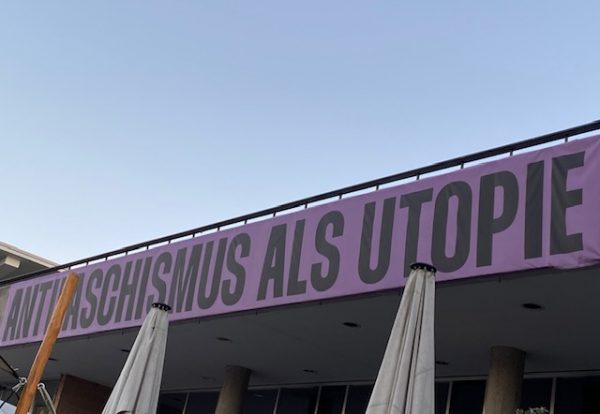
Next to the exhibition on “Global Fascism” in Berlin in 2025-12 there was a banner on the wall, which stated “Antifascism as Utopia” (see image below). This statement invites the question, whether an antithesis can serve as a positive utopian idea guiding large numbers of people. It is certainly necessary that all people who subscribe to democratic principles and human values should be able to unite under the banner of antifascism, but the ways to pursue this goal are manifold. This makes the claim of an utopian objective a bit more obvious and, at the same time, more plausible as a potentially overarching objective. The statement might well turn out to be the defining statement or key visual of the year 2026 with rising nationalist and in some places also fascist ideas and rhetoric. Thoughts and words might be only precursors of more such actions in the coming months. 

Q Q Utopia

Projections into the future, the painting of a futuristic image or an utopian narrative can be based on a quantitative or a qualitative approach. A quantitative projection into the year 2100, for example, is form of creating an utopian vision of quantitative developments. Projecting the small reduction of working hours into a very distant future will eventually approach zero hours (tous sublime). Alternatively, utopian scenarios for qualitative characteristics of work and employment range from full health and safety or “cure yourself by work” (?really, “Arbeit macht frei”) to AI and robots designed to solve major laborious tasks and challenges for us. It is important to differentiate between the qualitative and quantitative forms of utopian visions. The time frames matter, too. In politics various combinations of utopian perspectives have frequently been combined. The human mind’s capability to project itself into the future explains our tendency to come up with utopian ideas or scenarios irrespective of our ability for rationality. We better acknowledge these human characteristics rather than insist on an either, or image of ourselves.