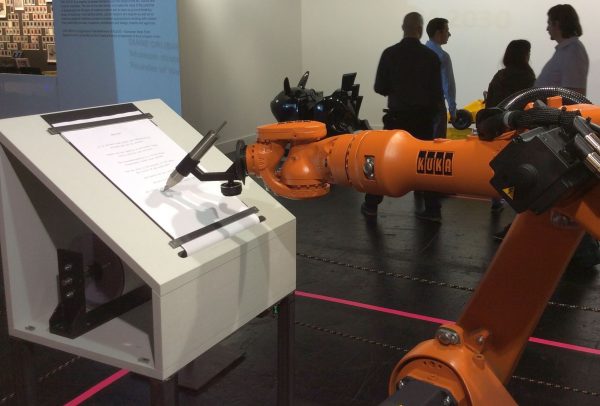
First we teach robots how to move. Next, they teach us how to move and motivate us to do more. This is not only for the elderly persons to imitate the moves and talk to AI systems, but children too will have fun and learn new tricks from robots rather than old dogs. Learning languages with an AI system is well advanced. Soon we shall walk with our artificial friend around cities and have a perfect tourist guide with us. Imagine walking in the countryside with your robot explaining you the flowers and herbs next to you. These brave new worlds are not too far off and it is up to us to be open to accept or dismiss these applications. Coaches using ball throwing machines or robots have managed to lead pupils to higher levels of practice faster than others. Motivation through move technology has undeniable advantages. 
Ed Tech
Education Technology is much more than the use of tablets and Internet access in schools or in each classroom. Some schools revert to ban mobile phones access during classes or introduce specialized social media breaks during the school day. At the other end of the intelligent use of digital technology is the digital classroom with digital whiteboards in each classroom or the first fun hands-on experience with coding for primary school pupils through, for example, the “Scratch” platform. Once you are used to the power of the whiteboard to use web-based information in teaching systematically, most teachers and pupils will no longer want to miss these tools. Public libraries become important access points for those who have no speedy access at home to assist in learning. Digital tools and e-learning are an empowerment of learners to benefit from the millions of useful learning tools and platforms on the web. A first understanding of easy coding allows children to figure themselves as producer of games rather than only a consumer of fantasy games. Create your own story instead of following the stories of others is empowerment. Scratch it, if you like. The role of the teacher in classrooms is evolving fast as well beyond the 40-60 minutes slots in class. Play the games of your pupils, is a bit like a flipped classroom.
(Image: SCCON Berlin 2024 connected classroom simulation) 
AI Nobel
Artificial Intelligence has made it into the ranks of Nobel prizes in 2024. As AI is been talked about everywhere by now the Nobel Committee has deemed it expedient to award Hopfield and Hinton the Nobel Prize not in informatics, this does not exist (yet), but in physics. Neural networks focus on the links between bits of information rather than just the sheer number of data points mimics the functioning of our brains. The most remarkable statement by Hinton is probably the one of the also dangerous potential of this invention. He has already issued a disclaimer on the potential of AI in warfare or other ways to impinge on our human idea of freedoms. The discovery of the applications, good and bad, of these AI-based systems has just begun. The comparison with Nobel‘s original discovery and mass production of explosives from which the prize draws its name has hardly been more adequate recently. (Image stockholm City Library)

Smart Cars
Technology of cars and in cars has evolved rapidly with the move towards the smart cars. Smart cars are characterized by many additional sensors, almost permanent connectivity to the producer’s software platform, the internet, autonomous driving capability or, potentially, remote control. We might still curse some nostalgic feelings of being in driving seat, but the supervision of our capability to drive and monitoring of behavior has reached impressive levels of perfection beyond the fasten your seatbelt sign and alarm. The software that is driving our cars has become the challenge of the coming years and with this the concern for data privacy and cyber security. Smart cars have multiple cameras to guide driving and parking effectively. These cameras are also a perfect spy even around or in your home. From our smartphones we all know the scanning of connectable Bluetooth devices or wlan nearby. Smart cars are powerful assistants in data collection sometimes even beyond your control, for example who these data are sent to. June Yoon (2024-10-2 Financial Times) has developed this rationale even further to stir up additional fears: “A hacked self-driving car might even be turned into a weapon”. The weaponization of beepers, talky-walkies is certainly not the last step in this process of potential dangers of technology. Smart cars come with additional risks, not only additional comfort. Better choose your rollercoaster wisely. 
Knowledge Work
In the social sciences the term knowledge work defines the group of professions that deal with and deal in knowledge. Most of them are in academia, but there are many other professions like ICT professionals or lawyers that used to shuffle paper who now work all digital. Hence the relatively new addition to the sociological vocabulary is “mobile knowledge work”. We, and yes I am part of this group, can do our job from almost any place with a stable internet connection. Breda Gray et al. (2020, Made to work: Mobilising contemporary worklives.) highlight the importance of gender considerations when we study these new forms of work. Similarly, social class and cultures of more or less trust are thriving for independence. This will play a role in who choses these new forms of work. The digital technology enterprises, media and social media workers are and will be the forerunners of this change. The education sector and academics in general have followed suit.
The issue of autonomy has also received some attention by the authors and this is likely to be a big challenge to standard work relationships as we knew them before the digital turn and the Covid-19 pandemic. The mobile knowledge workers were the first to insist on change of work practices, there will be other professions that will strive for greater autonomy of various kinds.

LED light
For decades now, we have the LED light technology around us. In many instances we do no longer realize the presence of light emission devices (LEDs) for example in our television screens or in road lighting. However, this still is an exciting field of electrical engineering and the replacement of gas lighting as well as other electrical devices with higher energy consumption are high on the agenda for sustainable lighting. There are important health and security aspects related to lighting (sleep and road traffic).
In Berlin the demonstration and test area for innovative LED lighting is also an open-air museum which can be experienced throughout the year. The party-goers and club visitors might best know the demonstration street as part of the “Deutsches Technik Museum” The energy saving potential of LEDs use in street lighting is substantial and should interest most rural and city councils. The demonstration of the differential effects of targeted lighting and broad illumination based on the same technology is impressive. Of course, the design aspect of LED-technology with the colourful potentials are of interest beyond the technical aspects to replace for example gas lighting. There is much more to lighting than just opening your eyes in the morning. (Image FG Lichttechnik TU Berlin) 
AI Ghost Writer
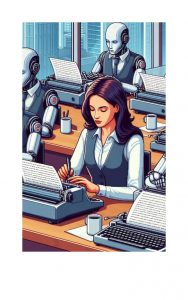
Yes, with AI we have entered a new phase of the impact of IT. Beyond the general applications like ChatGPT there is a rapidly expanding market of AI applications with more specialized functions or capabilities. In the realm of scientific writing AI-Writer is an interesting example of the AI assisted production of scientific tests. After the specification of the topic you will receive several options to specify the content of the short paper you want to produce with AI-Writer. You may choose the headline, keywords, subtopics and the logical order of these subtopics depending on your audience. Alternatively, you leave all those decisions to the application and restrain yourself to fix the amount of words you would like the paper to have.
AI-Writer is a powerful ghost writer for much work even of advanced scientists. The quality of the paper needs to be checked by yourself, but the explicit list of references, from which AI-Writer derives its restatements of the content, is just next to it. Your ghost writer AI is likely to replace a number of persons that were previously involved to just produce literature reviews or large parts of textbooks sold to millions of students.
A much lesser known feature of such tools is the way it makes plagiarism much more transparent for the scientific communities and the public at large. These programs demonstrate the techniques of combining knowledge and the citation imperatives in a transparent, almost pedagogical way. This latter function will speed up scientific work like dissertation drafting, since the reading up and documentation of previous literature in a field is a time consuming early stage of academic degrees.
Email composition, rewording, plot generator or social media posts are additional nice-to-have features of the new AI-assistants. A lot of work that has been outsourced, for example, to lawyers, consultants or other technical professions, might equally be challenged. Ghost writers have been around for centuries. With AI for everybody, they will also be involved everywhere.
(Image screen shot of working with AI-Writer 2024-6) 
AI Reader
In the middle of the hype around AI it is useful to take stock of the reflection and evolution of AI. In my own analyses and writings on AI it evident that a narrowing of focus has taken place. Whereas before 2022 the writing dealt more with digital technologies in general. The links to the literature on the social construction of technologies was obvious. Algorithms and AI was a part of the broader topic of society and technology.
This has changed. The public debate is focused on “everything AI now”. We look at technological developments largely through the lens of AI now. Hence, my focus of assessments of technology from a societal perspective follows this trend. In a collection of blog entries on AI we try to demonstrate the far reaching changes that have started to have an impact on us. In the last few months the all encompassing concern about AI’s effect on us needs full attention of social scientists, policy makers, companies and the public at large. We can no longer leave this topic to the software engineers alone. By the way, they themselves ask us to get involved and take the latest advances in AI more seriously.
As a “flipbook” the online reading is rather comfortable (Link to flipbook publisher MPL). The pdf or epub files of the blog entries allow to directly follow the links to sources in webpages or other publications (AI and Society 2p 2024-4-18). The cycles of analyses and comments have become faster. Traditional book writing suffers from time lags that risk to make pubications outdated rather quickly. Dynamic ebook writing might bridge the gap between time to reflect and speed to publish or inform the wider public. The first update as .pdf-file is available here: AI and Society(2).

Digital organising
Since the digital innovations continue to broaden our scope of how to organise, we have to make conscious choices which way to choose. The traditional form of sending out newsletters and waiting for responses is still a feature that is prevalent across Europe. Most organisations have shifted to digital plus physical versions by now, just like newspapers. Young organisations by founding year have started or shifted to digital only for speed of delivery, CO2 and cost saving mainly. We may derive a first dimension of organising between the digital and physical. 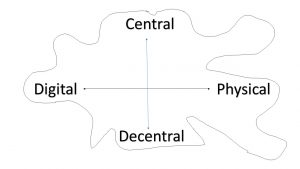
A second dimension consists in the central versus decentral forms of organising. Similar to the franchise principle of organising companies, organisations have a choice to keep a central structure with varying degrees of freedom at the regional, sectoral or local level. Organisation theory is helpful in this respect. Various hybrid forms are equally possible. Centralised in financial aspects, but scope for local decisions on content.
Bohn et al. (2023) define digital organising as “collective purposeful alignment and distributed action fostered through digital technologies”. Centralisation and/or Decentralization become a matter of conscious choice. The processes of datafication and connectification, whereby every bit of information becomes a data point and any electronically enabled device can be connected with each other. Organisations now have a choice of how to organize including digital organising. The opportunities are within the space opened up by the 2 dimensions (figure below). A specific subject matter may require more physical presence and maybe centralised structure, but digital only forms with highly decentralised forms are powerful tools in the 21st century. New as well as established social movements may well take advantage of these digital technologies as well. (Image: Digital Organising 2024 Protest Berlin). 
AI and Behavior
We start to analyze the impact of AI on our behavior. It is an important question to be aware of not only how we interact with AI (Link), but also what effect the use of AI (disclosed or not) will have on our social behavior. Knowing that AI is used might change our willingness to cooperate or increase or decrease pro-social behavior. The use of AI in form of an algorithm to select job candidates might introduce a specific bias, but it can equally be constructed to favour certain criteria in the selection of candidates. The choice of criteria becomes more important in this process and the process of choosing those criteria.
Next comes the question whether the announcement includes as information that AI will be used in the selection process. This can be interpreted by some that a “more objective” procedure might be applied, whereas other persons interpret this signal as bad sign of an anonymous process and lack of compassion prevalent in the organization focused mostly on efficiency of procedures. Fabian Dvorak, Regina Stumpf et al. (2024) demonstrate with experimental evidence from various forms of games (prisoner’s dilemma, binary trust game, ultimatum game) that a a whole range of outcomes is negatively affected (trust, cooperation, coordination and fairness). This has serious consequences for society. The social fabric might worsen if AI is widely applied. Even or particularly the undisclosed use of AI already shows up as a lack of trust in the majority of persons in these experiments.
In sum, we are likely to change our behavior if we suspect AI is involved the selection process or content creation. This should be a serious warning to all sorts of content producing media, science, public and private organizations. It feels a bit like with microplastic or PFAS. At the beginning we did not take it seriously and then before long AI is likely to be everywhere without us knowing or aware of the use. (Image taken on Frankfurt book fair 2017-10!)