Besides the English term memory, which refers to a huge scientific literature starting with cognitive psychology, I like the French version of “mémoire”, because it is more comprehensive with additional meanings, nicely represented by Wikipedia.org. On the German Wikipedia-page you find first the reference to the children’s game memory, turning around images and memorising where the counterpart is/was (play pairs). This diversity hints towards a cultural element in memory. There is a person’s memory or mental capacity to recall and ways to remember. The latter term refers a lot more to collective memories and becomes a more debated issue. Danny Trom uses the term “split memory” in a chapter on France and the “myths of nations” (p.129-151). In David Brook’s reader on “the social animal” he states that grandmasters in chess (p.88) were long believed to have superior memory. This is actually not true as memory experiments showed, but they rather saw formations and “internal connections forming networked chunks of information”.
“Mémoire”, on the contrary, refers also to the writing of a person’s own biography. Nowadays, book shops contain whole sections of autobiographies, the most sold appears to be the one by Michele Obama recently, if I recall correctly. Among the most scandalous is the publication of the “Journal pour Anne (Pingeot) 1964-1970” by Francois Mitterand. All the autobiographical documents make explicit major parts of what might form collective memory later on.
Memory has found its way into engineering and computing. The memory effect in batteries or being “out of memory” frightens users in computing or programming. In short, I wish you the best of memories reading this page and stimulation by visiting memorials (image: Jewish Museum in Berlin 2022, Ullmann exhibition). 
L for Law
Contrary to a popular misunderstanding. Law is not boring. The history of ideas is full of exiting projects based on laws. Starting with the foundation of empiricism, i.e. the comparison of laws governing the different Greek city states pioneered by Aristotle. Considering law from the perspective of legislation gives it an actionable touch and makes it more exciting to many persons. Contrary to a static perception of law, laws can be changed and are subject to interpretation continuously by courts and judges. The fascination with law might start with the philosophers of the French enlightenment like Montesquieu. “De l’esprit des lois” – explains already the need to look behind the literal text of law. What is the spirit of law, becomes the driving question. Not only the categories of countries like republic, monarchy and despotism were argued by him, but also the separation of powers into an executive, legislative and judicial power is his original contribution. These principles govern the German “Grundgesetz” and are a common understanding of the founding states of the European Union as well as a potential breaking point.
A sociological perspective on law is formulated by Niklas Luhmann (short intro in D) and highlights the danger of laws as a self-referential system. This dominated by experts who develop the system further independent of the concerns and understandings of wider society. In order to understand this concern, it is probably useful to think of climate change as an urgent problem. Bio-diversity has for much too long not been of much relevance for legal founding principles of our constitutions. In the same vein, women judges or diversity in the legal profession is a point of concern. Majorities versus minority rights create intrinsic tensions in law, legislation, execution and interpretation. Analysing the half-life of laws is interesting, i.e. how fast do they really change or get abandoned altogether. Equality in front of the law remains a thorny issue. It is a huge issue when moving from law to justice as primary concern. The most interesting point is the view of law as a changing matter, hopefully for the better, but this is another question altogether. Reveillons-nous l’esprit des lois ! (pas seulement au Reveillon). 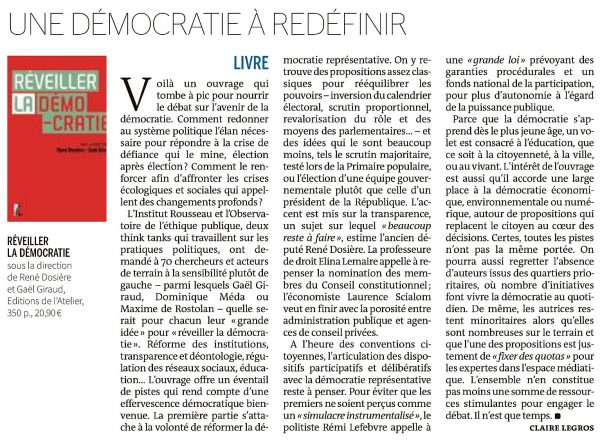
D for Democracy
Stand up for Democracy. Give me a D. Yes, we are passionate for democracy. Even if we are not singing Beethoven‘s “Ode an die Freude” every day, we are well aware that we have to defend democracy at numerous places. The essay in the New Yorker by Jill Lepore from January 2020 on the manifold risks to democracy and the way forward is a great inspiration. Democracy is always a “work in progress”. It improves and in most cases rises with the challenges. However, this demands to stay alert and wither the beginnings of threats to its functioning. Beyond the external threats, internal threats to democratic values are abound. The discursive element that is highlighted in the essay remains crucial. Debating in public is key. Transparency of arguments, reasoning and values are constituent parts of democracy. Clandestine ways of corruption, bribery and threatening of violence become apparent when fractions of society retreat from the public to form insider groups. Defenders of democracy need to speak out in public, publish they work, expose and perform their arts, challenge school curricula and be active in any policy field. This is a lot to do, but we have to prevail and rise to the continuous challenges to the democratic way of life. Too many dictators and autocrats around the world would like to see democracy fail. Worse, they work actively, like in “Qatargate” in November 2022 in Brussels to spread illicit practices of corruption. We have to strengthen our “antennas” and sensors to detect such practices. Prevention is key. Tough reactions with the force of the legal system to stop the spreading is also indicated. Let’s rise to the challenge, again and again with the latest technology. 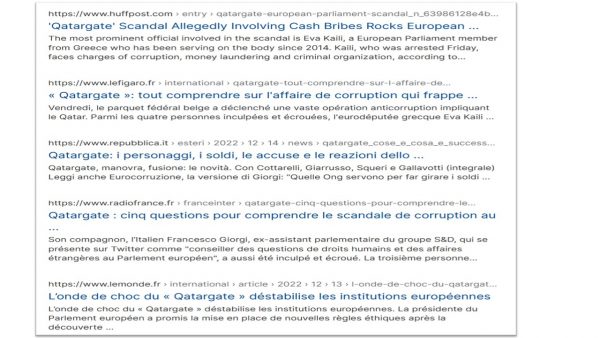
C for Corruption
After the association of C with crises of corona, climate, consumption and the church we have to come back to one of the original links: corruption. Beyond the work of describing and analysing corruption from the time of the Roman empire to the Americas of today (Link) by Thomas Strunck, the re-reading of Niccoló Machiavelli is recommended by a number of scholars (in latin here). Also, in Asia the work and writings of Niccoló have been rediscovered (Link). “non creando in veritá le cuose nove”. It needs “una ferma experienza”. As people don’t just believe in the truth of new reasons, a firm experience of them is needed. New princes cannot just pray, they have to install a new vision or belief with force (p.25) by literally forcing persons (forzare) or “fare … credere par forza” stated in Chapter 6 of THE PRINCE. If we just complement the term force by force of persuasion, or money as surrogate for both, the writing of Niccoló speaks directly to corruption in our times. History does not repeat itself. However, the history of ideas still teaches “some dogs old tricks” until they are found out by investigative journalism and an independent judiciary, which both did not exit at Niccoló’s time. (inspired by Chaudhuri, S. & Chakravarty, P. (2022) Machiavelli Then and Now: History, Politics, Literature. Cambridge University Press.) 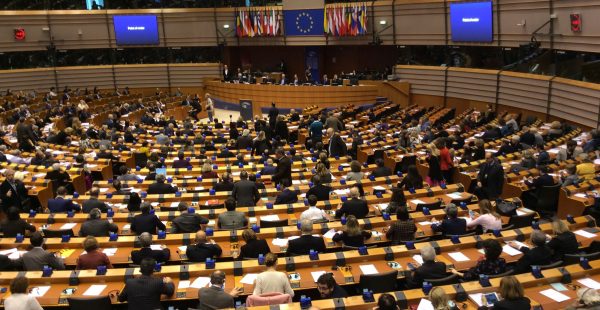
Human Rights
It is 10 years after the publication of a Ph.D. thesis on “Corruption: a violation of human rights and a crime under international law?” by Martine Boersma that at the top level of the European Parliament and the International Trade Union Congress the smell of corruption is investigated by police and judges. Following “Qatargate” (Radio France Link) this means that the persons accused of corruption, forming a criminal group and money laundering have changed their lobbying in return for accepting cash. Exploitation of workers and more than 100 deaths in Qatar was the result, due to the heat when building the stadiums for the Football World Cup which took place in 2022. Following the recommendations of Boersma corruption in this respect can be interpreted as these persons contributing to and being guilty of abusing their political positions to silence criticism and whistle-blowers, and the right for defendants to a fair trial for example. The advocacy to counter corruption with developing international human rights legislation and persecution in this respect is dearly needed now. “This line of reasoning transforms a corrupt act into a possible starting point for legal action, be it at the national level, …, or at the international level by submitting a complaint to a regional or global human rights monitoring body.” (Boersma, 2012 p.376) The International Criminal Court or “alternative such as the establishment of a permanent anti-corruption court, or anti-corruption commission to monitor compliance with the UN Convention Against Corruption should be kept in mind, as well as the possibility of setting up ad hoc anti-corruption tribunals” (p.380). Not much to add to this, act now, before the practice spreads.
Francesco Merloni wrote in his book (2019, p.132) on corruption with Italy in comparative perspective: “when corruption is defined in its wider meaning of maladministration, we are looking at a mass phenomenon which is “sub-criminal”, yet nonetheless with strongly negative implications for the efficiency and effectiveness of public administration and democracy in general.” The practice of excessive salaries of the Italian parliament (p.131) is mentioned in the list of case histories of corruption just like the international event of the EXPO 2015 in Milano with huge construction projects (LeMonde on Panzeri l’ex-eurodéputé). Learning from case studies is best practice in many business schools and probably beyond. Finally, attention should be drawn to prevention of corruption. Here the reading of Corruption and Anti-corruption by Larmour and Wolanin (2001, p.235) offers good advice. The micro-economics of corruption (pp. 119) states for example that “If expected penalties are sufficiently high, bribery is deterred” (p.126). Equally the real threat of a full and explicit audit of operations, promotions and financial transactions might deter corrupt activities. Most importantly the authors state, “the social networks approach to corruption allows the corruption investigator to conceptualise the operation of corrupt networks in terms of power flows and relationships rather than the attributes of actors. The question to be asked by the corruption investigator is not whether actor A is corrupt. The question should be, what is the relationship between actor A and other potentially corrupt actors in the network.” Re-reading some classics of sociology like Max Weber on bureaucracy, but also James Coleman’s foundation of social theory provide basics for understanding social interaction when things go fundamentally in the wrong direction. We might even need to use artificial intelligence to detect corruptive practices to shield and support the trade union movement. 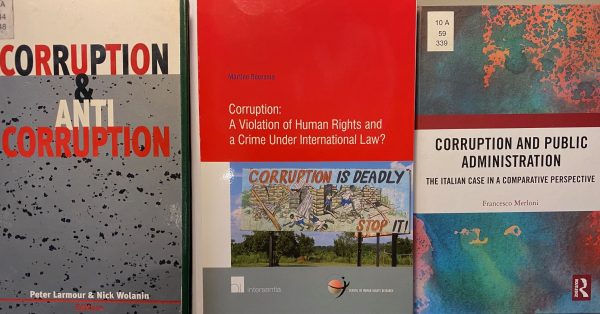
State of the Union
“The times they are a changing”. Currently, we witness that democracies are at multiple risks. One existential threat is, of course, war of external origin. Democracies have been perceived as often to slow to mobilize military forces sufficient to resist “Blitzkrieg”. What Nazi-Germany applied successful at the beginning took a long time and millions of dead persons to rectify. Similarly, the threat to Ukraine’s independence and liberal aspirations are threatened by Russian imperialism. The other existential threat is that of “the enemy within”. This is the conclusion by Canova (2011, p.213) when he writes on “democracy’s disappearing duties”. Whereas he has primarily in mind, that citizens need to participate more actively in the duties to democracy’s survival. These are “the duty to become informed and to vote, as well as rights and duties related to civic and/or military duties. The discussion, whether we need an army of the many or an army of specialists has shifted largely in favour of the need for specialists, simply think of cyber or drone war technology. However, the threat of the enemies from within becomes clear if we remember terrorist attacks targeted at democracies practice of free movement, free speech or art. Another centuries-old threat has come to our attention again. Corruption. The slow-motion erosion of democracies is hard to fight against as it operates not with visible tanks and weapons, but with clandestine and psychological ways of slow corrosion of organisations and institutions. Combatting corruption is even more tricky in cross-country settings like the European Union. Reference to cultural practices and exclusive or inner circles as cultural exceptionalism make it hard to introduce non-discriminatory monitoring and controlling mechanisms in democracies. Only a well-equipped security, police and judicial system can stem the risk to democracies from corruption and organized crime. It is not only a matter of state responsibility, but our democracies rely on an alert public to stand up continually for our basic values. Just singing the national and European anthem is not enough, fighting corruption is laboursome and cumbersome, particularly as corrupt circles do not refrain from using brute force and weapons (Reichsbürger, Mafia, etc.). Addressing inner and outer enemies at the same time remains high on the agenda for the surviving and thriving of democracies. The foundation ideas of the European Union were constructed by Monnet and Schuman on a sustainable democracy. Let’s not endanger this through a sluggish response on corruption.
inspired by Canova, T.A. 2011: Democracy’s disappearing duties. In: Democratic Citizenship and War. Peled, V. et al. (eds.) pp. 199-216.
Corruption
There is an extensive literature on corruption in the social sciences. However, the evil practice continues to ruin personal lifes, institutions and countries. Psychologists put corrupt persons in the psychopath life trajectory (Link) or explain corruption as result of the triad of personality traits for persons scoring high on not only psychopathy, but also on narcissism as well as Machiavellianism (Link). Some important lessons derive from a fast reading of the scientific literature. (1) Corruption develops over a period of time. The creed for ever more power seems a strong driving force. (2) Some personality traits are more likely to deteriorate into corruptive behavior and (3) institutions need to monitor carefully leadership practices and guard against abuses of power already at small instances like threatening with violence or dismissal. (4) Countries can do a lot to limit corruption through adequate legal systems, most notably through a truely independent judiciary as well as the need of investigative journalism to accompany potentially illicit behavior. All this comes at a cost, but without it democracies are at high risk. The European Union has to strengthen its defences in this respect to remain a credible institution, just as much as a great number of Member States. Not only the World Bank or OECD need to be monitoring countries, but we all need to be better equiped to read the early signs of corruption. Whistle blowing and the protection of these persons is part of an effective anti-corruption system. Early signs of “nepotism” and “favoring of friends” in the workplace are easy to identify, but taking measures against it, needs firm committment on the part of advisory boards, colleagues at work or other interested parties like stakeholders or investors in case of private firms (wirecard) . (Link to NZZ). 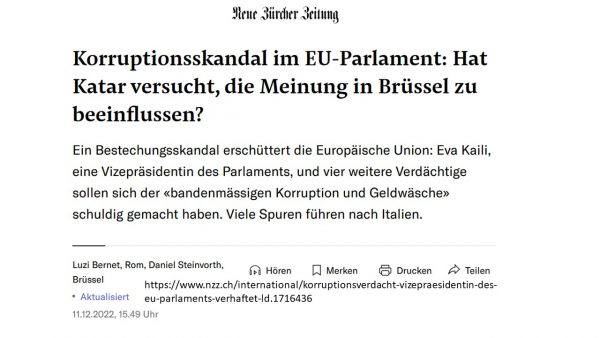
Hommage Ukraine
Viele westliche Demokratien waren überrascht über den aufopfernden Freiheitswillen der Menschen in der Ukraine. Die „Sonntagsdemokraten“ unserer westlichen Staaten bewegen sich alle 4 Jahre zu 2/3 an die Wahlurne und glauben, wir haben genug getan für die Demokratie. Wahlen sind eine wichtige demokratische Basisentscheidung, egal ob es sich um repräsentative oder direkte Wahlen von Personen handelt. Aber demokratische Systeme leben von dem immer wieder Einstehen für diese Werte der Wahlfreiheit und der unveräußerlichen Menschenrechte. Dazu ist es für alle Demokraten wichtig zu verstehen, wie diese Antriebsfeder des ukrainischen Widerstands gegen eine übermächtig erscheinende Militärdiktatur Russland funktioniert. Anfänglich war es nicht die militärische Hardware, die entscheidend bei der Verteidigung war, sondern ja was? Kulturelle Werte, Geschichtsbewusstsein, Selbstbestimmungsrecht, Völkerrecht, Menschenrecht? Dazu ist im Verlag Stock (F) und Knigolove (Ukr) das Buch „Hommage à l’Ukraine“ erschienen. Emmanuel Ruben schreibt darin im Vorwort: „Dank an die Autoren, uns diese Erzählungen zu übermitteln, die heute in höchstem Maß, die Idee eines starken und geeinten Europas symbolisieren“ (S.18). Das einleitende Zitat von Boris Khersonsky « Les enfants, ceci est une lecon de géographie. Voici la carte. On s’en souviendra » (S.11 und 145) hat mich elektrisiert. Seit Tagen verfolgte ich die Verteidigung und Rückgewinnung der Stadt Kherson in der gleichnamigen Region Kherson in der Ukraine von den russischen Besatzungstruppen. Clausewitz hatte diese präzise geografische und topografische Kenntnis bereits als oft kriegsentscheidend in konventionellen Kriegen betont. Jenseits dieser Militärstrategie ist es wichtig zu verstehen, wie tief diese Ortskundigkeit gehen kann. Der erste Beitrag von Luba Yakymtchouk mit dem Titel „Maison Mon Amour“ spricht von Heimat und erzwungener Veränderung. Es reicht meist, die Augen zu schließen, schon erscheint ein Stück Heimat. Aber dieses Gefühl ergibt sich auch im Denken an Personen und Objekte, die diese vertraute Umgebung inkarnieren. Es sind wir, die diese Verbindungen kappen oder an neue Orte mitnehmen. „Avec le temps, les bons souvenirs feront oublier les mauvais. Et nous construirons avec tout cela une nouvelle et véritable maison. Oui, une maison peut se réduire à la surface de ton corps, des paupières peuvent suffire à la protéger du danger, mais elle peut aussi résider dans les personnes que nous aimons, … (S.39). Boris Khersonsky ist mit den Gedichten « Déflagration 1 und 2 » in dem Band vertreten. Aus der Lektion in Geografie wird eine Geschichtslektion, sogar eine Handlungsanweisung zum würdevollen Überleben. „Tout quitter demande à préparer son plan. Et de la lâcheté. C’est ce qui me manque tant !“ (S. 158 Übersetzt von mir:) Alles verlassen, verlangt, seinen Plan vorzubereiten. Und Feigheit. Das ist es, was mir so fehlt! – So erklärt Boris Khersonsky für mich den unbeugsamen Willen, die Stadt Kherson für die Ukraine zurückerobern zu wollen. 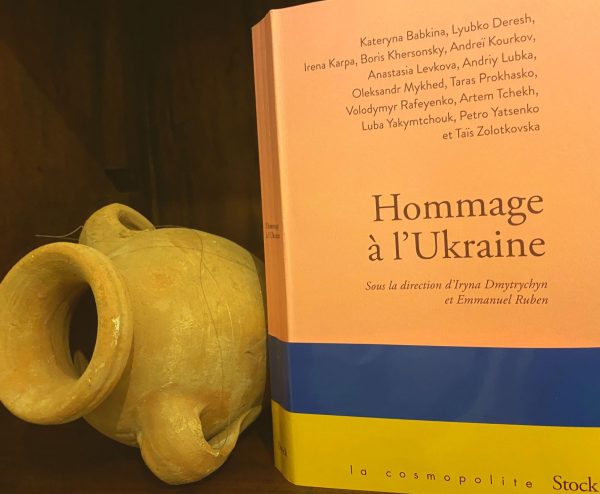
The world according to Putin
Das Centennial Issue von Foreign Affairs (Vol.101, Nr.5) trägt die Überschrift „The Age of Uncertainty”. In der Tat müssen wir mit einigen scheinbaren Gewissheiten aufräumen. Da ist einerseits die Gewissheit der große Staat im Osten hegt friedliche Absichten, andererseits ist das Verlassen auf Beistand ohne feste Bündnispartner geopolitisch naiv. Das hätten wir eigentlich seit den Schriften von Clausewitz theoretisch und mittels historischer empirischer Evidenz aus den beiden Weltkriegen wissen müssen. Unser Geldbeutel, sprich billige Energie, sowie eine durch wirtschaftliche Interessen geleitete Doktrin „Wandel durch Handel“, oder wie die Bremer Handelskammer seit der Hanse sagt „buten und binnen, wagen und winnen“ hat uns geblendet. Der Handel hat dem Westen ermöglicht, auf hochwertige, innovative, technologisch anspruchsvolle Produkte zu setzen und auch Russland in die „Rohstofffalle“ zu befördern. Einfaches Geld verdienen ohne viel Aufwand war die Devise, da durch Handel höherwertige Produkte eingekauft werden können. Gesellschaftlichen Wandel wollten die Russen sich ersparen. Mal sehen, ob diese Strategie weiterhin aufgehen wird. Der Beitrag „The world Putin wants“ (S.108-122) von Fiona Hill und Angela Stent ist dabei eher skeptisch und sieht den Angriffskrieg gegen die Ukraine als (letzten) Versuch, das Russische Imperium wiederherzustellen und zwar das der Zaren, bevor die Bolsheviken die Ukraine als eigenen Staat (Ukrainische Sozialistische Republik) etablierten (S.111). The Russian limited logic is as follows: If you are not Russian you must be a Nazi, if Ukrainians say they are not Russian, therefore they are Nazis. Dabei ist der rhetorische Kniff ganz einfach: Um von eigenen nationalistischen und völkischen Ambitionen abzulenken, müssen andere Staaten wegen Nationalismus/Imperialismus angeklagt werden (Beitrag von Timothy Snyder S.124-141). Eine einfach zu durchschauende Strategie, aber immer noch fallen viele Länder innerhalb der UN darauf rein. „The world according to Garp“ von John Irving könnten wir wieder lesen, oder ansehen, als Lehrstück über Toleranz und Intoleranz, sozusagen als Gegenmittel. 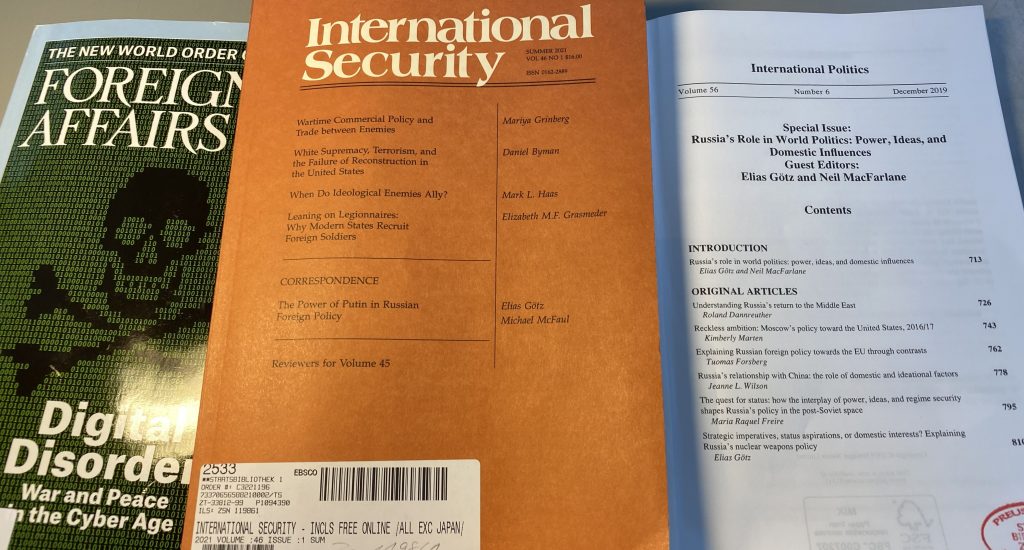
Fukushima
Ein Bericht über die Explosionen von 2 Blöcken des Kernkraftwerks Fukushima lassen uns Menschen ziemlich dumm aussehen. Wir glauben, alle möglichen katastrophalen Ereignisse vorhersehen zu können und werden doch wieder des besseren belehrt. In der Buchserie der Presses Universitaires de France (PUF) erschien in 2022 “Un récit de Fukushima” in dem der Direktor des Atomkraftwerkes vor der Untersuchungskommission berichtet, wie genau die verschiedenen Ereignisse Erdbeben und Tsunami mit der Verkettung von offensichtlichen menschlichen Fehlentscheidungen einhergingen. Planungsfehler, wie zu tief liegende Notstromaggregate, da rasch überflutet, sowie Kosteneinsparungen bei Vorsorge gegen als unrealistisch eingestufte Risiken (so starkes Erdbeben, Tsunami) haben die Katastrophe ermöglicht. Nach Tschernobyl haben wir nun Saporischschja fürchten gelernt. Das Atomkraftwerk Mykolajiw steht wohl als nächster Schrecken auf der Liste.  Neben Planungsfehler, Kostensparen und menschlichem Versagen kommt nun die Gefahr von Nuklearkatastropen auf die Liste des Kriegsarsenals. Nicht als Bombe, wie wir bisher annahmen, sondern als nicht schützbare Infrastruktur, die kaum zu verstecken ist. Der nächste Tabubruch ist realistischer geworden. Die Kosten für Abwehrraketensysteme neben jedem Atomkraftwerk wohl etwas teuer und eventuell ineffizient. Wer befasst sich mit derartigen verbotenen Gedanken? Die Schrecken des 21.-ten Jahrhundert könnten sich als noch schlimmer gestalten als wir zu denken wagten. Atomkraft: die Geister, die ich rief, ich werd’ sie nicht mehr los.
Also eine dezentrale Energieversorgung durch Wind und Solar mit 100.000-den von kleinen Anlagen, in Gärten und auf Dächern erscheint als realisierbarer Lösungsansatz. Warum sagt das kaum eine/r? “Everyday for future” its easy. Mehr grüne Energie für Frieden = Greenpeace mal anders.