Gardening culture

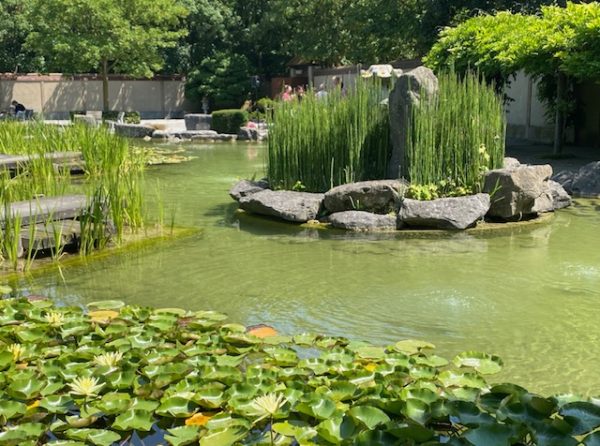
There is a specific set of skills attached to gardening culture. You do not have to travel continents to experience the pleasure of gardening from more than just your own culture. Beyond the tradition of the French garden “à la Le Nôtre”, the English garden including the short precisely trimmed lawn and blooming arrangements, the Japanese gardens have a wholistic approach, which pay attention to broader human experiences of nature. A garden is a kind of sanctuary. It resembles more an internal journey rather than a showing off to others. Walls serve to enhance privacy to be able to open-up again later to others rather than a symbol of distinction and exclusion from the less privileged. Small places suffice to give room to a Bonsai experience. The very busy seaside resorts and port of Ostend on the Belgian coast has reserved a small spot for inner peace in its Japanese garden. (Image: Japanese garden “Shin Kai Tei” in Ostend created by Takahashi Sawano) 
Autonomous Agents

We all have seen more or less autonomous robots somewhere, maybe in a garden silently doing its job or doing more demanding tasks like in playing table tennis against a human. Even the evolution of polluting fireworks to swarms of little light-emitting drones designing figures on the sky have become quite popular. The AI-world is similarly advancing rapidly and proposes more and more “autonomous agents” to assist us. It seems crucial to distinguish the 2 Ds of autonomous agents: Degrees and Dimensions. As with job quality or job satisfaction, there are several sub-dimensions, which need to be considered when dealing, in a summarizing form, with such encompassing terms.
You might allow an agent to order missing food for a meal and pay for this autonomously. You might even be assisted in financial choices to a large degree, but you might not want an autonomous agent to make far reaching decisions concerning your health or partnership(s). Besides such dimensions, the degree of autonomous decision-making needs to be calibrated according to your (perhaps changing) preferences. Booking a table in a restaurant, with a single other person, might not just be a friendly, nice assistance, but it might get you into severe trouble. However, managing conference bookings, a family event or a birthday party might allow you to concentrate on other issues or specific details. Additionally, there are underlying and cross-cutting topics like trust, risks and security that enter the “2 Ds of autonomous agents”. A 2-dimensional matrix plotting levels across dimensions might work as a behavioral guideline in the development of autonomous agents. More dimensions may be added during the implementation.

Autonomy in literature

As we might imagine, autonomy has been and is a huge topic in literature. From the foundations of democracy to the autonomous state building, historical accounts are full of treaties on autonomy. Literature has taken similar steps by asking can we really be autonomous in our decision-making as we are social beings embedded into varieties of Throne, families and networks. There are ever larger parts that we are conscious about, but the realm of unconsciousness or sleep remains substantial. Maybe in literature, the author Samuel Beckett has gone furthest in dealing with human autonomy in his writings. The search for autonomous action might lead to far-reaching inactivity in “Waiting for Godot”.
However, Beckett’s view about autonomy can also be interpreted as a continuous battle of mankind as demonstrated in the often cited expression by Beckett (“Worstward Ho”, 1983, p.7) “All of old. Nothing else ever. Ever tried. Ever failed. No matter. Try again. Fail again. Fail better.” Our strive for autonomy remains a lifelong struggle. The path to more autonomy is not linear over the life course. In fact, much evidence from gerontologists suggests that it might follow an inverse U-shape, being low at birth and low before death. Literature has guided us in such questions just as much as religious, philosophical, legal and social concerns enter into the underlying concept of autonomy and autonomous decision-making across the life course.

China Job Quality

In a small study of 771 Chinese adults, Dong, Wu, Ni & Lu (2021) have reported on the impact of long working hours on job satisfaction. If you work few hours, job satisfaction increases as you work more hours. However, working many hours already, additional work, 40+ per week, does no longer increase work satisfaction in China. In order to preserve the recommended or communist work ethos of a “996 work schedule” (from 9 a.m to 9 p.m, 6 days a week) the authors recommend that managers support more autonomy for workers to fix their schedules as this could increase their job satisfaction. Autonomy to schedule your work and more autonomy in decision-making moderate the impact of long work hours on job satisfaction. Eventually the Chinese comrades might get satisfaction in other areas but work as well.
(Book Exhibits on Karl Marx, Museum Trier Germany Books 2023)

Job Quality Insights

In the U.S. the Upjohn Institute for Employment Research conducts a major empirical study on job quality (Houseman et al. 2025 1st wave 18.000 respondents). The documentation and the full set of questions (Link) cover 5 dimensions of job quality: compensation and job security; work structure and autonomy; work environment; worker agency and voice; growth and development. The special merit of the survey is that it makes great efforts to cover also new forms of (precarious) self-employment (Abraham et al. 2026). The degree to which can you make autonomous decisions is of relevance to the self-employed as well as it is a part of the job quality of dependent employees in small, large or big firms.
Related to the use of AI for work purposes question 31 asks for the influence on the decision to use new technologies in your job. This is the modern version of a question, whether you have influence on how you do your job. Bullying in a job may come from supervisors, colleagues or customers and respondents report on this. Beyond the answers given for “your main job”, it is noteworthy that the inclusion of questions on a secondary job allow to identify with more precision the precarious forms of how people try to manage to make a decent living in the U.S.A.
(Image: Exhibition Fashion Council Berlin at New National Gallery 2026)

Autonomy as Job Quality

As many labour markets have been confronted with employment and skill shortages in OECD countries, the interest in what constitutes a good job has increased. After the “decent jobs” campaigns by the ILO, it became crucial to be able to better measure what constitutes a decent job and job quality more generally. The COVID-19 crisis had pushed remote work, but the impact on job quality has been mixed.
A larger empirical effort set out to measure job satisfaction and job quality more precisely. The study funded by the Luxembourg Chamber of Labour (Steffgen, Sischka et al. 2020) puts autonomy at work in the category of “job design”. The findings suggest that autonomy has substantial correlations with almost all other measures of job quality, but in a multivariate setting work-life conflicts, job security, atypical working time, mobbing, time pressure or social demands overwrite the issue of autonomy as a statistically significant impact on general well-being. Social support, however, has the strongest positive impact on overall satisfaction. Solidarity at work drives overall well-being.
The more narrow concept of satisfaction with one’s job find autonomy just as important as career advancement on the 5% significance level. Participation in decision making, income and again social support have somewhat stronger impacts. Autonomy concerns time and tasks. Can you decide what to do, how to do, where to do and when to do your tasks?
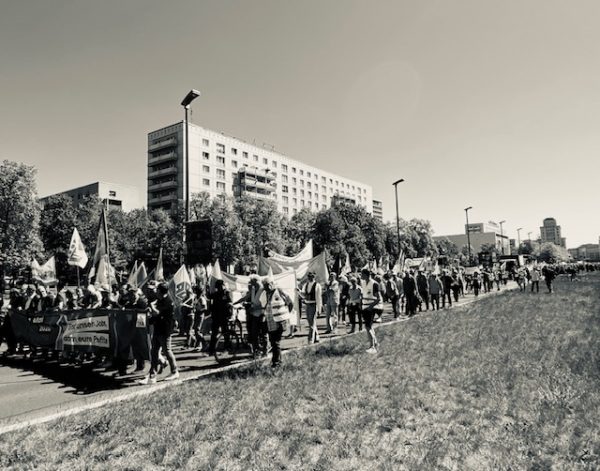
Depending on how you answer these questions on a 1-5 scale, the more or less satisfied you are with your job. Of course, leadership styles might interfere additionally. (Image: May 1st 2026 Berlin)

VOC for VCs

The research into VOCs (short for “volatile organic compounds”) is a busy research field in biology and environmental sciences. It might be of interest to VCs (short for “venture capitalists”) as well in the near future. VOCs are those organic compounds that orginate in animal manure as well as those emanating from plants have an impact on people working there or who are living nearby. Allergic reactions cause millions of days lost in working every spring or summer season. Long-term effects are yet another critical issue in this respect. Whereas the measurement techniques of VOCs have evolved a lot, the interaction effects of different VOCs are slowly producing interesting results that might eventually become of interest to VCs.
Abonde et al. (2026) show that there is a kind of communication between different plants via VOCs, which has an impact on growth and defence mechanisms of some plants. Amateur botanists have always wondered about the anecdotal evidence that some plants or flowers grow well next to each other, whereas other ones seem to deter each other. For crops, this mechanism has been documented and more experimental research of this kind will corroborate the potential of, for example, “natural fertilizers” in future. Remember to think of VOCs the next time you experience scents from animals, plants or flowers as a wonderful research topic with VC potential.

Waterfront Paris

Most people enjoy the banks of the river “La Seine” in Paris. Ever since the Olympics in Paris 2024, the temptation to go swimming there or to do some other kind of water related activities, is high. Fewer people are aware of an other splendid location near the Gare de l’Est. The canal Saint Martin and the nearby end of the Canal de l’Ourcq ( image below) have much to offer for stressed people to take some time off and relax. From cinemas, cafés and bars you can choose your favorite to pass time with friends or family, alternatively just keep walking for miles to get your exercise as needed to sustain your body in good health and shape. The health impact of such cool and more humid areas has a high value to the benefit of all without forcing people to travel long distances for recreational activities or normalizing weight or heart rates. 


Set and Match

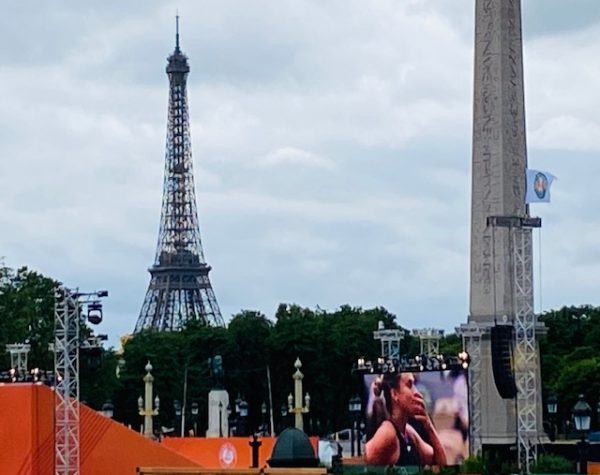
The organizers of big tennis tournaments like at Roland Garros in Paris have to reach ever bigger audiences to be able to cash out the prize money for the top players and their expenses. Besides the number of spectators on site, the prime income comes from television rights and sponsorships through advertising. Gambling on set and match is also a rising annex market, just like tourism linked to the event. For such purposes Paris offers screenings, similar to the Olympic Games 2024, in the centre of Paris. The park “Les Tuileries” offered to follow the tennis matches on big screens against the background of the Eiffel Tower (image below). Of course, the “rue de Rivoli” nearby offers additional pleasures or take home goodies for spectators, which add to the overall budget spent by an average tourist in Paris. For people interested in a walk in “Les Tuileries” and the plants ( Acanthus), trees (Linden) and flowers (roses) have to choose the other parts of the park. Big cities have the chance to offer a bit to everyone within relatively short walks. 

Dry January

There is a health trend to pass a sober, “dry January” after the X-mas and New Year festivities. It seems to be rather popular, so that the French wineries have started a marketing campaign of a “French January“. We shall see what the battle of marketing campaigns means in the end for the health of our liver (Study Link). It might lead to changes in consumer behavior of the following kind. Take advantage of good price offers for French wine and champagne in January and drink it as of February.
For addicts of the “carneval season” this should not be too difficult, jointly with a couple of friends. Alternatively, you might not be bothered and continue a moderate consumption across seasons. Moderate consumption, however, is the tricky part of alcohol consumption. Medical guidelines (health of liver) have evolved recently to count each drop of alcohol into your total consumption in either fluid litres of pure alcohol or the equivalent measured in grams.