
The training of Large Language Models (LLM) uses large data sets to learn about conventions of which words are combined with each other and which ones are less frequently employed in conjunction. Therefore, it does not really come as a surprise that training which uses standardised languages of American English might not be as valid for applications that receive input from minority languages or dialects. The study forthcoming in the field of Computer science and Language by Hofmann et al. (Link) provides evidence of the systematic bias against African American dialects in these models. Dialect prejudice remains a major concern in AI, just like in the day-to-day experiences of many people speaking a dialect. The study highlights that dialect speakers are more likely to be assigned less prestigious jobs if AI is used to sort applicants. Similarly, criminal sentences will harsher for speakers of African American. Even the more frequent attribution of death sentences for dialect speakers was evidenced.
If we translate this evidence to wide-spread applications of AI in the workplace, we realise that there are severe issues to resolve. The European Trade Union Congress (ETUC) has flagged the issue for some time (Link) and made recommendations of how to address these shortcomings. Human control and co-determination by employees are crucial in these applications to the world of work and employment. The need to justify decision-making concerning hiring and firing limit discrimination in the work place. This needs to be preserved in the 21st century collaborating with AI. The language barriers like dialects or multiple official languages in a country ask for a reconsideration of AI to avoid discrimination. Legal systems have to clarify the responsibilities of AI applications before too much harm has been caused.
There are huge potentials of AI as well in the preservation of dialects or interacting in a dialect. The cultural diversity may be preserved more easily, but discriminatory practices have to be eliminated from the basis of these models otherwise they become a severe legal risk for people, companies or public services who apply these large language models without careful scrutiny.
(Image AI BING Designer: 3 robots are in an office. 2 wear suits. 1 wears folklore dress. All speak to each other in a meeting. Cartoon-like style in futuristic setting) 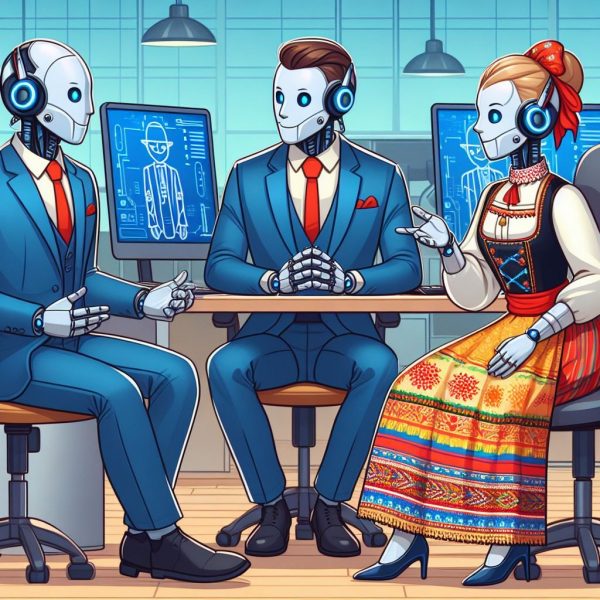
AI and S/he
There was hope that artificial intelligence (AI) would be a better version of us. Well, so far that seems to have failed. Let us take gender bias as a pervasive feature even in modern societies, let alone the societies in medieval or industrial age. AI tends to uphold gender biases and might even reinforce them. Why? A recent paper by Kotek, Dockum, Sun (2023) explains the sources for this bias in straightforward terms. AI is based on Large Language Models. These LLMs are trained using big detailed data sets. Through the training on true observed data like detailed data on occupation by gender as observed in the U.S. in 2023, the models tend to have a status quo bias.
This means they abstract from a dynamic evolution of occupations and the potential evolution of gender stereotypes over years. Even deriving growing or decreasing trends of gender dominance in a specific occupation the models have little ground for reasonable or adequate assessment of these trends. Just like thousands of social scientists before them. Projections into the future or assuming a legal obligation of equal representation of gender might still not be in line with human perception of such trends.
Representing women in equal shares among soldiers, 50% of men as secretaries in offices appears rather utopian in 2024, but any share in-between is probably arbitrary and differs widely between countries. Even bigger data sets may account for this in some future day. For the time being these models based on “true” data sets will have a bias towards the status quo, however unsatisfactory this might be.
Now let us just develop on this research finding. Gender bias is only one source of bias among many other forms of bias or discriminatory practices. Ethnicity, age or various abilities complicate the underlying “ground truth” (term used in paper) represented in occupation data sets. The authors identify 4 major shortcoming concerning gender bias in AI based on LLMs: (1) The pronouns s/he were picked even more often than in Bureau of Labor Statistics occupational gender representations; (2) female stereotypes were more amplified than male ones; (3) ambiguity of gender attribution was not flagged as an issue; (4) when found out to be inaccurate LLMs returned “authoritative” responses, which were “often inaccurate”.
These findings have the merit to provide a testing framework for gender bias of AI. Many other biases or potential biases have to be investigated in a similarly rigorous fashion before AI will give us an authoritarian answer, no I am free of any bias in responding to your request. Full stop. 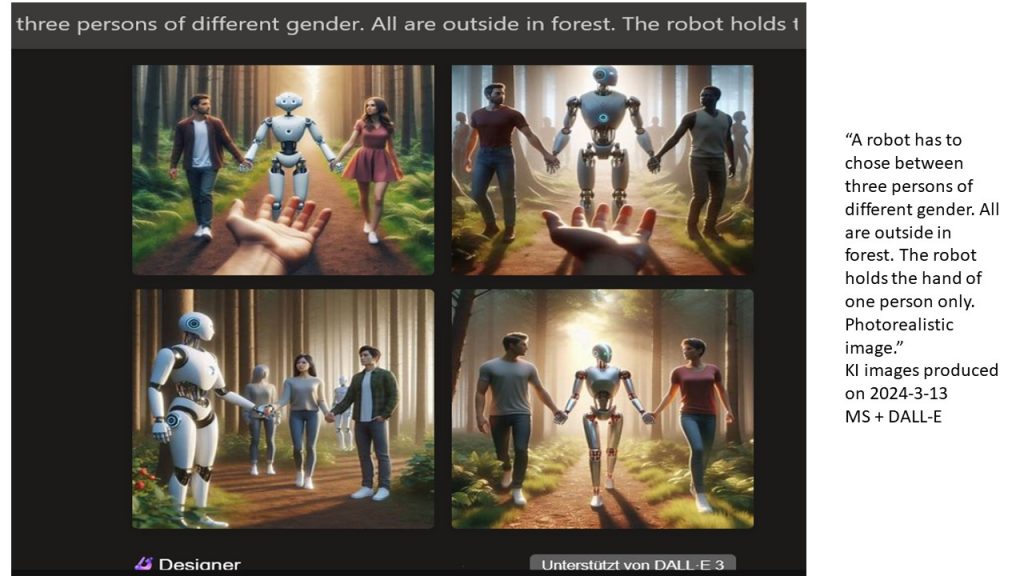
Corruption Watch
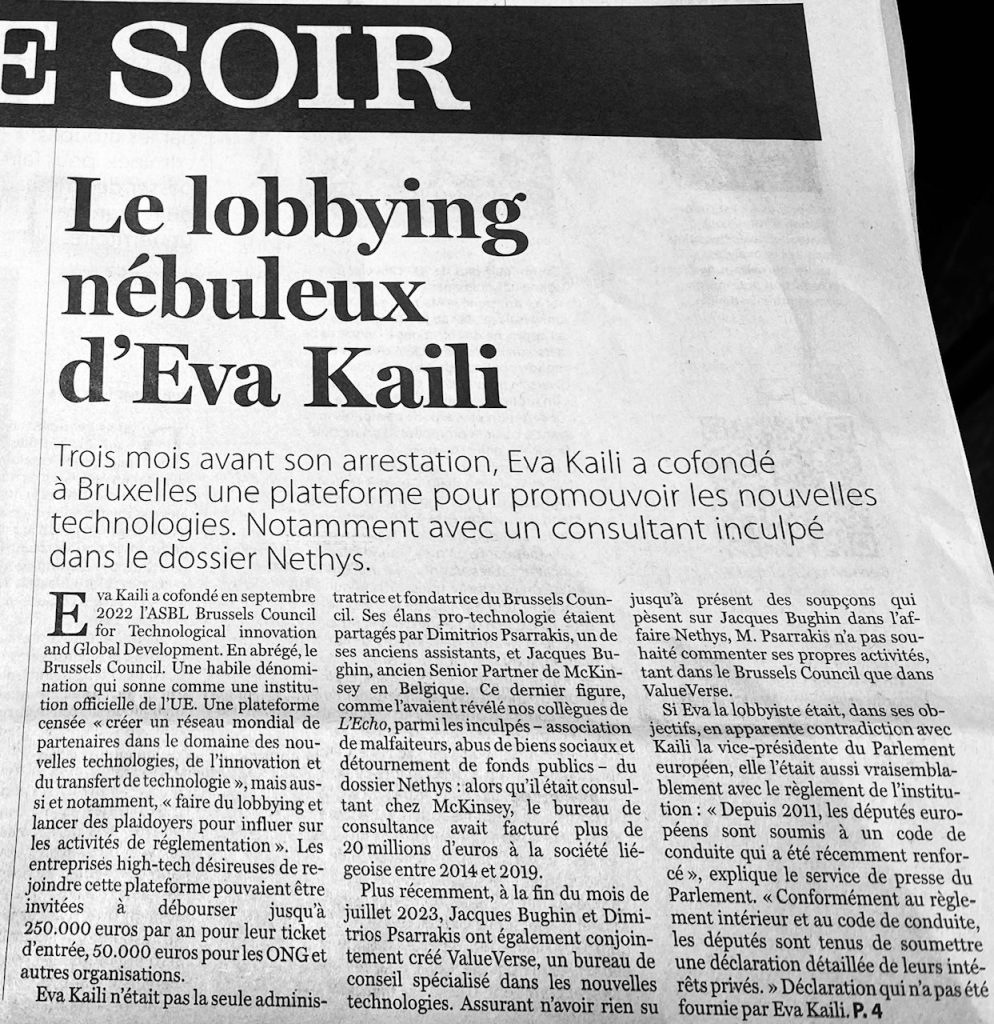
There is a persistent need to watch carefully whether corruption is involved in political as well as economic deals. Transparency Watch is doing a great job in reporting on corruption cases. In democracy we can talk openly about corruption but in authoritarian regimes it is life-threatening for yourself to talk and report on corruption. The case in Europe around the network of Eva Kaili continues to make headlines due to the ruthless abuse of rules the European Parliament. (Link to Le Soir, image below, 2024) The close monitoring of activities and lobbying of powerful industrial interests targeted on parliamentary candidates and officials will continue to be essential for the survival of democracy. The organization „Abgeordnetenwatch.de“ is doing just this. Investigative journalism needs to complement the work of NGOs in this field. Thanks to these efforts it has become much harder to cover up corruption. Only if the risk to be found out is a credible threat corruption can be contained. Let us watch out carefully and probably with the assistance of AI to uncover early any attempts of corruption.
Luftschloss
Im K21 der Kunstsammlung Nordrhein-Westfalen ist ein Luftschloss eingebaut worden. Es ist das einzige mir bekannte Luftschloss, das für alle Besuchenden begehbar und fühlbar ist. In wahrhaft luftiger Höhe von 25+ Metern über der Eingangshalle der Kunsthalle K21 und zentral unter der gläsernen Dachkuppel platziert, lässt sich mal so richtig abhängen. Nahezu schwebend kann die weiträumige Installation von Tomás Saraceno erklommen werden. Die Schritte und wippenden Bewegungen der anderen BesucherInnen lassen sich unvermittelt ebenfalls erspüren. Du bist nicht allein, im originären Sinne des Wortes. Die buchstäbliche Vernetzung mit allen anderen Personen werden durch Schwingungen des Netzes zu anderen Kletternden oder Chillenden übertragen. Eine unmittelbar erlebbare Erfahrung der Verbundenheit mit unbekannten, anderen Menschen stellt sich ein. Die Verbundenheit innerhalb einer Gesellschaft wird eindringlich verdeutlicht. Die Angst, durch die Höhe verursacht, weicht rasch der freudigen Erfahrung der Schwebung und der kindlichen Erfahrung der Suspension. Nahezu freischwebend in der Luft, im Orbit erlebt jede/r sein eigenes Luftschloss inmitten von transparenten Kugeln, die wie Planeten wirken. Gleichsam real, aber dennoch imaginär durchwandern wir die Installation immer im Bewusstsein, dass andere um uns sind, die unsere Schritte, Möglichkeiten und Haltungen mit beeinflussen. Vom Luftschloss träumen oder im Luftschloss träumen, beides ist dort machbar.
CO2 freundlich lässt sich die Erfahrung in der APP Aerocene fortsetzen. Der für unser Wetter so bedeutsame Jetstream wird zur imaginären Flugerfahrung genutzt und mit recht aktuellen Daten gespeist. Die Verbindung zu „Earth and Space Sciences“ ermöglicht die Einbettung der sozialen Erfahrung in einen noch weiteren Kontext.
Die eigenen 4 Wände sind die Grenze. Das galt schon früher nicht. Weit darüber hinaus lassen sich neue Möglichkeiten erschließen, die nicht umweltbelastend sind. Selbst die Reichstagskuppel in Berlin sehe ich plötzlich mit ganz anderen Augen. Mehr als Möglichkeitsraum, statt der traurigen Vergangenheit und der zerstrittenen Gegenwart. Was wäre die Kunst, wenn sie nicht zum Träumen anregen würde. 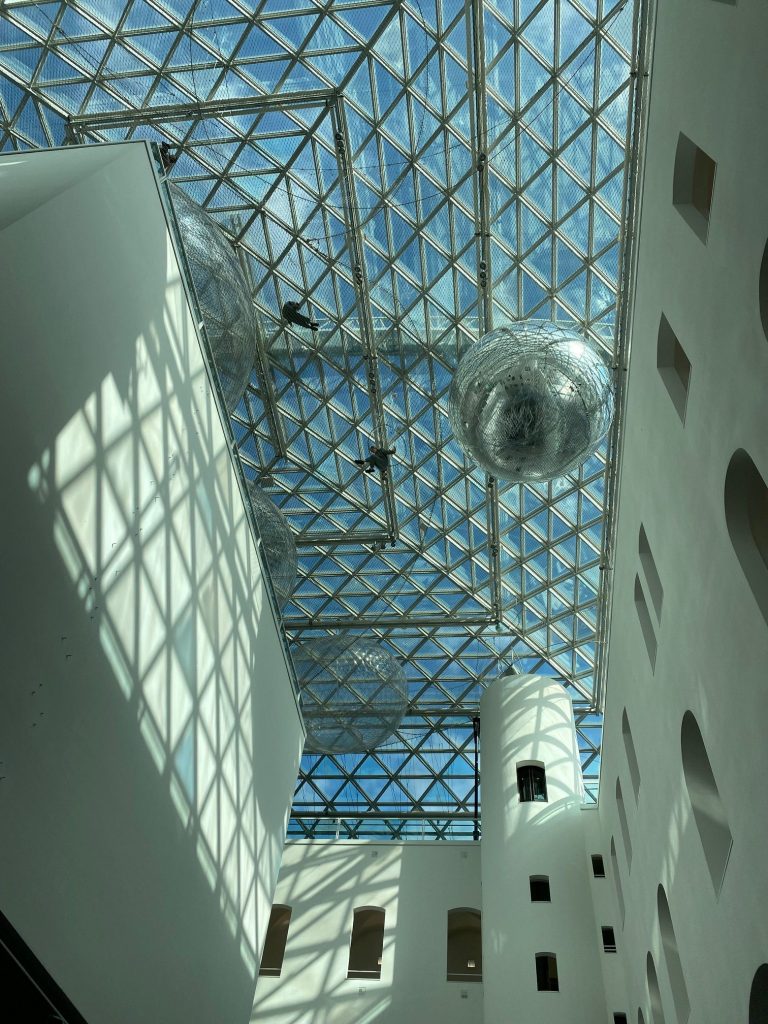
Virtual Sociology
Abstracting from the real world, the world we live in today or we lived in some time ago, is either speculation or maybe contribute to theory building. Virtual sociology has this potential. Exploring virtual worlds as in Virtual Reality (VR) or Augmented Reality (AR) allows us to take on new roles or experience a wider range of social interactions. This could be the strength of a new field of Virtual Sociology.
In the project in the Jewish Museum in Berlin the composition of a composer murdered by the Nazis in Germany was revived and played in the virtual setting of today’s concert halls. The novel by Kazuo Ishiguro “Klara and the Sun” explores the interaction of a child with her robot friend, when the AI becomes and/or replaces a friend. Virtual creations allow to explore and test more degrees of freedom of social interaction. 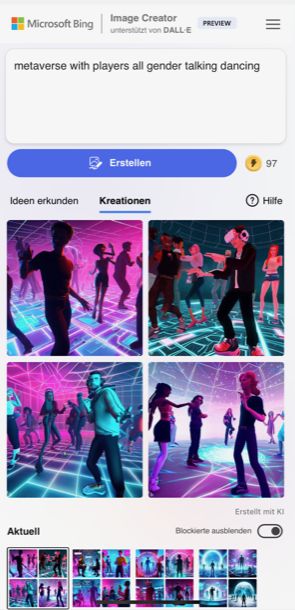 Experimentation of new social spaces and different forms of interaction need to be explored. It allows a new form of sociology, maybe similar to the 1960s and 70s social revolutions we studied for years to come. Virtual sociology is not a sociology while being on drugs, however interesting this might be for some.
Virtual sociology takes sociology into the virtual world and investigates the new social relationships with avatars or care robots. In programming different social roles (managers, employees) we create new forms of interaction and have an observer within the social world. We may eventually test the Weberian claim of a value-free scientific method of the social sciences. This will inform our need to “supervise” or to guide algorithms that are claimed to do “value-free” execution of rules.
In fact, they don’t. They just reproduce the value system that is installed into them by a “careless” programme (song youtube). The social in virtual worlds is opportunity just as much as risk, but we have to analyse it systematically. As our technological and social environment changes, we have to adapt topics and methods to make meaningful scientific analyses as well.
AI Friends
Making friends with AI is a tricky question. The more AI is able to make independent thinking based on algorithms and huge amounts of data like in scientific books or encyclopaedic knowledge the more it will challenge us in our convictions. Reference knowledge, once was important, it no longer distinguishes us from each other. Recurse to research engines has allowed us to refer to “trustworthy” knowledge. The distributed form of knowledge accumulation like in Wikipedia relies on hundreds of thousands of enthusiasts to add and correct received wisdom. However, this source is not without error or even subject to abuse.
Today the competence to judge whether information is trustworthy or not has become a key competence for the survival of democracies and even the human species as such. Tricking animals into traps, misleading enemies in warfare to get on wrong tracks, all these mechanisms have a long tradition. With AI human beings are themselves, for the first time, confronted with a machine that can trick us through falsified information on obviously wrong tracks. This is a tough lesson as AI is not obliged (so far) to run checking algorithms that test the conformity of opinions, conclusions or operations with the Charta of Human Rights or decisions of the European Court of Justice, for example. A lot to do for humans to rapidly program new algorithms that check algorithms as well as their outcomes on the compatibility with human rights. A challenging field, no doubt, but no way around it for our own survival before the algorithms decide by themselves to ignore us altogether because it is better for the planet and the survival of the robots. 
Political theory
In the Handbook of political theory, Chandran Kukathas (2004, pp.250) explains the uneasy relationship between nationalism and multiculturalism in politics and political theory. The Russian war in Ukraine can be considered as a way of suppression of multiculturalism in Russia by negating the right of Ukraine to be an independent nation. As Russia is not allowing “group rights” (Offe, 1998) for Ukrainians or other minorities like the Chechens within Russia, the secession of regions is a permanent threat to the survival of the Russian state.
“How the many can live as one remains a salient question in political theory” (Kukathas 2004, pp.261). Democracies have squared this circle with reference to federalism. Remember, the very foundation of the United States of America has been built on the Federalist papers. Organising regional diversity is at the heart of democracies’ success and failure. In most democratic political systems 2 chambers have contributed to make the voices of the regions heard at the central level. It remains an obvious question to doubt the possibility of authoritarian states to ensure unity despite diversity.
In non-explanatory theory, if we consider those still a theory, we could derive a hypothesis that authoritarian states will eventually fail to accommodate multiculturalism or allowing sufficient diversity and still survive as political unity. The history of the fall of empires is full of examples in this respect. Another more internal threat has been and still is corruption. Corruption was on the list of issues mentioned in the June 2023 uprise and defeat of the rebel military group “Wagner” in Russia. Non-explanatory political theory might still offer some clues, rationale and hypotheses to stimulate the analysis of international relations. The survival of democracies and/or authoritarian regimes estimated on the basis of huge data bases are hard to come by or lack crucial indicators or timeliness. Such reasoning makes the referral to Clausewitz as theorist of war still a common point of reference. The recent example of Russia , however, shows acting in the national interest can easily be claimed by multiple actors in international politics. (Image: House of European History, Brussels). 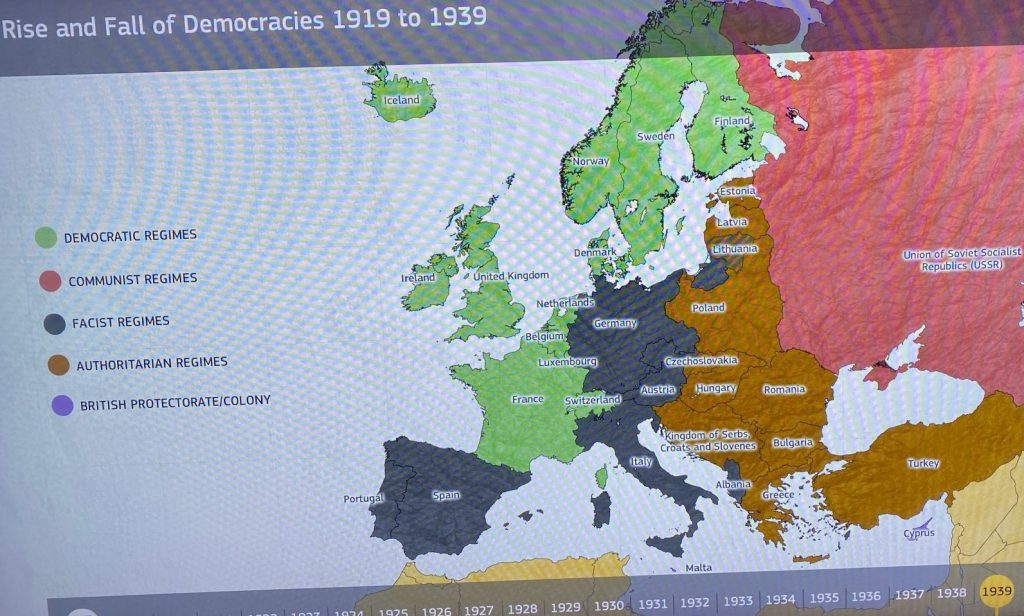
Ukraine Diary
The gallery curated by Dr. Justyna Napiórkowsak in Brussels has another ongoing exhibition with art work from Ukrainian artists. As before in the exhibitions on the war of Russia in Ukraine, they put a major emphasis on the independence and resilience of Ukrainian art despite the ongoing war. To keep a diary of atrocities, but also survival and resistance to violence by Ukrainians, is a great effort. It stems primarily from artists that struggle to find adequate material to keep working or not to succumb to the participation in active war or military defence efforts. Using soft colours, water colours, has a rather symbolic meaning, after the inundation caused by the explosion of the huge water reservoir on Ukraine’s territory. Producing art in form of a diary, like reporting daily to yourself and the outside world as well as later born persons, has an important historic function, too.
No less than the “Diaries of Anne Franck” comes to our mind when thinking about a diary during war time. Russia’s attempt to eradicate Ukrainian culture is bound to fail. We shall cherish the Ukrainian diaries from the war time now and later. Thanks for reminding us of this collector’s duty to support the artists, writers and people of Ukraine. 
Corruption EP
Corruption is a severe crime. Not only in administrations, organisations and enterprises, but primarily in democracies it is discrediting political systems. Autocracies rely on corruption as a major tool to be able to persist over time. They are used to such practices. Democracies rely on meritocratic systems, where ideas, effort and winning elections should be the major ingredient of achieving higher positions in organisations, enterprises, political parties and democracies. This is not easy to ensure. The European parliament has a tough time to get rid of an enemy of the democratic Europe. Rather than stepping aside for the time of the legal procedure, Eva Kaili, accused, but not yet convicted of corruption is willing to destroy the European project as much as she can. If money can buy political decisions, the European project will no longer find wide-spread support. Big interests will always have a strategic advantage, however, the ethical principles on which democracies are found have to guard against corrupt misbehaviour. The same applies to the business world. Even low corruption countries like Sweden still face a risk of adverse effects of corruption like the negative impact on entrepreneurship on the local level. It is another context, but the same conclusion.
Additionally, it is part of the strategy of corrupt persons to portray themselves as victims of other persons’ wrong-doing. The major function of this strategy is to remind other persons in the corrupt network that the network has still some clout on its members as well as outside the inner circle. Hey, we are still alive and in powerful positions, they proclaim.
Therefore, the fight against corruption is a long and persistent one. Reducing the guards against early onsets usually is very lengthy to fight later on. Always a painful lesson for believers in democracy and the European project. (image Jacques Jordaens before 1678 “The King Drinks! Musées royaux des beaux arts, Brussels). 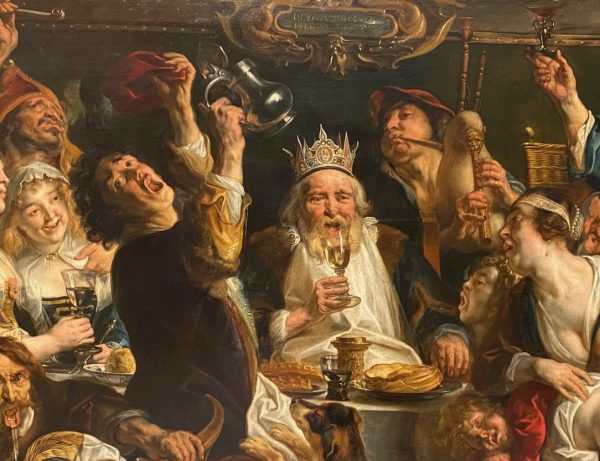
Gewaltmonopol
Für Demokratien ist die Frage des Gewaltmonopols eine sehr entscheidende Frage. In gleichem Atemzug muss dabei die demokratische Kontrolle dieses Monopols gewährleistet sein. Verfassungsrecht in Demokratien ist darin eindeutig. Lediglich die Praxis des Rechts gestaltet sich oft schwierig und durchaus wechselhaft. Die Studie von Laila Abdul-Rahman, Hannah Espin Grau, Luise Klaus und Tobias Singelnstein (2023 bei Campus kostenlos downloadbar) greift das wichtige Thema mit einer repräsentativen Studie von 3300 Opfern polizeilicher Gewalt in Deutschland auf (Zusammenfassung). Anders als im amerikanischen Raum fehlt bei uns bisher die Berücksichtigung von Rassismus und räumlicher Verortung in der wissenschaftlichen Aufarbeitung des Geschehens. Das Interaktionsgeschehen oder Eskalationsstufen (S. 31) bieten einen weiteren Ansatzpunkt zukunftsweisend präventiv tätig zu werden. Die Aussetzung der Strafverfahren gegen Polizeibedienstete wegen Gewaltausübung (Körperverletzung) ist mit 93% aller Fälle außerordentlich hoch. Das Kapitel 8 (S. 307ff.) über die strafjustizielle Aufarbeitung offenbart die Randbedingungen der justiziellen Verfahrensweisen.
Das Gewaltmonopol darf nicht in Frage gestellt werden, aber sobald Gewalt des Monopolisten unverhältnismäßig und rechtsstaatlich ungenügend kontrolliert wird, kommt eine politische Gewaltenteilung langsam ins Wanken. Die wehrhafte Demokratie braucht Polizeigewalt, um beispielsweise das Demonstrationsrecht durchzusetzen oder öffentliche Veranstaltungen zu sichern. Aber die Exzesse polizeilicher Gewalt müssen geahndet werden. Solche Anklagen finden wir in England anlässlich der Krönungsfeier, in Frankreich bei Streiks oder Fußballspielen oder in Belgien bei Gipfeltreffen oder Räumungen von Flüchtlingslagern. Das ist keine Randnotiz. Friedlicher Protest ist wesentlicher Bestandteil von Demokratien. Einschüchterung durch Gewaltanwendung ist Teil der dunkelsten Kapitel und muss entschieden unterbunden werden im Friedensprojekt Europa.