Georgia

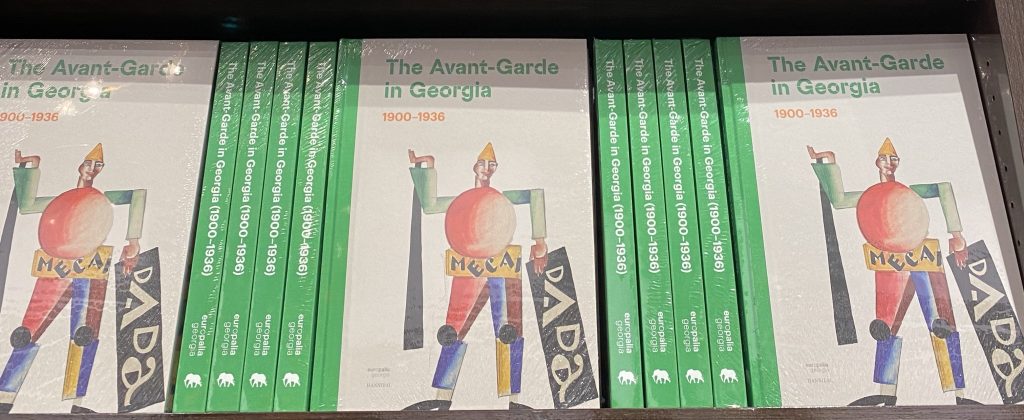
The Republic of Georgia is honored with a wide ranging program in Brussels in the series of countries presented as part of the”Europalia” events and exhibitions. The exhibition at Bozar in the center of Brussels has a focus on the years between 1900-1936. It is astonishing to look at the creative examples of adaptations from western modern art with cubism and expressionist resemblance. Many artists had travelled to western parts of Europe or trained at well-known art schools there. Own adaptations to paintings, theatre and cinema yielded a unique style of Georgian modernism before Stalinism put an end to independent artists and their creative work.

During the short spells of political independence Georgia managed to re-establish each time a remarkable will to its own culture. Unity with artistic pluralism is a core value of the European unity and union as well. We are many and happy to have a chance with Georgian people to celebrate their artistic past and future.

catalog of exhibition Brussels 2023

Strafbar

Wir alle wissen, dass in Deutschland die Verwendung von Symbolen der Nationalsozialisten zum Beispiel in Fotos strafrechtlich verfolgt werden kann. Das trifft auch auf vermeintlich nur private Verwendung zu. Dazu hat das Bundesverfassungsgericht eine hilfreiche Erläuterung und Auflistung erstellt (Link dazu hier).

Das Oberverwaltungsgericht von Rheinland-Pfalz hat bereits klargestellt, dass eine Unterstützung der Reichsbürger für Beamte zum Verlust des Ruhegehalts führt. (Pressemitteilung OVG RF) Die Demokratie hat sich Mittel für ihre aktive Verteidigung geschaffen. Diese rechtsstaatlichen Mittel müssen wir noch entschiedener einsetzen.

Hilfreich kann das Weiterlesen auf der Konrad Adenauer Stiftung dazu sein. Dort wird in allgemeinverständlicher Art beschrieben, dass die zur Schau Stellung von Teilen der Uniform und Symbolen seit Gründung der Bundesrepublik verboten ist.

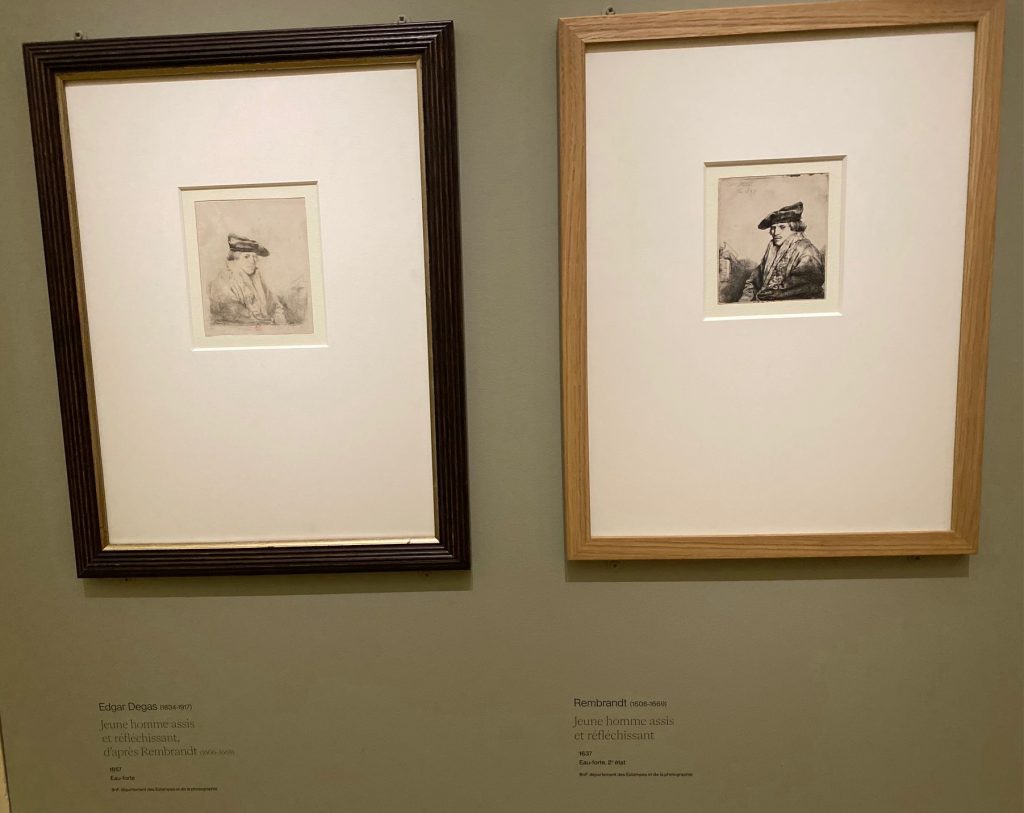
Meist steht hinter der Verwendung dieser Symbole keine Dummheit, sondern eine bewusste Aggression oder gar Boshaftigkeit gegenüber anderen Menschen. Menschenverachtung der Nationalsozialisten lässt sich nicht entschuldigen, damals nicht und heute nicht. Image: Edgar Degas d’après Rembrandt 2023 BnF.

Edgar Degas d’après Rembrandt 2023 BnF.

World in Common

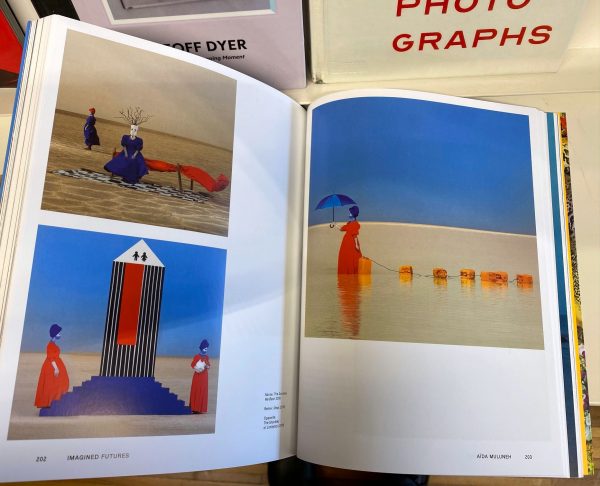
The Tate Modern Gallery in London has an exhibition of photography on display which challenges our Western view of art works. With a focus on photography and African photographers it is complementary to the many other photo exhibitions. We have a world in common, says the title of the exhibition. The images, however, reveal another vision of African photographers. Other perspectives on beauty, architecture and the distribution of wealth and waste across the world becomes explicit. Beyond the documentary effect of a lively African scene of photography and past colonialism the forward-looking vision of African photographers is also evident. Colours and Imagination of a unique kind allow us to look beyond the current state of affairs. Rising from the ashes and western waste the colours of Africa will prevail.
Only through the force to imagine a different trajectory for the continent we shall eventually be able to see new flowers blooming.
Positive images have to be put in front of the “negativity bias” in Western media when reporting about African countries. The light, the sun, the sea and coast lines, all can contribute to the rise of Africa in various ways. The photographers in the Tate exhibition demonstrate an impressive power to go beyond the day-to-day topics.
Broadening our scope of visuals with more images from Africa certainly are  fist steps to enlarge the spectrum of photography and art. A chance to browse through the catalogue allows to go back from time to time to counter our usual stereotypes. (Image taken from Tate catalogue A world in common, 2023 Muluneh Aida 2018 p. 202-3).

Beckett by Beckett

There is an interesting discourse in literature about how to define irony. This really begins with Plato commenting on Sokrates who makes use of the term “eirôneia”. In the history of the idea of irony comes next the philosopher Kierkegaard with his not-ironic treatise “The Concept of Irony. With Constant Reference to Socrates”. Reading philosophy can be really entertaining. It is, therefore, no surprise to find a publication entitled “Ironic Samuel Beckett” (Pol Popovic Karic, 2009). Following Karic there are 3 defining elements of irony: (1) “The message should be intentionally created, …(2) The meaning of an ironic message needs to be “covert”,… (3) During the analysis of a stable irony, the reader can assume that the first interpretation of the ironic message is correct.” (Pol Popovic Karic, 2009 p.49).
Additionally, to understand irony it might be necessary to know more about the context of the statement. Sometimes the ironic statement can only be interpreted as such if you have additional knowledge about the biography of the author (p.47). To understand Beckett better it is advisable to read about his life course in the many biographies available nowadays.
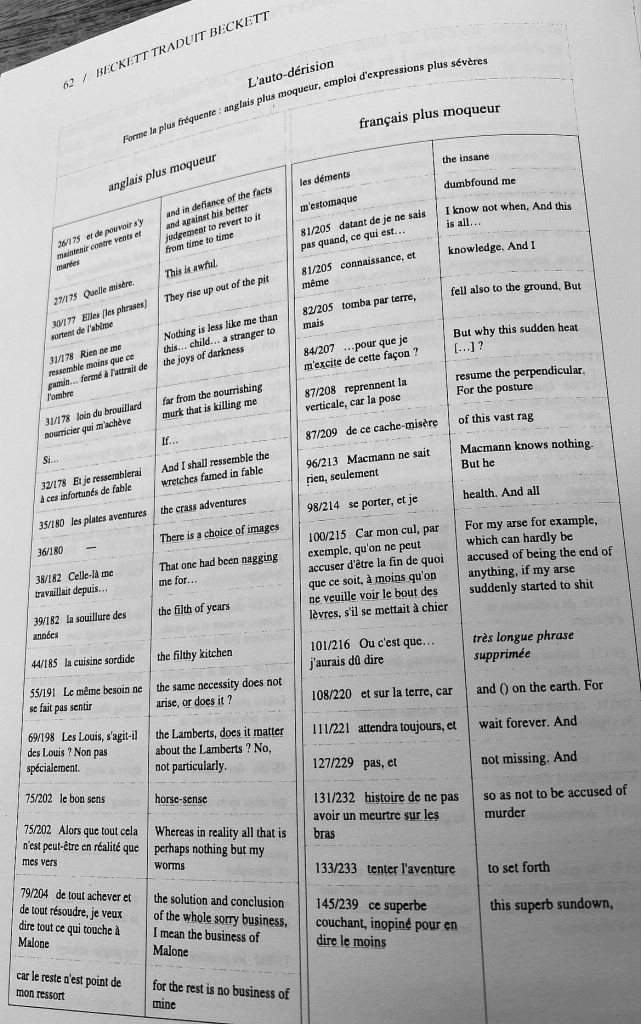
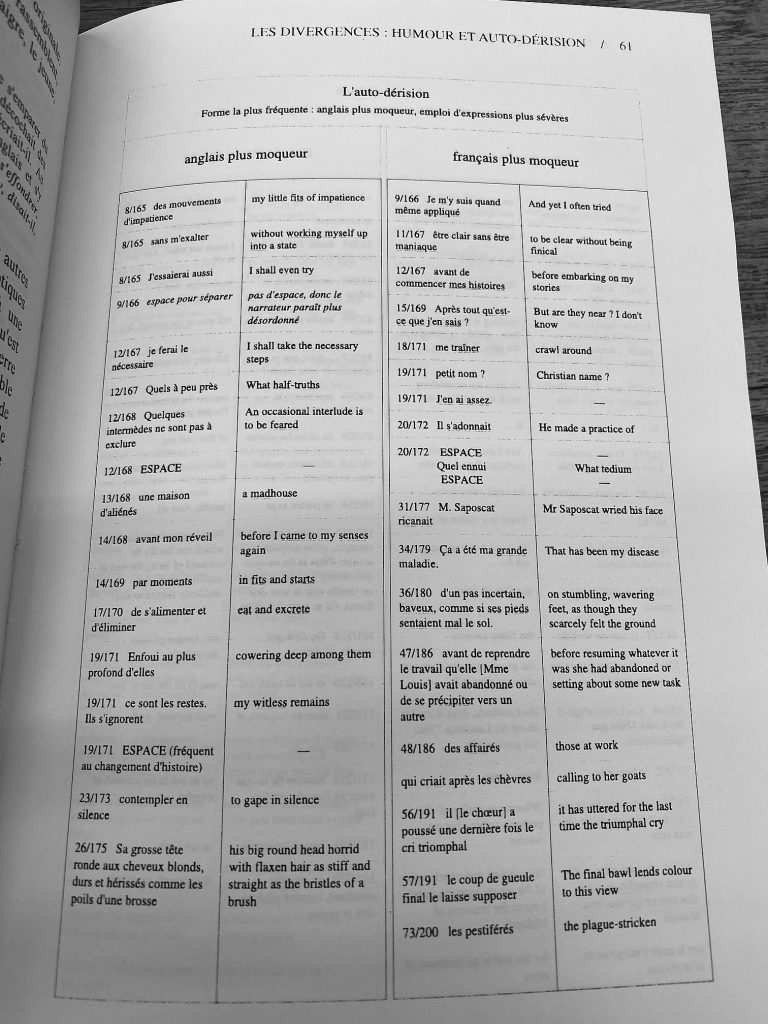
Beckett by Beckett, meaning the translation of Beckett by Beckett himself yields many fruitful insights into his kind of irony and constant reflection and laughing about himself as his very own form of irony. This becomes most evident in the many helpful tables Linda Collinge (2000) presents in her book on “Beckett traduit Beckett”. Translating irony is a tricky endeavour. Many of the translations do not seem to be straightforward at all and can only be understood from the perspective of the whole translation of a piece and the underlying “Haltung”, ironic attitude of the author to his own work. Beckett by Beckett remains a master piece for translaters beyond those from French to English. (Images: Linda Collinge, 2000, p.61-2).

Beckett and philosophy

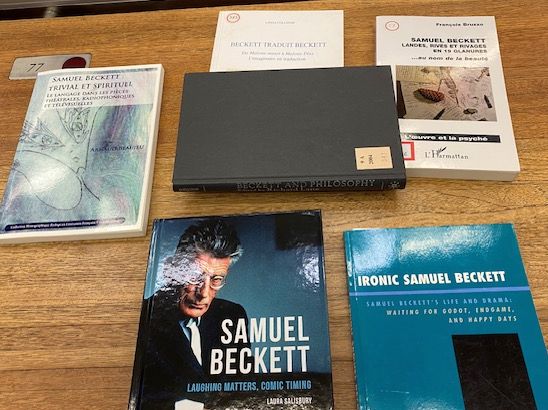
Beckett and philosophy is the title of challenging read of usually unconnected literatures. Richard Lane embarks on the challenge “theorising Beckett and Philosophy” in Part 1 of the book. This is followed by 2 other parts on “Beckett and French thought” and “Beckett and German thought”. The whole book constitutes an attempt to identify the links between seemingly unrelated work. Sometimes spurred by tiny citations, the importance of influences becomes apparent.
Beckett like Rousseau favours speech over writing. Speech giving access to nature. This, Beckett has taken from French thought traditions. Redefining philosophy after the 2nd world war links Beckett to the thoughts of Adorno and Habermas (early writings). Posing Nietzsche’s thoughts as a post-modern project of endless questioning, Beckett himself enters into a kind of Socratic dialogue with Nietzsche. Spoken words become writing, the written word resembles an unspeakable void. The borders between void and silence, between spoken and written, become blurred. The essence is the world in-between.
It appears like irony and yet it is our very existence. We probably need somebody to translate Beckett for us in order to better understand his philosophical stance. “Beckett translates Beckett” is such a book title. It invites us to study Beckett’s own efforts to translate himself, at least from one language to the other.

Laughing Matters

It is time to dig out our copies of Samuel Beckett. Jon Fosse refers his work back to a tradition of Samuel Beckett. It is interesting to re-read some of the plays of Beckett. The famous “Waiting for Godot” or “Endgame” figure prominently on the reading list and theatres even today. Laura Salisbury (2012) honours Beckett in devoting a book on Beckett with the subtitle: Laughing matters, comic timing. She refers to a tradition founded by Aristotle: “man is the only animal that laughs”. Even in the most horrible scenarios of war and suffering, the human brain brings up thoughts containing jokes. Laughing makes us a part of the human species. Humour then becomes the “locus and limit of the human” (Salisbury, p. 4).
It is obvious that the basic problem of jokes like most of our communication has a “sender” versus “receiver” problem. People just do not have the same sense of humor in many instances. We might even go as far as stating that a person feels at home, if cracking a joke is readily understood by surrounding people. Test your cross-cultural competence by trying and sharing laughter. It is hard to do.
Beckett succeeds in a formidable way on a philosophical level even to bridge cultures and spread his way to look at the world from a meta-perspective.
Waiting … for what? Endgame … what is the game? Is it a game? These are laughing matters. Not for all, but for many on the way, trying to learn about existential matters that define humanity.
Through choices Samuel Beckett made in his lifetime, it becomes clear that he did not shun away from the most existential choices. In World War II he joined the French resistance movement and risked his life to save our laughter. Jon Fosse appears in the footsteps of Beckett, who decided to seek the silence and remoteness to develop his work for years also in the tiny village of “Ussy sur Marne” near Meaux and a bit further away, from Paris.
In Beckett’s own words he defines what a comic spirit is;
“comic spirit: oscillation between equilibrium and lack of it” (Salisbury, p.20), referring back to Racine and Molière. It is a social skill and it is not always easy to master, like for example to suppress laughter. Aging might play additional tricks on us (reduced strength of affect inhibition). There is a cognitive element in laughter, but also an affective and a spontaneous mix of reactions.
Affect inhibition is linked to the ability to resist spontaneous impulses like laughter.
Resisting impusles, but also resistance on a philisophical kind is in Beckett’s work “a resistance to the given world, while nevertheless displaying all its violent administrations;”. (Salisbury, p.172-3). In asking what remains after we abandon belief makes it necessary to foster a resistance to brutal deviance from humanity. Laughing may matter here more than we might want to acknowledge.
Source: Salisbury, Laura (2015). Samuel Beckett: laughing matters, comic timing. Edinburgh : Edinburgh University Press.
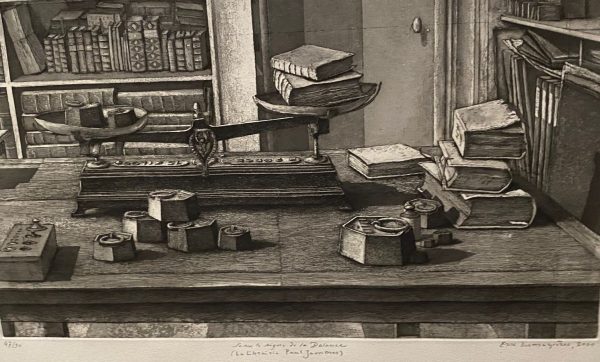
Image: extrait Eric Desmasière, 2000 Sous le signe de la balance.
Book traders

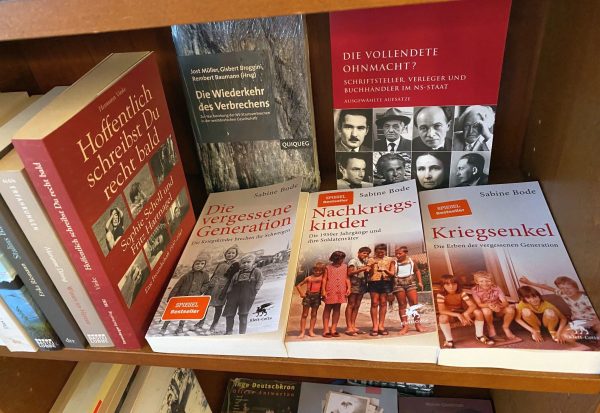
Some book traders have a mission. They assemble little corners on their book shelves or in tiny cupboards reserved for their passion or mission. In some book shops you’ll find a corner devoted to a specific language or translations, in some a world region is represented as a specific predilection. The choises are as numerous as there are books. Of course, from an economic point of view national and international bestsellers will be shown in the most prominent places. Second come books for children, cooking, life and travel guides. All those are the cash cows for book shops and traders.
But beyond those, it is always worth the effort to search for those little carefully curated corners in a good bookstore that derive from the vision or mission of the book trader, employed or owning the shop. In some areas this contributes even to a small community building. Readings of authors add to the function of book sellers to build a relationship to their non-random book buyers. I keep going back to my favourite book stores and libraries with those curated corners for decades and across countries to find inspiration and updating of special topics.
There is a danger that we are going to lose all this professional work of thousands of well-trained book traders that guide readers in addition to publishing houses, literary critics, numerous awards and huge marketing campaigns of derived products (as with Harry Potter). Living up to your mission while running a book store must be a great experience. If is really increases the buyers and readership for the topic, would be a great result. However, I suppose many bookshops manage to keep their little curated areas despite economic pressure to go with the mainstream marketing campaigns and top selling books and gadgets.
With the decline in the number of smaller book shops (in Germany from ca 5000 to 3000 in about 20 years) we see a parallel increase in number of franchises of the big book sellers (Thalia.de 500 stores in D). Big chain increase seems to cause fewer professionally trained book traders (-10% in D) within a country. For younger generations TikTok (BookTok) has taken over large parts of the “book counselling” of book traders previously. This was a big event at the Frankfurt Book Fair 2023 as well.
Time to rush to your local bookstore and book trader before it is taken over by a big chain or simply disappearing silently. We are likely to lose many of those book traders with a mission to make this world a better, more beautiful, more tasty, enjoyable or inclusive place.

Art to People

It is a timely move to not only rely on people to come to exhibitions or a museum, but for art and artists to go towards people. Advertising exhibitions is a first step in this direction. As photography and selfies are all around us, it is a small step to get more people interested in art through photography. The treasures of archives and libraries complement the markets for art and photography. Susan Sontag has taught us the social sciences related to photography. Learning by looking is just like the well-known learning by-doing.

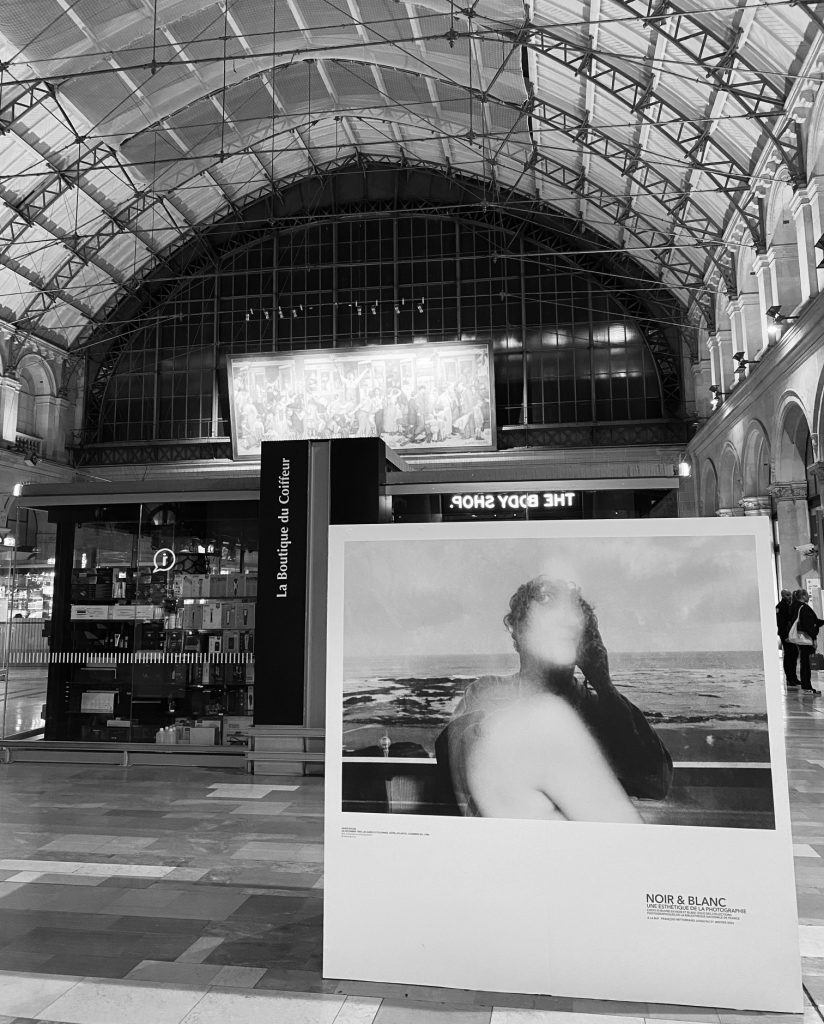
The BnF in Paris is advertising at the Gare de l’Est in Paris. Passing by the board might inspire thousands of travelers and commuters to stop for an instant. Eventually being bothered and to take notice of the intriguing image or images in this reproduction of a photograph or maybe 2 blended ones. A few might note down the address or take a screenshot with their mobile camera to remember. All these instances enlarge the audience for the exhibition or motivate people to go beyond the quick shot with their smartphone camera. The artwork related to photography mostly starts after the first shot. It is in fact sometimes quite a long journey to come up with the final image. Just go for it.

Gare de l’Est Paris 2023-11 BnF exhibition

Black and White

Nothing is just black and white. Some animals have a representation or vision of images in black and white. Just like in computing full color modes or high resolutions use more power of chips and memory. In short colors are computationally costly. For our brains this is unfortunately just as important. Therefore black and white images have a certain advantage. On the one hand they reduce an image to its essential elements, on the other hand they allow a faster grasp of the message or content at sight.

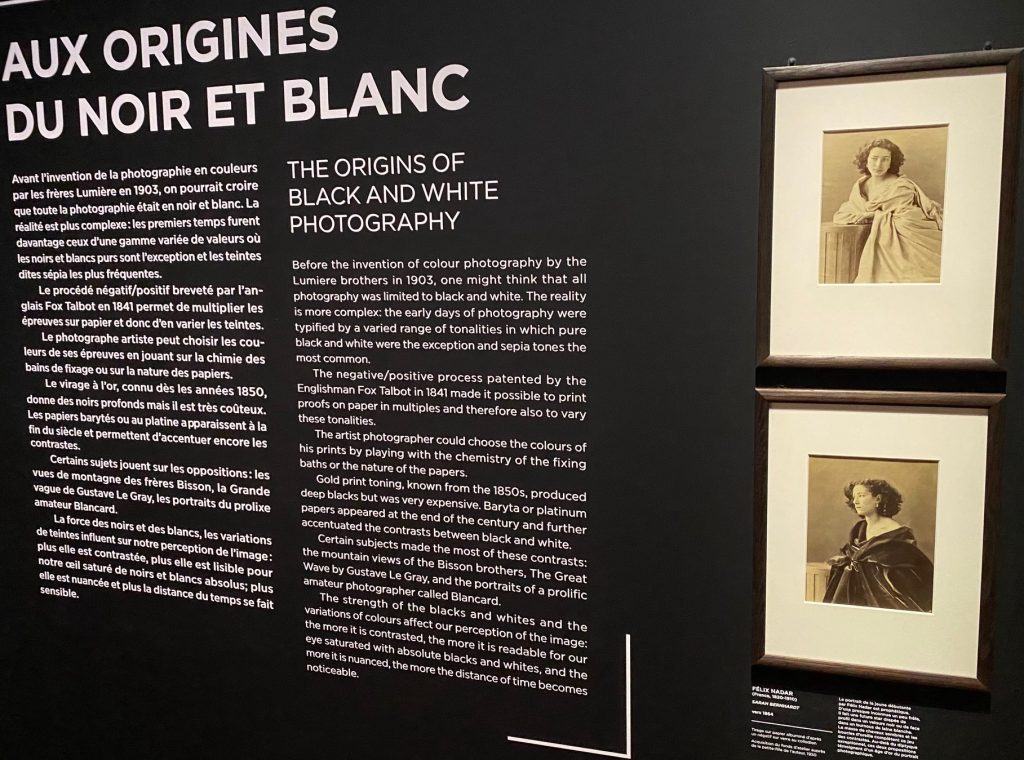
The BNF presents a wide range of images in black and white from the time that color photography has been available, but photographers consciously chose to represent their image in black and white (1907-). Obviously with black and white photography we maximize contrasts. An image can be converted into a graphical representation like a black and white pencil sketch or drawing. A few more nuances are introduced in applying perspectives to capture or to produce by use of lighting forefronts and shadows.

Using different materials as support of photography allows us additional creativity and stunning effects. Lighting from behind the image is popular in advertisements on our high-streets. Last but not least using techniques of color photography gave rise in modern black and white photography to allow for chromatic transitions and contrasts within images.

All this is well documented in the exposition and ample examples make it a formidable visual learning experience. From the origins of just black and white we have come around to the fabulous and magical in black and white. In reducing to black and white the essential becomes more visible. The superfluous is blackened or whitened out. It is a skill of importance nowadays to focus on essentials and to find new ways to go beyond the obvious shot.

BnF 2023-11-10 B/W

Chrysanthemum

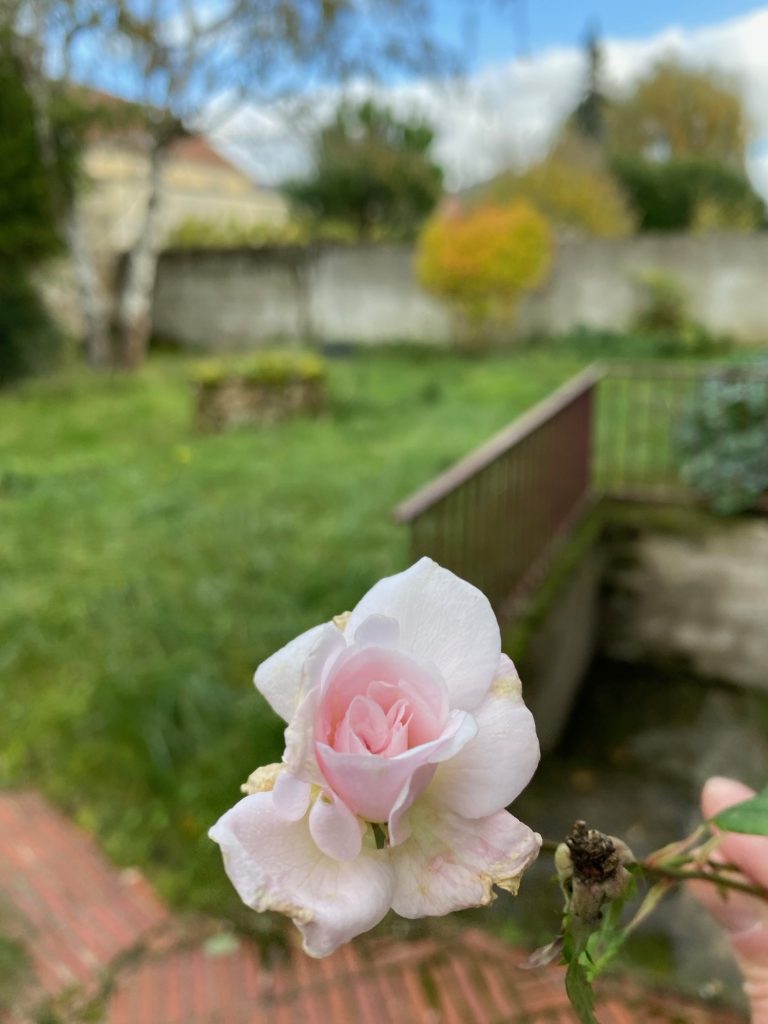
We all know Chrysanthemum as the flowers of the autumn season. For Christians the Chrysanthemum is popular to decorate the graveyards around all saints day or reformation day. But also in the commemoration of armistice day of the Great War 14-18 flowers to remember that last a little bit are widely spread throughout Europe. But climate change and a prolonged summer season threatens these traditions. It is not uncommon to spot even a few roses here and there. It may well be the one and only “last rose” in other places.

Maybe we have to reconsider our concepts of seasons and planting cycles. Less use of tap water, but rain water recovery instead will help us get through droughts and a prolonged summer. Let’s see what changes we shall live through in autumn and winter. Chrysanthemum in winter, Chrysanthemum for Christmas is strange idea. Maybe that is what we should expect from now on.

11.11.2023 Ile de France