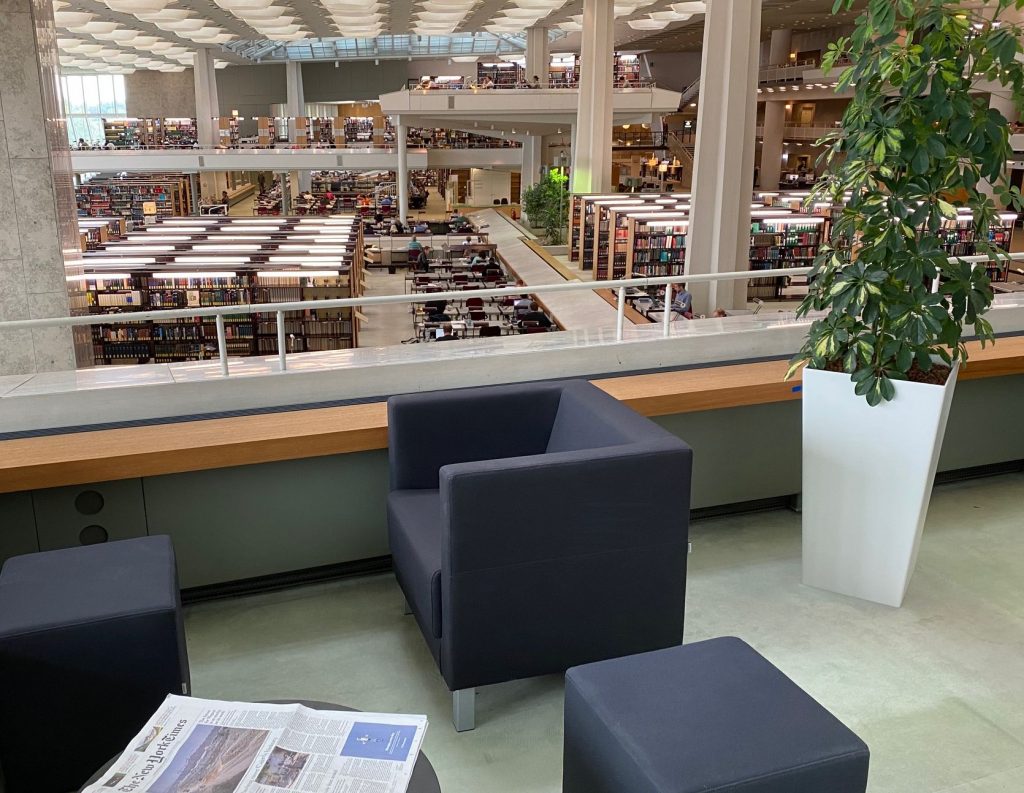

The rather stiff and rigid structure of the “Staatsbibliothek” in Berlin does not yet have a reputation to be a place of poetry, translation of poetry and recitals. This is about to change. As a student, researcher or lecturer I would have adored to see my library proposing a poetic coffee break. I would have gone for the necessary break in the afternoon, the coffee and, okay why not, a poetic experience. This time it was different. The organisers, “ilb and Stabi” got together and Ursula Jäcker together with Michael Bucher presented poetry from Shakespeare (Sonnet) in English followed by the German translation by Wolf Biermann.
Translating poetry is a very tricky thing. Just try it yourself and you will be full of admiration for the admirable work of translators of words, sentiments, rhyme and rhythms. The presentation of Biermann’s comments on his own work on translating Shakespeare’s sonnets gave interesting additional information on the short and precise English original and the longer, somehow fat translations into German (Biermann’s words). Thanks for the indication that Biermann deviated from the Shakespearean “iambic pentameter” to add a sixth foot most of the time (to be checked OMG). The choice of numbers 6, 18, 27, 66, 73, 76, 121, 147, 154 from the Shakespeare Sonnets were witty and entertaining for a coffee break. For example, from 27:
“And keep my drooping eyelids open wide,
Looking on darkness which the blind do see:…”
Also, from 76:
“Why write I still all one, ever the same,
And keep invention in a noted weed,
That every word doth almost tell my name,
Showing their birth, and where they did proceed?”
More than 400 years ago, these rhymes were drafted and still today writers and learners, at the Stabi and beyond, can somehow identify with the intricacies of the process of creative writing.
More of this, we need, today and for tomorrow. THX. 
Ozone
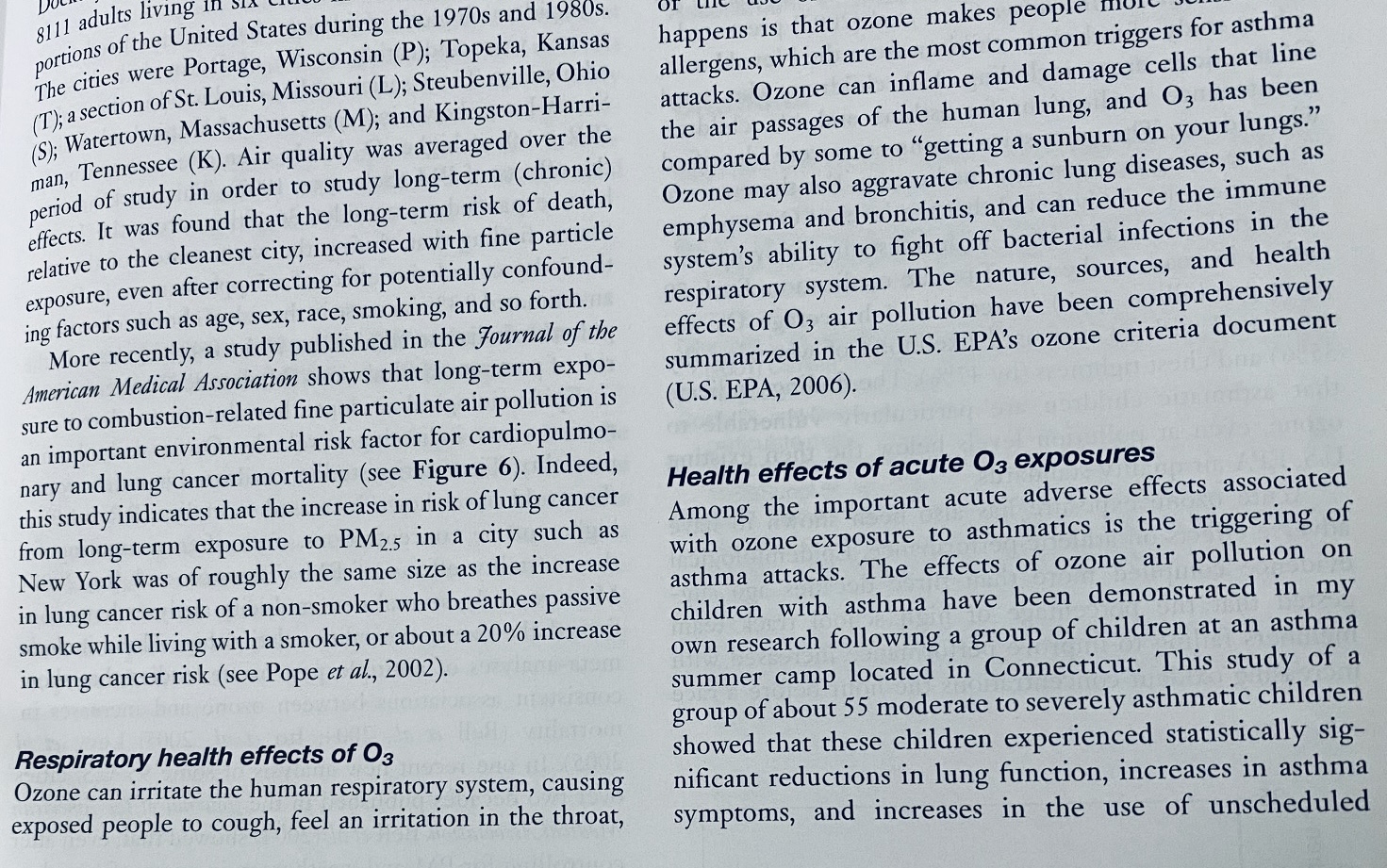
Ozone (O3) has a rather mixed reputation. High up in the stratosphere it protects us from too much radiation from the sun, but down on earth in our respiratory environment it causes and amplifies respiratory difficulties. Hence, it is very important to differentiate the 2 different layers and differential effects of concentrations of ozone in the air. A forthcoming study in the Lancet Regional Health Europe (Nov. 2023) by Tianyu Zhao et al. demonstrates the long-term, negative effect of higher concentrations of Ozone on lung function. The prospective cohort study followed individuals in multiple states and locations over 20 years and corrects estimated effects for other environmental effects (fine particles PM 2.5 pollution) and green environment. Faster decline in spirometric lung function is highly likely to be caused by higher ambient ozone concentrations. The study is based on 3000+ observations from 17 centres in 8 countries in Europe. Older persons in the range from 35 to 55 had a steeper decline in ozone-related decline in lung functions.
This is rather bad news for older persons living in inner cities where both ozone concentrations, mainly in summer, heat and micro-particles cumulate. Similarly, areas with frequent so-called inversion micro-climate, (a layer of cold air on top of SMOG blocks the renewal of air for extended periods) face particular health risks. Professions that work long durations outside in the sun or the exercise of sports during high ozone day-time run higher risks for a deterioration of their lung functions in the long-run. The medical evidence is there now, also for Europe, what had been shown already for the US before.
It is time to adapt our lifestyle to these health risks. High effort physical work outside should start as early as possible in the morning hours or even before sun rise. Staying indoors is highly recommendable for older persons and persons with reduced lung functions (asthma risks) during such periods of high ozone concentrations. Like it or not, even wearing a mask outside, when it is sunny and hot would be preferential, but is rather inconvenient. We need to shift airing living rooms or offices without climatization to early morning hours rather than ambient temperatures in the afternoon, when ozone peaks are prevalent.
These effects and remedies have been known for some time, but the evidence is much more compelling now (Zhao et al. 2023). Climate change in form of global and local warming, particularly in inner cities, will only exacerbate these effects in the coming years. Prevention measures need to be considered in public health measures as well as urban planning. We can do it, if we want to. Start now to benefit from the effects a decade later or for the benefit of younger generations. (Image: Int. Encycl. of public health, p.702). 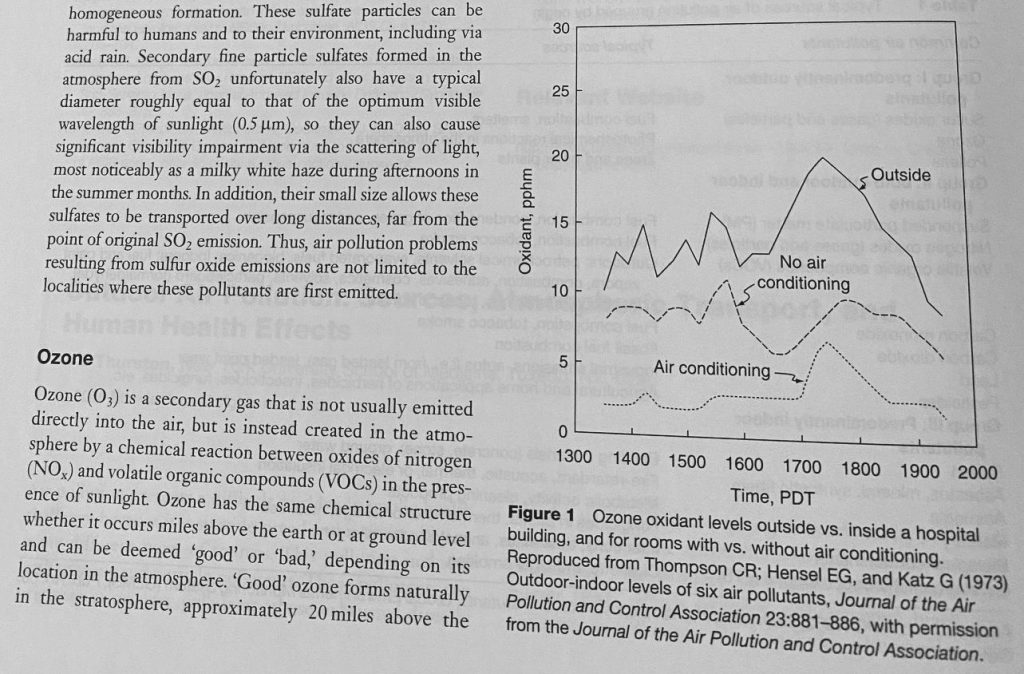
Princess
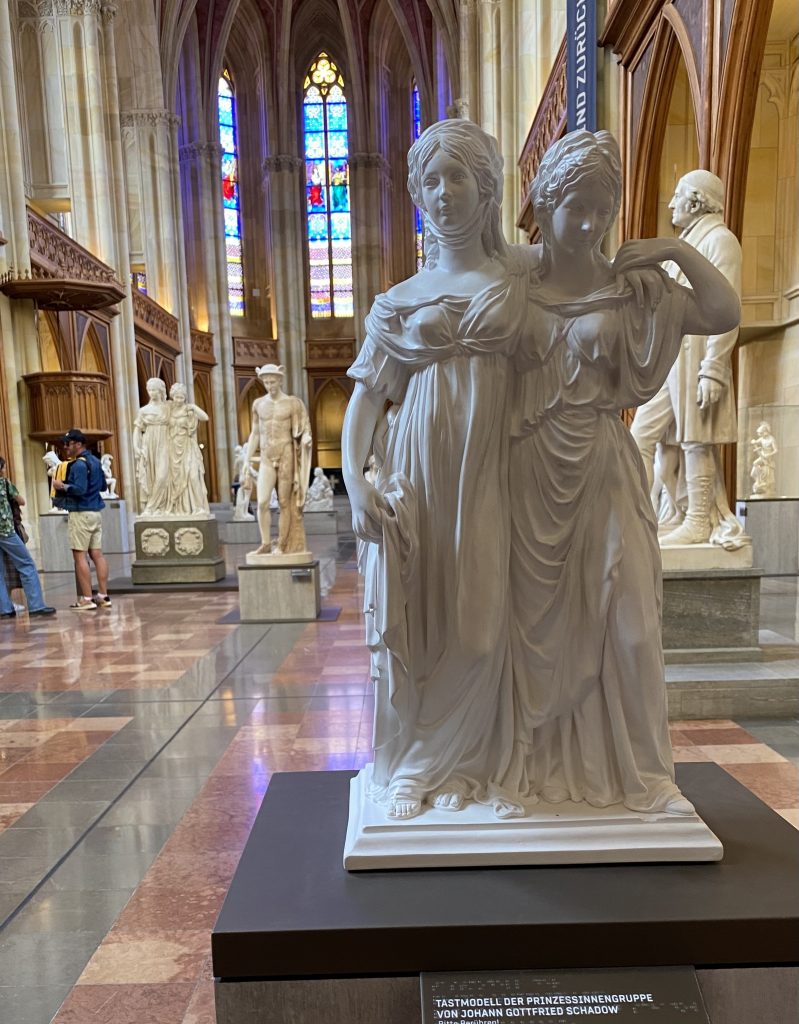
Berlin is proud to present its princesses after a marvelous lifting. Yes, in the middle of the barbie hype, Berlin exposes two of its princesses of the late 18th century. And you can touch them, if you like or dare to. They don’t bite. I have not seen anybody kissing them either, except for a Spanish football president. All this is happening in the Museum Church Friedrichswerder designed by architect Schinkel an built until 1830s. The grouping of the two sisters was unusual for the time and only the inscription at the bottom introduces the distinction that Louisa on the left is the princess heriting the throne. Frederica on the right is wearing a different foot wear, considered less noble. The privilige to touch the princesses applies only to the smaller copy in front of the image below with “Braille inscription”. The original is further behind. Of course, this one is protected against unwanted contact with the masses or “followers”. At the time “follower” still had a different meaning from today.
Bogenspannerin
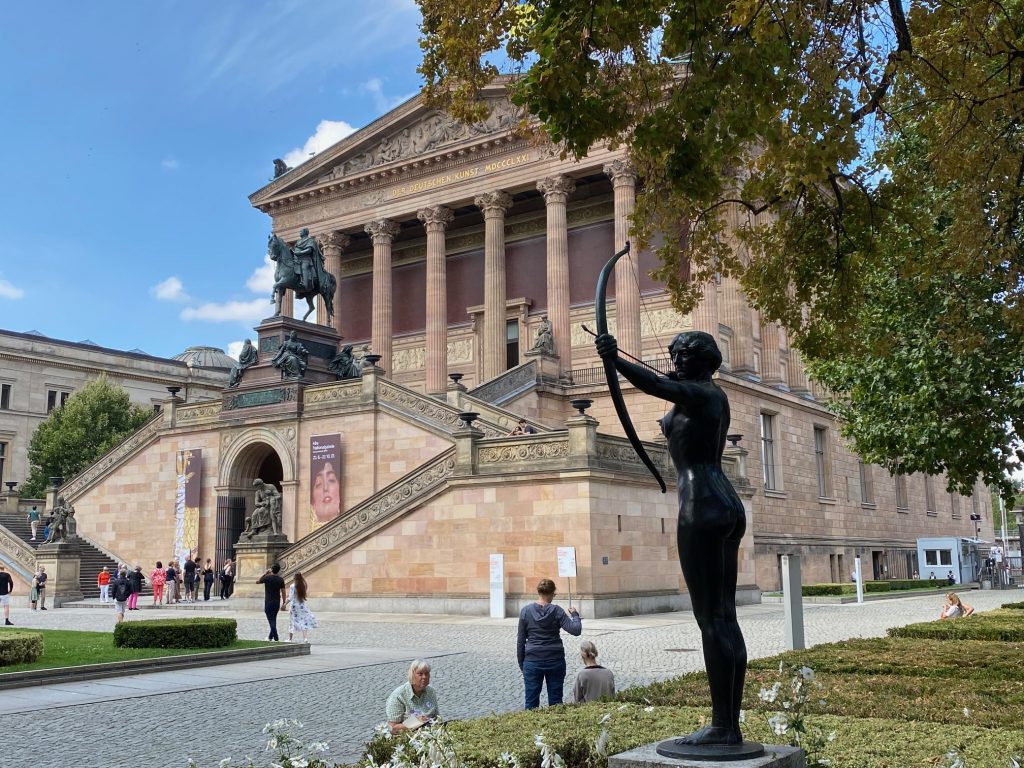
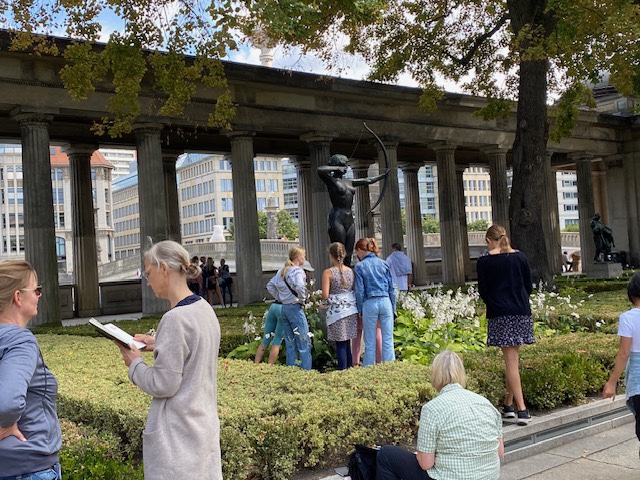
Seit der Antike sind Bogenschützen und Archer ein Thema der Künste. Meistens ist die männliche Repräsentation die dominierende Variante. In Berlin lässt aber auch seit langem eine starke weibliche Realisierung bewundern. Nahe dem Pergamon Museum und der Alten Nationalgalerie steht die Statue der Bogenspannerin. Die Zielrichtung geht Richtung Hedwigsdom, als ob der Kampf zwischen Kunst und Religion ein andauernder wäre. Erfahrene Stadtzeichnerinnen, aber auch Jugendliche fühlen sich dadurch angeregt. Kunstschaffende können einen nachhaltigen Einfluss haben. Innerhalb Berlins ist nicht nur die Vielfalt der Kulturen zu bestaunen, sondern auch der Wettbewerb der Künste um Aufmerksamkeit. Da werden nach Regierungswechseln oft viele Bögen gespannt. Bleibt abzuwarten, wen es alles dieses Mal treffen wird.
Energy Ethics
Around the topic of energy there many ethical issues that urgently need sorting out. Carlos Diaz-Rodriguez and co-authors have provided a sound basis for such ethical considerations. To leave the disastrous path of energy provision through polluting fossil fuels and, additionally very risky, nuclear energy, they propose a departure from the principles and values that have guided us into a dead end. In their opinion we suffer from a mistaken belief to be able to control in extremis, through scientific methods, the forces of nature. In ethics this mistaken belief has roots in religious beliefs that mankind is mandated to make the earth subordinate to its own will. The authors propose to overcome this old paradigm with a new paradigm. This builds on the (1) “precautionary principle”, (2) justice as equity, (3) protection and the (4) principle of responsibility.
Most European readers of philosophy and social science are familiar with these principles. The virtue of the paper is to expose and juxtapose these principles in a clear format and a stringent application to the ethics of energy (production as well as consumption of it).
The precautionary principle is part of the European treaty on the functioning of the European Union Art. 191, but its implementation on energy issues reveals that it is a tiger without teeth. Younger generations across the globe are right to claim a more forceful implementation of this principle.
The perspective of justice as equity is bringing in later born generations as well into the balance costs and benefits of “cheap energy today” but huge costs of dismantling, repairing, stocking deferred to the future.
The protection principle refers to the loss of biodiversity and exploiting resources in areas of world heritage, for example.
The principle of responsibility goes beyond the judicial and economic principle that the person, company or state causing damage through exploitation of resources, and in producing energy with it, has to pay for repairing those damages.
As this is hard to achieve in real terms, there is an urgent need to reiterate the responsibility principle at all levels. Despite the inefficiencies of legal systems, the international legal order in particular, there is no way around than to insist on responsibility from the individual behaviour, company strategic goals as well as objectives set by nation states and international organisations. The Paris agreement and all COP XY conferences only prove the fact that irresponsibility continues to be a guiding principle.
Maximalist positions as well as continuing like decades before is failing people on earth. Organising a discourse on these ethical issues is a first step, but we have to be able to address negationists as well.
The missing principle so far is the solidarity principle. Without a firm commitment to intergenerational and international solidarity we shall remain unable to solve the ethical puzzle. It is high time to organise solidarity related to the field of energy.
(Image: “The fallen tree of knowledge” by Fabrice Samyn. Exposition in Yerres, France 2021-11) 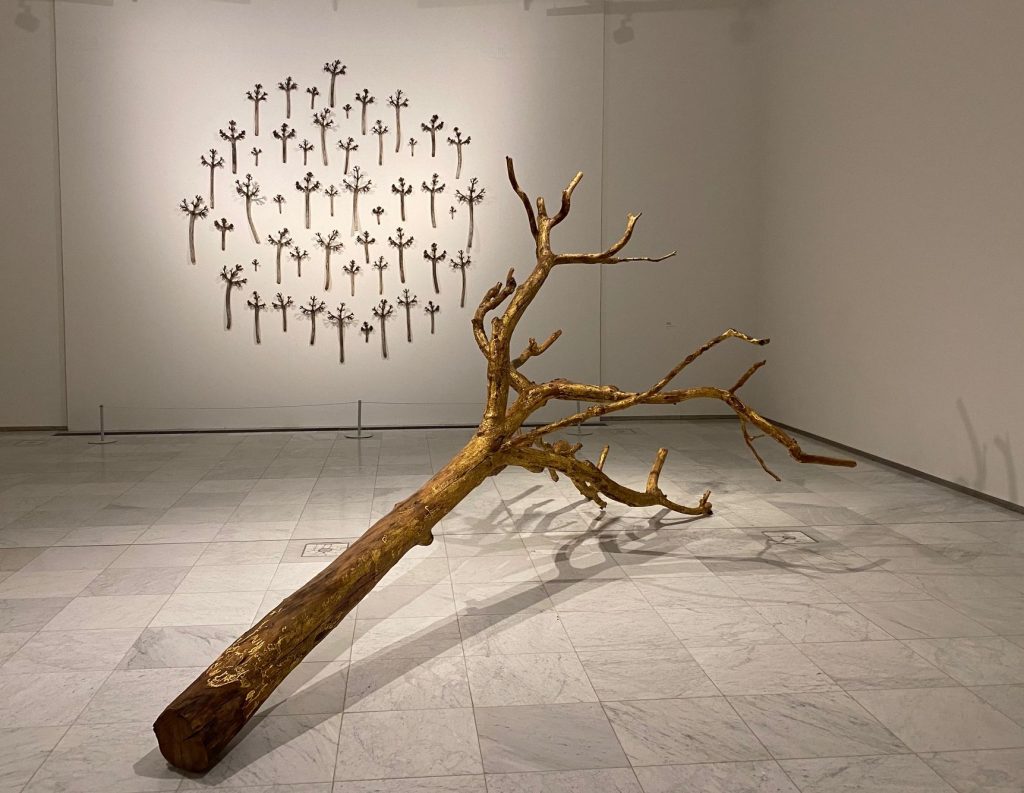
Energy Food
For more than a decade now researchers have shown the link between energy prices and food prices. At first sight this might seem surprising. In traditional or romantic associations with growing food, there is no link between the cost of energy and food production. Growing crops in your garden does not need more than sunlight, soil and water. Yes, that was long ago. Industrial production of food is heavily relying on energy to heat, feed and water plants or animals. Additionally, the supply chains have become far more distant, which increases the CO2 footprint even further. Therefore, it is no longer surprising that a great number of econometric studies confirm the close link of energy prices and subsequent pressure on food prices. This is not restricted to Europe, but has reached global contamination.
Enjoying seasonal local food is a double catch solution. You grow according to local weather conditions and use traditional conservation methods, if the crop is exceeding your demand at that time. Providing heating for animals to increase productivity or quality of products appears to be one of the most wasteful ways to further increase the spiralling up of energy and food prices.
In agricultural science there is a lot of research into the “energy intake” of animals to better grow or produce more milk etc. This is the expensive intermediary step using energy to produce energy intake for animals rather than humans. It is surprising that we take so many years to address these well-known linkages that have turned to serious problems after Russia’s war on Ukraine. Agriculture and farmers can be part of the solution rather than a problem themselves, if the link of energy consumption and food prices is taken seriously. 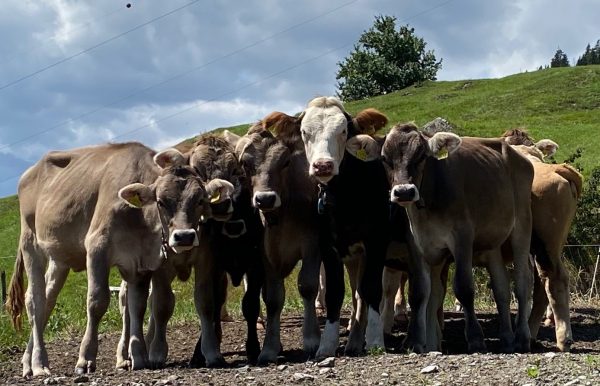
10000
In France 100.000 is associated with Monsieur 100.000 Volt Gilbert Bécaud due to his dynamic singing and performance style. Since August 2023 we now have an additional association with the number 10.000. Ten thousand m3 was the size of stones that came down from the mountains near the popular skiing resorts in the French Alps (Le Monde Link+video). To visualize the amount, a back of the envelope calculation with a standard container size of 25 m3 returns 400 loads of lorries to be removed from hard to access landscapes. Count this into the costs of running ski resorts.
A study in the scientific journal “Nature Climate Change” in 2023 highlighted the increasing risks to European skiing sites. Same holds for the Alpes in Switzerland. Some areas relying on water resources to create artifical snow do so in less and less safe areas. Costs accrue to communities who benefit only indirectly from the skiing hype, celebrating 100 years of Olympic skiing next year. After all it is big business to sell or lend equipment, provide hotels and meals for all those sports women and men.
The so-called collateral damage is probably even worse. Interrupted railways, bridges, motorways and traffic in general becomes a severe disruption for quite some time adding to the total costs of having fun in winter. Is it worth it? A tricky question to ask in a referendum. We shall have to revise our past decisions to expand skiing resorts in light of the new evidence of higher risks and costs involved. A book on 10.000 years of history of glaciers is full of side-effects of glaciers melting away, which cause instability to valleys on the sidelines. In the most recent break-up of rocks it is actually more the access to the skiing resorts that was blocked, but this demonstrates to all: passing this area now, is not without serious side-effects. 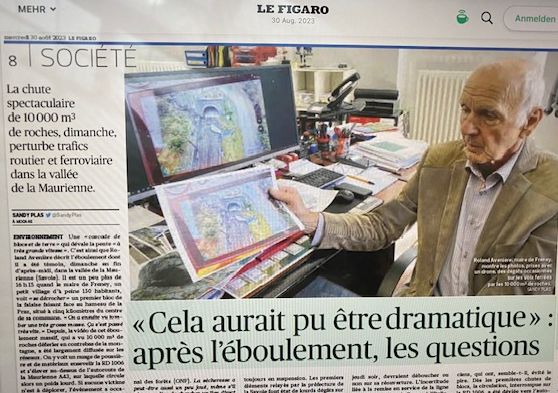
Everyday objects
If you were wondering whether everyday objects can be a piece of art, then the exhibition at the “Neue Nationalgalerie Berlin” is for you. Isa Genzken challenges our traditional view of everyday objects through small transformations of these objects. At first sight you “only” see something utterly familiar to you. A window, a radio, a rose or a wheelchair are immediately recognisable. However, all objects have a little twist to them causing some alienation, questioning or finding new connections. This is the stimulating experience of a visit of the exhibition. The booklet gives an informative overview of choice of sculptures chosen for the exhibition. Walking around in the spacious entry forum allows to appreciate the objects from many angles and in different lighting including twilight. Allow yourself to be challenged. Distancing your perspective beyond the obvious object you recognise broadens our vision of what we see and how we perceive it. The huge pink rose in front of the gallery overshadows even the monumental appearance of the Neue Nationalgalerie. In memoriam “Rosa Luxemburg” and Karl Liebknecht who were murdered not far away, near the “Landwehrkanal” in 1919.
Some visitors might like the skyscraper models she created to remind us that “design catastrophe” with the usual high rising buildings are pervasive around the world. Sculpture as architecture or architecture as sculpture has been her forward looking work from 2008 “Ground Zero – Hospital”.
With the construction work in full swing in the neighbourhood of the gallery with the design of a barn (Scheune) we understand the choice of the artist as a timely reminder that Berlin could be more daring in the architectural design. 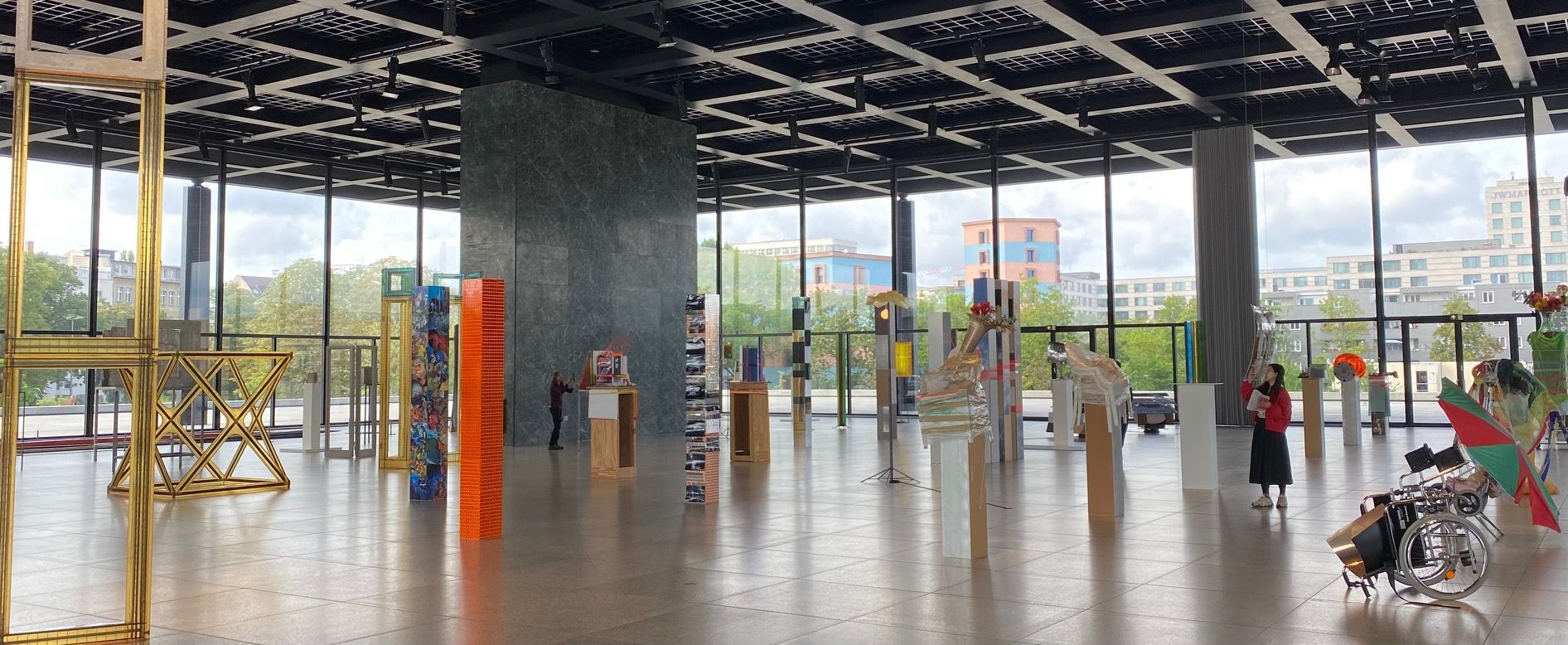
Smart watch
Das Handgelenk hat noch viel Platz für elektronische Geräte. Vom preiswerten Schrittzähler bis zur smart watch und intelligenten Armreifen oder sogar Ringen gibt es dort viel Potential für Innovation. Jenseits der Schritte werden mittels vielfältiger Sensoren eine Fülle von Daten erfasst. Datenschützer erschaudern geradezu. Das Potential für medizinische und soziologische Auswertungen dieser Daten ist immens. Vergleichbar mit einer elektronischen Waage, die Knochenmasse, Wasser und Muskeln erfasst erlauben die smarten Uhren noch mit Ungenauigkeiten, aber stetig besser werdend, kardiologische Werte und Schlafrhythmus zu erfassen. 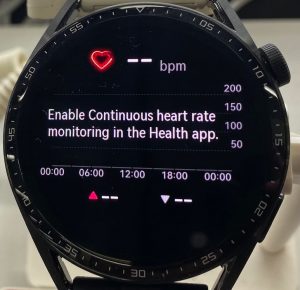
Mit Daten von tausenden bald Millionen Datenlieferanten lassen sich wichtige Studien zur Früherkennung von Gesundheitsrisiken durchführen. Plötzlicher Herzstillstand ist eines der immer noch wenig aufgeklärten Phänomene. Die Studie im LANCET digital health hat solche Daten ausgewertet und kommt zu der Schlussfolgerung, dass dyspnoea für Frauen und Männer der größten Risikofaktoren darstellt. Für Frauen wird Entwarnung gegeben für Diaphoresis, exzessives Schwitzen, aber nicht für Männer. Letztere sollten Schmerzen in der Brust ebenfalls ernst nehmen. Daten sammeln kann durchaus Leben retten. 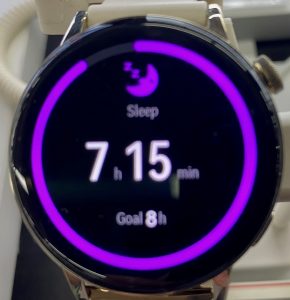
Dennoch droht dem Gesundheitswesen eventuell eine Welle an falsch positiven Selbsteinweisungen in der Notaufnahme der Krankenhäuser. Darauf sind wir noch wenig vorbereitet, inklusive der möglichen rechtlichen und finanziellen Konsequenzen. “Big brothers are smart watching you”. Müssen Ärzte die smarte Evidenz berücksichtigen, etwa so wie eine Patientenverfügung? Was wenn plötzlich der Notarzt unaufgefordert an der Tür klingelt? Wer hat meine Uhr gehackt, … , singt das Paulchen Panther jetzt.
Stabi locker
Die Staatsbibliothek Berlin in der Potsdamerstraße macht sich mal richtig locker. Neben all dem gebundenen und gebündeltem Wissen gibt es eine kleine, etwas versteckte Ecke in der richtig gechillt werden kann. Mit aktuellen Tageszeitungen in Papier und online lässt sich gut pausieren. Eine tolle Aussicht gibt es zusätzlich. Selbst eine vorübergehende Schließung wegen überfälliger Sanierung wird die Stabi bei den Wissbegierigen eine wichtige Location vermissen lassen (fehlende Bücher).
Neben Wissensmaschine ist die Stabi eine Lernanstalt erster Klasse. Die Anzahl der mitgebrachten dicken Gesetzbüchern samt Kommentaren lassen einen immer wieder staunen über den Mangel an stillen Lernorten an Universitäten und in Privatwohnungen. Die richtige Lernumgebung befördert den Ansporn, noch eine extra Meile zu gehen. Wissbegierig ja, aber es braucht auch viel Durchhaltevermögen bei ständig wachsenden Ablenkungsmöglichkeiten. Gemeinsam, einsam, allein mit sich und dem Wissen lässt sich vorzüglich dicke Bretter bohren. Das ist ein wichtiger Teil, das Lernen zu lernen. Kunst am Bau und im Bau gibt es gratis dazu. Die Nähe zur Ablenkungsindustrie am Potsdamer Platz, Kinos, Spielbank und Fresstempel kann da getrost auf ihre späteren Opfer warten. Mit Regionalzügen und S-Bahn kommt man von dort rasch wieder weit weg.