Gone paddling

Similar to windsurfing, paddling has not only a physiological, but also an ecological impact. Rather than using external power the equipment requires a good sense of balance on the board and propulsion originates in your own muscles. The benefits are great for mind and body and sharing a board is the standard way of getting your regular exercise.
There are more and more stations near the sea or on lakes available in 2026-5, so that it has become a much more accessible form of exercise. Paddling is also an age-inclusive practice, since the “probability to fail“, with the pleasure of spontaneous diving, is spread relatively equal across ages. Learning curves, however, may differ substantially across generations depending on prior balancing experiences. The ecological bottleneck consists in the access to sufficiently clean water resources so that the healthy and fun exercise shall have positive long-term health effects. 

Gone reading

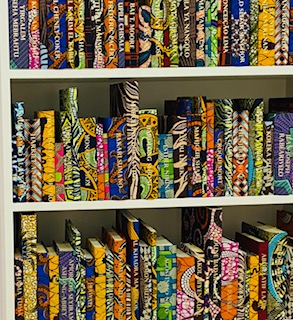
From time to time we should reflect on our scope of reading experiences. Over time, a certain bias for probably predominantly Western European or western parts of the world is likely. Therefore, it is an interesting experience to consciously choose authors from a broader geographical background.  The reading, which originates or takes its motivation from an exhibition, is a good start to broaden reading, particularly if images enliven the reading experience. The art work by Yinka Shonibare CBE on display in Berlin at the Palais Populaire manages to make this point in a colorful, compelling fashion.
It is difficult to assess what we have missed so far without having embarked on a longer reading journey. (Image: extract from Yinka Shonibare CBE, 2022, “The African Library Collection (Poets)”

Gone walking

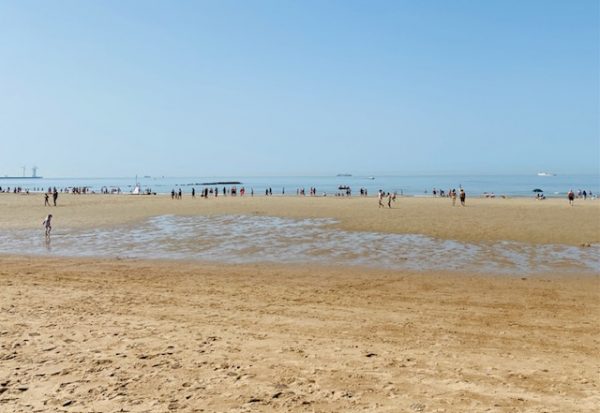
During busy weeks or travel times it can be difficult to keep your average healthy walking distance up to standards. Rather than traveling even longer distances to far away destinations, nearby areas might have to offer lots of options to get more exercise of any kind and particularly walking. The environment for walking plays an important role as well as for example walking on the beach distracts easily from the efforts involved. You don’t have to go fishing, but lots of activities will encourage you to further to explore soft forms of exercise. 

Hybrid art

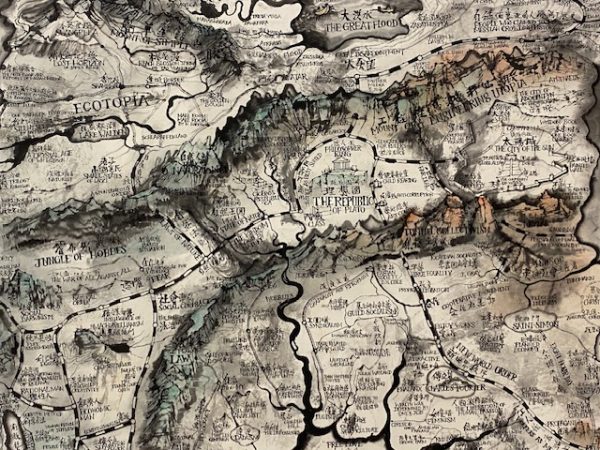
Bringing together 2 kinds of art makes hybrid art. Just as other fields of art have combined for example music with text to create the art form of songs as of the medieval ages, for example, the emancipation of another form of hybrid art is gaining prominence, text incorporated into or in cooperation with painting. The incorporation of text into paintings, sculptures or installations represents a drive to ise multiple channels of communication with an audience. Each might be sensitive to a specific word or sound, which creates an entry to gain attention or enlarge awareness for some cause. The “Palais Populaire” in Berlin displays the combination of the collection of the Deutsche Bank Art collection and the “Written Art Collection” to make this point with some forceful pieces of hybrid art focusing on text in art. (Image: Extract from “Map of utopia” by Qiu Zhijie, shown at “Seeing words, reading imagesSeeing words, reading images” at the Palais Populaire” in Berlin 2026-5). 

Latent social structure

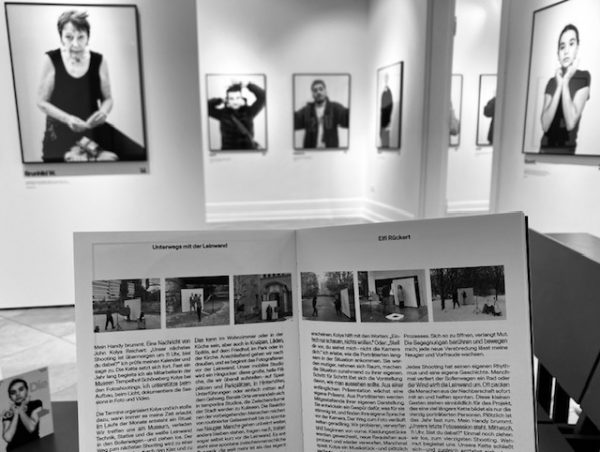
In empirical approaches to sociology we occasionally apply “latent variables analyses”. The aim is to uncover links between data that are not obvious in standard analyses of data. We are pretty convinced by evidence that age correlates with the probability of death. However, most tragedies are created around exceptional counter examples to this “rational expectation”. We also somehow have an intuition about the positive effect of social networks or the social fabric in a more general sense on living and survival. In some of those latent variable models we find evidence for an underlying factor without being able to properly name or frame it. Hence, as social scientists we continue to be interested in ways to make latent social structures more visible. With such an approach in mind I visited the exhibition by author and photographer “John Kolya Reichart” in the “Schöneberg Museum” entitled “Die Kette” (The Chain, 2026-5). The start of the chain is a familiar person in your neighborhood who leads you to the next person and so on. It is explicitly a non-random procedure, which complements proceedings of strictly random sample selection of survey methodologies. The sources for bias outcomes are multiple, however, an underlying or latent social fabric of a friendship and support mechanisms can be shown. Besides the b/w portraits and audios, giving a justification for the choice, the documentation of the process of production gives more insights into the risks and potentials of this form of insights into latent social structures.
(Image: Schoeneberg Museum, “Die Kette” by John Kolya Reichart)

Nothing changed

It reads like an entry into a personal diary. The poem “Darmstadt, 4. Januar” by Renate Schmidgall (2025, p. 24) reflects on the obsession with change. The sky shows traces of airplanes, which have passed some time ago. Trees age slowly, a pigeon sets off. “Nichts ist anders als gestern,” (Nothing is different from yesterday, then suddenly a poem finds again its space in me, …). Nothing changed, and yet, suddenly, all is different again. Motivation sets in and time appears rather short.
In “Donnerstag” (Thursday) Schmidgall (2026, p.30) notes a daily routine and the planning of today, even the day after tomorrow. Emptying her paper basket, she finds a quotation from Bruno Schulz she noted previously. “An allem schuld ist der schnelle Zerfall der Zeit.” (The fault of everything is the rapid dissolution of time).
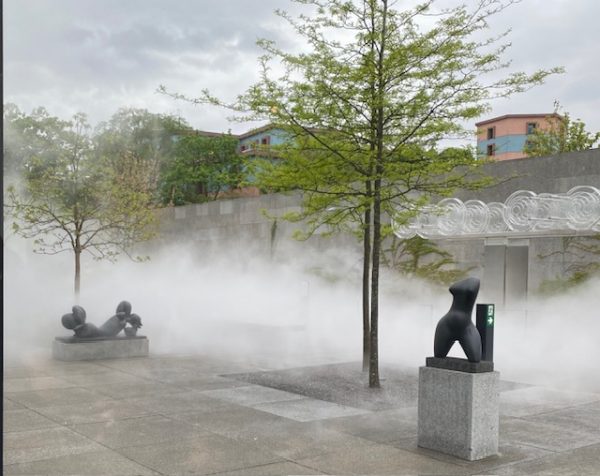
Time is portrait in these two poems as both a moment-specific personal experience as well as the short-cut description of a society-wide trend. Just, as if time was the driving force of change on both levels, even if we know it is not time in itself, but other forces are at work. “O tempora, o mores” as Cicero stated, appears to be still valid summary claim. (Image: Neue Nationalgalerie Front – WZB (Stirling architecture) in background, Fog installation in sculpture garden 2026-5).

Time in poetry

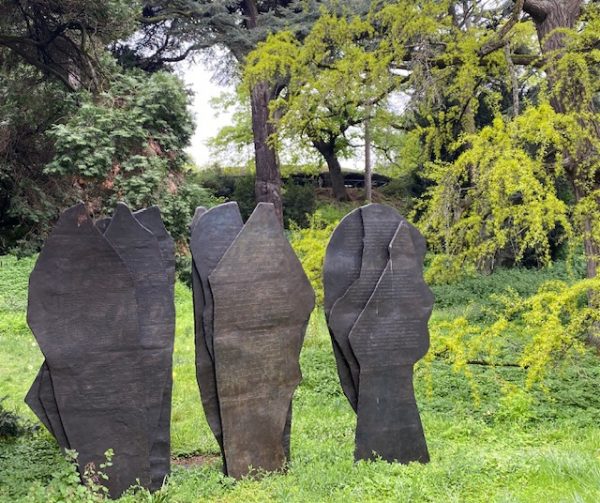
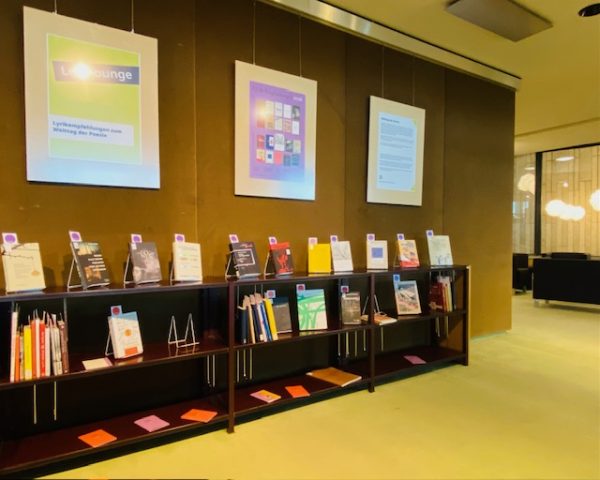
Some might argue poetry is all about time. It is a perfect way to “decelerate”. Reading pace, in most instances, slows down considerably. At least the first time reading is frequently a stop and go process. A few examples of poetry may hit personal trigger points. The random collection of poems I consulted in the “Lese lounge” in 2026-5 contained each the topic of time in one or the other form. Renate Schmidgall (2025) carries time indirectly in her title “Kein Verlass auf Uhren und Gestirne” (Don’t depend on clocks and stars, own translation). She creates new metaphors like “Am Kirchturm rostet die Zeit” (p. 12 On the church tower time rusts). This sentence precedes the sentence which became the book title. Time is also envisioned a bit like an onion in another metaphor “die Uhr schält rückwärts die Stunden“ (the clock peels backwards the hours). So much to gain with so little time spent with poetry.  (Image: Bronse in Jardin des Plantes, Paris, homage to Saint-John Perse 2026). 

Taking a break

The time a researcher spends reading is still above average, I suppose. Even in times of AI doing astonishing summaries of documents and texts in general, we still need to check the output by reading as well. Taking a break from data compilation and writing, it’s time to do other reading. The Staatsbibliothek tries to lure people studying and researching there into their „Reading Lounge“. In 2026-5 the proposed reading is poetry. Based on the recommendations by an expert group 10 titles of German and 10 translations of poetry are available with direct access for onsite reading. The shift from on screen reading to paper based reading gives your eyesight a break. Your mind wonders off to something else. Much better concentration and new synapses afterwards. Why is still so difficult to take a break this way? We are working on it. 

Litfaß Advertisement Column

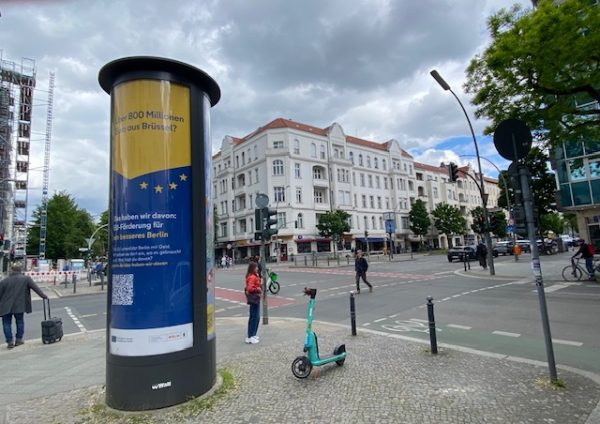
Berlin has renovated some of its early say notice boards and advertising columns. The original „Litfaßsäule“ has already the round column shape where you clued a poster on the sirface so that it was visible to several persons interested to look and read. After more than 150 years after its invention, Berlin has digital advertising columns which resemble the original Litfaß design. Rather than the spectator walking around the column, the column now turns around in a steady manner so that nearby you can see the whole advertising content from all points in the neighborhood. Simple change, but a remarkable improvement in the reach of the advertisement. Retro-lighting increases the duration of the effects as well. Mass communication and commercial innovation can sometimes just improve on an existing marketing channel, and still reach a specifically targeted audience.  

Renovated sacred architecture

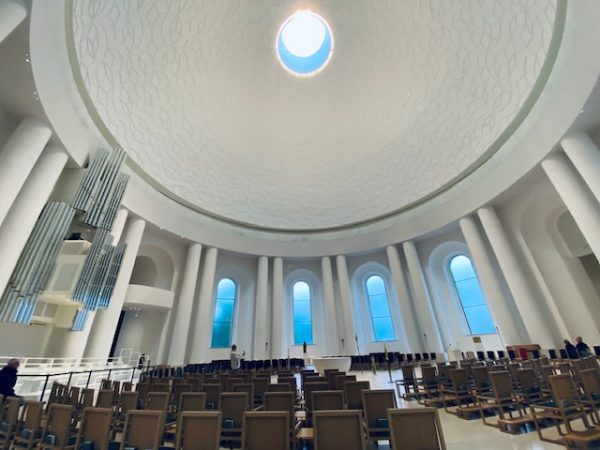
The 18th century catholic St-Hedwig Cathedral in Berlin has been renovated in the 2020s. The sacred building benefits from its central location in Berlin near “Unter den Linden”, Staatsoper, Staatsbibliothek and Humboldt University. The remarkable round shape of the church and its dome appear small from the outside between the high buildings in the surroundings. The size becomes more visible from the inside. The renovation made the choice to clearly define the center of activities again with the “altar” in the middle surrounded 360 degrees by the audience. Every visitor will be fascinated by the sound design of this renovated sacred architecture. The organ, orchestras and choirs have to handle this with care. Speech is transmitted with astonishing clarity. The sober interior focuses on essentials and might give the impression to be in a protestant church rather than a catholic one.
Silence or rain on the roof become an experience in itself, believing or not.