Gay science 2026

This is an intended test of the translation and contextual interpretation competence of various AI-systems in the year 2026. The Anglo-American translation of the “Fröhliche Wissenschaft“ with Gay science could nicely be interpreted as being in line with the original intention by Nietzsche of ambiguity in his aphorisms. Langer (2010) had chosen this translation knowing that in the 21st century the term gay as adjective had shifted from primarily being meaning cheerful, showy, bright or careless to the noun of gay ( mostly men) as a community. In her introduction Langer (2010) discusses the Aphorisms of gay science beyond the simple view of “postcard-like” ephemeral thoughts of a traveler. Whereas Allison (2001) reads the aphorisms as a “dynamic play of multiple and continually changing appearances”. Langer is more inclined to follow Schacht’s (1988) perspective that “we have much more than the disjointed collection of reflections and aphorisms which it may at first glance appear to be”. The art in Nietzsche’s writing is the “surface disorderliness” which “conceals its fundamental coherence” (cited after Langer 2010, pp. xiii-xiv). The contextual interpretation à la Stegmaier (2012) of only the 5th book of the Gay science spans 646 pages in text plus very informative name and concept registers as a blending of mind maps of Nietzsche’s as well as Stegmaier’s contextual and conceptual thinking. Both Stegmaier and Krochmalnik (1997) have contributed individually and jointly to a “rehabilitation” attempt of Nietzsche towards the end of the 20th century and a lasting continuation of “gay science”.
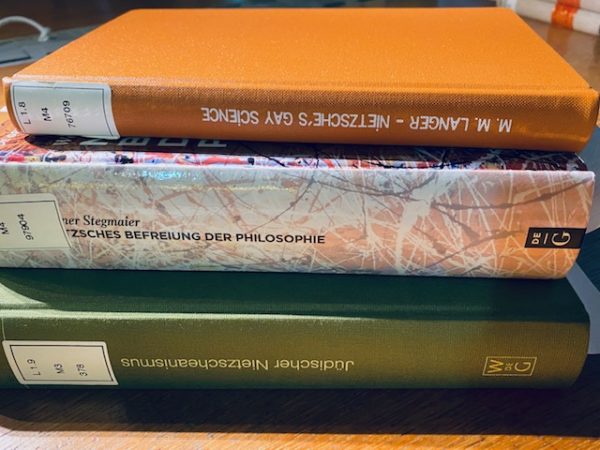
Reading on Nietzsche in 2026 to better understand Gay science

La gaya sienza

Nietzsche published his 1st version of “Die fröhliche Wissenschaft“ in1882. Ever since a controversy over the translation and interpretation of the title broke out. The publication in English referred to the title as “Joyful Wisdom”. A major question remains: is the opus a piece about science in the sense of philosophy, or less rigorous in method and therefore more a kind of general contribution to a perspective on wisdom? 12 x 12 years later of the 1st publication the “Motto” on the opening page should be taken more seriously. “Dem Dichter und Weisen sind alle Dinge befreundet und geweiht, alle Erlebnisse nützlich, alle Tage heilig, alle Menschen göttlich.“ Such a  radical Version of enlightenment as scientific method announced his attempts to demystify everything from religious beliefs to also science as well. The Motto of the 2nd edition in 1887 goes beyond the original one to include himself into this demystification. “Ich wohne in meinem eigenen Haus, Hab Niemanden nie nichts nachgemacht Und – lachte noch jeden Meister aus, Der nicht sich selbst ausgelacht. In a nutshell, mock yourself as much as you mock about anyone else. Can this science be science, intelligence, artificial intelligence or is this already the precursor of „super intelligence“ of the 21st century AI hype? 

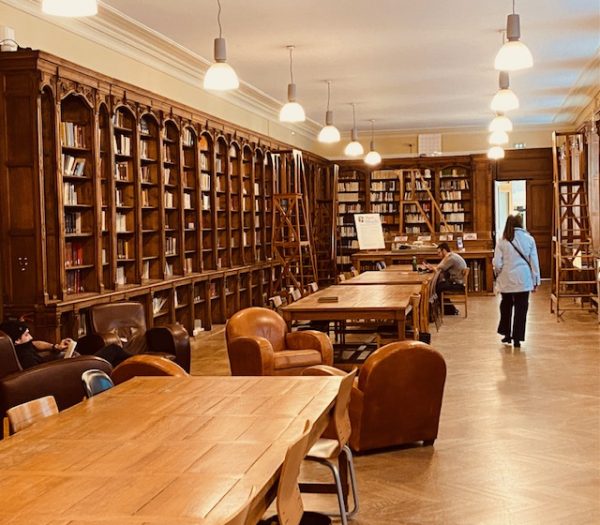
Marc Bloch Library ENS Paris

Bulimia Capitalism

Each time a wave and speculative bubble in the economy is building up or even bursting there are thousands of people who become drawn into chaos. Let us quickly review: Oil bubbles in the 70s, financial crisis and  subprime lending in housing markets, 1st internet bubble and the year 2000 bugs, AI excesses in 2025. These boom and bust cycles resemble the medical and psychological patterns of a bulimia nervosa. The overly optimistic outlook for AI companies’ future profits and shifts in the size of office space needed for companies announce bulimic behavior when at the same time vomiting by the same companies occurs with regard to investments in nuclear energy plants even in the sites like Fukushima in Japan or Three Mile Island in the USA. Bulimia Capitalism seems to be eating its own children. The upcoming year 2026 will be full of revelations in this respect. (Image: collection of about a hundred barbies exposed on a flea market in Brussels on 5 levels).

Spring in Autumn

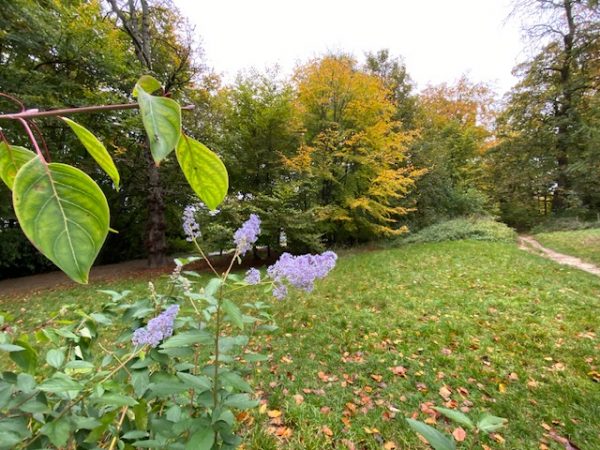
Can we have spring in autumn? Of course not, most people would answer. The definitions of spring and autumn are clearly defined as separate seasons. Depictions of the seasons in paintings in the Romantic or Impressionist periods are hard to imagine with somewhat blurred distinctions between seasons. And yet, climate change in the 21st century show surprising spring flowers in autumn across Europe. This leads to lots of confusion in nature’s time table.
From a life course perspective, we may ask, whether it is possible to experience a 2nd spring in the season’s view of the life course. More healthy years and spring feelings in the autumn of live have propelled a whole new industry around longevity and the mantra to “stay healthy for the wealthy”. The growing health inequality over the extended life course is a silent killer. The experience of spring in autumn remains a distant dream for most people with multi-morbidity.
Our experience of sequential or linear time, where one season follows the other, gets disturbed or at least blurred. The “Gleichzeitigkeit des Ungleichzeitigen” in English the “simultaneity of the non-simultaneous“ can be observed in the macro-world of everyday experience, albeit in a different way than Ernst Bloch defined the concept. On the other hand, it is no longer necessary to invoke Einstein’s theory of relativity or quantum physics to come up with apparently strange phenomena, but empirical facts allow us to question received wisdom, evidence based.

Chatbot Me We

In order to dig deeper into the functioning of AI, I deemed it expedient to construct, for example, a simple chatbot on a limited knowledge base from my own writings on AI (link to reader in previous blog entry here).
A toolbox from Google offers powerful assistance in such an endeavour. The outcome uses only my input text and no other sources. It is dynamic in the sense that it interprets questions and searches within the text file provided only. The answers are edited with a LLM (large language model) and provide flawless English texts. You can try it here using catchat as magic formula and Google account so far.
With a bit of programming knowledge (htlm, python, Java) and related learning sites it is feasible to come up with a “static” chatbot hosted at a free of charge provider as well. For learning purposes this step by step building and coding of a chatbot is helpful. The outcome is rather limited or requires a lot of time to increase the scope of Q & A interactions and to move from a static (predefined Q & As) to dynamic ones.
Full control of answers, excluding any hallucinations and high-speed replies, come at a cost. Take a look here. It is a very basic version so far, just to get the idea of it. full web address:
https://schoemannchatbot.eu.pythonanywhere.com/

AI employment effects

The first robust empirical evidence about employment effects of AI in the USA has been published by the Stanford Digital Economy Lab by  Chen, Chandar and Brynjolfsson (2025). A previous paper by Wang and Wang (2025) highlighted the comparative advantage of persons who use AI in their work compared to others and the authors coined the term “learning by using technology”.  The prediction of the model was that there might be job losses of more than 20% in the long run and half of this already in the first 5 years of the introduction of the technology. The Stanford economists have estimated with real world data these effects in the USA and find quite surprisingly that the negative employment effects of AI have the strongest impact on young labor market entrants with few years of labor market experience. Middle-aged and more senior employees seem to benefit from “tacit knowledge” about the work, which is more difficult to replace with AI, at least for the time being of the early days of AI. This evidence is based on recent payroll data from the largest payroll processing firm “ADP” in the USA which has firms overrepresented from the manufacturing and services industries as reported in another paper  (Firm size maybe another source of bias).  However, the effect that youth 22-25 years of age suffered the most calls into question the common belief that older workers are more likely to suffer the consequences as during in the rise of the digital economy around the year 2000. (AI Image created with Canva)

Napoleon legacy

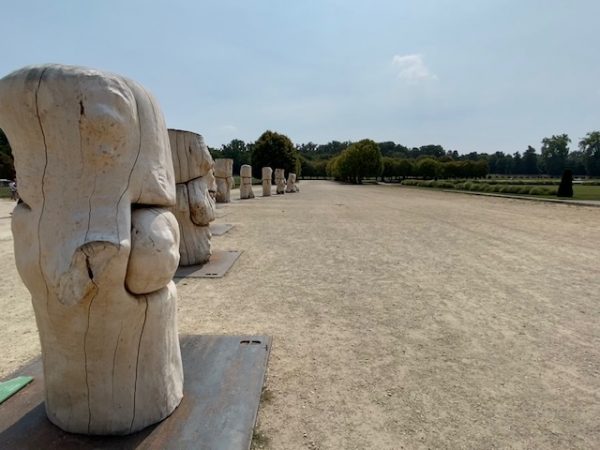
It is huge historical project to try to summarize the legacy of Napoleon Bonaparte. AI is by design less hesitant to come up with any length of a summary statement some with good references on which the statement is based. In combination with a visit at Fontainebleau and a first hand impression of the environment of the autocratic ruler, the remainders like the introduction of a Civil Code to guide also administrations to lawful conduct, we still see influences of this legal innovation in many other countries across the globe. The recognition of Jews as equal citizens and to allow equal access to property and many professions have been influential across Europe mostly in occupied territories. Military service for Jews in Napoleon’s army was another consequence, which spread into the Prussian army and the 1st world war. It is in the 21st century that we see shifts towards more authoritarian governance styles spreading again, we did not want to see this happen until Russia‘s war in Ukraine. (Image: La Chair de la forêt, Frénésie des Géants by  Wang Keping Fontainebleau 2025-8)

All electric now

The shift over to the “All electric society” is easiest in sunny states like California in the USA, Africa or Southern Europe. For other regions of the globe not only the production of energy through the sun is a bit less abundant, but the storage of the sun’s energy production for deferred use is the next challenge. Countries of the globe near the equator have to balance 12 hours daylight with 12 hours night, countries far from the equator have to balance additionally more long-term between short winter days and long summer light.
Different energy storage solutions have to be envisaged.
On a daily basis or even weekly basis, battery energy storage systems (BESS) can do the trick. These systems become more costly for high capacity, longer duration storage. Battery size and price quickly become an issue. The number of electric vehicles (EVs) that have this more intelligent BESS is rising. This makes it possible to eventually use this storage capacity, if your car is sitting around your home or office for most of the time anyway. To make the “all electric society” function 24 hours, energy storage has to be planned at the same time as production and consumption patterns. The all electric prosumer will be the de-central “pro-store-sumer” in the 21st century.

Home Leaks

When did you last think about leaks in your home?
Usually we associate leaks with water leaks, or the heating system leaking somewhere. In the 21st century leaks at home are more importantly the leaks of your home security, especially your email, digital and cloud services which are at risk. You may test your favourite AI system to advice you on your risks for digital leaks, but we know little whether these systems are yet another dangerous port of entry into your home or privacy themselves.
There is a helpful tool to find, whether your email has been hacked or distributed widely already for potential thefts of your identity. Hence, better check this from time to time using for example the “leak checker“, just like checking whether you closed your door or the water tap before leaving for vacations. As we live more and more in “virtual homes” in addition to our physical homes, checking your digital identities should become a part of our personal hygiene routine. Let’s just take a shower from time to time and change passwords regularly.

Preventive War

The term “Preventive War” is staging a revival in international politics. The recall of the famous quote “war is the continuation of politics with other means” from Clausewitz encompasses the idea of a pre-emptive strike and entering into war to avoid an enemy to grow too powerful at a later stage. In the age of weapons of mass destruction and the non-proliferation of nuclear weapons, an intervention to limit the spread of nuclear weapons has taken the form of a preventive war. The international community has been quite unsuccessful to limit the spread of nuclear weapons so far. Research shows that democracies are less likely to go to war than authoritarian regimes and dictatorships.
The preventive war strategy (Levy, 2008), however, is a means for democracies to defend their survival against the spreading and warmongering of authoritarian regimes. However, preventive war, by definition, is a war. The preventive aspects derives from the logic to avoid a much more devastating later war. There is a longitudinal assessment at the base of the calculation to enter now into a preventive war, rather than later into a more difficult defence. In anticipation of the defense, a pre-emptive strike is undertaken. In international politics the lack of a “policing of treaties and international agreements” has initiated the return of the neoclassical concept of national interest as a guiding principle for nation states. A continued threat to the survival of a state, Israel as an example, by the Iranian dictatorship makes the application of a preventive war strategy more likely.
Historically, democracies have applied such military strategies as a continuation of politics and diplomacy with other means. In this sense the 21st century is apparently no different from previous centuries. The revival of “Realpolitik” has been spurred by Putin and his war on Ukraine territory since 2014. How and when to return to the negotiation table is the litmus test of the preventive war strategy.
(Image: Paris, Hotel de la Marine, Le salon diplomatique 2025).