Forced Labor 2024

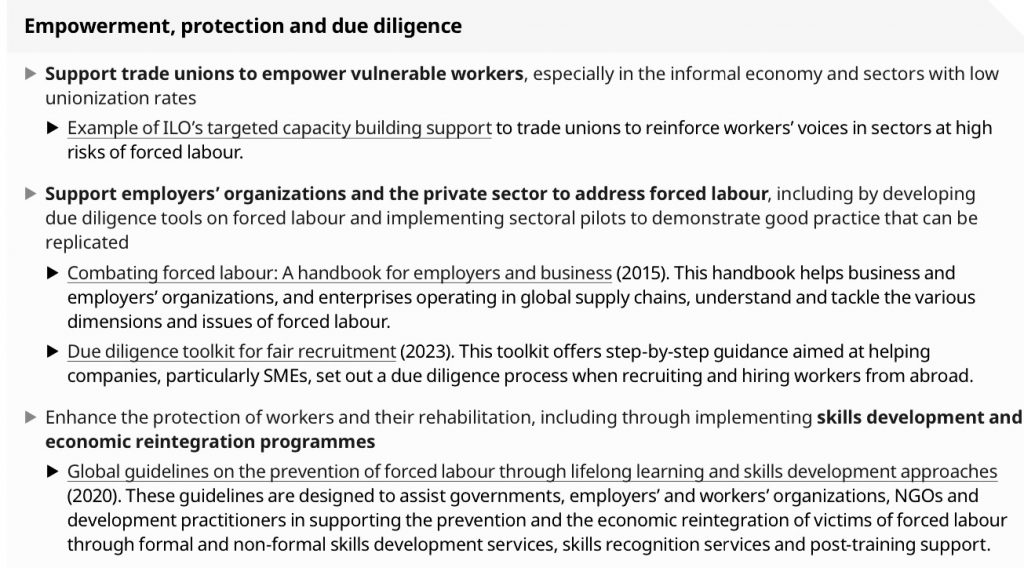
Thanks to the ILO we have recent data on forced labor across the globe. At the time when the EU struggles to tighten the rules on decent supply chains, it is important to draw attention to the already reversed trend that worldwide forced labor is on the rise again. According to latest report by the ILO 27.6 million women, men and children were in forced labor at any day of the year 2021. This is even about 10% more than 5 years before in 2016. The fact sheet from ILO highlights the region that are practicing it the most but mentions at the same time that no region in the world has completely wiped out this criminal activity. Despite the SDGs containing a goal to eradicate forced labor by 2025 for children there is little hope that this will be reached. Controlling supply chains of the rich countries could be an important factor in identifying the states or companies which built their production model on forced labor. The fight against this practice is an enduring challenge. We cannot allow to shun away from the thorny issue. The price for labor is only one argument in the reasons for the persistence of forced labor, migration is also a force at work. This asks for specific solutions to country-specific or sector-specific problems. It is a global responsibility but needs partnerships across continents to reach better outcomes in the interests of humanity. Some countries like Germany have a historical debt to invest more than others.
ILO recommendations 2024-1

Timeless Values

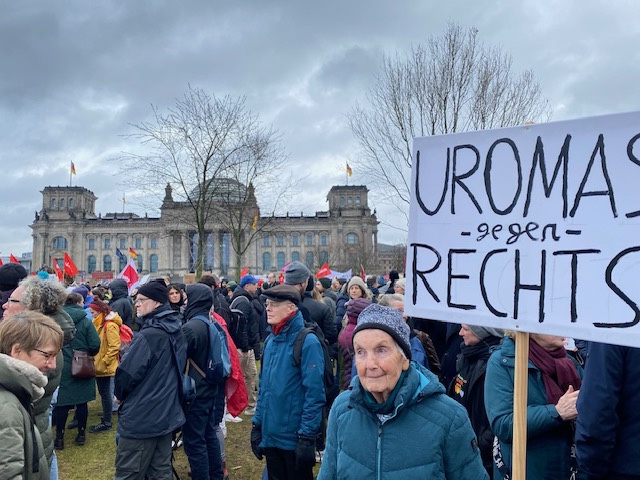
The declaration of human rights is more than 200 years old. However, the need to stand up for the defense of these rights needs many people to act accordingly. Political parties and courts are not strong enough to be the only defendants of democracy and human values. Solidarity across generations is another part of the struggle to defend democracy. In addition to the broad movement of “Omas gegen rechts”, the age distribution has been further enlarged with the “Uromas gegen rechts”. This most likely the generation with first hand life experiences from Nazi Germany and they should have reached an enlightened view of the horrors caused by the Nazi-regime. Unfortunately there are still some who continue to be prisoners in a fascist “brown” cage of mischievous memories. The great grandmother who was present at the demonstration was clear in her statement to stand up against right-wing extremism. (Image: With the permission of the lady I am happy to have evidence of the presence of super-agers at the demonstration in Berlin).

Berlin 2024-2-3. Demonstration

Fighting Fascists

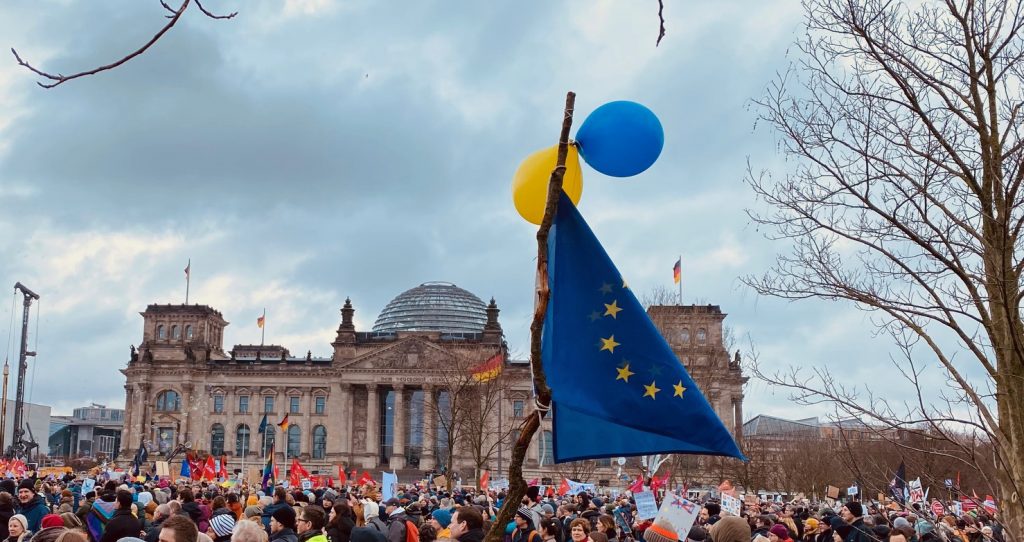
On february 3rd 2024 Berlin has seen the Parliament (Bundestag in the old Reichstag building) surrounded by young and old to raise their voice against the rise of right wing extremism in Germany. The broad alliance against extremism finds grassroots support from a very broad and diverse community. 1700 organizations have joined forces to send a strong signal that they are ready to act against the inhuman propaganda and persistent hate speech. The creativity to express the discontent in clear messages is impressive. Civil society is showing that diversity offers multiple benefits to find new ways to unite people. Great that European flags and balloons in Ukrainian colors where present as well. A movement of solidarity was felt with these people and that provides a strong message for the months ahead with so many elections taking place at the local, regional, national and European levels.

Berlin 2024-2-3

Postmodernism

The grand narratives of the modern world, like modernism itself, are under serious criticism. Deconstruction of the modern way of thinking has become philosophical mainstream. Economics as a science is in the middle of the behavioural shift and changing or at least complementing its narratives. Sociology has embraced postmodern thinking in theoretical as well as empirical forms (Mirchandani, 2005). The empirical measurement focuses a lot on the groups and people who hold postmodern beliefs and values. The discussion in the social and literary sciences continue. In the arts reading on modernism and postmodernism is a must in order to understand much of contemporary art or art from the 19th and 20th century.
Bookstores in art galleries that cover long spells of history can make surprising links between historical periods of art. Books of postmodernism appear next to books on romanticism. A lot of the ideation of postmodernism rejoins romantic depiction about nature, re-naturalizing or the emotional connotations of wildlife, isolated places and stillness.
On the other hand, we are confronted with the brutal world of war, drugs and crime. Classical warfare and strategies are back in Europe with tanks and rockets killing like in previous wars. The Russian empire of a specific version of modernism strikes back as if it were to stop the postmodern turn of the 21st century. Neo-fascism tries to build on the losers of the transitions to the socio-ecological economy and society. There are manifold backlashes of modernism, but the postmodern world is under continuous construction, most of in our mindsets.

Memory Struggle

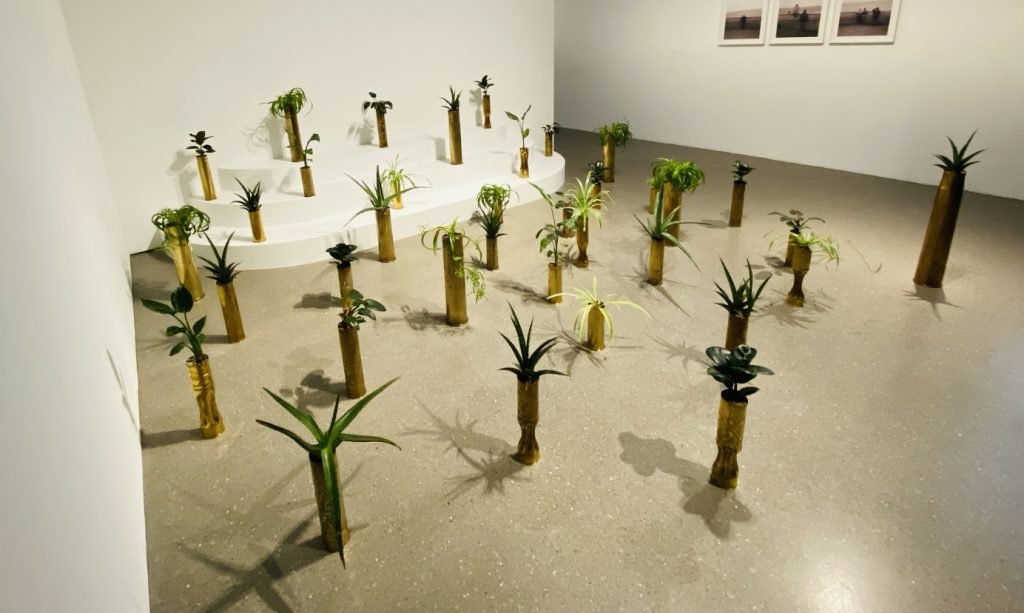
The struggle of memory is also the memory of a struggle. The exhibition in the Palais Populaire in Berlin doesn’t leave spectators untouched. It is a struggle to recover memories which were attempted to be eradicated. This is the univeral message of this exhibition. The colonial past and crimes are part of the struggles of artists from these cultures to re-establish their rights to their own views, traditions and memories. Grass and plants may cover the shelled soil and people, but traces or mortars are often left behind. Light from different angles needs to be shed on these places to reveal the shadows of the wounds. The atrocities and exploitation linked to colonialism and imperialism keeps us struggling with those memories. Just before we jump to the conclusion that it is a memory of a past struggle, we are reminded that consequences are still haunting the present and with the Russian aggression in Ukraine we have to realize the fight against imperialism continues in the 21st century. Thanks for memorable moments and impressions in view of a global arts and history experience. (Image of art work installation by Sammy Boloji, untitled 2018, exhibition Palais Populaire, Deutsche Bank foundation)

Sammy Boloji, untitled 2018 exhibition Berlin 2024

Throne

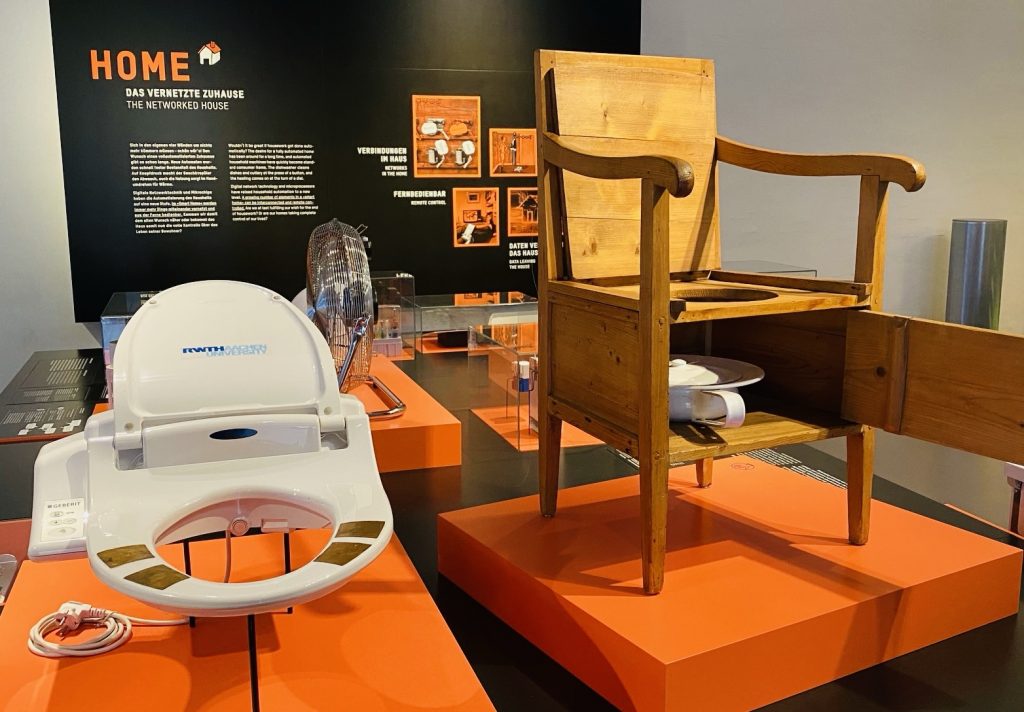
In continental Europe some people say they are going to sit on their throne for a while if they are going to the toilet. Previous furniture built for that purpose almost resembled a throne. Nowadays the comfort has increased and most households have an excellent WLAN connection in the tiny place, automatic ventilation and heating comfort. Linked to the throne, the issue of the smart home comes back into our mind. Besides the increased comfort we generate abundant amounts of data. Sensors of all kinds can track lots of information that may reveal quite intimate details which we did not intend to share. The movement pattern of mounting your throne might be easily identifiable by your smartphone. Such data could be added to assess your health status in your dedicated health app. Anonymized data could give early warnings about a local outbreak of diarrhea. Do we want this? Probably not. In countries where thousands die from diarrhea, probably yes. It is a matter of balancing the pros and cons. Health data are thought to be particularly sensitive information about us. It certainly is the new luxury to keep your health data private. Even if you measure and capture a lot of information in your smart home, make sure your smart home is sufficiently secure. For the benefit of all of us.

DTM Berlin 2024-1

Renewables

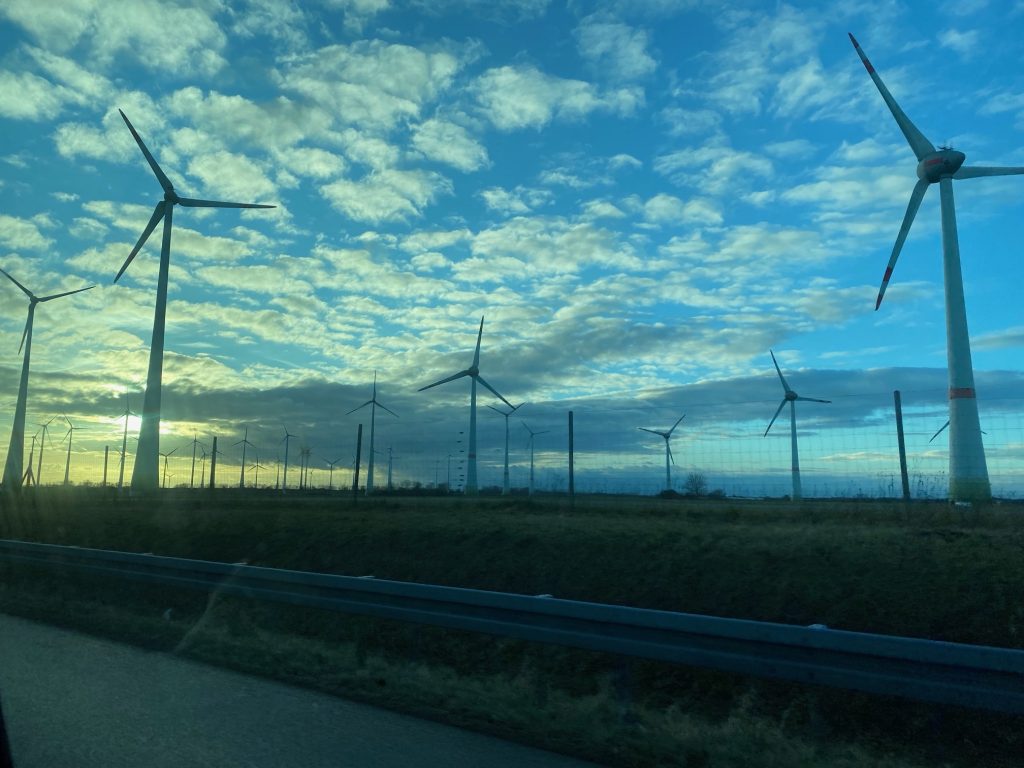
Renewable energy has reached for the 1sr time a share of more than 50% in Spain and Germany in 2023. This is an astonishing milestone in the energy transition of both countries. For Spain a report from Red Energy Espanola attributes the Spanish success story to the expansion of mainly wind energy (Link). The increase of renewable energy in Germany is due to a more rapid expansion of solar energy (Link). In any case a continued expansion of both forms of renewables allows to reduce the share of fossil fuel even more rapidly than previously estimated. Good news for the planet particularly to phase out energy from coal due to its highly polluting side effect. Countries with faster trajectories shall serve as examples that it is feasible to manage the energy transition also for large countries. Political instability might be a price worth paying considering the positive effects for future generations. Managing the transition in a just way which means to assist poorer households, ensures the respect of social policy targets at the same time. With this in mind the energy transition can be perceived by all as an opportunity rather than a threat to their welfare and wellbeing.

Sleeping

Sleep is a process. That is why it is best to talk of sleeping rather than sleep. There exists abundant research on sleep and more and more acknowledge the process-like characteristics of sleep. The medical literature deals a lot with sleep apnoea, which constitutes a serious health condition. Time use surveys establish links between daily activities and sleeping for example. The social context is another influence on sleeping. Friends and family co-determine sleeping patterns as well. The latest better understood impact on sleeping depends on the use of technological devices before and during sleeping. Smart phones reveal themselves as not so smart if it comes to the quality of your sleep. At least this the result of the study on „bedtime technology use on sleep quality and excessive daytime sleepiness“. It yet another field in which technology is slowly creeping under our skin and we have to learn how to handle negative side effects before they endanger our physical as well as mental health. Bedtime routines or reading without a screen before falling asleep appears to be a worthwhile way to improve sleeping. Worth trying out again and again.

POSSE

for a German speaking audience POSSE stands for a farsical popular drama of the 18th and 19th centuries. Nowadays POSSE has particularly in the English speaking world a completely different meaning. POSSE is short for Publish on your Own Site, Syndicate Everywhere. In other words publish your own creative work, text, tech or melody on your own website first before spreading the content on other platforms. By this strategy you make sure your content stays your content even if a platform like eXitTwitter disappears or the hype has passed like with facebook. And if at any point in time you decide the whole internet is a farce, you will be able to edit the content from your own webpage as a book or audio version as an edited volume. Do not make yourself a modern slave of tobacco, drugs, alcohol or platforms for whom you create (mostly unpaid) content they use to sell advertisements with huge untaxed profits. With POSSE you can make an end to this farce. We still rely on search engines like QWANT, Ecosia, duckduckgo or Mozilla’s Firefox, to name a few less well known web searching tools. They ensure that other people find your webpage beyond the elephant in the room called Google.

Examples of search engines of the internet

Styles are a Changing

We all have our very own style. Even if you believe you have no style, then this will be your style. Of course, styles are changing continuously and fast fashion tries to make us believe we even ought to change as frequently as possible. Just find your style no matter of age and gender. Yes we can. Young designers test new materials and cuts to make new impressions. As science is progressing with new fibers that imitate the apparently light fur of polar bears, new designs will become feasible and enrich the list of potential fibers in clothing. In addition to seamless 3D knitting the new fiber allows to replace down with light fiber. Going out into the cold will be fun again. Want more of this, visit Fashion in Action! (Image from empty space designers webpage 2023-12-24 Berk and Julien).