Autonomy in literature

As we might imagine, autonomy has been and is a huge topic in literature. From the foundations of democracy to the autonomous state building, historical accounts are full of treaties on autonomy. Literature has taken similar steps by asking can we really be autonomous in our decision-making as we are social beings embedded into varieties of Throne, families and networks. There are ever larger parts that we are conscious about, but the realm of unconsciousness or sleep remains substantial. Maybe in literature, the author Samuel Beckett has gone furthest in dealing with human autonomy in his writings. The search for autonomous action might lead to far-reaching inactivity in “Waiting for Godot”.
However, Beckett’s view about autonomy can also be interpreted as a continuous battle of mankind as demonstrated in the often cited expression by Beckett (“Worstward Ho”, 1983, p.7) “All of old. Nothing else ever. Ever tried. Ever failed. No matter. Try again. Fail again. Fail better.” Our strive for autonomy remains a lifelong struggle. The path to more autonomy is not linear over the life course. In fact, much evidence from gerontologists suggests that it might follow an inverse U-shape, being low at birth and low before death. Literature has guided us in such questions just as much as religious, philosophical, legal and social concerns enter into the underlying concept of autonomy and autonomous decision-making across the life course.


Autonomy as Happiness

The French philosopher Émile-Auguste Chartier, better known as Alain, is a proponent of a rational approach towards fundamental issues. Therefore, we should expect from the reading of “Propos sur le bonheur” a thought-based conception of happiness. In his propositions on happiness, autonomous decision-making and autonomous actions play a decisive role. Rather than writing a voluminous “treatise” on happiness, he had chosen in the 1920s, the form of 93 about 2-page long propositions about happiness. These propositions are a bit more explicit than, for example, Nietzsche’s aphorisms, but they remain short without much literary context to the kind of rational analysis based on observations and anecdotal supporting evidence.
In propositions 42 “Agir” and 44 “Diogène” he deals with autonomy as subject. “on veut agir, on ne veut pas subir” (in short, “act, not endure”, own translation), that is his quintessence. “Tous les métiers plaisent autant que l’on y gouverne, et déplaisent autant que l’on y obéit.” (44). (All professions are pleasant if you govern, and are unpleasant if you have to obey). More than 100 years later, empirical studies on job quality, job satisfaction and happiness still build on this rationale.

Democracy or Democrisis

Measured on a global scale, democracy is in retreat. The report by the “Varieties of Democracy Institute” indicates that there are fewer people on the globe who enjoy the freedom and benefits of democracy overall. This is measured in domains like freedom of expression and the democratic quality of elections. The prevalence of democratic decision-making in opposition to autocratic ruling is closely related to the possibility to freely elect a new government in regular time intervals. The V-Dem Report 2026 indicates that 18 countries are on a favourable democratic development trajectory, whereas democracy is on the retreat in 44 countries. The freedom of expression suffered most (44 countries) and the quality of elections suffered in 22 countries. The positive developments (11 for freedom of expression, 7 for quality of elections) were outnumbered by negative ones. The cases of big countries with negative trends towards or tightening of autocratic ruling deteriorates the overall number of countries and specifically the number of people living in democracies in 2025 on the globe.
For all those living in lively democracies this should be a warning message (South Korea), that democracy is not a given. The enemies of democracy are working continuously from external territories to undermine a country’s democratic structures and decision-making. It is urgent to raise the quotas and limits by which fundamental democratic rules can be abandoned before it is too late. Let’s prepare a “defensive democracy doctrine” in Europe and the EU to signal more forcefully our willingness to stand up for freedom and democracy as fundamental values of humanity rather than an “Animal Farm“.

Master AI

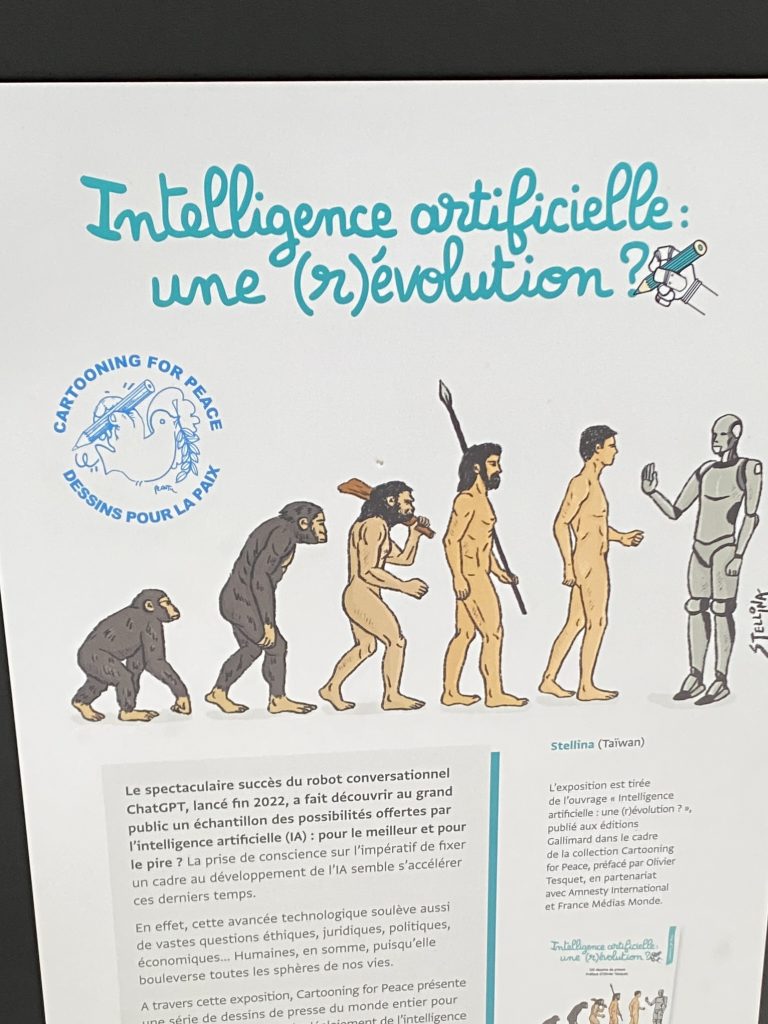
In 2025 the exhibition “Cartooning for Peace” at the BNF in Paris had already an exhibit authored by Stellina Chen from Taiwan, which summarized the evolution and projected the consequences of an all encompassing AI revolution (Image below taken at exhibition 2025 BNF). Currently we exercise ourselves in using various forms of AI or learn how to program them ourselves. It is our aim to master the new technology so it becomes a helpful tool. However, there are already many instances where it is no longer us mastering AI, but the AI has turned around the table and has started to master us. The applications of AI have entered our work tasks, tries and frequently succeeds in improvements of our routines and processes.
In private life a similar revolution is happening, when AI offers advice, which is hard not to follow and very convincing most of the time. Since getting involved in a conversion with AI tests your logic and debating competences, we find ourselves more and more in situations where AI is telling us what to do in the best of a convincing manner. After centuries of humanity to find freedom from oppression and the freedom to what we want ourselves, we seem to be ready to hand over control to AI. We are just like toddlers in this respect, willing or obliged to follow our master.

Korean Independence

The independence of a country is sometimes a long struggle. At particular points in time, a window of opportunity may open up, which allows to change the course of history. In many cases the opportunity to gain independence has been prepared for several decades, at least from 1919 onwards to come to fruition only after the end of the Pacific war, shortly after the Nazi-regime was defeated. The long and relentless preparation of the Korean Provisional Government ensured that a consensual constitution was ready to be adopted and elections to be held. The resulting division of Korea into 2 parts (South and North), just like East and West Germany, is rather long lived on historical time scales. For that matter, the hope of a peaceful unification needs to be reiterated again and again. The informative exhibition of the Korean Cultural Center to Belgium and the EU highlights the continued “Dream of Peace” which continues even after more than 100 years.

Endless Questions

The winner of the Niépce prize 2024 has been awarded to Anne-Lise Broyer and features prominently at the BNF in Paris. The exhibition of the professional photographer reflects by way of photographic “still images” on the historic fate of the mediterranean basin. Each and every image has no answers, but keeps posing questions. In the long alley of the BNF in honor of Julien Cain, we walk through history of more than 2 thousand years in photographs up until today and even beyond. Let’s keep asking the most fundamental questions again and again. The exhibition entitled “Est-ce-là que l’on habitait ?” invites us to ask ourselves about the historic origins of so-called Western culture in the mediterranean basin. Ancient philosophy and arts are the foundations even of our current ideas of democracy and freedom.
However, what has become of this in the 21st century? The original statue of freedom has suffered badly. What has become of the freedom of mobility at a time of barbed wire fences rising between countries that influences each other over thousands of years? How about nature? How about religion and freedom of expression? Where is progress? Where is regression?
For centuries we have sought answers in libraries starting from the Library of Alexandria to the treasures of art and knowledge of today across the world. Let’s make more intensive use of these treasures where we shall find answers to most of our questions of the past, to the past and of future interest.

Enshittification

Don’t laugh. This is a very serious scientific term to describe the way social media function in the 21st century. The scientific reference goes back to 2025 and article in “Science” by Kai Kupferschmidt. Twitter, now eXit, like most other social media platforms uses algorithms that select posts for you from the millions of posts that are likely to induce a reaction from you, which prolongs your time on the platform. Additionally, eXit Twitter applies an algorithm that prioritizes accounts with already a huge followership, which makes these accounts even bigger. The result is an increasing inequality in attention to info, facts, fake news, but also revenue for the platform owners through more advertisements. As hate speech and fake news are commonly perceived as shit, many social media are happy to spread more shitty things on their platforms as this generates more money for the platform as well. In short, enshittification happens sooner or later to most platforms and we all suffer from this. As user of these platforms, it is hard to escape from this process, as most platforms tend to “convert” to enshittification at some later point in their life cycle, unlike babies who manage to quit this phase after a few months. A move to Bluesky might be indicated, but there is no guarantee that the same process will just happen again. Mastodon is another small twitter-like platform that like Bluesky offers a more open approach to its governing algorithms and a more controlled access in the registration process.
To avoid enshittification, we have to be ready to move away from one platform to another one, just like changing bank accounts or club memberships. Make sure to take most of your friends with you and there are already tools for this online as well. Enjoy the safe online life again on another platform or consume more of the traditional media like newspapers, radio or tv with proven quality. (Image: extract from Jan Steen, 1625-1679, The Rhetoricians – “In liefde vrij”, MRBAB)

Marketing bicycles

The marketing of bicycles has changed considerably over the course of history. Today’s narrative is more about the eco friendly impact of it. Historically the freedom aspect of free movement and emancipation of women was at the forefront. The collection of images in poster formats presented at the DTM in Berlin is impressive. The focus on women on bicycles is quite surprising for this early time around 1900. Few of the companies from the early days have survived until today. Bicycles are still fascinating children and adults today. The experience of a fragile equilibrium, your own strength and weakness in muscle power, cardiac or pulmonary strength is always challenging. It is you who is in control of speed and direction. This should be easy to sell to the masses, and it was and still is. “Bikenomics” is here to stay. Artists had the same impression and created a whole universe of promises for riders of bicycles. The long run health benefits were not even known at the time, but it was unthinkable that humans would spend most hours sitting in offices, cars and on their couches. The biking story needs to be retold to encourage people to take up the emancipating storyline again. Get on your bike again!

DTM Berlin 2024-6

Portable Grundgesetz

Celebrating democracy in Germany is rare. We take it for granted that democracy persists, as most of us have not experienced it otherwise in Germany. This is grossly mistaken as the opinion polls show repeatedly in recent years. Therefore, it is welcome to find the “Portable Grundgesetz” at the “Demokratiefest” in Berlin and Bonn at the event to celebrate 75 years of democracy in West Germany and 35 years in East Germany.
The century-old tradition to produce miniature books has been revived and the miniature books have been widely distributed at the event. A side effect consists in the eco-friendliness of this version, which saves a lot of paper. It is fun also fun to turn pages rapidly and discover some paragraphs which we would not have read otherwise. “Daumenkino” is the German word for versions that contain many images. Maybe next time, an illustrated and/or animated version of the Grundgesetz could encourage youth to celebrate using the texts, §s and images to discover the fundamentals of our constitution.
325 years ago, Weigel the Elder has illustrated, edited and published such a tiny edition of the Bible. It is currently exposed in the treasure museum at the “Kulturwerk” in the “Stabi Ost” in Berlin. “Back to the Future”, lots of ideas we get by taking archives seriously. By chance inspiration is undervalued. Search algorithms have a hard time to replace this in an effective way so far.

Mangel Armut

Herta Müller hat bereits 2012 in „Das Chinesische Glasauge“ sehr treffend die Funktion von Mangel und Armut in Diktaturen beschrieben. Sowohl der ständige Mangel als auch die Armut dienen als Instrumente der Macht. Sie sind quasi die Fortsetzung von Ideologie zur Beherrschung der Massen. Zusammen bilden sie die Umgebung, den Kontext in dem dort gelebt wird. Die Herrschenden jedoch haben Privilegien, die sie von der Allgemeinheit absetzen. Diese knappe Beschreibung und Einleitung zur Kurzgeschichte haben eine große Portion Allgemeingültigkeit. In Mangel und Armut können kleine Vergünstigungen eine viel größere Wirkung entfachen. Sehnsüchte nach mehr werden nahezu zwingend hervorgebracht. Allein die Aussicht auf ein teilweises Stillen der Erwartungen oder nach mehr entfachen weiteres „höriges“ Verlangen. In Diktaturen werden die Personen, die unaufhörlich auf die Armut und den Mangel hinweisen meist geächtet oder sogar ins Exil gezwungen. Solche Störenfriede sind nicht gern gesehen. Das Russland unter Putin braucht Leute der herrschenden politischen Klasse zujubeln und bereitwillig in den Krieg ziehen oder an der Kriegsmaschinerie mitwirken. Wir sind mehr als eine Dekade weiter, aber diese Zusammenhänge bestehen ebenfalls weiter. Schmuck in der Mangelwirtschaft ist bereits eine Provokation. Das offene Tragen der Provokation kann im schlimmsten Fall das Leben kosten.
(Image: Herta Müller, 2023, Eine Fliege kommt durch einen halbern Wald, Carl Hanser Verlag, “Das Chinesische Glasauge”, S.50-61)