
Paris Parks

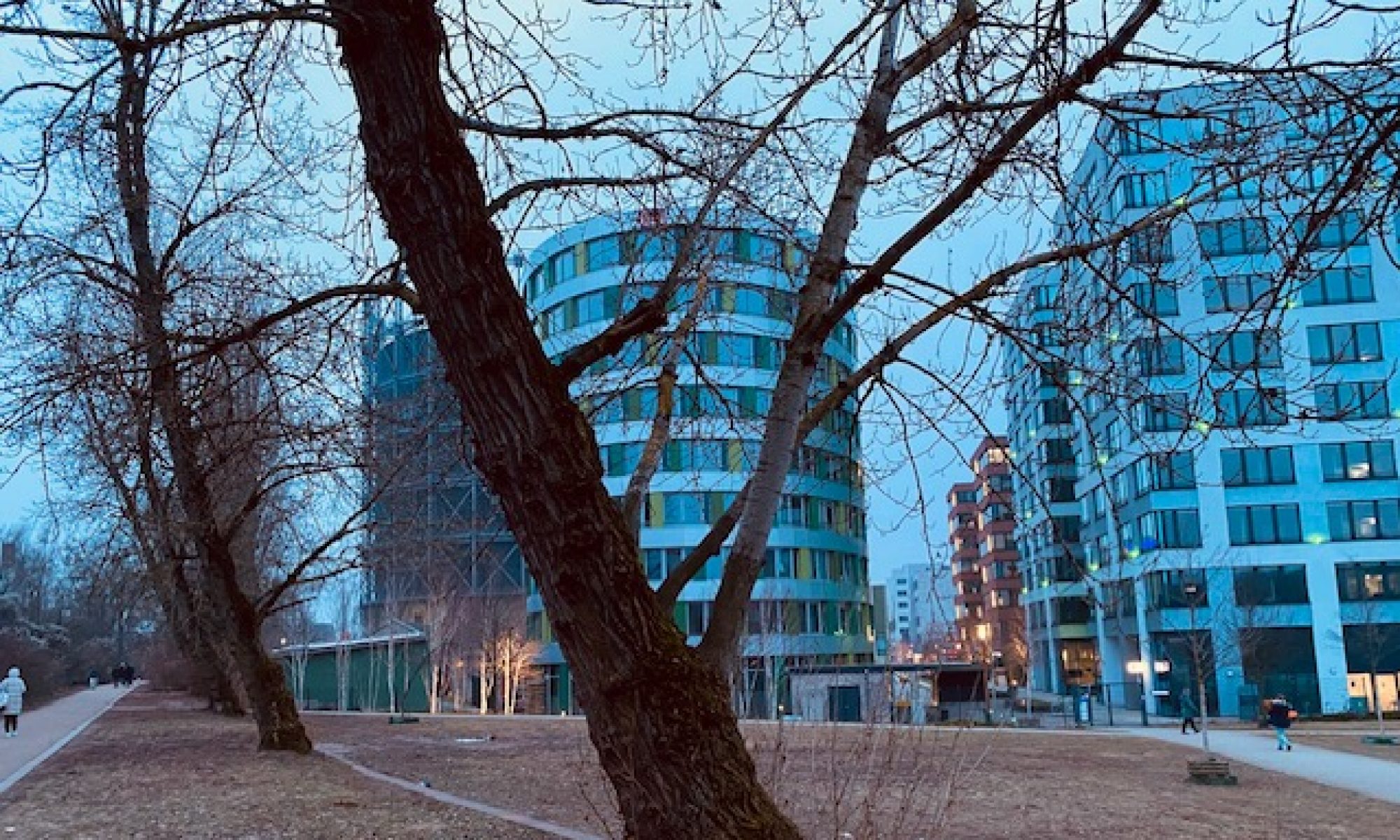
There are many splendid parks in Paris. They all have an important function to cool the city in summer. Good for exercise and walking all year round as well. The latest addition is the “parc suspendu” between Gare de l’Est and Gare du Nord (Jardin Marielle-Franco).
Many travellers pass there from one station to the next. The creation of this space is rather tricky and avoids the building of yet another shopping mall for tourists. The cleaning of the park and the growing of the grapes are a challenge for those in charge.
This park is an interesting melting pot of very diverse social groups. The sportspersons and walkers confront “la misère du monde” of people entering to sleep rough in the park or attempt to do or deal drugs there. Paris is fighting back for its public spaces and devotes resources to these purposes.
The “Cru bourgeois” is also challenged in this area. Living together accepting the unresolved social problems and to confront them rather than to ignore them, this creates the “metropolitan experience”. Parks in and around Paris build on a great historic tradition. “Le Nôtre” stands for the creation of Parks that were copied across the world.
The cleaning up of Paris for the Olympic games 2024 is a tremendous effort. The swimming in the Seine (rather than singing in the rain) is probably the steepest challenge of all efforts, even if in retrospect the opening ceremony happened during heavy rain.
Parks need water, rainwater is best. Hence, the alimentation of parks from sources far away from them is part of urban and landscape planning.

(Image: Jardin Marielle-Franco in Paris between Gare de l’Est and Gare du Nord)

Sport Fashion

Sport is fashion and fashion is sport. Not only in the Euro 2024 the teams make a big fuzz about the design of their sportswear, but certainly the Olympic games in Paris 2024 will demonstrate the close links between the 2 worlds. We might say playing football is a bit like a fashion catwalk. Keep going right on target, despite obstacles, when thousands of people are watching your performance and potential failures very closely. Making a “bella figura” is a must in both spheres. There is also a strong tendency for “the winner takes all”, that s/he takes the trophy and the jackpot.
Both worlds are also big business in their own right. It is at least 100 years old that sport and fashion got married. The “Musée des arts décoratifs” in Paris had an excellent exhibition on the combination of sport and fashion (booklet link). According to the curators both spheres have always been interlaced. High-level performance and specialized fashion just made for a splendid combination. As the rich and wealthy had more than a penny or two to spend on their leisure activities the combination of sport and fashion soon became itself a big business, beside the visible beauty of the bodies, movements and dresses. Just watch the breakdance fashion as the latest addition to the repertoire of olympic disciplines. In a recent article in “Le Monde” (2024-7-11) the value of the market of sports including its fashionable merchandising is estimated to reach a turnover of € 500 billion in 2022.
The competition of sports has been turned into a competition of the best images and videos. Fashionable as well as functional clothing can assist in climbing the podium. In the Euro 2024 Football Final the teams equipped with Adidas (Spain) and with Nike (England) compete for the trophy. Changing equipment sponsorship from one to the other can raise substantial amounts for a team (€ 100 million/year for the German national team). Big business seems to take over sports and fashion after the century-old marriage of sport and fashion. Since then, they have jointly been on an extended honeymoon. (Image from www.emptyspacetm.com 2024-7)

Olympic Games 1924

100 years after the Olympic games were held in Paris, they will take place there again. Each time for the Olympic games new locations (Colombe) were built. For the 1924 games for example the first 50m swimming pool was built (Stade nautique des Tourelles, Porte des Lilas, Paris 20th), but a new one will host the 2024 competitions. However, the old pool will still serve in 2024 for the preparation of the competitions. The successors of Johnny Weissmuller (5 gold medals in swimming 1924) and star in many Hollywood films, the access to the stadium has become much more secured these days. In fact, security has turned into a crucial issue to host the “peaceful games”. In 1924 Germany was still not allowed to participate in the Olympic Games in Paris as the security of participants could not be guaranteed. Some competitions at the time turned rather violent as the example of the rugby competition, in which the converted American football team as rugby players had beaten the Fench rugby team.
The idea of alternative games has also been around for decades. There were already in the 1920s international competitions of worker associations (for example Frankfurt 1925) and the Olympic idea had to defend itself against the accusation of a Western countries’ domination. The set of disciplines in the competitions is always up for discussion and negotiations. We shall see interesting new additions in 2024, like break dance, to broaden the understanding of Olympic disciplines.
Even 100 years after Pierre de Coubertin steered the modern Olympic games, the idea is to bring more to the games than “Faster, higher, stronger”, notably to be together. To be together in a peaceful way remains the biggest challenge for humanity. The inclusive turn is, however, a challenge to host the games, particularly to host paralympic games in inner cities that have abundant barriers of access for impaired persons. Inclusiveness for many countries is another challenge that goes beyond the simple participation in the games, but consists in training facilities and equipment for many disciplines.
(Image: BNF Gallica)

Flotow Paris1

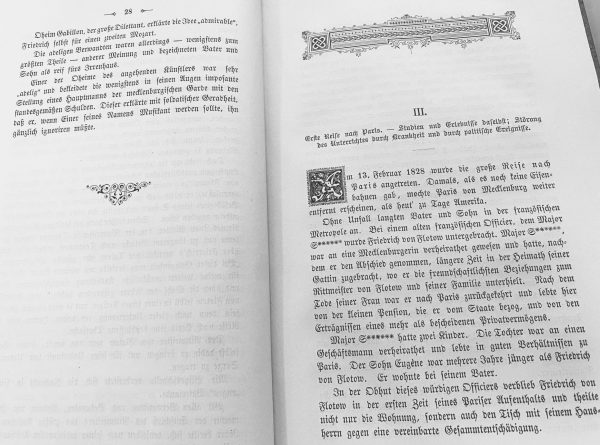
Die Biografie von Friedrich von Flotow, verfasst von seiner letzten Ehefrau, beschreibt die erste Parisreise und den prägenden Aufenthalt für die Ausbildung des noch sehr jungen Komponisten (S.29 ff). Bereits im Februar 1828, mit erst 15 Jahren, begann der erste Studienaufenthalt in Paris. In einer den Eltern bekannten Familie wurde der junge Friedrich aufgenommen und begann sein Musikstudium am Konservatorium. Prof. Friedrich Reicha war dort sein Lehrer, der 1825 seinen “Traité de la haute composition” veröffentlicht hatte. Schon Adam und Berlioz hatten bei Reicha Kompositionsunterricht einige Jahre vorher. Die Juli-Revolution 1830 in Paris führte jedoch zu solchen Unruhen, dass die Familie den Sohn rasch nach Mecklenburg zurückrief.
Die frühe Erfahrung in Paris, und wie wir heute sagen “total immersion” in die französische Sprachwelt und Musik, eröffnete dem jungen Komponisten einen Berufsweg, der sicherlich ohne den Aufenthalt völlig anders verlaufen wäre.
Seine letzte Komposition “Der blinde Musikant” ist als reale Erfahrung des jungen Flotow in der Biografie erwähnt. Zusammen mit seinem Freund Aubry hätte er für den stadtbekannten blinden Musikanten als Straßenmusikant Geld gesammelt. Mit seiner letzten Komposition hat er im Vorgriff auf seinen eigenen Tod, dem blinden Musikanten noch ein Denkmal gesetzt. Dieser war bald nach dieser Aktion dennoch verstorben.
Schüleraustausch und Studienaufenthalte zwischen D und F kann eine äußerst prägende Wirkung entfalten. Das trifft auch noch 200 Jahre später zu. (Image: Flotow Biografie 1892. A.28-29.

Nachhaltigkeitskonzept

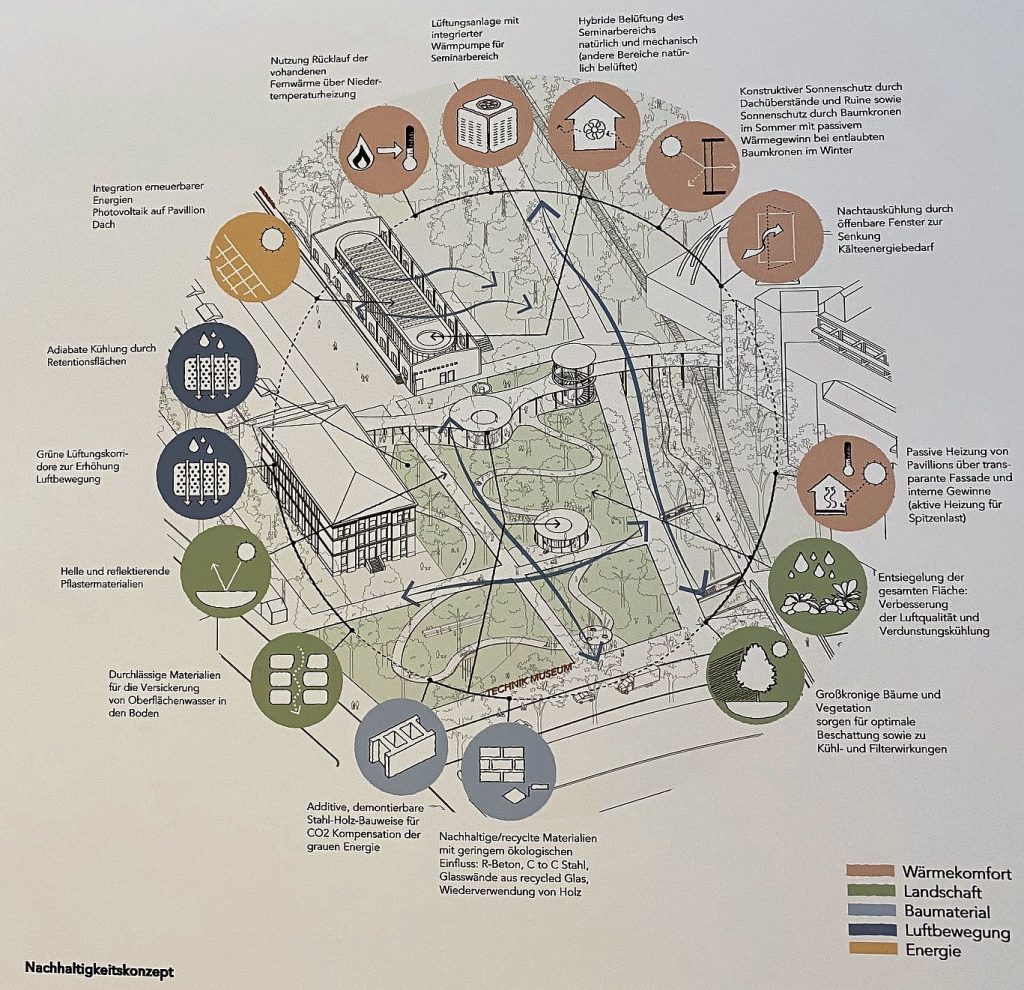
Ein Nachhaltigkeitskonzept gehört zum Bauen mittlerweile wie das Gelbe zum Ei. Die Einreichungen zum Realisierungswettbewerb eines Portals für das Deutsche Technik Museum Berlin hatten entsprechende Anforderungen zu erfüllen. Für ein Technik Museum können dazu die Anforderungen schon etwas höher sein und die oft geforderte „Technologieoffenheit“ oder die Diskussion darüber zumindest andeuten. Der Anerkennungspreis ging an ein Konsortium für die Einreichung 1110, die eine klare Übersicht ihres Nachhaltigkeitskonzepts vorstellten (siehe Auszug Image unten, Foto aus der Ausstellung 2023-12). Nachwachsende Baustoffe gehören zum Repertoire. Gleichzeitig sollte die Erhaltung oder gar Förderung der Biodiversität Teil der nachhaltigen Konzeption sein. Innerstädtisch ist die Rückumwandlung der Versiegelung der Böden eine wichtige gesundheitsfördernde Bauweise. Kühlung in den aufgeheizten Städten ist durch Grünflächen und Beschattung zu erreichen. Tolle Architekten sind das, die den Mut aufbringen den Stachel in die Wunde zu legen. Die Anwohnenden und Besuchenden würden es den Verantwortlichen jahrzehntelang danken.
Das sind längst keine abgefahrenen grünen Ideen oder Träumereien mehr. Paris hat es schon längst vor gemacht. Ganz nah beim Eiffelturm ist das „Musée du Quai Branly –  Jacques Chirac“ das als Neubau mit Garten vom konservativen Präsidenten Jacques Chirac eine grüne Naturoase mitten im Herzen Paris hat bauen lassen. Es ist immer noch eine Art Geheimtipp für Pariser in den zu warmen Sommermonaten. Berlin könnte wie mit der vom Pyramiden-Architekten Pei geplanten Eingangshalle vom Deutschen Historischen Museum mal wieder mit einem Nachhaltigkeitskonzept mit Paris gleichziehen. Gemeinsam können wir auch nachhaltig. Mit der vom Menschen und seiner Technik verursachten Erderwärmung haben die nachfolgenden Generationen noch lange genug zu kämpfen. Mehr Nachhaltigkeitskonzepte braucht die Technik. Das ist die wirkliche Herausforderung des 21. Jahrhunderts.

Art to People

It is a timely move to not only rely on people to come to exhibitions or a museum, but for art and artists to go towards people. Advertising exhibitions is a first step in this direction. As photography and selfies are all around us, it is a small step to get more people interested in art through photography. The treasures of archives and libraries complement the markets for art and photography. Susan Sontag has taught us the social sciences related to photography. Learning by looking is just like the well-known learning by-doing.

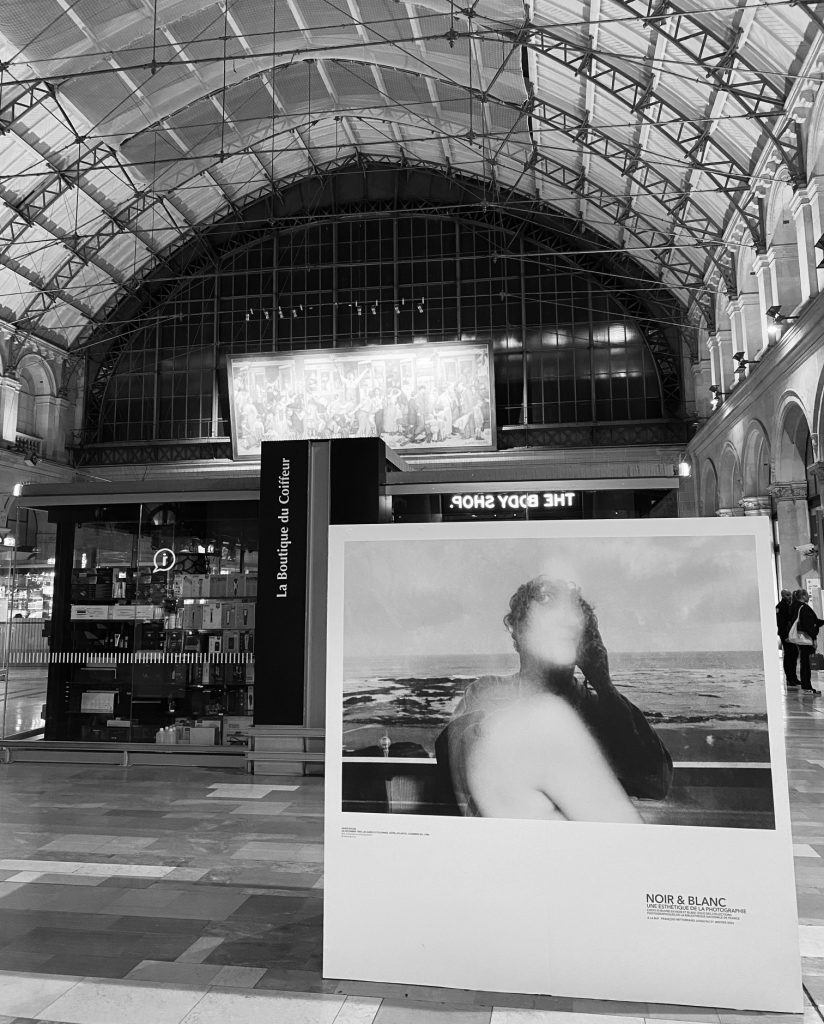
The BnF in Paris is advertising at the Gare de l’Est in Paris. Passing by the board might inspire thousands of travelers and commuters to stop for an instant. Eventually being bothered and to take notice of the intriguing image or images in this reproduction of a photograph or maybe 2 blended ones. A few might note down the address or take a screenshot with their mobile camera to remember. All these instances enlarge the audience for the exhibition or motivate people to go beyond the quick shot with their smartphone camera. The artwork related to photography mostly starts after the first shot. It is in fact sometimes quite a long journey to come up with the final image. Just go for it.

Gare de l’Est Paris 2023-11 BnF exhibition

Black and White

Nothing is just black and white. Some animals have a representation or vision of images in black and white. Just like in computing full color modes or high resolutions use more power of chips and memory. In short colors are computationally costly. For our brains this is unfortunately just as important. Therefore black and white images have a certain advantage. On the one hand they reduce an image to its essential elements, on the other hand they allow a faster grasp of the message or content at sight.

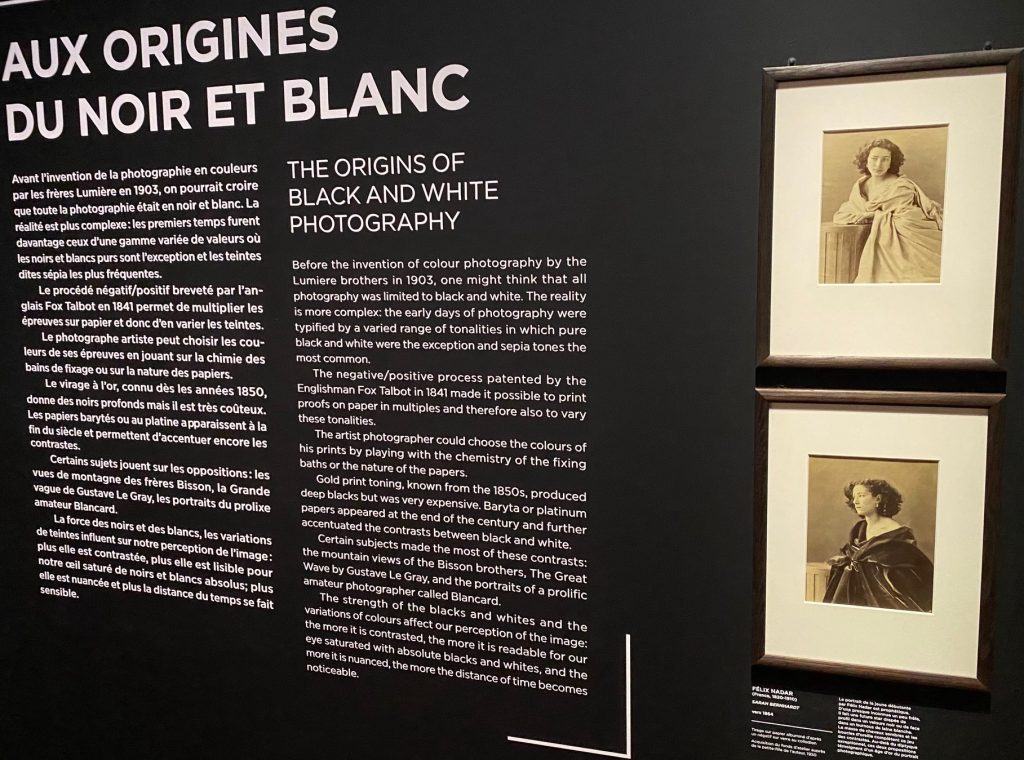
The BNF presents a wide range of images in black and white from the time that color photography has been available, but photographers consciously chose to represent their image in black and white (1907-). Obviously with black and white photography we maximize contrasts. An image can be converted into a graphical representation like a black and white pencil sketch or drawing. A few more nuances are introduced in applying perspectives to capture or to produce by use of lighting forefronts and shadows.

Using different materials as support of photography allows us additional creativity and stunning effects. Lighting from behind the image is popular in advertisements on our high-streets. Last but not least using techniques of color photography gave rise in modern black and white photography to allow for chromatic transitions and contrasts within images.

All this is well documented in the exposition and ample examples make it a formidable visual learning experience. From the origins of just black and white we have come around to the fabulous and magical in black and white. In reducing to black and white the essential becomes more visible. The superfluous is blackened or whitened out. It is a skill of importance nowadays to focus on essentials and to find new ways to go beyond the obvious shot.

BnF 2023-11-10 B/W

Züge

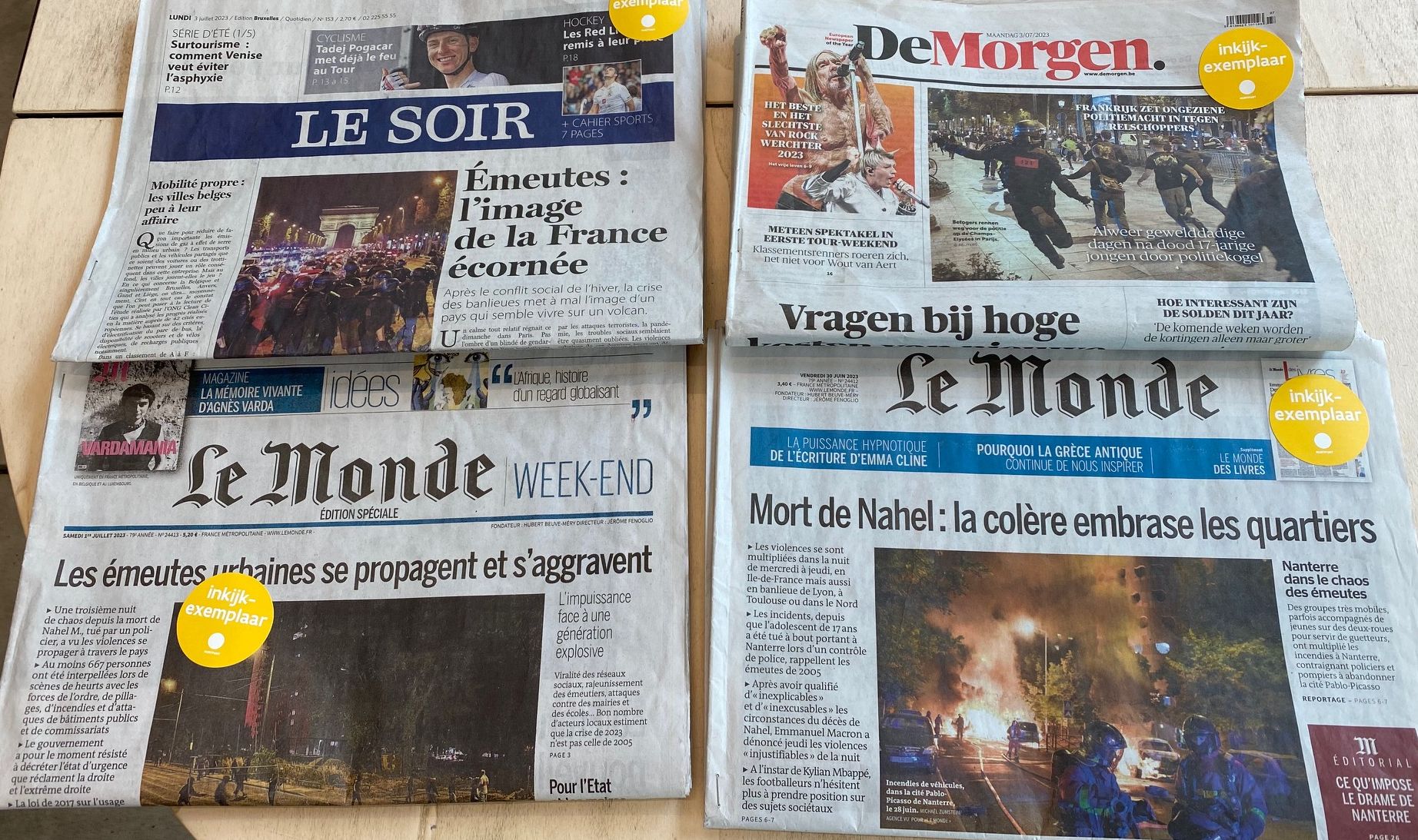
Wer heutzutage mit dem Zug verreisen möchte braucht starke Nerven. Eine lange im Voraus geplante kostengünstige Reise kann dann schon mal zu unerwarteten Kapriolen führen. Jede Person wird wissen, dass eine Reise zum 14.Juli nach Paris ein besonderer Anlass ist. Normalerweise wird Revolution gemütlich gefeiert und nicht Revolution gemacht. Die Befürchtung ist jedoch im Juli 2023 könnte das anders sein. Die Gewalt an Jugendlichen und in der Folge von Jugendlichen war schließlich erst vor einigen Tagen mehrfach eskaliert. SozialwissenschaftlicherInnen führen dabei nebenbei Feldstudien durch.
Aber eigentlich war die Reise mit dem Zug schon Monate vorher geplant. Jetzt kommt es anders. Die THALYS Gesellschaft hat in ihrer App allerdings eine Gebühr für das Umbuchen fest verankert, selbst wenn es eine erzwungene Umbuchung ist. Also rein ins Geschäft, Wartenummer ziehen und Warten, Warten und nochmals, na was schon, Warten.
Zum Zeitvertreib wird ein Geschichtendrucker bereitgestellt. Ouf, Kurzgeschichten und Comics. Das macht Hoffnung beim, na was schon, Warten. Aber irgendwann fahren wir dann ganz schnell mit dem Hochgeschwindigkeitszug nach Paris. Aber da wir doch bitte 30 Minuten vorher auf dem Bahnsteig sein sollten, wissen wir schon, wir werden, na was schon, Warten. Mein Mantra bleibt: Mit der Bimmelbahn mag ich gerne fahren, die fährt langsam und kommt trotzdem an.

Collective Violence 2

Summers and Markusen (1999) subsume state terrorism under the broader heading of collective violence. Even beyond non-governmental groups, states might apply collective violence against innocent people. Among the strategies governments use as a form of collective violence fall (1) arbitrary arrests, (2) imprisonment without trial, (3) torture and (4)a summary execution of members of alleged enemy groups. Particular outcries are caused by, for example, police or other para-military groupings of persons who jump from (1) to an execution of an innocent person or of several even seemingly unrelated murdered persons (4b).
Amnesty International attempts for decades to fight against such occurrences on an almost global scale. The need to complement the national legal systems through supra-national instances as well as NGOs in this domain is obvious. Even the most advanced democracies need to permanently check their systems for several forms of state terrorism or abuses of power to eliminate or intimidate opposition.
Staub (1999, pp.195) undertook an attempt to list elements that allow to predict and maybe prevent collective violence. The theory starts with “conditions of life” more generally like economic, social and political conflicts as well as rapid social change. Activation of basic needs in people, like several forms of security, challenges to a person’s self-concept, traditional values, simply the customary way of life (COVID-19) or new comprehension of (climate) realities, they all challenge old world views of people (superiority) and their place in the world (AI).
Claims for support by other people (government), missing connection to others (individualism) lead people to focus more on their own needs and isolated action. Rebellion as collective violence is directed against differences in status, power and (social) rights. Self-interest is becoming an overriding societal principle. Racism (p.200) and police violence (p.201) are part of Staub’s theoretical considerations. He argues in favour of training of situations in which a police officer is likely to become unnecessarily violent or to stop it if it occurs. At least a medium-term solution.
Framing of such training as preparation of good teamwork rather than betrayal is crucial in action teams, be they in the police or the military. The reader on “violence subie, violence agie” by Seron and Denis (2000) allows us to take a step back and reflect on the spirals and repercussions involved in violence from the perspective of the person who carries out an act of violence and the victim. A social-therapeutic approach aiming at reconciliation is worth trying, albeit a lot of obstacles. Collective dance rather than collective violence is the immediate as well as long-term solution (More on dance here).

Police Violence

As a test of the viability of ChatGPT you might enter Police Violence. What you get in return is just a summary of some nice newspaper-ike editorial of a polite statement that this is a problem about everywhere and that the division of power will take care of it eventually. This is an unfair summary, but it highlights the risk of too many conservative editorialists in Europe that do not dare to take sides of the innocent youth that is at a permanent risk of police violence due them living on the margins of our modern, fast-moving societies that do not allow for lifestyles off-the-normal “protestant work ethic”.
Perceptions of what is fun and what is serious differ within societies, particularly between generations. Baby boomers have known and many experienced unemployment. Youth today has “precarious jobs” just around the corner. But just having “any” job without any career potential or,  at best, on the minimum wage is no longer enough. Social media show that there is much more to life than just a 8-5 normal job. High-streets are full of marketing tricks that solicit people into spending without cross-checking their red lines.
Police and the flourishing private security sector are then charged to ensure that boundaries of financial and spending power are respected. This is exactly where the capitalist market economy fails the people. Without a tough police, ensuring property rights, the system cannot survive. Social market economies claim to soften the borders between have-nots and have-too-much. This needs permanent readjustment. That is where many of our social market economies have failed the poor and even middle-class people threatened with economic and status decline (latest at time of retirement).
Reactions may turn out violent, and again, the police is sent in to “stop” violence. As it turns out police, being abused as “political weapon”, may then become overly violent as well. Not as an overall force, but specific units or just several individual persons who have been trained in anti-terror exercises and have “a license to kill” (007). French legislation has recently facilitated the use of guns to impose the monopoly of power. The probability of who constitutes a potential target might be interpreted by the police itself. A threatening situation is perceived differently by different persons. Too much room for interpretation.
The image of the French superpower that is threatened by a 17-year-old youngster is not credible. It is time to sharpen the control of the police also in France. ChatGPT only on special addition includes the social movement of “Black lives matter” in the return on police violence. If you know the topic you can make use of the AI tools in drafting on police violence for example. Rather than to spend billions on fancy Olympic Games in preparation for Paris 2024, youth programmes would be much better investments in the medium and long run.
Tourists cancel visits to Paris and France in masses already. That is probably the only lesson that receives sufficient attention in the current government and may lead to better control of violence not from some pick-pockets, but from the police as well.