There is a pandemic that is silently spreading across countries and continents. It only indirectly related to the Covid-19 pandemic. The medical journal “The Lancet Respiratory Health” (2024) has an editorial about the inequities of asthma as they develop over the life course. The development of asthma has pre-natal, genetic, environmental, life-style and socio-economic co-determinants. The study of respiratory disease, therefore, is a multi-factorial issue, which needs to disentangle the specific influences. Smoking as well as obesity have an impact on asthma, instantaneously or with delayed time effects of sometimes many years. Hence, it is important to take the whole life course into account, if we want to address the rising disease burden of asthma. Air pollution and heating-up of the planet are important drivers of the silent asthma pandemic across the globe. The social distribution of people working in “asthma- prone” work environments and/or living in highly polluted urban, suburban or rural areas near high frequency traffic is another latent factor causing huge costs to persons and society as a whole. Health inequity is growing over the life course. This is not easy to tackle as policy target as the onset of the disease has no single trigger, but rather a combination of influences that contribute in varying amounts to the evolution of respiratory diseases. (Image air pollution https://aqicn.org/map/germany/de/)

AI Racing
AI has entered the racing of cars after we have been racing horses, dogs and camels for many decades. The fact behind all these races is the huge market for gambling. Anything you can bet on will do for juicy profits in that industry. The recent “Abu Dhabi Autonomous Racing League” is the latest addition to the racing craze. Moving online with 600000 spectators at its peak on video and gaming platforms the investment seems promising. The only problem, AI is not yet ready to really compete with the world of real drivers. The progress, however, is astonishing. Just one lap of 2 minutes on the circuit yields 15 Terrabyte of data from 50 sensors. These are closed circuits so no person can enter or animal can get in their way. The challenge to integrate more data and faster processing as well as algorithms for fast decision making is steep. Great learning opportunities for advances in robotics. The hype has not been able to live up to the expectations as no real racing took place yet. We have replaced the gladiators of the Roman empire with Formula 1 drivers. It is only fair to retire those drivers soon and let AI race cars against each other. It feels like a computer game on screen and it is as we shall most likely watch these races on a screen as well. Hence, what is the point. Watching youth on TWITCH play racing games will probably not change the viewing behavior of the masses. The programmers have nevertheless great learning opportunities and will find their way rapidly into the job market. The other challenges of ASPIRE seem more important for humanity like human rescue and food for the growing world population. In the meantime let the boys play around with cars and learn about potentials as well as failures of AI-programmers and dealing with both.

Weight Stigma
The fashion industry has for a long time produced images of mostly women and men that did not correspond to the normal weight distribution of people. Skinny models were present across all media. The so-called social media of today amplify this trend further. The “Barbie hype” has reinforced the idea of low weight as a socially desirable norm. In scientific research the term coined for this phenomenon is “internalized weight stigma” (IWS). A study shows (Highes et al. 2024) it affects more women than men and more people who are described as socioeconomically disadvantaged adults. Pressure to lose weight originates from multiple sources and social media platforms have given rise to bullying. A major outcome of IWS is eating disorders as eating is often wrongly associated to be the only cause of higher weight. It is not. Many other factors contribute to the actual weight of a person. Even the overuse of the body mass index (BMI) as short hand version to define overweight or obesity is misleading for persons with strong muscles. Just fixing on one parameter of body shape or weight tends to reinforce weight stigma. “Keep walking” and a regular healthy diet, this avoids to internalize a weight stigma. Exercise is fun, the more you do it in a group, the easier it is to get going regularly. We ought to keep trying and eventually it will become a routine.
Science Politics
We tend to believe that science is independent of politics. Even if the individual scientist does research and studies free of immediate political influences, there are many ways in which politics has an impact on science. Sociologists refer to Max Weber as a prominent figure in the “Werturteilsstreit” that claimed the need for science to be conducted beyond political interference. Karl Popper is another reference in this respect who proposed the positive science approach which starts from theory, hypotheses and testing in the sense of identifying false statements, hypotheses and underlying theories. Modern science is also linked to publications of results. This has become an industry of its own and it is sometimes quite surprising to see the lengthy delays that scientific results get published. One example, Jackie G. Schneider and Julia Macdonald (2024) had to wait 3 years until their paper finally appeared in print in a scientific journal. This paper was received by the Journal in February 2021 and published only in 2024 in the 2nd issue of the journal but online in January 2023! Reports in Nature on difficulties of Indian, African and Chinese scientists to get their work done and published are alarming as well. Further regionalization and departmentalization work against the fundamental principles of independent science and scientists. It is a big issue of international cooperation as well.

May 1st
More people take to the streets on the 1st of May in Germany. The costs-of-living crisis with high inflation has increased the claims for pay rises for workers and adjusted wages for employees. We all have observed “greedflation”, i.e. excessive company profits in several sectors. Additionally, “shrinkflation” has affected consumers in their daily shopping experience. Political efforts to curb inflation have taken a long time to come about and most initiatives have ended already (Energy sector). This spurred a new drive for trade unions to come out in huge numbers to protest and claim adequate wage increases to cover the increased costs of living. In Germany the DGB informed on the annual 1st of May demonstrations across the country about a strong new entry movement of members of 400.000 persons. It is higher than the loss of members of the large baby boomer cohorts who retire.
Through a broad and engaged membership the pressure on higher wage settlements will persist. Companies have used the crises to generate extra profits. It is only fair that those employees who largely contribute to the success of a company will claim their share as well.
For society as a whole it is important to consider that the discrepancy between managerial pay and shop floor wages do not increase further. The social fabric of societies is in danger if perceived injustices grow. More radical forces can all to easily exploit this causing a severe danger for democracies. Meeting people on the 1st of May and joining forces across sectors and trades ensures that a society continues to build and rely on solidarity. High inflation times are a great reminder of the economic basics of societies in history as well as today. 
Comparative Advantage
In economics all students go through the calculus of comparative advantage. People, regions or whole countries tend to apply comparative advantage to their production systems and ensuing internal or external trade. The basic rationale developed by David Ricardo has not changed that much over 200 years. The fields of application, however, are continuously expanded. Lindsay and Gartzke (2020) have applied the comparative advantage rationale to military strategy. The paper quotes 26 times Clausewitz and demonstrates the links of strategy to the basic economic and social rationale of comparative advantage. It is the politics of production that even the presence of trade may override the rationale of comparative advantage to favour local production of “operational domains” or military equipment.
In Russia’s aggression and war against Ukraine own production and trading of weapons has returned to the forefront of the concerns. In addition to the production of ammunition, the provision of drones has dominated the international arms trade related to the Russian aggression. Resources and time for production are additional factors that have an impact on availability of weapons at the right time at the right place and with the sufficiently trained persons to operate them.
The strategies that cross domains or combine domains seem the most promising. The careful analysis of your own comparative advantages or disadvantages needs to be the basis of any strategic decisions. This has been known for 2 centuries at least and is still valid in many fields of application. Additional considerations for “home production” might add to the complexity of the issue. Sustainability has also found its way into the field of comparative advantage at last. This may alter the analysis of comparative advantage of operational domains as well. Lots of unresolved puzzles still around. It will need years to sort this out despite the urgency of the Russian aggression on Ukraine.(Image: AI Copilot.2024-4-30 2 political leaders deal weapons. One has a comparative advantage in ships. The other one has a comparative advantage in aircrafts. they deal together)

AI Disruption
Many scientists started to question the disruptive potential of AI in, for example, the military’s domain. The Journal of Strategic Studies featured 3 papers on AI and autonomous systems more generally. The major argument by Anthony King is the reliance of autonomous systems on other systems mainly human operators even in the background to get these systems off the ground and maybe back again. Not only logistic support but also satellite communication is needed to guide and protect the operations. In quoting Clausewitz, Anthony King stated that war is a “collision of two living forces”. Strategy and counter-strategy will co-evolve as will attack and defence.
Jackie G. Schneider and Julia Macdonald (2024) advocate the use of autonomous and unmanned systems for their cost effectiveness. Economic costs as well as political costs are lower for these new strategic weapons. Mass fire power from swarms of drones is much cheaper than nuclear warheads and the home electorate is assumed to be more willing to accept and support limited and more precisely targeted unmanned missions. The disruption potential of AI is huge but it is most likely an addition to the arsenals than replacing them. (Image 2 swarms of drones fly in the air above tanks, created by AI – copilot-designer 2024-4-29).
Hannover Fair
The annual science fair at Hannover is a kind of a show of things to touch and of those things that come to the public market in the near future. Most of the annual hype is about potentials of production. Rationalization, using few resources or innovative solutions of digitization are high on the agenda. Create your digital twin, save energy, make production more safe or cyber secured.
Robotics is another reason to visit the fair. Some 7 years ago I had my Sputnik experience there. The robotics company KUKA had demonstrated live the that assembling a car from pre-manufactured components takes just 10 minutes for the robots. Shortly afterwards the whole company was bought by Chinese investors. Roughly 5 years later we are swamped by cars from China. It was not that difficult to predict this at that time. Okay, we need to focus on more value added production and take our workforces (not only) in Europe along on the way. Reclaiming well-paid, unionized jobs in manufacturing, as Joe Biden does, will not be an easy task. Robots and their programming is expensive, but skilled workers, too. Hence, the solution is likely to be robot-assisted manufacturing as a kind of hybrid solution for cost-effective production systems.
Following the proceedings of the 2024 fair we are astonished to realize that visiting the fair is still a rather “physical exercise” walking through the halls. After the Covid-19 shock we expected a lot more “online content”. Instead we keep referring to webpages and newletters rather than virtual visits and tours. The preparation of the visit in advance remains a laborious adventure. However, the in-person networking activities in the industry are largely advanced by ease of exchanging virtual business cards and the “FEMWORX” activities.
This year’s Sputnik moment at Hannover is probably most likely related to the pervasive applications of AI across all areas of the industry and along the whole supply chain. Repairing and recycling have become mainstream activities (www.festo.com). Robotics for learning purposes can also be found to get you started with automating boring household tasks (www.igus.eu).
Visiting Hannover in person still involves lengthy road travel or expensive public transport (DB with ICE). Autonomous driving and ride sharing solutions might be a worthwhile topic for next year’s fair. Last year I thought we would meet in the “metaverse fair” rather than in Hannover 2024. Be prepared for another Sputnik moment next year, maybe.
(Image: Consumer’s Rest by Stiletto, Frank Schreiner, 1983) 
AI Defence
For those following the development in robotics we have been astonished by the progress of, for example, rescue robots. After an earthquake such robots could enter a building that is about to collapse and search the rooms for survivors. A recent article in “Foreign Affairs” by Michèle A. Flournoy has started its thinking about the use of AI in the military with a similar 20 year old example. A small drone flying through a building and inspecting the dangers of entering for persons or soldiers. Since then technology has advanced and the use of AI for automatic detection of dangers and “neutralising” it, is no longer science fiction. The wars of today are a testing ground for AI enhanced military strategies. It is about time that social scientists get involved as well.
Warfare left to robots and AI is unlikely to respect human values unless we implement such thoughts right from the be beginning into the new technology. An advanced comprehension of what algorithms do and what data they are trained on are crucial elements to watch out for. According to Flourney, AI will assist in planning as well as logistics of the military. Additionally, AI will allow a “better understanding of what its potential adversaries might be thinking”. Checking through hours of surveillance videos is also likely to be taken over by AI as the time consuming nature of the task binds a lot of staff, that may be put to work on other tasks. Training of people and the armed forces become a crucial part of any AI strategy. The chances to develop a “responsible AI” are high in the free world that cherishes human rights and democratic values. Raising curiosity about AI and an awareness of the dangers are two sides of the same coin or bullet. Both need to grow together.
(Image created by Dall-E Copilot Prompt: “5 Robots disguised as soldiers with dash cams on helmet encircle a small house where another robot is hiding” on 2024-4-23) 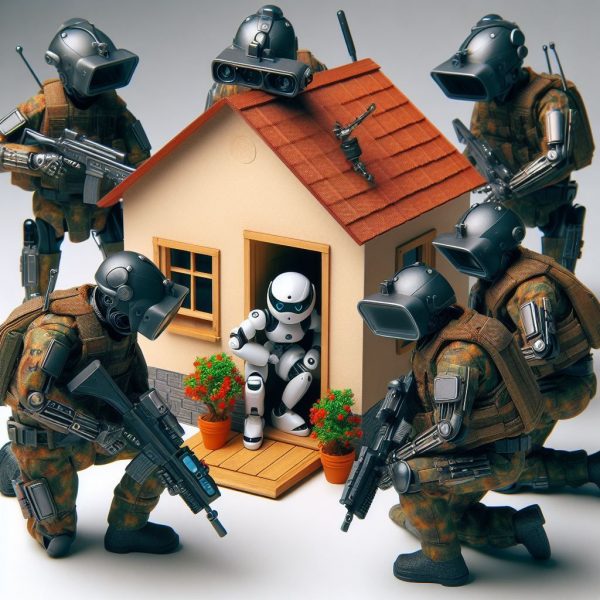
Puppets Museum
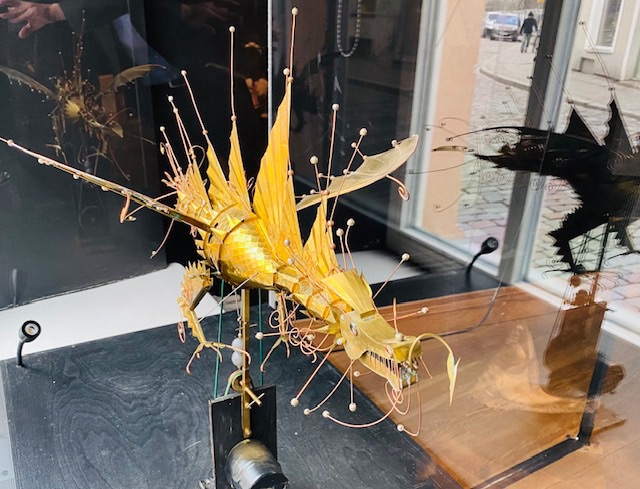
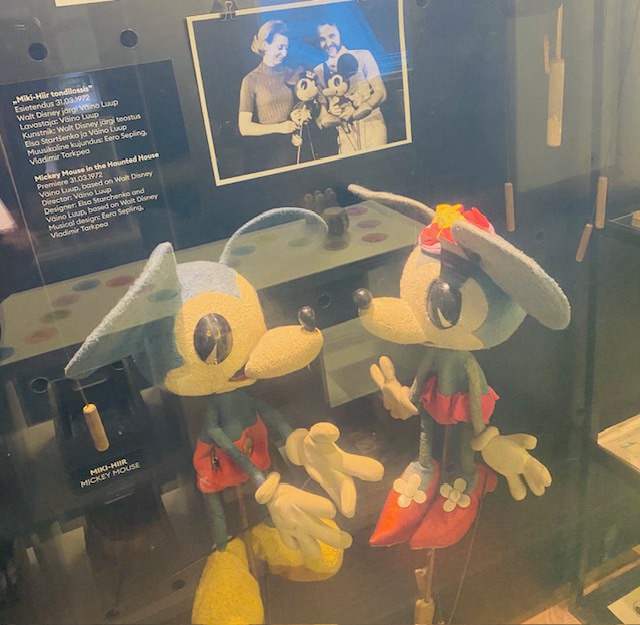
The puppet theatre is still a tiny part of the theatre world. The century old tradition has roots in all cultures across the globe. The Puppet Theatre Museum in Tallinn has a fine selection of puppets to perform theatre pieces from India, China, Indonesia and Europe. Storytelling is part of humanity and learning through narratives distinguishes us from other species. Religious traditions have appropriated these techniques just as modern performing arts. From the carnival tradition of using masks not only children adore playing with characters. The famous founder of the Estonian Puppet Theatre has his small monument outside the historic building in the old town, but a big puppet theatre with 400 seats. The adventures of Jules Verne have been played there just as most well known operas or children’s tales. Puppets comment on puppets (Mickey Mouse) just as they take on political debates. The forthcoming piece on the Ministry of Solutions sounds promising indeed. We envy the puppets that have a Ministry of Solutions rather than lots of ministries and ministers but no solutions.