

Is learning by using different from learning by doing? In an economic model to test the employment/unemployment impact of AI in the USA, Wang & Wong (2025) suggest an important impact of employees’ productivity due to learning by using AI. In terms of the traditional language of economics the employees who use AI in their work shall have comparative advantage to those who don’t.
In a model of job search in the economy there is the additional possibility, similarly to robots previously, that certain tasks maybe influenced by the, more or less, plausible threat of an employer to replace the employee by training an AI system to perform the tasks. The credibility and acceptability of such threats are likely to impact wage claims and unemployment risks. All these effects do not happen instantaneously, but evolve over time with varying speed. Hence, calculations of effects have high error margins. The resulting model yields oscillations of “labor productivity, wages and unemployment with multiple steady states in the long run”.
Learning by using seems to be a good description of what occurs at the micro level (the employee) and at the macro level of an economic sector or the economy as a whole. Society may guide the use cases of AI just as much as the business case to use AI, for example in the creative industries as infringements of copyrights may occur on a massive scale. However, learning by using is not free of risks to society at large. Just like allowing people to use automotive vehicles has lead and still leads to thousands of deaths annually, learning by using produces external costs. Overall, this is another case for a benefit/cost analysis for businesses, the economy and society.







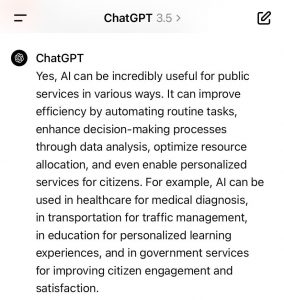 The AI ChatGPT is advocating AI for the PS for mainly 4 reasons: (1) efficiency purposes; (2) personalisation of services; (3) citizen engagement; (4) citizen satisfaction. (See image below). The perspective of employees of the public services is not really part of the answer by ChatGPT. This is a more ambiguous part of the answer and would probably need more space and additional explicit prompts to solicit an explicit answer on the issue. With all the know issues of concern of AI like gender bias or biased data as input, the introduction of AI in public services has to be accompanied by a thorough monitoring process. The legal limits to applications of AI are more severe in public services as the production of official documents is subject to additional security concerns.