
Music Lunch

The possibility to pass a lunch break with live music inspiration is, unfortunately, quite rare. The Brussels festival “midis minimes” has created a popular format for classical music to be performed in easy to reach venues in the city center. Working in the center allows to hop into a 45 minutes performance of varying artists, instruments and music styles. The “Cercle Royal Gaulois” offers enough seats. Even without a reservation it is feasible to forget about work and get inspired by musicians. and the composers and arrangements they propose. Gaëlle Solal and Juliette Hurel offered short digestible pieces by Bartok, Ravel and Piazzolla with a focus on their popular dance tunes often based on previous folk tunes. We virtually traveled from Romanian tales to La Habanera and Tango and back to work for some.

Contextual Vision

The attempt to define a sociology of vision has had a hard time to build on hard evidence that vision may depend on context or in a broader sense your visual heritage. A standard definition of context in vision highlights the areas around a focal point. The findings by Krupin et al. (2025) show through the comparison of persons from very different populations that our vision depends on our cultural background. It is the social background and upbringing in a specific cultural setting, which determines what we see in an image at first sight.  The so-called Coffer illusion test (Deregowski 2017) reveals what we see in an image spontaneously and maybe after some longer staring at the image or doing it repeatedly, we learn to see that there is more to see than our original impression. Depending on our cultural heritage we might focus unconsciously on rectangular or round shapes in a geometric image. This fundamental finding questions the view that there is only one universal kind of vision common to all humans. In fact, there is variance around what we see and thereby how we perceive an image. This research provides a justification to delve also into the field of a sociology of the visual. Because of the common term in informatics “WYSIWYG”, (what you see is what you get), we might  spend more efforts on research of how human vision is shaped over generations or according to social background. We know that in some images different people see different things. What appears as a splendid opportunity for some, is a very risky situation for others. Eyes are so closely wired to our brain that inscriptions of vision on the brain functioning are quite likely. The plasticity of this process over the life course remains a crucial topic to understand the process(es) of how a person’s social background shapes her/his vision.

Real dad-ication

The last few years there has been a stronger recognition of the need to get fathers more involved in caring for children. In the USA the #dadication became a symbol and an annual campaign to raise awareness to the importance of fathers to get involved in addition to mothers. The combination of fatherhood and dedication was shortened into “dadication” to reflect the combination of both elements that we not always considered to a natural part of fatherhood. It is a win-win-win situation as fathers gain emotional strength, children learn about parental styles and mothers get some relief from at times overwhelming family care.
In literature we have some great examples of caring or neglecting fathers. Famous are the letters to his father by Franz Kafka. Historically, fathers have often thought their role solely as ensuring a social status for their children, but nowadays the role patterns is much broader and much more emotional or psychological as well. As there are more “dadication” role models around, the song “Papa où te” (Dad, where are you?) will still be popular, but with more reassurance that children or adolescents have vivid memories of time spent together.

Erik Satie Satisfied

The collection of letters from Erik Satie contains more than 1000 letters amongst them some in exchange with the best artists of his time. The range is largely due to the circle of artists who met at Montmartre in Paris before and during the Great War. We discover letters to Maurice Ravel, Claude Debussy, Pablo Picasso or Henri Matisse. For some artists there are 100+ letters preserved like to Jean Cocteau. In the 1920s he composed music for shows at Montmartre, where the scenario was painted by Pablo Picasso and costumes designed by Coco Chanel. The sculpture by Brancusi must have been familiar to him, just as much as the cubist paintings by Georges Braques, as there are also letters or references to such letters in the impressive 1000+ pages collection. Like Ravel he was rejected by the Conservatoire de Musique de Paris in his early days as student. Montmartre allowed to live and create at the same time while living on a minimal budget. Erik Satie signed his letters with ES. In German this denotes a “neutrum”, maybe, beyond male or female differentiation, but also a tonality in music (E flat). There is no trace that this was a conscious choice. It is just another unresolved puzzle about the self-declared “Gymnopédiste” and composer of the “Parade” and the popular piano music the “Gnossienne”. 100 years after his death on 1925-7-1 he (ES) could be rather satisfied with his impact on the course of music in the 20th century and beyond.

Memories updated

In Berlin and many other German cities it is a regular practice to scrutinize the memory inscribed into street names. In order to correct the honors given to persons with a past as fascist or responsible for mass killings street names were changed at several points in the history of the city. Streets named after battle fields, for example, are a continuous point of discussion. It is important to keep the perspectives of victims in mind. Therefore, changing street names is a little contribution to rethink the role of places and persons. Such changes are sometimes very controversial as people become accustomed to names, some might even not care much at all. Recognition and responsibility, however, have a lot of currency in historical perspective. Overpainting like in the paintings from Gerhard Richter has an important function in society and can be one way of coping with the demons of the past.

Artist Development

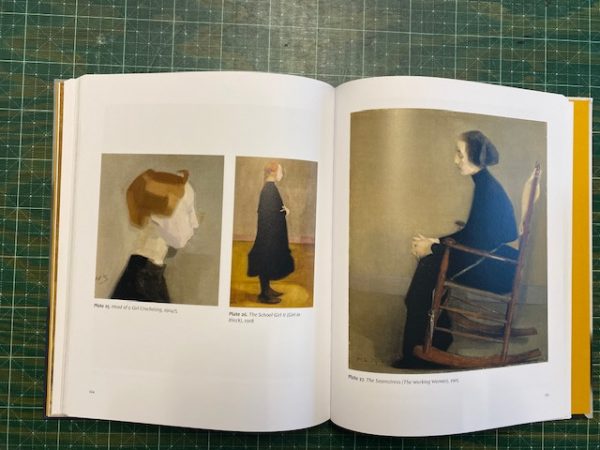
For many artists it takes years before they find their idiosyncratic style. Testing different forms of art before zooming in on a particular style of art is the  common trajectory for most artists. Maybe the art marker and collectors of art are in search of a “defining style” for an artist so the uniqueness becomes more easily identifiable. Being part of a group of artists has been beneficial as well. The “Neue Nationalgalerie” in Berlin makes this development of an artist, in this case Lygia Clark transparent through the organization of a retrospective devoted to her evolution from abstract paintings towards participative and more organic forms of art. Berlin offers to interact with the pieces at the exhibition. You become part of the exhibition and the happening of art instantaneously. The form stays the same, the persons interacting change permanently. The piece of art is never the same. Just the idea of it thrives. In the Corpo Colletivo the performers wear an overall, all of them are linked to each other and movements happen organically as a group rather than individually. This is like a tutorial in sociology as individuals move as part of a collective body and feel the embeddedness and multiple links to other persons (Image: Corpo Collectivo 1970, exhibit in Berlin 2025)

Odessa Berlin Odessa

With a sense of partnership, it is possible to travel between Odessa and Berlin in the “Gemäldegalerie” in Berlin 2025. Due to the war of Putin in Ukraine the “Museum of Western and Eastern Art” in Odessa had to relocate its treasures to safe places. The Gemäldegalerie offers a chance to view the splendid collection nevertheless. The curators’ team in a spirit of “art intelligence” propose, in a splendid way, most oeuvres from Odessa next to an example by the same painter from the Berlin collection. The visitor leaves the exhibition enriched by an experience of “jumelage” (engl. sister cities) of partnerships between museums, cities and their people.
In fact, we have shared the same imagery or visual heritage in Europe for centuries . The collections of paintings ranges from the 16th -19th century art  or from Frans Hals to impressionist influences.
We shall cherish the return of the collection to Ukrainian Odessa as soon as possible. The image below shows the places of origin (yellow dots) of the art works of the Odessa collection across centuries (map from the exhibition).

Dépaysé in gallery

The installation ar the Neue Nationalgalerie in Berlin entitled „Fog Sculpture“ takes us from the sculpture garden of the Gallery into a tropical forest atmosphere. Just changing the humidity and visibility through the artificial production of fog transforms the perception of the artworks. A kind of Asian flair surrounds the western sculptures in the garden. The fog installs also a mystification whoch we know in art from the romantic painters like Caspar David Friedrich for example. All long-term followers shall appreciate the new perception of the artworks thanks to Fujiko Nakayo. It’s definitely more than old wine in new bottles. The artwork brings a more global twist to the preexisting sculptures and reminds us in Berlin even of the wrapping and unwrapping of the  Reichstag building by Jeanne-Claude Christo. We see the sculptures or architecture differently after they disappeared temporarily and reappear again.

Lviv Ukraine

Small galleries can make a real difference. In Berlin the gallery “streulicht” has a selection of photos in an exhibition that portraits artist from Lviv in Ukraine. Hans Hugo Hoffmann manages in his photographs to depict the extraordinary resilience of Ukrainian creative persons who live through a protracted war of their country against the Russian aggressor. The persons embody the strength of resisting through their art work despite the wounds inflicted on their families or the people of Lviv and the whole of Ukraine due to the war. The persons portrayed try to continue their normal day to day work, knowing that nothing is normal anymore in Ukraine. “Bizarre Normality” characterizes our perspective on these artists, who are thrown into a world of events that we no longer thought might be possible in Europe. Bucha and other crimes by Russian soldiers in this Russian aggression leave traces in the faces of Ukrainian people and even beyond. We all wish that the people of Ukraine can return to “normality” as soon as possible, although we know that nothing will be normal as it was before the Russian invasion.

Ugly duckling revival

Ever since Hans Christian Andersen created the fairy tale of the “ugly duckling” (1843) the story has been adapted to all forms of theatre. The adaptation of the fairy tale to the stage in 2019 and the revival in 2023 at the “Deutsches Theater” in Berlin keeps inspiring people to surpass their restrictions or inhibitions, whatever they may be. This early 19th century fairy tale is a fine piece of the search of identity of a person. As it deals with the difficulty of individuals to find their own identity, the fairy tale deals already with the fitting of an individual into society. Society exercises pressure on individuals to conform to written and unwritten rules, which tend to hold up rules like “one size fits all”. Differentiation and allowing individuals to be different from an established norm becomes a central theme of modernity and even more so in the post-modern world. It is the essence of democratic societies to practice a tolerance of persons being or just wanting to be different. The performance at the “Deutsches Theater” might be a test of your level of tolerance or acceptance of diversity for some, but at the time of rising intolerance in and beyond the U.S. under Trump, such performances are dearly needed to celebrate the rich cultural heritage and achievements of far reaching tolerance. It becomes more evident what we are about to loose (again), if such performances would no longer be possible in a controlled or financially overly restricted world of theatre.

Persistent beauty

The fashion industry is known for its fast turnover of beautiful designs from season to season. Some designs and often just single pieces survive the fast turnaround of the fashion industry. In many cities we find shops that sell so-called vintage cloths and objects. For men and women it is feasible to rediscover pieces of longer lasting beauty or even persistent beauty. The persistence of an image of beauty may follow the classics of designers and specific brands, but it may also have a very personal touch referring more to a person’s own life course (when we were young) or associated with freeing yourself from your family or societal context. The 60s and  70s were such time periods with radically changing images and ideas about beauty. Since then more individualised clothing seems to take hold, although there is an equally strong tendency of social or age groups to identify themselves through specific clothing, showing that you belong to the “in-group”.

Archi Geometry

Architecture has an obvious and visible link with geometry. Clear lines, rectangular or triangular shapes have dominated for centuries since the Greek temples. Geometry was a discipline that has attracted many scholars and particularly architects. Nowadays the shapes are much more diversified and sometimes complex. The calculation of surfaces, curved lines and shapes have become an issue of more complicated mathematics. Volumes of irregular shapes are a challenge for most people to calculate and heating or cooling sich buildings adds considerable complexity. It is, however, rather relaxing and fascinating to look at the marvels of modern shapes in architecture. Technology and material science have allowed us spectacular progress and designs in recent years. Paris offers a splendid perspective on such developments. 

Liszt home

In Budapest we can visit one of the longer living places of Franz Liszt or Ferenc Liszt as some Hungarians would insist to call him. The Beethoven trained Carl Czerny offered piano and music classes free of charge to the young Franz Liszt in Vienna at the age of 11. In the biography by Klára Hamburger she describes the Paris years of Liszt from 1823 until 1839 as the most important ones for the pianist and particularly for his later compositions. Born in Hungary, the son of 2 Austrian parents he was trained in Paris by amongst others the Czech professor of the Conservatoire de Paris Antonin Reicha just like Chopin, Flotow or Offenbach. Writing an opera was the “must do” for a composer who aimed for the highest possible career at the time. In a letter to George Sand, Liszt (published 1937) complained already about the social status of musicians in society as servants to the higher ranks of society. Similar to Ravel many years later Liszt was rejected as official scholar by the Conservatoire de Musique and his wish to marry a daughter of noble decent was rejected early in his career. Such experiences probably contributed to his leaning towards the romantic form of expressions in music during most of his compositions. Literature, paintings of the French romantic period and the traveling artist “voyages et pèlerinages” became influential in his creative process. The competition between composers must have been fierce at the time and despite ample opportunities to perform in public and private venues making a living from music wasn’t always easy at the beginning. More than 100 years after his death his compositions are still a challenge for all pianists and the Hungarian Rhapsodies probably his greatest homage to his early childhood.

Tchaikovsky home

During the time before the “Zeitenwende” it was easy to visit the home of the composer Pyotr Ilyich Tchaikovsky in St. Petersburg. Therefore, we refer to our memory of the visit and the already 10 years ago restrained liking and appreciation of the Russian officials for the aristocratic composer, even accused to not be sufficiently Russian in his music compared other Russian composers. The composer had diverse love affairs, which were also not conform to official doctrines. The world wide success of his compositions, mostly known for his ballet music, remains popular in the 21st century. Similar to Beethoven, the biography by Malte Korff (Tschaikowsky, in German), highlights the final symphony as his masterpiece. The seems to be a reason to study “the last works” of composers specifically. The mature compositions appear to reflect on previous work and build or comment on previous work. The 6. symphony “Pathétique” was completed in his last year of his life, only at age 53. The final IV-th piece of it is entitled “Adagio lamentoso” and ends in very calm tempo and almost silence like a withering away heart beat. To my surprise I found a similarly very quiet ending in one of his early piano composition when he was only 28 years old “Romance Opus 5, Andante cantabile”. This early piece also ended “più lento” and from pp to ppp. (compare extract of image of notes below).

Kids Gaming

The pressure on children and their parents is high to succumb to the temptation of digital and online gaming. Albeit there are many funny and learning alternatives for them if they are accompanied by an instructor to build or invent their own game. With some adaptations it is possible to assemble for example a coordination game for children which directs a small ball through a labyrinth. Add speed and tricky holes to the “parcour” and the race is on. It is little bit like hands-on physics as the speed and acceleration patterns across the parcour varies a lot. Planning, building and playing are an ensemble in this simple game. Probably also more fun than the x-th repetition of a digital game.

(Inspiration from: Berliner Kultur gestalten, workshops for children).


Intimate housing

The housing of famous persons has always attracted a lasting fascination. The “esprit des lieux” or the experience of the surroundings of an artist, composer, author or otherwise famous person, where most of the work had taken place is of general interest. In today’s language we would describe this as the context of creation. Biographical information and references to specific objects central to the process of creation play a crucial role in understanding what is behind human creation as it is district from AI. There are objects ( compare MAD Paris) and there are the social networks of creators. Modern biographies include both, some even in graphic forms similar to ancestry diagrams. 

The design of intimate living spaces for private life or the adequate environment for creativity are becoming more clear with the consciousness of the importance of dedicated designs of furniture, accessories and even scent. Our brains are multimodal and working as well as processing lots of information even beyond our conscious realizations. This black box of creativity is rather unique to the human brain and AI will probably take decades to emulate such complex processing. The MAD exhibition reveals that intimacy is also related to housing design and interior design. It doesn’t seem to be a random process, but habituation is part of the continued creative process. 

Private Intimacy

Intimacy has been reserved for private affairs for centuries. Although in the medieval ages formally the right of so-called noble men could be very far-reaching into intimacy of families when the permission to marry was quite restrictive. The private intimacy is the central theme of the Paris exhibition at MAD (Link) « Private Lives ». The organization into 14 almost private rooms around a larger center piece on design leads us through the major topics of intimacy. Maybe as a surprise to some, the exhibition starts with the major actors of change related to privacy and intimacy, i. e. women. Opening up enclosures gave women more room for intimacy and at the same time it made intimacy a conscious choice and decision. “A room of one’s own” is an important step in personal development of children particularly with respect to one’s intimate life. Restrooms are another issue of intimacy, just consider recent adaptations tor m/f/d people. A whole set of accessories are on display which previously were intimate products or even secrets prepared for public viewing. Of course odors are part of the experience with a test space of noble perfumes. The various manifestations of sexuality has brought about a growing number of pleasure objects, which might also be criticized as a growing commodification of intimacy as well. The connected bedroom and the risk of surveillance are raised to warn on overexposure on social networks. Intimacy in prisons or community shelters closes the exhibition before the final highlight the room on “conversations with oneself”. A whole literary form of keeping an intimate journal has arisen from the conversations not intended to be shared with others, at least not during one’s lifetime. After a person’s death for some persons of public interest even their private intimate journals will be published shifting the balance between the private and public parts of intimacy. (Image below from exhibition, photo bottom left, Matisse painting on wall while in bed in old age). 

Intimate change

Society changes and with it so does intimacy. The major changes pass through the behavioral changes of persons and sooner or later the whole society adopts such changes as the new normal. Trends of individualization have moved over centuries as the exhibition in the Museum of decorative art (MAD) in Paris demonstrates. At the same time the changed individual approaches to intimacy have become more widely spread quickly over time. Social media have accelerated such new trends again. Social class is yet another intervening variable in this context which created different speeds of adjustment as well as sustaining differences in kind. 

Religious beliefs and practices have made claims about how individuals should handle intimate relationships and affairs. Legal issues are defined by each society to guide moral practices as well. Hence, the sociology of intimacy is a huge topic and comparing societies an interesting topic. The development of intimacy over a person’s life course, however, is given little attention due to a lack of adequate longitudinal data. From the exhibition we are encouraged to think about the relationship of hygiene and intimacy. Bathrooms accompany us throughout our lives and privacy was originally a bourgeois concept. Over the life course we move from dependency to independence and maybe dependency again in very old age. The images (below) from the MAD exhibition range from basics of bath tubs to a painting of Edgar Degas in the background. Instagramer or YouTuber share lots of images and stylized arrangements of bathrooms on social media. It seems that intimacy is moving further into the public domain. 

Body Soul Membrane

The 40 art works from the Pinault Collection on display at the “Bourse de Commerce Paris” deal with a depiction of the body and soul in the broadest sense. The range of works from paintings, sculptures and video installations is impressive. The link between the body and the feelings or emotions is obvious. Contexts leave deep impressions on bodies and frequently embodiments do not fit emotions. The membrane between the two instances creates an additional barrier or chance to align both instances. Racism and discrimination are recurrent topics in the exhibition. This makes the exhibition a welcome antidote against the increasing risks of violence in many societies. Artists have a subtle emotional connection to suffering of people and their art work does not shun away from confronting us with violence experienced by large groups of society. Body and soul membranes are also an internal or intimate affair, which words can only address with difficulty. Many artists therefore chose other ways than writing or drawing to express or cope with this reflexive relationship of body and emotions. We do not leave the exhibition unmoved, maybe even a bit unsettled in our emotional state of mind. Our own membrane might be moved or become unbalanced after the visit. 

Art from India

Indian music, art and performances have had a difficult time in traditional western cultures. Based on the historical collections and donations in the BNF, this WEIRD bias is challenged a bit. The focus on performances and art from India of centuries old traditions of high standards could have been a major source of inspiration to wider audiences already. The narrative language of for example dance as Bharatanatyam is a sophisticated ritual of expression. It appears to us like a spiritual performance which reaches our emotions much like our modern ways of expressing and performing. It seems amazing how the western world has omitted looking and listening to other continents. 

Of course, archers have played an important role in Indian culture as well. Such depictions have been common across cultures in previous times. These images can reflect the shared human heritage and this with a global perspective on art history. Flora Willson (2024 in Die Musikforschung) refers to this Indian cultural heritage in her book review and why Italian Opera never really became popular in India. 

(Image BNF, Paris Richelieu in Rotonde 2025).

Expo Disco

The combination of music and dance is a powerful, captivating experience. From folk dance traditions across the globe to ceremonial performances. In the past this combination has often related ro religious practices. Later manifestations include classical ballet, modern dance and disco music and dancing. History is full of examples that have been turned into mass culture. 

Rock on festivals and rap in clubs or hip hop outside have complemented this experience over the last few years. Each time the combination made the popular difference. Therefore the Disco exhibition in Paris just next to the Conservatoire de musique et de dance de Paris and in the building of the Paris Philharmonic is an appreciation and respect to the disco culture, popular mostly during the 70s and 80s. From a sociological perspective the throve by minorities for recognition of their cultural practices and diversity has been a driving force. Andrew Diamond has coined the expression of „disco at the intersection of minorities struggles“ (p.70 exhibition catalog). At the origin of the disco movement, there was the aftermath of the 60s power struggles. Black, women, gay and student protests asked for „all power to the people“. Music and dance were forming identities. Posing and showing off became part of disco. People created and lived their own utopia in glamorous lighting.

Image: Exhibition shop Paris Philharmonic 2025.

Bilingual Plus not WEIRD

The scientific literature on bilingual learning and living experience is abundant. Positive cognitive and social inclusion effects dominate the results. The scientific research has moved on to more tricky questions of bilingualism which shifts gear to multilingual learning. Many people and children are bilingual plus additional contacts to another or several other languages. Multilinguism has been of interest for several scientific disciplines. The effects on cognitive development have received a lot of attention. In order to achieve further progress in the study of multilingual development, it is instructive to move beyond bilingualism and the WEIRD particiants in most psychological studies (WEIRD = Western, Educated, Industrialized, Rich and Democratic). The paper by Omane, Benders & Boll-Avetisyan (DOI) takes this as a starting point and investigates the experience of infants with 2-6 languages.
They establish a protocol how to record the surrounding languages in a structured way. A major distinction into direct and indirect exposure to languages is a major finding. The example from Ghana provides a useful basis for other studies of multilingual experiences. A correct recording of different language inputs in time and of the sources is at the basis for later measurements of effects of different kinds of exposure and intensity of exposure.
(Image: Children’s room in Berlin Museum Martin Gropius Bau 2025)

Berlin Mind

For a long time now, I have been asking myself the question: What is like to be in a „Berlin state of mind“. The exhibition of the 2 photographers of the Berlin Landesarchiv as part of the Berlin activities of the EMOP contributed to understanding and more precise description of the „Berlin state of mind“. As we shall celebrate in 2025 the 80th anniversary of the liberation of Europe, Germany and Berlin from Nazi rule and terror, we have seen endless reconstruction and reshaping of the city. The ever growing need for housing and space-grabbing office buildings bring about a permanent feeling of change, of becoming, of under construction. The years of the separated city as well as the building and taking down of the Berlin wall created many new opportunities for developers of the city and its structure of quarters, arrondisements or „Bezirke“ and „Kieze“ within the districts. 

Due to the continuous urban renewal also of basic infrastructure Berliners have the impression that there is construction work all around us all the time. With the abundant construction works come the construction fences. They too have changed. Some fences show digital prints of virtual worlds of the Berlin living in some future time. However, the promises often mask the reality that fences will be replaced by concrete walls and inaccessible buildings for most people of the neighborhood as gated business space or city blocks grab the space to form and reform the metropolitan landscape. The construction fences themselves become the contested areas where different strata of society interact or intersect. The „Berlin state of mind“ is one of becoming. Longing to become something else, something aware of the overwhelming historical duties, but still rising from the ashes. The experience to see a wall come down between cold war enemies liberates a belief that we can overcome frontiers. However, this in-between state of mind has brought us multiple fences of all sorts. Construction fences are only the most visible ones that surround the many spaces under construction. In the imagery of Berliners and visitors beyond the wall, fences are continuously on our minds in the „Berlin state of mind“.

Ukraine Chanson

The Russian war in Ukraine is not limited to the military killings. From the earliest period in 2014 already Russia initiated a war on Ukraine culture and Ukrainian cultural heritage. Therefore, it is great to witness the efforts by Ukrainian musicians not only to retrieve their rich heritage for example in the field of chansons, but to develop traditional songs with new formats. Jazzy versions of children’s songs have been sung with an admirable soft voice by singer and composer Viktoria Leléka and her band.
Most people might think of children’s songs as an insignificant niche of music. The importance of singing songs for children and babies is a scientifically well documented finding. Early bonds are created and a sense of belonging and comfort, particularly during difficult times of life. Comforting music is also an intergenerational issue. Transmission of emotions and values across generations is the very fabric of societies. The recent album “Kolysanky” and the song “Ne Zhal” is a great reminder that it is the children that count not the, maybe, broken cradle.
During the war time with many absent fathers, chansons can bridge the emotional hardships. The movie “The Chorist” had demonstrated the power of children songs for children, their parents and all generations involved. Chansons have a much longer “half-time of life” than war.
From an unknown French composer the cradle song “Fais dodo Colin …” and Brahm’s Wiegenlied are classics many people in Europe will remember from their childhood and still transmit them today. Great news that Ukraine continues this tradition with new, innovative adaptations of their own lively cultural heritage.
(Image: extract of lyrics Ne Zhal’, from webpage)

Zerreissprobe

The term „Zerreissprobe“ has been chosen by the curator team of the Neue Nationalgalerie In Berlin for the Retrospective of „Art between politics and society“ in the years 1945-2000. In this time period after the 2nd World War until the other „fin du siècle“ the politics of creating a new world order, the cold war and the liberalization of societies had profound impacts on art as well. The positioning of art in the dynamic context and conflicts of these decades is quite well reflected in the title of the exhibition. The English title „extreme tension“ suggests somehow that these years were rather extreme compared to ?, probably today? Although on the territory of Ukraine we witness a hot war rather than a cold war initiated by Putin‘s Russian imperial illusions. The cited work of Günter Brus „Zerreissprobe“ is translated as „stress test“. And maybe, this translation characterizes the post war period even better as these years are a forerunner of what happened after 2000. We continue to be put to tests in politics and societal developments. Accomplishments from the last century are put to crude tests again. Solidarity of people and nations are under pressure to demonstrate their reliability under extreme tension or stress. Art throughout the 5 decades of the last century was a precursor of stress tests for politicians and challenged society in its basic understandings. The comments on the notice board next to the exhibition show the themes of tension in the 2020s. Tensions in families and partnerships, often more extreme around christmas trees, have taken center stage for younger visitors of the exhibition. Sociological research has observed such trends and coined this societal phenomenon „individualization“.  Art embedded in society seems to be part of that evolution as well. Art movements are less visible as collective movements. Artists appear more individualistic or ideosyncratic nowadays, just less inclined to be part of a defining larger group. If artists are no longer avantgarde but rather followers of societal trends, the whole „raison d‘être“ of art changes as well. We are likely to witness yet another „ Zerreissprobe“. Cuts to art and culture budgets constitute an additional „ Zerreissprobe“ in the original sense of the word and of art between politics and society in 2024/2025.

Famous Neighbors

Sometimes people believe they can catch a bit of fame, if they live in a prominent neighborhood. Next to a famous person or the glamor surrounding such a place is inspiring. In Berlin the honor or fame is transmitted for example with the street names of composers. Everybody knows Johann Sebastian Bach and around Christmas time many of his compositions will be performed again. Directly next to Bach street we find Flotow street. It needs a bit of info about music and music history to identify the honor for Flotow to appear next to Bach. Well, Berlin you are „wunderbar“. You have made my day just on one of the first few days of the direct train connection between Paris and Berlin started. We grow together in small steps.

Book Annotation

For most people book annotations are considered a nuisance. However, most pupils or students mark their so-called textbooks, which contain many images nowadays anyway. A good mindmap, summary of text, highlighting or critical comments may be part of their day-to-day working with a book. Some editors facilitate this using broad margins and more space between lines. Working through a text can take multiple forms and books have allowed over centuries different kinds of their usage.
There is yet another underexplored usage of books. On printed volumes annotations of previous readers may serve as a guide to a script of places, thoughts or material of particular importance. I have always found annotated copies of other readers interesting in their own right. Reading an annotated copy felt like reading another person’s mind, thought or learning process.
A modern view of books as a tool of communication might extend this perspective to study annotations of several readers on the same copy. Just like we comment today in word processing on texts from collaborators or students. Books are a means of communicating with other people or machines (AI) usually with the aim of spreading ideas, content, horror or pleasure.
Therefore, I am always happy to find annotated versions of a book, especially of prominent authors. It sometimes feels like reading a “partition”, a transcript of music which contains the comments or fingering of the reader or the performing musician. The BNF has a lot of such special copies in its archives, usually found in the donations of persons or prominent authors and their families to the archives. This can be put together to make an interesting exhibition of the process of thinking and writing and of special treasures – annotated books.
Image Bibliothèque nationale de France BNF, collection, “Annotations by Jean Racine on Homer “Ilias“.

Book Value

What is the value of a book? For the author of a book each book s/he has written or sweated the value of the accomplishment is pretty high. From the publisher’s perspective a book is an investment and sometimes a very risky one. The book store makes choices and takes the risk to devote time and effort to select the bestselling books or the best one suited to the local or passing audiences. Next in line are librarians who either stock everything published in a specific language or country (legal deposit) or select from the offer according to perceived interests of their subscribers. On the way to their audience many mistakes may occur. Books miss their targets or librarians go wild in their efforts to guard or discard books. In any case, many books do not find their audience. Some sit on shelves for years and will never be touched by anybody. Other ones pass from one hand to the other rapidly with long waiting lists.
Even if many conservationists don’t like it, it is the use of books that honors books and authors. Pocket books play a specific role in this link of readers and writer. Use rather than conservation, is the prime role of these lighter versions of books. They also have to endure heavy weather, scratches and folding of persons focused on content rather than precious form.
Last but not least in line comes the market for recycled books. Re-use of read or unread books has increased over years and some readers are happy to discover a discarded book from a previous owner (public or private). The value of a book lies in most cases in the eye of the reader. This then makes it an object of competitive marketing and continuous auctioneering.
(Image: pocket books at display of Popular heritage Lost and Found at the Royal library of Belgium 2024.

Virtual author

« La Mort de l’auteur « . In a radical sense Roland Barthes was the first to proclaim the death of author as the sole master or mastermind of a text or speech. In fact there are many more on whose direct or indirect contributions a text is based on. However, biographical accounts of an author can only enlighten some (minor) aspects of the influences on the author and the final version of a text, (l’écriture), and the reader (lecteur). In « Le degre zero » the analysis of the different styles of Flaubert and Proust are extolled ( p. 131-139). Flaubert is characterized as the author with infinite corrections on the same texts and sources. It appears today as an endless loop of an algorithm where the stopping rule is not properly defined or implemented. Much in line with the « tabula gratulatoria » of Barthes (p. 279 of Fragments…, see image below) some AI systems return fake versions of a bibliography some readers will rely on. 

In the 21st century l’écriture has become almost inexistant without the technical support of machines, but most of all artificial intelligence. The author is dead, long live the virtual author. The assistance of spelling, grammar and style editing from software programs has widened the spectrum of coauthoring. Editors take more influence through pushing marketing potentials of authors and their writings. Based on previous manuscripts and publications it is possible to produce hallucinations of an author whereby only the author might be able to identify the virtual authorship. At best AI generates first drafts, but similar to the linguist of Barthes, AI is likely to become another brother or sister of l’ecrivain (p. 139). 

The thrust of Barthes is to highlight that there is more to a text than just the version at hand. In fact there are texts in a text or multiple versions or layers of a text. « L’enjeu de l’analyse structurale n’est pas la vérité du texte mais son pluriel » (1972, par ou commencer p.148). In conclusion, almost 50 years after the death of the author we currently witness the miraculous rebirth of the virtual author as the original deus ex machina which we always feared. Don’t worry it’s just another sibling of the original authors.

Degré zéro

As all of us use GPS systems to navigate across the world or just in your city, “degré zéro” might nowadays be associated first of all with the prime meridian 0° longitude, which runs through Greenwich near London and around the globe.
In « Le degré zéro de l’écriture », Roland Barthes (1953) challenges the bourgeois kind of writing of literature. He introduced the pertinent distinction of the verticality of writing styles in the sense of social classes as well as the horizontal form of spoken language He further distinguished écriture as a person’s style which is embedded into the historical and social context of her/his time. As a radical change, Barthes proposed to use scriptor instead of writer as the latter expression is too much loaded with the historical package of the person. Barthes inserts the scriptor as écrivain into her/his time and insists on the intellectual and social context of writing or the author.
As the scriptor (p. 26) does not escape to become a writer « écrivain «, the degree zero de l’écriture postulates a homogeneous society, which obviously is an ill-conceived vision of reality. Language and texts, therefore, are not universal in kind, but bound to situations, which are defined in historical time and space (p. 67). Semiotics was a major field of his analyses of literature and language.
Whereas in a talk you might focus on the person you are talking to, in a written text the other person is « the many » readers, wherever they are and maybe at a much later time as well. There is a qualitative difference and yet modern “voice to text” transcription makes all spoken words immediately available as written document or “compte rendu”. (Source: Roland Barthes: De la parole à l’écriture. in Le grain de la voix, Entretien 1962-1980. p. 12).
Let’s watch our language as we follow the longitude or latitude around the globe and even small deviations from degree zero matter a lot.