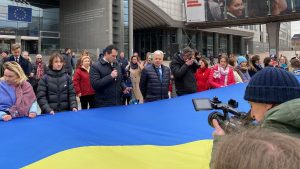
Short Video on extract of speech by Commissioner Reynders at the opening of the exhibition on Ukraine Resilience despite the atrocities of Russian Agression commited in Bucha. www.RememberBucha.eu
Click on the this Link: Ukraine Reynders 24-2-2023


Research Teaching Consulting
Short Video on extract of speech by Commissioner Reynders at the opening of the exhibition on Ukraine Resilience despite the atrocities of Russian Agression commited in Bucha. www.RememberBucha.eu
Click on the this Link: Ukraine Reynders 24-2-2023
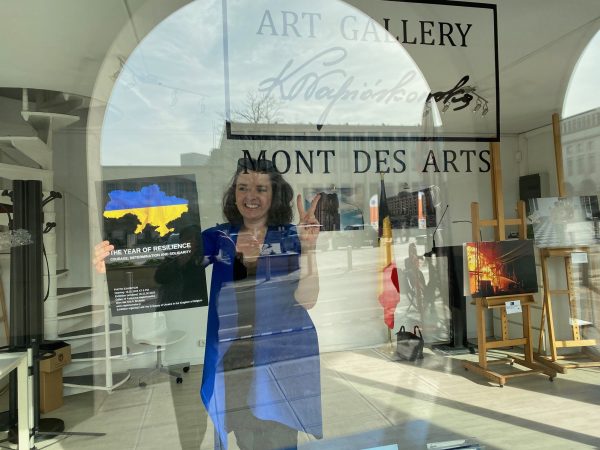
360 days of traumatising war of Russia in Ukraine. Yet, Ukrainians manage to stem the invasion this time for a year. My generation of baby boomers in Western Europe no longer knows the day to day horrors of war. A photo-realistic exhibition organised by Dr. Justyna Napiórkowsak together with the Ukrainian Embassy in Brussels brings to us more than images of destruction. The Exhibition builds on a transparent organisation. All day and night long you can feel and reflect in front of the gallery windows of what war means to people affected. Rather than passing over the daily horrific news, it is important to take in images that will last within you. Since the exhibitions excels in linking to strong own emotions, the images tell lasting stories. Communicating about war is difficult. This exposition at the “Mont des Arts 8” in Brussels, not far from the “Place des Martyres” is symbolic. Ukrainian artists are going to stay with us, showing us what “The year of resilience. courage, determination and solidarity” mean in the Europe of today. Ukrainian youth, like the whole population, demonstrates all of this in posing for their 2022 graduation photo (Stanyslav Senyk, 2022) actually within the ruins of their city. They seem to sing: “We shall build this city on rock and roll” again. Ukrainian culture is unique. Putin’s Russia is still living in the 50s state of mind. The Russian soldiers might soon have their 60s moment “make love, not war”. For persons with Russian roots in Eastern Europe it feels like what you believed or were told was a friend before is now turning around and you shooting at you including committing war crimes (Geneva convention) on you. The exposition is a “homage to Ukraine”, Ukraine’s resistance and resilience. Teaching us lessons, lessons we should like to learn fast for the survival of democracy and our way of life based on freedom not coercion. The sociology of war informs what the term “Zeitenwende” means. Look at it, rather than look away. As previous College Master at Jacobs University Bremen graduation ceremonies were very personal and emotional events meeting students, many with their families. Ukraine 3.0 will prevail eventually. Thanks, Justyna for putting images 360° and 360 days next to this optimistic message. 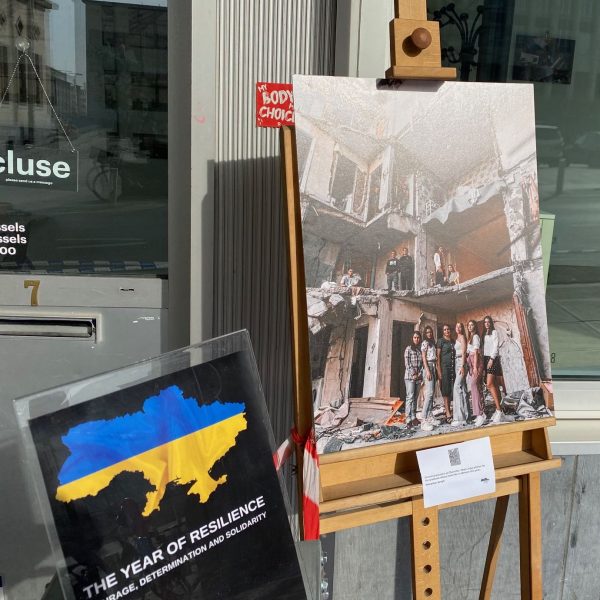
Eine Sammlung von Aphorismen, wie sie Georg Christoph Lichtenberg hinterlassen hatte, regten viele Denkende an, sich mit seinem Gedankengebäude zu befassen. Die prägnante Form der Zusammenfassungen, Hypothesen oder Vermutungen zu jeweils einem großen Thema hat ihn unsterblich werden lassen. In Form von Gedankenblitzen, Neudeutsch Tweets, vor mehr als 222 Jahren, gestorben ist er im Jahr 1799, zeugen von großem Weitblick, Tiefe und Breite seines Wissens (Polymath). Jede Person, die sich heute in der Schule mit der Infinitesimalrechnung befasst, der mathematischen Annäherung an einen GrenzwertS (Mathe Vorlesungsnotizen pdf), findet bei Lichtenberg zum Beispiel die Anwendung dieser Methode auf soziale Phänomene. Einer Wahrheit werden wir uns auch nur annähern können, selbst wenn wir sie auf unsere Weise, zumindest temporär, als solche definieren. Vor mehr als 250 Jahren hat Lichtenberg bereits in seinem ersten „Sudelbuch“ interessante Gedanken niedergeschrieben, die uns heute noch Nachdenken lassen. „Unser Leben hängt so genau in der Mitte zwischen Vergnügen und Schmerz, dass uns schon zuweilen Dinge schädlich werden können, die uns zu unserm Unterhalt dienen, wie ganz natürlich veränderte Luft, da wir doch in die Luft geschaffen sind.“
Dem modernen Menschen ist das Bewusstsein, in die Luft geschaffen zu sein, fast vollständig abhandengekommen. Unsere Eingriffe, wider besseren Wissens, lassen weltweit jährlich Millionen Menschen vorzeitig sterben am Smog der Moderne. Innovation ist enervierend, wenn sie nicht vornehmlich den Menschen im Blick hat. Es sollte noch einige Jahre nach Lichtenberg brauchen bis Goethe Faust den Satz sagen ließ: Die Geister, die ich rief, ich werd’ sie nicht mehr los. Lichtenberg setzte das obige Zitat so fort: „Allein wer weiß, ob nicht vieles von unserem Vergnügen von diesem Balancement abhängt; diese Empfindlichkeit ist vielleicht ein wichtiges Stück von dem, was unsern Vorzug vor den Tieren ausmacht.“ Aus dem Akt der Balance den jede/r Einzelne zwischen Schmerz und Vergnügen im Lebensverlauf beschreibt ist längst ein gesellschaftlicher und politischer Balanceakt geworden, zwischen gesellschaftlichen Gruppen sowie zwischen Generationen. Die Abweichungen von einem Grenzwert oder von einem ausbalancierten Zustand sind ebenfalls größer geworden, so dass der ganze Akt ins Wanken gerät. Mit dem beschriebenen, unserem Vorzug vor den Tieren, könnte jedoch ebenfalls ein Teil des Problems sein, denn die Vernichtung der Biodiversität ist nun mal noch die Lebensgrundlage des homo sapiens. Seien es Schwankungen um einen Mittelwert oder immer kleinere Annäherungen an einen Grenzwert, wir wanken auf Pfaden, die Lichtenberg angerissen hat. Blogposts sind wohl vergleichbar den Einträgen in Sudelbüchern. Aus vielen Puzzleteilen kann ein Gesamtbild entstehen, muss aber nicht. Die Begriffe „Random Walk“ oder „Brownsche Bewegung“ sind erst lange nach Lichtenberg entwickelt worden. Heute sind wir von dem „Random Walker Algorithmus“ begeistert oder erschreckt, wenn letzterer für „fake news“ statt Wahrheitsfindung missbraucht wird. 
The fifties are remembered as the prosperous and booming years in the 20th century, worthy of nostalgy for some. Indeed, after the 2nd world war and its destruction the time of re-construction had come already some way, thanks to the Marshall plan of the late 1940s. Most countries had to turn huge military equipment industries into civil uses. After the Schumann Declaration, the European Coal and Steel Community was a first successful and lasting institution building in Central Europe. A mass production boom of cars, civil aircrafts, radio and the beginning of public television were landmark changes in the relationship of technology and society. The U.S. became a leading force in this evolution pushing for free trade between countries and consumerism. The deprived generations of the war period in the 40s welcomed the “fabulous fifties” (Arleen Kelin, 1978) as a dynamic and prosperous decade, despite dramatic speed to innovate new more deadly weapons. The atomic bombs were tested from superpowers and nuclear energy started to surface. Solar cells and optic fibres were also inventions of the mid-50s. Strange that we had to wait for another 70 years and multiple crises before these resource-efficient technologies achieved popular success. Integrated circuits, micro-chips, the laser, Tupperware, Coke, Lego, Mickey Mouse and global cinema came upon us during the 50s. The Sputnik effect re-opened an arms race as part of the cold war including outer space beyond airplane reach.
Families longed for and indulged in an as normal as possible family life. Unfortunately, this meant for many women, who had worked outside home during wartimes, to return to a role of housekeeping. Rock n Roll and increasing consumption of mass produced products could compensate for some of this deprivation. Higher divorce rates in the 60s and/or lack of own pensions were the dire consequences for many women. Showtime, and showing-off were the mantra of the 50s. Glamour (Magazine) rose to cult status and prepared popular culture and art. Following fashion and awareness of design spread across societies enabled by the easier access to “sewing machines” allowing more home production for the middle-class persons. The “people of plenty” (Andrew Dunar, 2006 p.167-8, referring to David Potter, 1954) were effectively sold a car culture with the automobile as an agent of change.
The atomic era was believed to continue prosperity for more decades (Expo 58 in Brussels) and a delicate, but relatively stable balance of power restricted open wars. “The End of Ideologies” during the fifties (Daniel Bell, 1960) lead to focus on Realpolitik and a race for prosperity, oblivious of the ecological consequences for many decades to come. 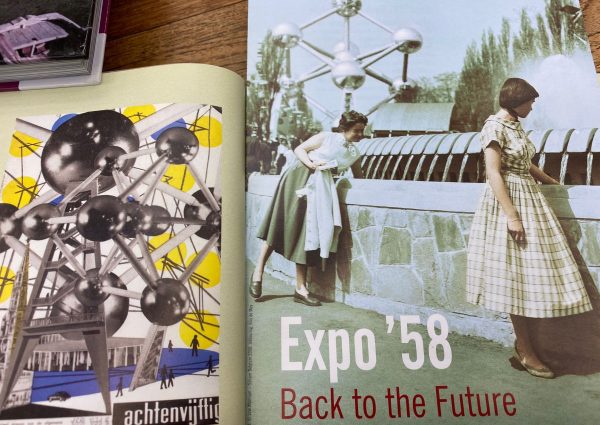
The evolution of time is fascinating as research topic. Both in theoretical as well as empirical approaches. Beyond the precise measurement of time and the use of time in measuring working time, which intensified during the industrial revolution, we witness continued struggles over the length and the organisation of working time. The 30+X hours week working time could be reorganised into a 4-days week to improve work-life balances for millions of people. The effects are not only on employees directly concerned, but also on their families and/or households involved.
The changing perception of time (as being short of time) and its evolution over time needs huge surveys collected over time (known as “Time use studies”). Inequality over the life course remains an issue with a persistent gender bias. Unhealthy and excessive overtime work is still a problem, usually negated by upper ranks in hierarchies.
Let us start to imagine different concepts of time to maybe one day overcome the shortcomings of our current understanding and use of time. Usually, time is considered a linear concept, one day follows another day and so on. Time, depicted as an arrow or a horizontal axis in graphical representations, is helpful for most processes we observe. If our aim is to explain a social process which evolves over time, we could perceive time as running with different speed in, for example, urban and rural areas of the same country. The liberalisation of women or peace movements evolved or spread with different speed in different regions. The 60s became known for many women as the decade when the control of reproduction allowed different life styles. Concerning reproductive behaviour and divorce rates a break in series compared to previous periods is observable, reduction of reproduction and diffusion of divorce throughout societies. Instead of continuous time we might speak of discrete time, in for example decades like the 60s, 70s, 80s. In retrospect “social time” seems to have passed faster in one decade than the other. We might also imagine time as growing exponentially as time². Taking into account the slowing down and successive rise again of evolution over time, the time trend might look like a rising wave (time² + time³). In econometric models testing of such hypotheses is feasible, although it is more difficult to convince reviewers of an alternative theoretical model of time.
An investigation of trends of democratic behaviour over time would need to adjust for the potential and sometime measurable return of undemocratic practices for periods. A depiction of such “social time” of democracies as an upward rising line with periodic relapses is a plausible theoretical framework. Trajectories of inwards or outwards spiralling processes are already fairly complex trends for the process of democratisation as the phenomenon to explain or the modelling of a time trend to explain the level of democratisation reached so far. Challenges of time frames for independent and dependent variables in social processes might be questioned altogether to claim that time is a spurious occurrence of events much like a process of a so-called “Brownian motion” also named white noise. In fact, not being explicit about the concept of time applied in social analyses amounts to a severe neglect. Examples of such neglect are certainly all those cross-section studies, still pervasive practice, in social sciences or opinion polls. The linear concept of time, as a chronologically processing arrow of time, is a convention useful for synchronisation of action. However, this synchronisation is already debated more forcefully with more persons being unsatisfied with the use of synchronisation as a tool to regulate our “social time” and social processes. Time zones, summer and winter times challenge our day-to-day perception of everybody living at the same time, speed or intensity. Bedtime for me, wake-up call for others, or vice versa. 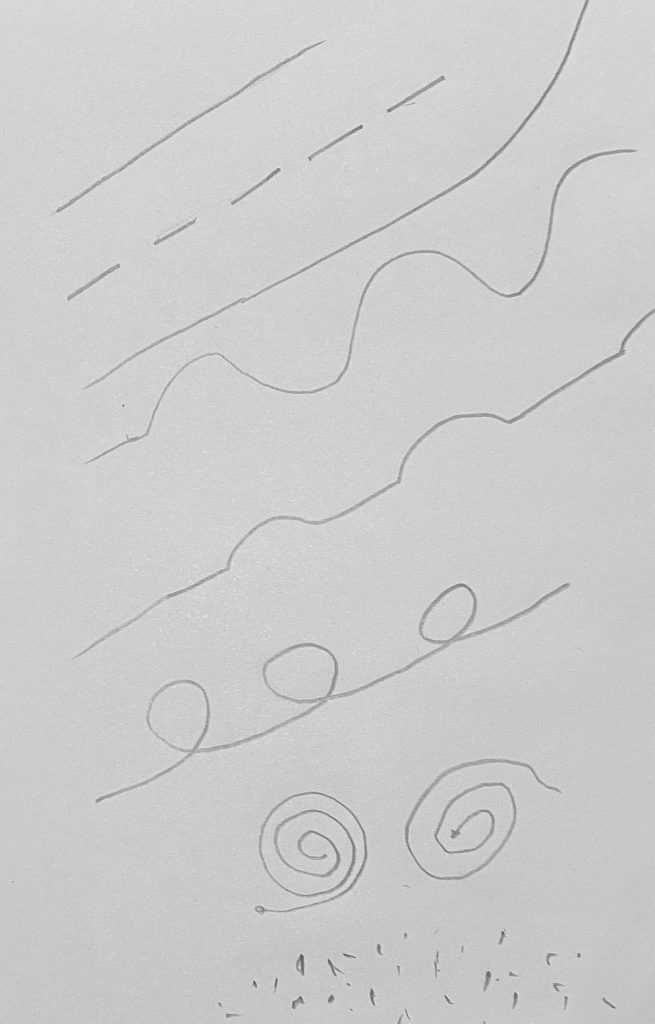
Languages are simple once you understood the making of them. Take children, they learn the alphabet first, and use notions or images in alphabetical order, which you associate with this list of short words from A to Z in western cultures. From short words like “Cat” and “Dog” the learner moves on to longer ones like “Bird”, just 4 letters now. More advanced learners then use more letter words like “supercalifragilisticexpialidocious” invented for amusement in the Disney-film Mary Poppins. It sounds a bit like one of those never-ending long German words with lots of nouns just added on. This is exactly what we shall do in the following. A bit like in computational linguistics when ChatGPT is predicting the next word, we use algorithmic thining to form new combinations of an alphabetical list of notions. We start in the table below with column 1, then tell our spreadsheet to copy cells A1-01 to Z1-26 list and insert it in the second column just one cell below and insert Z2-27 at the place on the top of the list of column 2, which is A2-01. Then take this column 2 and repeat. Stop after, lets say the repeat counter is N=25.
The first 2 words combination then is “Action Zero”. Take this, enter it into Computer Search and take the top entry. “ActionZero” is an actual company name proposing actions to achieve net-zero emissions. Following this, we produce a whole encyclopedia of pretty up-to-date knowledge from the WWW with hardly any humans involved anymore. We only need to cut out duplicates and nonsense entries. That’s what most editors or teachers are used to do. Knowledge creation might no longer be reserved to the human species. Oh my God – but the machine might eventually sort this word out as nonsense concept, too. The new mantra could be ZeroGod or let us try the reset like in GodZero. In other words we move from HamletMachine to our own KnowledgeMachine. 
It is the role of scientists to ask questions. “The New Scientist” asked in one of its recent editions the fundamental question of what are the limits to knowledge? Nice, they provide 5 parts of an answer to the question. (1) According to Karl Popper, the falsification guy, knowledge is only valid as long as it has not yet been falsified. Hence, a limit to knowledge exists where we cannot falsify a hypothesis or theory, i.e. for example when empirical measurement is impossible. (2) Mary Douglas’s messy problems have been claimed as another limit, or as the New Scientist puts it, “when things are outrageously complicated”. Chaos theory, applied in climate modelling leads us to learn about the potentially huge impact of tiny, little things. (3) Our tools to look into the sky have improved since Ticho Brahe‘s time before the telescope was invented. Most of our knowledge about the universe has only be as accurate as the tools to capture radiation or to observe planetary movements. Therefore, the next limit arises from the fact, “when our best tool to describe the universe may be unreliable”. (4) “When we can’t directly experience something”, we might be unable to understand the concept of colour another person or animal is experiencing. Listening to colours is possible for some, but generally we would not accept such experiences without recourse to drugs, maybe. Bats use ultrasound frequencies, especially trained blind persons use “click sounds” for orientation. Dialetheism is another branch of the philosophy of science and knowledge, a bit hard to digest, as empirical evidence may lose its importance. Its all dialectic or what? (5) If “logic itself is fatally flawed”, what are we left with to construct as knowledge, beyond logical sequences or even causality itself is in question. The Condorcet paradoxon or the impossibility theorem shown by Ken Arrow is an example where it is impossible or very tricky to arrive at a logically consistent solution to a social choice issue. Our tree of science and knowledge grows, undeniably, every second even. Where are we located in this forest now? Thinking of a tree up-side-down shows some have roots even bigger than the visible branches.
Does the Panda bear in the Berlin Zoo have a cognitive map of the cage in his mind? Do they care? Only recently they even had a baby Panda bear there. 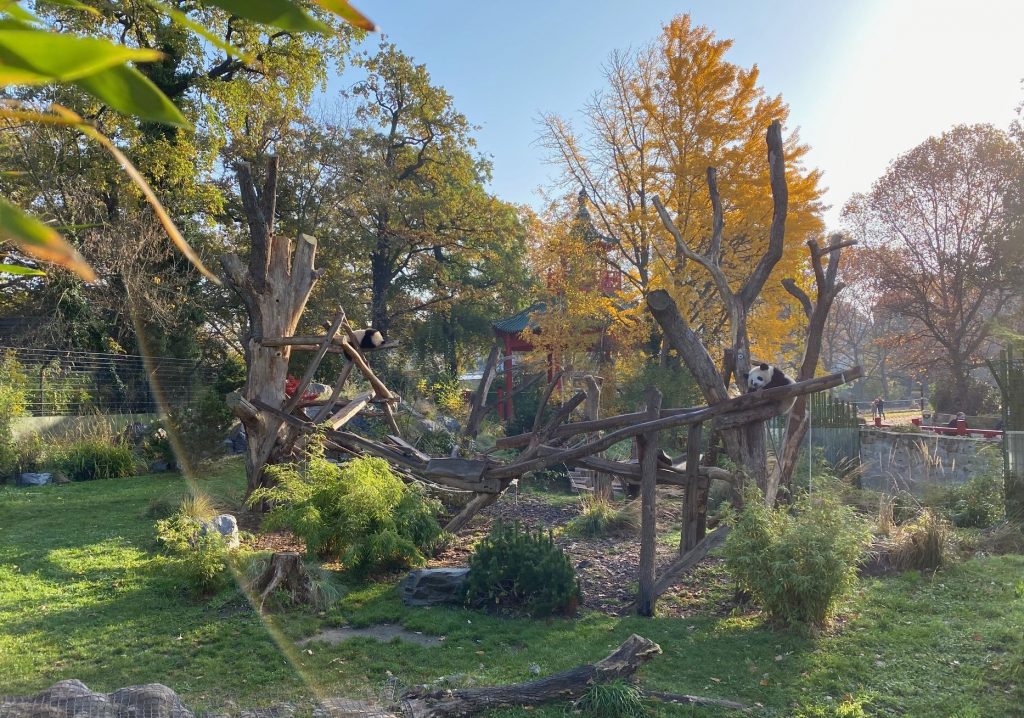
The urge to program human language originates for some in the quest for better explanation or understanding, for others in the improvement of communication. Both approaches have witnessed rapid evolution in recent years. Based on linguistics, psycholinguistics, sociolinguistics or neuroscientific advances, the potential of knowledge creation and communication has risen due to computational models and applications to linguistics. ChatGPT3 and Neuroflash allow us to play around with the commonly available AI-applications. Construction of a linguistically informed Glossary of political and social ideas is a specific application case. In addition to the subject/object list we may add predicates or verbs to link subjects and objects. For this purpose, we construct a basic alphabetical list below which draws mainly on action verbs and is embedded in the socio-cultural environment of the sciences in general. A categorised list of verbs, like the one from Purdue University, is helpful to draw on several relatively distinct fields. With perspective on labour market or societal relevance the list focuses on verbs related to skill sets: administrative/managerial; communication; creative, information/data; caring/helping; efficiency; research; teaching/learning; technical. The categories are not mutually exclusive and may well be supplemented by additional categories like relational skills and transformational skills. Computational psycholinguistics (Crocker, 2006 pdf-file) differentiate the “principle of incremental comprehension” (add one word at a time) from the “concentric theory of complexity” (start from complexity to specificity or vice-versa) and the “deductive sentence processor”. ChatGPT is built on the incremental approach, supposed to be the fastest and probably a more reliable computational approach. We could just attempt to use the other approaches in the simple ABC glossary of subjects, objects and predicates to test for the possibility to build no-nonsense short sentences using random choices as starting points. The Oxford handbook of psycholinguistics highlights in the final chapter the theoretical alternative of connectionism (p.811). Symbolic computation construes cognition as mental states that are symbolically represented. The sequence of operations then runs from one representation to the next one. However, the connectionist model operates more like a neural network and proceeds with the parallel processing of notions, relations or patterns. A list of predicates or verbs might do the trick: Chose a subject, chose a predicate and an object to start playing around: Subjects: action balance corruption democracy enterprise freedom god health imagination joy knowledge law memory nature optimism policy question repairing society time union value war xeno yinyang zero.
Predicates: applies broadens creates directs establishes forms generates helps induces jeopardises keeps likes moderates needs opposes prioritises qualifies represents strengthens tests uses varies weighs x-outs yields zigzags.
Objects: freedom god health imagination joy knowledge law memory nature optimism policy question repairing society time union value war xeno yinyang zero action balance corruption democracy enterprise.
Linking information, explanation and entertainment is the power of the world wide web. The tool used for this is the hypertext format of texts and media in general. Wittgenstein was already dissatisfied not to be able to show the steps of his thinking more explicitly. In the “Tractatus logico- philisophicus (Link to pdf-file de/engl” he uses the a cube (5.5423) to explain that we see to different facts depending on our point of departure of our vision. Try it with the logo of www.schoemann.org you should realize how our vision swops from one way of viewing the cube to another. The white corner is once in the front of the cube and appears to be in the back, when you move your vision further up. In general this leads us to be careful with the choice of our point of departure, not only for our vision. Context, some say background, is important to determine starting points. Adding the hypertext markup language to a document, like in a blog entry, allows readers (+algorithms) to see the cognitive structure surrounding a text as well. Potentially as a reader you enter into a multidimensional space with each blog entry. Any encyclopedia, glossary or index has an apparent alphabetical order to entries, but the links between the multiple entries remain hidden at first sight. With use of hypertext this has changed and each entry is turned into a 3-dimensional space, for example. Additionally, all entries have different numbers of links to other entries including dead-end entries. With the structure of links it is interesting to learn about the self-referencing just as much as about the disciplinary locus of a text, chapters, a book or a library. This helps to still see the forest despite all those trees in front of us ,or we see the geological structure of the mountain while in the middle of the forest. Happy travelling in our new knowledge space! 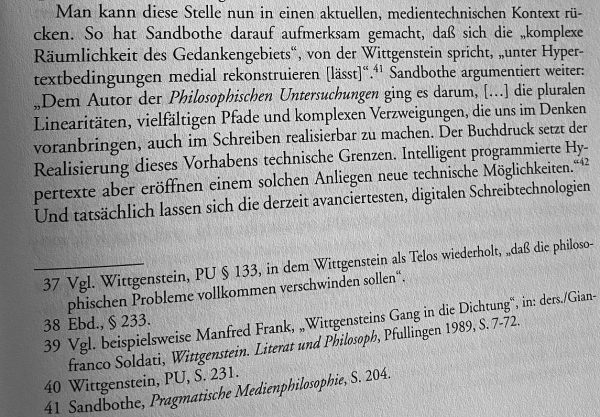
Action words are in other words called action verbs. Each complete sentence has one. Hence, they are part and parcel of the basic construction of sentences.
“The purpose of an active verb is to create a clear, concise sentence. By using an active verb, you can eliminate unnecessary words and make your writing more direct. In addition to making your writing more concise, active verbs also add punch and clarity. They can make your writing more interesting and persuasive. Additionally, active verbs can create a sense of immediacy which is often useful in persuasive writing. When it comes to writing, there is nothing more important than using strong, active verbs. Not only do they make your writing more interesting and engaging, but they also convey a sense of confidence and authority. In addition to being more descriptive, active verbs also add a sense of movement and action to your writing. Rather than simply stating that something exists, you can use active verbs to show how it exists. For example, rather than saying “there is a chair in the room,” you could say “the chair sits in the corner of the room.” This may seem like a small change, but it can make a big difference in how your writing comes across. Finally, active verbs can also help to set the tone of your writing. If you want to convey a sense of wit and humour, then using playful, lighthearted verbs is a great way to do so. On the other hand, if you’re aiming for a more serious tone, then using powerful, authoritative verbs will help you achieve that.”
After the 3rd sentence this blog entry (Link) has been written by the artificial intelligence app “Neuroflash”. They promise that it is not just copy and paste, but rather written following some instructions I gave like title, table of content, style and then selected among several choices. It makes sense to me, although it is just like many other textbook entries I have found on the web. It may well serve as an introduction. Lazy journalists, priests or lawyers in case they do little research will be replaced soon by AI, who else, who is next? Big brother drafts the brave new world for us already.