Die Zeiten, in denen Zigarrenrauchen Schlagzeilen machten, sind eigentlich lange vorüber. Heute wundern wir uns lediglich über die Sorglosigkeit der Personen bezüblich ihrer Gesundheit. Friedrich von Flotow hat die Szene im Salon de Marquis de Custine (Paris) in seinen Erinnerungen vorzüglich beschrieben. Die Schriftstellerin George Sand hat die Gemüter mit dieser Rauchszene nachhaltig inspiriert. Frédéric Chopin (1810-1849) hat an diesem Abend seiner (späteren) Mäzenin eine Ovation dargebracht. Flotow hatte sicherlich einen inspirierenden Abend verbracht. Seine unveröffentlicht gebliebenen Memoiren wurden von seiner 3. Frau publiziert. Ein Vorabdruck auf Schwedisch habe ich in der Svensk Musiktidning vom 15-8-1883 gefunden. Datiert ca 6 Monate nach seinem Tod, heute vor 140 Jahren, ist das eine Würdigung des Komponisten in Schweden und eine Anerkennung der Aufarbeitung und Verbreitung seines Werks durch seine Frau. Die Aristokraten und ihre Kreise waren Anregung für viele künstlerische Kreise. Das wohlhabende Bürgertum hat später diese Rolle übernommen. Heute brauchen wir zahlreiche öffentliche und private Stiftungen oder Crowd-Funding für diese Events und Inspirationen.
(Quelle: Flotow, Friedrich von. (1883). F. von Flotows minnen. II. En soaré hos marquis de Custine [Beskrivning av G. Sand (baronesse Dudevant) och Chopin]. Svensk musiktidning, 3(16), 121–122. ) 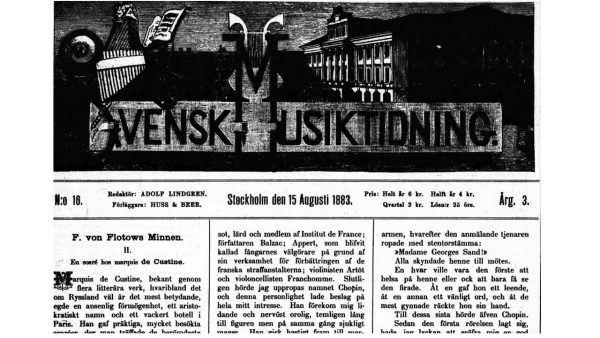
Linguistics
The urge to program human language originates for some in the quest for better explanation or understanding, for others in the improvement of communication. Both approaches have witnessed rapid evolution in recent years. Based on linguistics, psycholinguistics, sociolinguistics or neuroscientific advances, the potential of knowledge creation and communication has risen due to computational models and applications to linguistics. ChatGPT3 and Neuroflash allow us to play around with the commonly available AI-applications. Construction of a linguistically informed Glossary of political and social ideas is a specific application case. In addition to the subject/object list we may add predicates or verbs to link subjects and objects. For this purpose, we construct a basic alphabetical list below which draws mainly on action verbs and is embedded in the socio-cultural environment of the sciences in general. A categorised list of verbs, like the one from Purdue University, is helpful to draw on several relatively distinct fields. With perspective on labour market or societal relevance the list focuses on verbs related to skill sets: administrative/managerial; communication; creative, information/data; caring/helping; efficiency; research; teaching/learning; technical. The categories are not mutually exclusive and may well be supplemented by additional categories like relational skills and transformational skills. Computational psycholinguistics (Crocker, 2006 pdf-file) differentiate the “principle of incremental comprehension” (add one word at a time) from the “concentric theory of complexity” (start from complexity to specificity or vice-versa) and the “deductive sentence processor”. ChatGPT is built on the incremental approach, supposed to be the fastest and probably a more reliable computational approach. We could just attempt to use the other approaches in the simple ABC glossary of subjects, objects and predicates to test for the possibility to build no-nonsense short sentences using random choices as starting points. The Oxford handbook of psycholinguistics highlights in the final chapter the theoretical alternative of connectionism (p.811). Symbolic computation construes cognition as mental states that are symbolically represented. The sequence of operations then runs from one representation to the next one. However, the connectionist model operates more like a neural network and proceeds with the parallel processing of notions, relations or patterns. A list of predicates or verbs might do the trick: Chose a subject, chose a predicate and an object to start playing around: Subjects: action balance corruption democracy enterprise freedom god health imagination joy knowledge law memory nature optimism policy question repairing society time union value war xeno yinyang zero.
Predicates: applies broadens creates directs establishes forms generates helps induces jeopardises keeps likes moderates needs opposes prioritises qualifies represents strengthens tests uses varies weighs x-outs yields zigzags.
Objects: freedom god health imagination joy knowledge law memory nature optimism policy question repairing society time union value war xeno yinyang zero action balance corruption democracy enterprise.
Writing
“Are you writing or what?”
New research on the fabrication of writing allows to debunk some of the received ideas about writers as living and drafting in a solitary space. However, the facts frequently show something different. In the journal of the BnF (images 2022), (Chroniques des la BnF Nr. 95 p.9 pdf-file) the BnF makes transparent the creative cosmos of Marcel Proust (Exhibition closed). From correspondence and other influential images, we learn about the “fabrique de l’oeuvre”. Far from writing his books from front to end in a linear fashion, Proust drafts “isolated sequences which he mounts, demounts and regroups sometimes even years later. These clippings of text are arranged by him like a patchwork, a collage rather than following a linear progression. Just peeping into the writer’s studio, drafting style and “paperoles” is fascinating. What a mess, some would say. What a huge imaginative space he has been living in, despite being reported to draft most of his work while actually being in his bed (Lire Magazine 12-2022). Beds are not always for sleeping, only. Today’s start-up enterprises frequently start from home, a century ago Proust demonstrated a lot can result from a very tiny physical space, but an enormous space in mind. 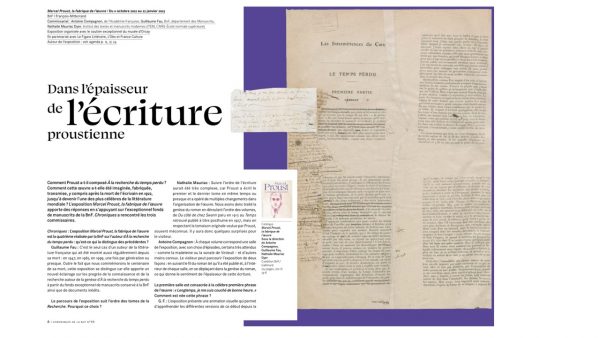
Syntax
Syntax is just one of the categories of linguistics. Carl Lee Baker (1989) wrote a whole book 500 pages on just English syntax, can you imagine. I like his modesty in the introduction stating that English syntax is just a subfield of linguistics (p.12). Other languages have different structures, some might be very different from our ways to communicate even. The ways how animals or plants communicate is an exciting subfield of linguistics, psychology and biology (Carrie Fidgor, Pieces of Mind). The SPO structure of sentences is only one simple way of constructing sentences. Syntax is much more complex. The sociological aspect of linguistics and syntax lies in the “acceptability judgements”, which are present once we establish rules and sort phrases into correct or incorrect sentence structures. Norms and standardisation as well as authority to decide on correctness becomes an issue. Countries used to many dialects or multilingual populations are confronted with these issues on a daily basis. Linguistics as basis of communication is continuously present even in the mental structure. Bilingualism, tri-lingualism and their effects on minds, competences, behaviour, culture and societies are own thriving research fields. Building a sentence or a phrase, following Baker, is built around a head and their complements. Such minimal phrases are comparable to what we coin in a simplified manner the subject-predicate-object structure of a sentence. The definition of the nucleus of the structure of a sentence is also about conventions and acceptability. Staccato speech and rap-music are examples of forms of speech, which are often considered beyond the normal. Computer voices are becoming more normal as we are faced with chat bots all around us now. The image below reflects the simplified “representation of syntactic structure” (p.48 The Cambridge grammar of the English language 2002 review here). To play around with “Clause”, let us analyse the clause: I bought a shirt; I wonder what I bought. You know what I mean Klaus, it is a clause, or is it Dady gone gaga = DADA? 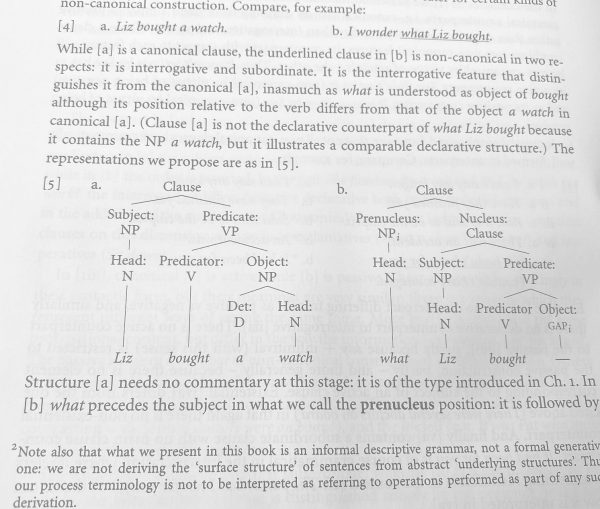
Hypertext
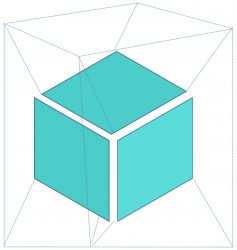
Linking information, explanation and entertainment is the power of the world wide web. The tool used for this is the hypertext format of texts and media in general. Wittgenstein was already dissatisfied not to be able to show the steps of his thinking more explicitly. In the “Tractatus logico- philisophicus (Link to pdf-file de/engl” he uses the a cube (5.5423) to explain that we see to different facts depending on our point of departure of our vision. Try it with the logo of www.schoemann.org you should realize how our vision swops from one way of viewing the cube to another. The white corner is once in the front of the cube and appears to be in the back, when you move your vision further up. In general this leads us to be careful with the choice of our point of departure, not only for our vision. Context, some say background, is important to determine starting points. Adding the hypertext markup language to a document, like in a blog entry, allows readers (+algorithms) to see the cognitive structure surrounding a text as well. Potentially as a reader you enter into a multidimensional space with each blog entry. Any encyclopedia, glossary or index has an apparent alphabetical order to entries, but the links between the multiple entries remain hidden at first sight. With use of hypertext this has changed and each entry is turned into a 3-dimensional space, for example. Additionally, all entries have different numbers of links to other entries including dead-end entries. With the structure of links it is interesting to learn about the self-referencing just as much as about the disciplinary locus of a text, chapters, a book or a library. This helps to still see the forest despite all those trees in front of us ,or we see the geological structure of the mountain while in the middle of the forest. Happy travelling in our new knowledge space! 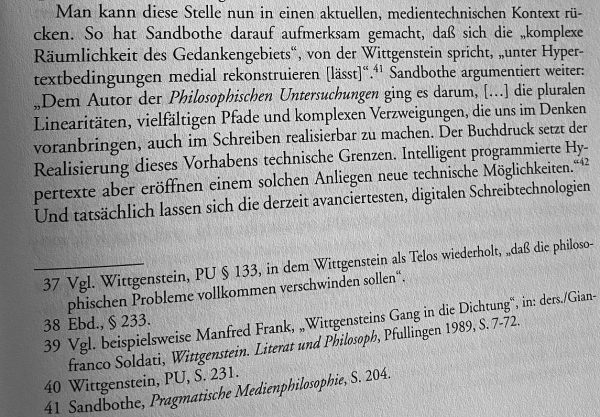
Inspiration
Artists and scientists, all have their sources of inspiration. The most beautiful way of putting this is contained in a poem by Jacques Prévert. “Moi aussi, comme les peintres, j’ai mes modèles…”. The source of inspiration varies from physically present models to imagined ones. Painters and sculptors, we imagine, have their models right in front of them and build on their specific kind of observation, view and vision, seeing more or differently from others, at least since modern times. Poets and authors are believed to draw inspiration from abstraction and imaginative description and narration. Musicians tend to rely on hearing fine-tuned or creative tensions, as much as the resolution in harmonies through sequences of sound. All seem to have a sensitivity beyond the normal and a skill to find a way to transmit to others. Photographers catch representative moments or visualize artifacts and combinations of them in new ways. Scientists are not so different as we might think. Imagination of new hypotheses in established fields is part of their skill set. The transversal skill in all these processes of inspiration is the openness to cross-discipline fertilization. So-called Polymaths reached excellence in more than one field of science, “Polyartists” touch several fields of different arts. Further new innovative combinations of disciplines like they are practices in “centres of advanced studies” are a first step to brings down walls in mindsets and disciplinary ivory tower practices. It will take only a tiny little step forward to come back to the practice of royal courts. The person called “fou du roi” had an important role to play, not only in the game of chess, but in questioning and entertaining leaders. I wish universities, science centres and ministries would allow themselves more of this kind of inspiration. Inspiration is considered here as a source of questioning your own approach from another perspective. Look at your phenomenon of interest with a different model or imagination in mind. New synapses will follow. Let us welcome them to make the world around us a better or more beautiful place. Wait, is more beautiful enough already? Is this a contradiction, better versus more beautiful, or is the latter a subset of the former, or is a tautology anyway? The catalogue of the exposition “Archives des rêves” du Musée d’Orsay gives plenty of insights into images as sources of inspiration for people of all walks of life. 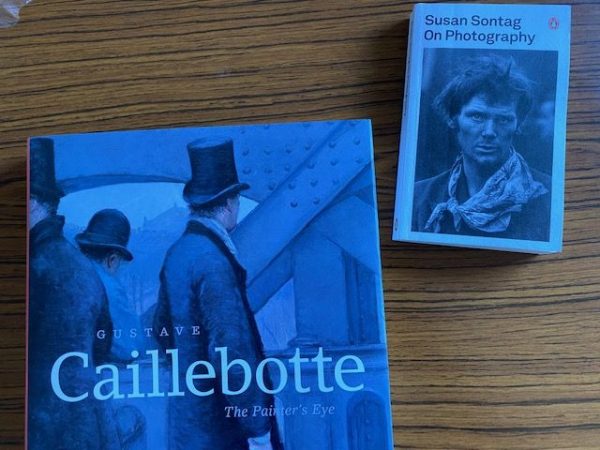
Giselle
Once upon a time, not at the Opera de la Bastille, but next it, in a small theatre called Théâtre de la Bastille, the fairy tale of “Giselle…” was performed. The world-famous ballet Giselle (Karlsruhe Programmheft) is still amongst the most frequently performed magic piece of classical ballet. What is it about? In short: sex and crime. Yes, and it sells well.
Francois Gremaud tells the classic story of excitement, love, deception, death, regret, haunting and memory in a concise and witty fashion. The exemplary dancer is at the same time the narrator of the story as well as the critic and art historian accompanied by a 4 musicians strong orchestra. The educational piece with a “womanxplainer” on stage is great entertainment, full of references, why it is still okay to like the piece in spite of its fantasy-loaded content. Modern dance (Cunningham, De Keersmaeker) has decoupled or emancipated movement from music. In classical ballet, at least, you still know what comes next and this is aesthetically appealing for most people. Besides Wilfried, no he is not part of the “Wilis” (could be an interesting variant), but in the ballet there figures “Hilarion”. He is not hilarious at all. Splendid entries are from Myrtha (close to Martha, but not quite the same) and, of course, Giselle, when she leaves her tomb and turned into a “Wili”. Then there is Albrecht in a pas de deux with Giselle, swirling between earth and space. Aldi dances like mad on impulse from Myrtha, but Giselle vanishes nevertheless. End of story, or is it? Giselle is a Wili and Aldi is the wally. Maybe the story could be retold like in the film “Billy Elliot – I will dance”, which is an emancipatory tale where dance is the liberation rather than part of the dooming fate.
Francois Gremaud with the astonishing performer and choreographer Samantha van Wissen have created a version of Giselle that is musical, aesthetic, funny and critic. For those who enjoy an epic theatre version of Giselle including its “alienation effects”, referring back to Berthold Brecht, will want to read the script as well, kindly distributed as a gift after the show. 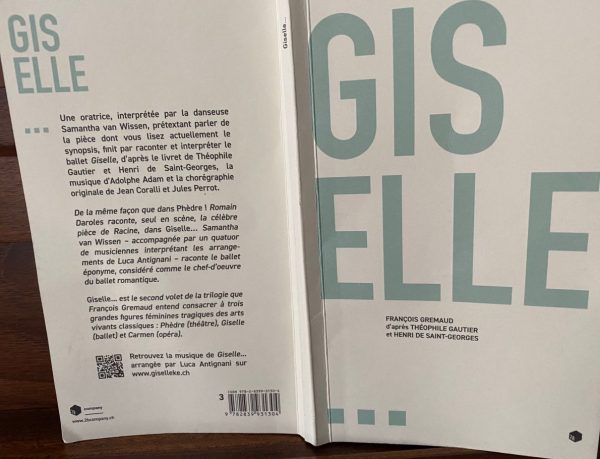
Employment
Employment is back on top of the agenda. Not as we used to think, though. Previously unemployment had dominated societal concerns. Now it is the lack of persons seeking or available for employment. What has happened? The Covid-19 crisis has demonstrated the need of persons qualified to work in the health sector. From health care and urgency care, we are short of personnel in all these fields, everywhere. 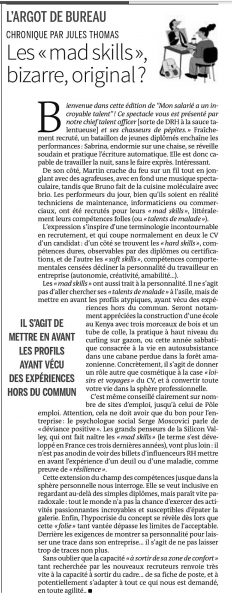 Then we discovered the role of essential services and the need to equip crucial infrastructures like ports, transport, shops, schools and ambulances with service persons resisting despite work overload. Larger cohorts leave employment to retire, some even early due to illness or burn-out. Additionally, war is back in Europe. Military personnel is in high demand again, drawing largely from younger cohorts. The need for conventional weapons. long thought to be oblivious, is forcefully back on the agenda.
Growth potentials are everywhere. However, these pre-modern facts encounter a population in the western democracies that insists on new approaches to employment. Beyond hard and soft skills, recruiters seek atypical skills, competences and trajectories. A parachute jump from an airplane, cooking and dining experiences, caring spells, periods in self-employment, all are directly or indirectly relevant for employment and teamwork. So, what is your specialty? Collecting stamps? Surely you are able to spot tiny differences in images with specific content. Fake news and fake image detection or video surveillance is in high demand, just try an application and discover the employment potential of your MAD skills. Sounds crazy? No joke. Skill needs are everywhere, just give it a start again and again. Read a serious newspaper regularly (here LeMonde 19.1.2023) for inspiration.
Relation
Several inputs from logic will assist us to establish relations between 2 objects, 2 subjects or 1 subject and 1 object as in simple relationships to form sentences. The most obvious is A = B. The most common, depending on definitions, A is not equal to B, hence A >B or B>A. Medieval logic adds the consideration of consequences and suppositions to relationships. A determines or leads B. We might suppose that A is a precondition for B. Logical arguments often attempt to explain. Mathematical proofs chose ways to deduce or induce, whether a statement is true or false. To reduce the number of lines to explain a theorem is a mathematical virtue, just like in a game of chess to find a check and mate in fewer moves.
Leibniz increased the repertoire considerably. In geometry objects are parallel or in the infinitesimal calculus they approach each other without ever reaching each other. With the art of combinations he describes a language than contains groups and elements. The binary revolution, to express numbers, letters, images in form of pixels as multiple assemblies of 0 and 1, has revolutionized our potentials. Beyond these determined relationships there are stochastic relationships, they happen more or less likely. The centre of logic relationships remains deductability = to deduce, consistency = to consist of and completeness = to complete (Encyclopedia Universalis 14, p.653). Time adds another dimension to our concern to exemplify relations. A pre-empts B, or B follows A in time, but not in respect of deterministic logic. Additionally, locations in space of 2 objects allows us to imagine additional abstract forms of relationships, artists play around with this continuously. Some artefacts have created fantastic new ways to challenge our learned ways to consider relations. Last but not least, sound has contributed to how we perceive relations. To superpose, transpose or dissociate relations leaves different emotions. Relations are all around us. They certainly link subject and object in a sentence in multiple ways, copying or imitating nature. For further reading: HERBERT HOCHBERG; KEVIN MULLIGAN. Relations and Predicates. Frankfurt: De Gruyter, 2004. ISBN 9783110326536. Disponível em: https://search-ebscohost-com.kbr.idm.oclc.org/login.aspx?direct=true&db=nlebk&AN=603683&site=ehost-live&scope=site. Acesso em: 23 jan. 2023.
Deconstruction
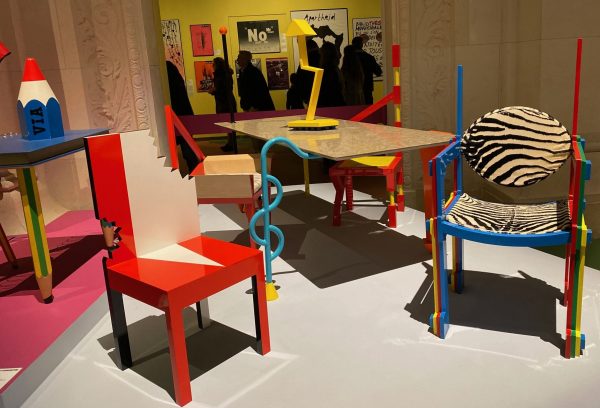
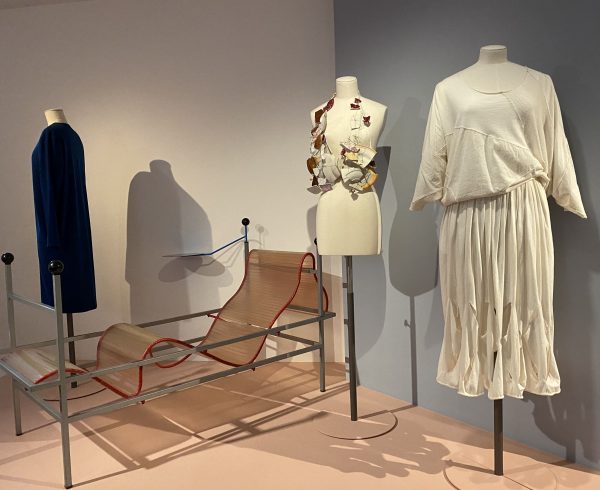
Deconstruction is a powerful tool or even method. Beyond imagineering, deconstruction in the literal sense means take to pieces. In most cases a physical object consists of several objects or parts. By deconstruction we attempt to understand the whole object as the sum of its parts. Before a new product or design is created, many scientists, engineers and artists start to deconstruct existing artefacts. Understanding how the object is assembled, for example, allows you to play around with pieces and maybe come up with an alternative way of constructing the object. The architecture of “deconstructivsm” has left us fantastic buildings. In furniture design there are also nice examples of deconstruction. Paris is a good place to study deconstruction (Explained), perhaps many still read Derrida there. It is a fruitful method beyond its engineering sense for example in law, literature or many other social science disciplines. If you are not mad yet, visit the MAD in Paris to see examples of deconstruction or construct your own deconstruction. Both have a dialectic relationship to each other anyway.