Family Archaeology

The archaeology of family bonds is an interesting branch of both archaeology and genealogy. The mixing of hunter-gather populations with settled populations seems a rather ancient fact (study link). Analytical DNA comparisons reveal that nearby groups had indeed contact and even intermarriage occurred more than 5.000 years ago (Mattila et al. 2026). The evidence is based on data from a cemetery where several persons were buried in the same grave.
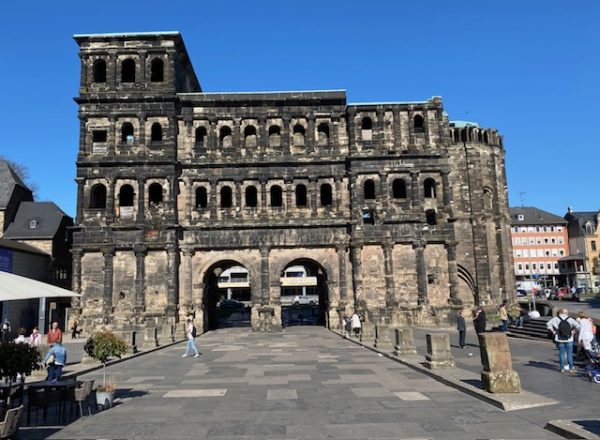
The study by Blöcher et al. (2026) demonstrates that in the late phases of the Roman empire along the Roman frontier in Germany a mixing of Romans with local populations a similar process took place. Whereas genetic structures persisted until the 6th century, the Central European genome as we know it today refers back to the 7th century. The inter-generational transmission seems to be an important driver of diversity. The high infant mortality together with an earlier mortality of women than men at that time show the accomplishments of modern medicine to safe infants and mothers from the hazards surrounding family formation and survival.
Given then Chosen

Family is first given and only later in life family becomes a matter of choice. This is a rather sequential perspective on family matters. A lot of ethnological as well as sociological research shows that the shadow of the given family can reach long into an individual’s later life. It is essential to be or become aware of the mutability of what constitutes a family. The ethnological variability across the globe of the norms and legislation that govern families is amazingly broad. The interference of religious beliefs and practices have always attempted to gain access to the nucleus of family life as an attempt to influence the “given part” of family.
It is a much more complex issue to understand and research the “chosen part” of partnership trajectories in a broader sense and from a life course perspective (Fasang et al. 2024). The social background and upbringing in a broad sense have a lasting impact on most people. However, there are enormous degrees of freedom to later on choose your friends, family or families. Societies across continents have chosen and invented particular rites of transitions between families and how to bridge networks. It is amazing that we tend to devote so little thought to this nucleus of our societies. 

Pictures at an exhibition

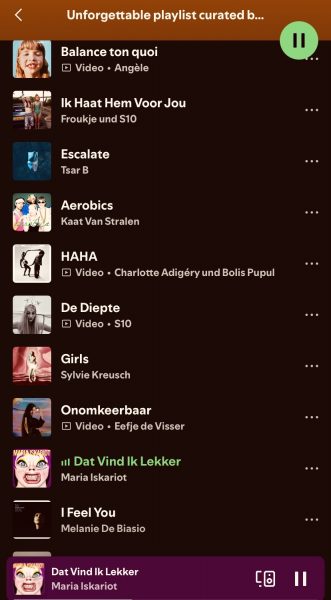
The playlist on Spotify, which accompanies the exhibition “Unforgettable” in Ghent, is an interesting extension of the unforgettable artists into today and tomorrow. You may be inclined to share your opinion in the way Maria Iskariot does it in “Dat find ik lekker” or more like Sophie Straat in “Dansen met de dood”. Anyway, women artists are coming front stage and this is great news despite all the backlashes we, unfortunately, witness in the 2020s. The curator of the playlist Murielle Scherre has managed to take us, a bit like the exuberant Modest Mussorgsky in his “Pictures at an exhibition”, beyond the marvelous exhibition rooms to a broad exploration of contemporary women artists’ world of imagination in music, visuals and songs. A great intergenerational accomplishment. 

Screenshot

Forgotten but Unforgettable

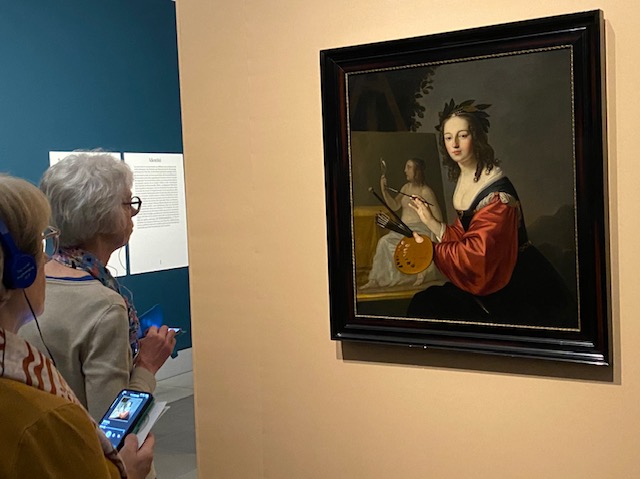
Many women painters and artists who worked during the 17th and first half of the 18th century have been forgotten until recently. The galleries of the time and many years later gave little attention to the women artists of that time. Most of them were relegated to be of minor importance in the course of art history. The exhibition of the Museum of the Fine Arts Ghent in Belgium has accomplished to rectify this place of women painters in art history. The fine pieces of art, ranging from painting to sculptures, were frequently signed by men, probably to achieve higher market values and become visible in the public sphere at all at their time.
The exhibition is a kind of a revelation of how difficult it was for women to move from an “object of art” to be the subject painting including painting themselves. This also dealt with the view or regard of others towards women. Additionally, the exhibition features a section on “Social Expectations”, which deals with the expectations of the Flemish and Dutch societies towards women. Family values, marriage, wealth and social status were of utmost importance.
These women painters were forgotten far too long, but have staged their comeback as “Unforgettable” in the 21st century.
(Image: “Pictura at an exhibition” taken in the MSK Ghent 2026-4)

Jobs First

The Berlin demonstration of the 1st of May has chosen to put „Jobs First“. Jobs before profits is a widely accepted claim by trade unions to highlight the importance of work in our societies. Particularly in times of robots and AI taking jobs away, this motto is well chosen as a principal risk in 2026. The current technological innovations seem to aim primarily at the maximization of profits for companies rather than the benefits for society as a whole.  The Berlin parade on the 1st of May managed to achieve a great mobilization, which is a great success for the labor movement and a demonstration of power and solidarity when in many countries basic employment rights and even the 1st of May as a social tradition is attacked.

Mobile Web Search

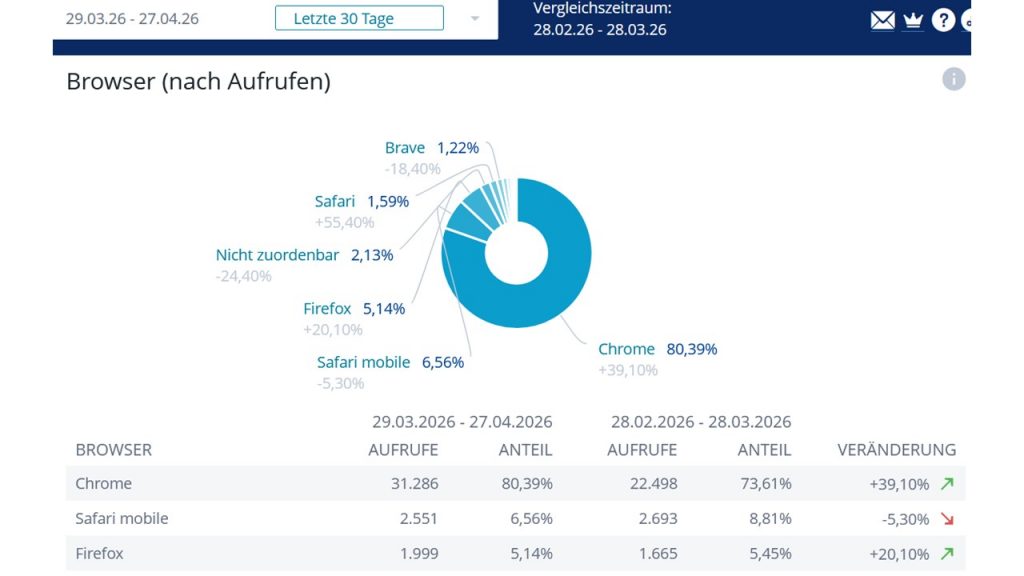
The smartphone is ruling the internet. This is probably a well-known wisdom in 2026. Just looking at the basic statistics of which browser people use to contact this webpage, it is evident that Chrome is vastly dominating search on the internet. Even the mobile version of Safari outnumbers the desktop browser access. Information gathering, viewing and reading have all moved from the desktop to the handheld smartphone, and maybe our glasses or wristwatches in the near future. For those still programming or designing webpages, the choice of “mobile access and functionality first” is an obvious choice for business, and even more so, for leisure purposes, like it or not.
Some parts of this evolution of search behavior are quite obvious, as we are more erring around cities like Paris, Berlin or Brussels than searching in front of our desktops or notebooks.

AI data Input

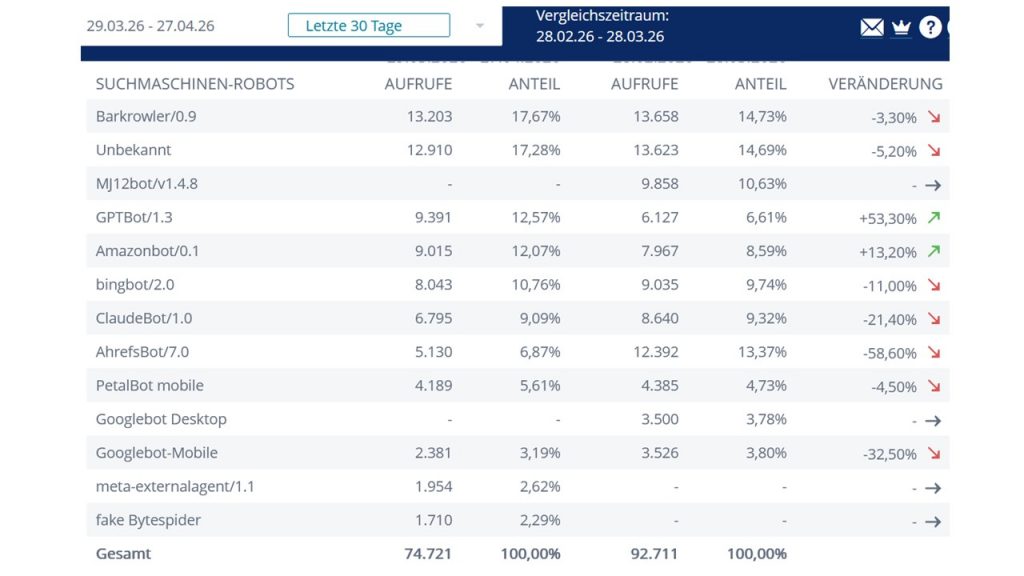
If you ever wondered where the information from AI and AI chatbots comes from, you will not be surprised that this webpage schoemann.org is regularly solicited for such purposes. The number of crawlers, that do so, is quite large. The ability to trace what exactly they are harvesting on your website, is quite a tricky issue. At least a basic awareness of how the internet has been transformed in the last few years becomes evident through the comparison of unique visits, many through search engines like Google search or others, with the amount of contacts by AI-associated crawlers (see slide from own webpage below).
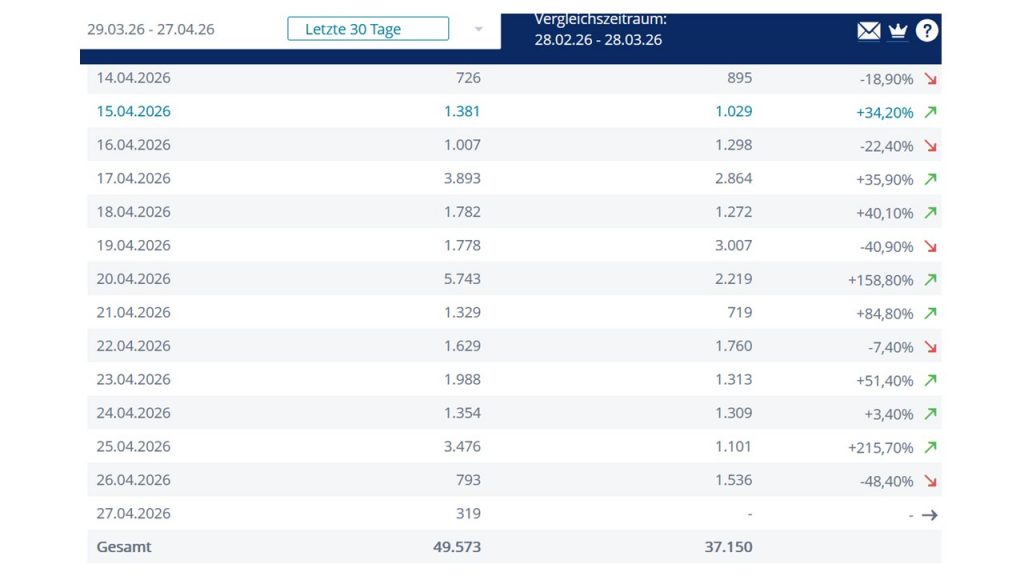
During he last month up to 2026-4-27 there were about 75.000 contacts, compared to 93.000 during the previous month.
At first sight, AI chatbots have largely outnumbered the “personal visits” of my webpage (see evaluate web analytics). On the other hand, I have no information of how many visits are, (at least potentially) re-directed hints from AI chatbots to my content.
In terms of “traffic” for a webpage, the information of how the AI-driven or AI-assisted search operates with other persons’ contributions will be the challenge of the coming years. If AI chatbots had to pay 10 cents per visit, I would have a comfortable pay every month from this content use. The issue of AI paying for access to reliable and high quality content has to be dealt with sooner rather than later. You may prompt a chatbot on this issue.
Meanwhile: My New Book on AI is out Now 2026-4-28:
“AI and Social Science: Potentials versus Limitations” by Dr. Klaus Schoemann, online reading and free download (here) before implementation of Paywall later on.

Evaluate Web analytics

An own webpage “schoemann.org” allows to gain interesting insights into the skills needed for the internet era and the security as well as cost structures for running such a business endeavour. Taking stock of basic web analytics, therefore, should be on the agenda from time to time. Towards the end of April 2026, it is about time to look into some simple statistics again. The host of this webpage offers access to some anonymous statistics (see below). The number of daily or weekly visits of the webpage are suitable to get a basic idea about frequencies of visits. Average daily visits are still below 1000 daily visits, but there are peaks of 3000+ and even 5000+.
Whereas the distribution across weekdays (no peaks on weekends, correlation with bad weather not tested yet ;-)) is rather random compared over months. However, the topics which received most attention are do not seem to be random. In 2026-4 the most attention has been raised with “Abduction of Europa”, followed by a brief entry on “Confessions” a philosophical topic in a broad sense (Stats below 2026-4-27. Next in popularity are 2 entries of my scientific “fail collection” which reflect on take-home-messages from the “Flop exhibition”, quite topical in combination with the 40th commemoration of the Chernobyl nuclear reactor explosion and pervasive contamination across Eastern Europe.
(Image: Page visits between 2026-3-29 to 2026-4-27 compared to month before same year)

Gone fishing

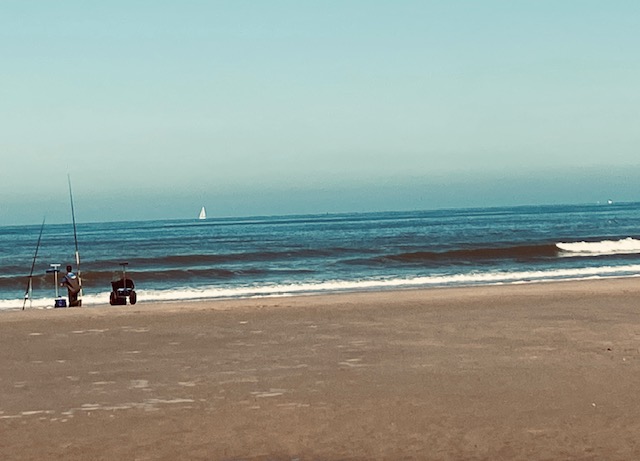
There are still many persons who on a weekend put up a sign on the door: “Gone fishing”. We are of course curious what these people are really up to. The reduction of fish in the sea and rivers has become a real problem across the planet. Overfishing is a policy issue and fishing quotas have taken hold of most fishing waters. The past time or hobby of fishing is very different from the industrial form of fishing. The preservation of the environment has a high priority in the very own interest of being able to fish in future. Simply watching a person fishing in the sea gives the impression that time is passing at a different pace.

Autonomous Robot

We have been used to computers beating the average chess player and even the best players. In 2026-4 the journal “Nature” published the documentation of an autonomous robot (Ace) winning the occasional game against top-level Japanese table tennis players. Peter Dürr et al. (2026) described the robotics challenge as constructing a robot that can match the human capability and reaction time of “fast, precise and adversarial interactions near obstacles”. The high speed perception of movement is coupled with event-based vision and builds on AI-algorithms like reinforcement learning. The step ahead is remarkable.
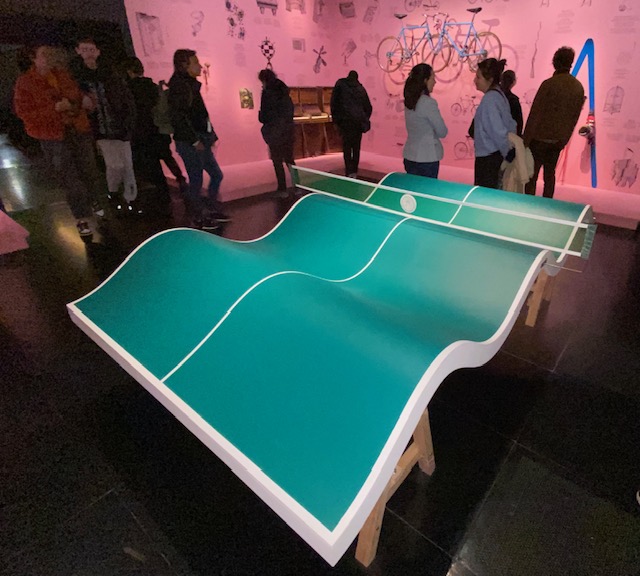
About 50 years ago, as coach in table tennis we used a machine or robot throwing balls towards us which moved from left to right in timed routine, for example. These simple robots we used to train humans. Now the robot is reactive and even interactive, learning from strategies and tactical moves. Technology can outperform us in most singular tasks in 2026. The combination of several of these skills is still quite unique to humans, but the clock is ticking for human singularity in technical matters. What was considered a “false good idea” in the Paris exhibition “Flops” at the Musée Arts et Metiers (see image below), might be an interesting response to challenge the new generation of autonomous robots.