Electric ships

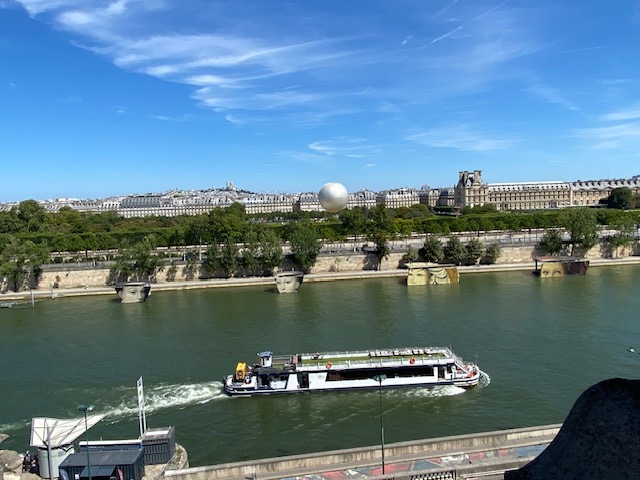
The transformation of mobility to an all electric mobility has been discussed mainly with regard to a narrow vision of the automotive sector. Beyond land based vehicles like lorries, buses, cars and bicycles or electrification of trains, shipping has been a niche market of the all electric society. The amateurs of silent shipping, sailing and surfing have explored and adopted the electric alternatives for quite some time. The professional ferry boats and river crossings have also opportunities to join the all electric society with a range of ships available for orders like from “Ampereship”. The increasing share of electric fun on water and electricity-propelled ships gives additional drive to the “All-electric-society”. 
Switch off

We have many associations with the imperative “switch off”. Depending on your background or state of mind, you might associate “to switch off” with a mental state, i.e. to calm down. Instead of buzzing about, juggling with multiple projects or deadlines at the same time, the reduction on a few major preoccupations can be achieved through a switch-off. In electrical engineering the switch, as switch-off or switch-on, is a key component of electrical circuits. In programming languages a key element is the switch implemented as an “if-condition” in form of “do if X=True”, in its easiest form.
Let us develop a social science corollary of a theoretical concept of “switch-off”. At times of energy shortages the switch-off option becomes an often overlooked or discarded option. Switch-off an engine to lower overall consumption of energy is a very powerful mechanisms. We do this manually by switching off lights, or as programmed or AI-assisted versions in modern homes. States might impose the switch-off of street lights or loud music after certain hours. In an energy crisis the switch-off option needs to be moved to center stage again as any MegaWattHour not consumed does not have to be (1) produced, (2) moved to local provision and (3) distributed. Additionally there is (4) less waste that has to be taken care of. Hence, the switch-off option is a fourfold win-win-win-win-situation. Who cares about this option as all 4 kinds of savings do not increase a standard measure of GDP in an economy? Broader social science perspectives may offer precious indications that “less can be more“.

AI Motion Sculpture

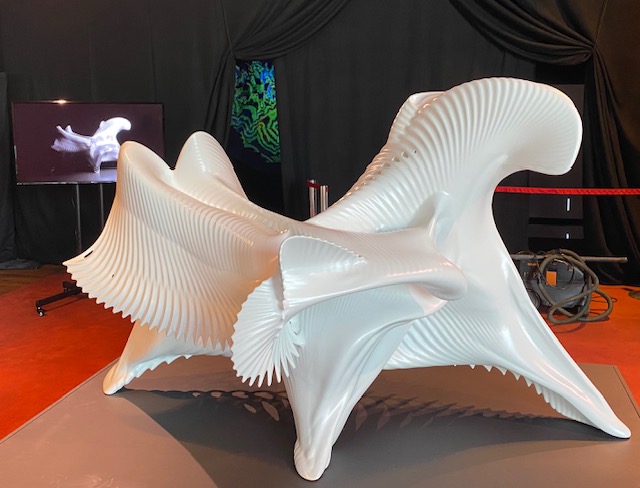
At the Festival Noûs in Paris, the collaboration of AI with artists was a major event. Based on the huge collections of the BNF in form of data bases it is possible to join the 3 worlds of library conservation, technological innovation like AI and the imagery of artists. In the preparation of the exhibits and the parallel documentation of the genesis of the exhibits of the artists, the creative potential and process becomes more evident and understandable to broader audiences. The exhibit by Tobias Gremmler, Anatomy of Motion (2026 see below), captures the motion of a dancing body in a sculpture based on a 3D printing of a series of images blended into each other. with a fast photography camera, known from sports images previously, the dynamics of a motion become a tangible sculpture. The intriguing new form is in fact a motion that has been captured or has cristalized or materialized in a permanent fashion. New technologies and materials enter into art as they offer new ways of expression as well. The collection of art and documentation centers shall enter into new phases as well. (Image: Tobias Gremmler, Anatomy of Motion (2026) at BNF 2026-4).

Mind mapping

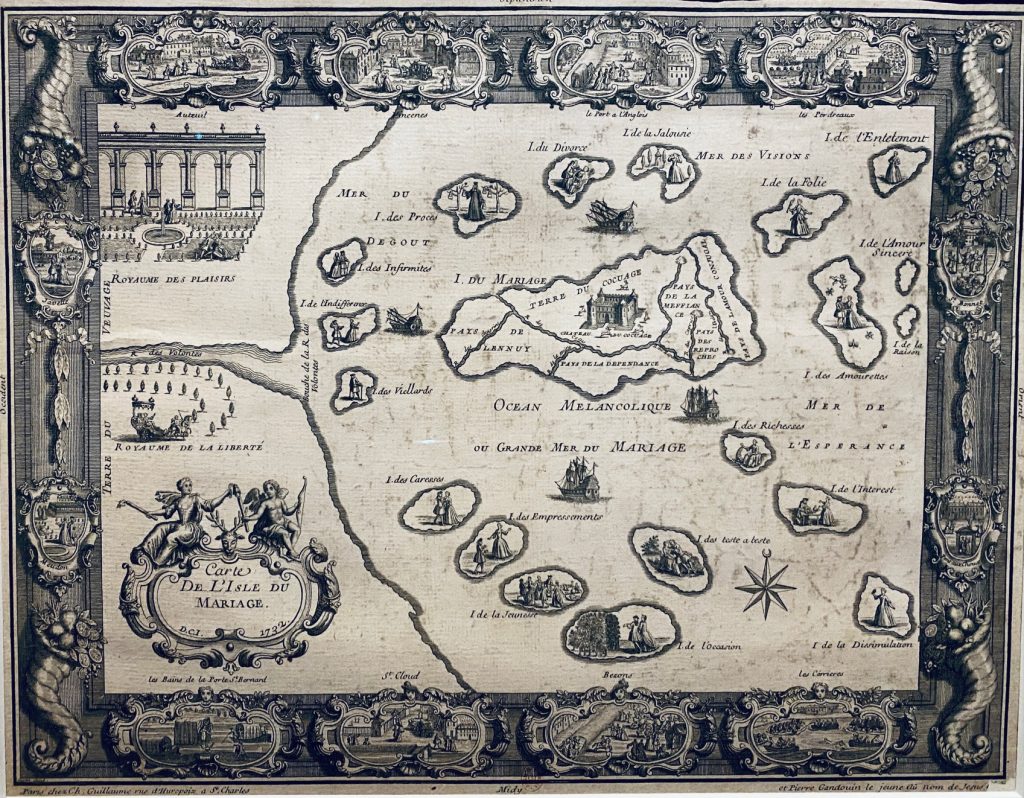
The exhibition in Paris on “Cartes imaginaires” at the BNF regroups treasures of maps across centuries in an interesting way. The technique of putting together elements in a map has been developed and refined over long time spans. Map are mostly in our minds as  depictions of geographical details allowing a broader overview amidst lots of detail. The mind mapping of today as a managerial or pedagogical tool is not much different even if AI might make is believe that it is a modern tool. The exhibit of “The island of Marriage” (image below BNF, “Cartes imaginaires”) in the middle of lots of distractions and potential distractions has a particular charm to it as it tells many tales and storylines for writing lives and novels. Our own lives or the depiction of life courses might be represented in a single map, maybe even comparable to a sequence analysis of events. The history and potential of maps and lives as mind maps is going to accompany us for quite some time as it already did for centuries. 

Critique of Maps

From a sociological perspective on maps we learn for example, that maps are also instruments to reflect property rights. This can be past claims of imperialism or recent claims of independence. A depiction as a map has historical and societal implications. Superposition of maps according to political, cultural or linguistic communities often reveal contested areas of domination and liberation movements. The specialized field of the history of maps can sharpen the senses for a critical view of maps in the 21st century. (Image:  Brankiza Zilovic, Nusquama 1984 exhibition “Cartes imaginaires’ BNF Paris).

Fact and Fiction on Maps

As a matter of fact, for centuries maps have played in both registers, fact and faction. In geography we expect maps to represent geographical facts, and yet based on a historical perspective on the subject, we realize that early cartographers had to brush over, at their time unknown, territories. What did many of them do? They imagined what could be the case.
In the early days of “creating a map” the artists had to rely on some sort of fiction or were intentionally creating a fictive image of the unknown world. Out of this “science and fiction” approach, a whole discipline of literature has evolved, science-fiction. The imagery of Manga-mania in the 2020s owes a lot to this drawing and mapping of fiction in form of stories.
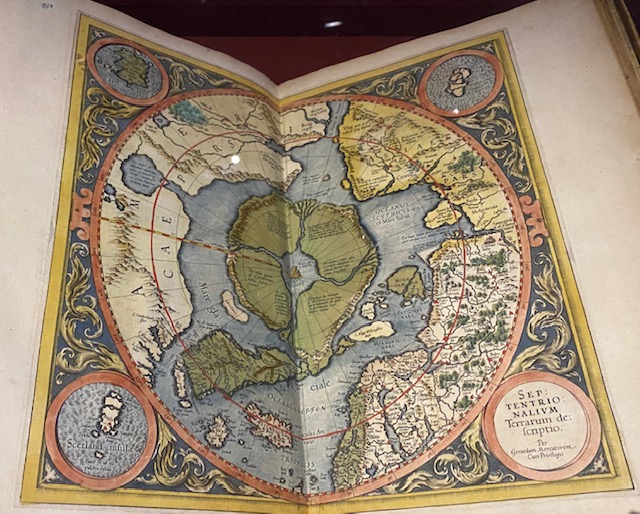
Maps tell lots of stories. They are powerful in their neurological function, similar to mind maps that are a tool to structure our thoughts or story lines. The gesture to point at an area on a map of the Arctic, Greenland for example, can send shivers across the globe. Maps make stories and stories may lead (eventually) to shifts of attribution on maps. In the same vein: the mapping of power also reflects the power of maps, be they based on facts or fiction.
(Image: Exhibition: Cartes imaginaires, BNF Paris 2026-4-8, Gerardus Mercator, Map of North Pole 1595)

Interests in failures

Decades or centuries after a successful or unsuccessful innovation, an evaluation of the reasons and circumstances of a temporary or permanent failure is informative. In the energy sector we observe another round of a power play in 2026. The more decentralized energy production and energy consumption models have been quickly put aside shortly after the oil crises of 1973 and 1979. The innovations using wind energy or solar energy of the 1980s have been discarded and were commonly considered as failures to provide cheap and reliable energy. An open international economy with expanding global markets for energy were perceived as a superior conventional solution. A country’s balance sheet of imports of energy and exports of higher value goods and services was the predominant economic rational and standard knowledge of the mainstream theory of trade. Other solutions, like a distributed “prosumer” model of energy might have ecological benefits, but would not show up in national GDP-statistics as a large part is home-produced energy and not accounted for in statistical measures of GDP, just like the home produced meals, health and care provided by mostly women. Societies, however, have a choice and an obligation to evaluate the interests in failures as economic and social development hinges on it in the medium to long run.

Failure as criticism

The production of an object, which does not abide by the norms and conventions of its designated use, can either be considered a failure, a commercial flop or a critical comment on consumerism. In some instances it may even have the intention to produce art rather than a useful product. A tea or coffee pot may serve as such an example of it (see image below). It is designed not to serve tea or coffee in a conventional way. Such an object invites us to think around the corner,  whether we could still use it in the “normal” way. We are forced to innovate as user or we just leave the object aside. The Flops exhibition also included early car examples which used a “Wankel car engine” and the aerodynamic adjusted car model (shape of a peach) of the R14 in its flops collection which were early precursors of a, later on widely followed, car design principle. Such an aerodynamic car design saves energy and therefore increases the reach of the car without refueling or battery charging.

Overall, some supposed failures are more indications that we are not easily prepared to accept behavioral changes or alternative visions of products.

Learn from failures

It is easier said than done. Acknowledge a failure and most people will probably pretend to know better already. Don’t worry. This is not the case. Many of the best “learnings” have come from learnings from failures, be they own mistakes or of other persons, organizations or institutions. If you really want to learn from a person, try to get honest take home messages from their “best” failures. Marc Aurel has proposed this in his writings on governance and, prior to him, Aristotle compared Greek constitutions to derive the most adequate, or the best of the many failures to achieve democracy. This is a perspective if you aim to improve on the achievements of current or past actors. Incumbents can only tell you about how they got where they are currently, not about any likelihood of future occasions. Hence, current failures are a very valid source for learning.

Time dependent failure

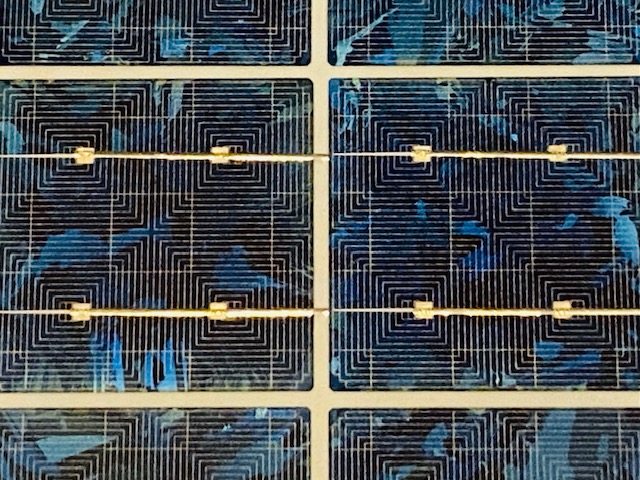
The collection of failures has an ambiguous relationship with time. Some innovations that are celebrated at a specific point in time shall be considered failures at some later point in time. The Musée des Arts et Metiers has an early version of a solar panel on display dating back to 1996 (see image below, Photowatt 1996). This example reflects the cycles of public as well as expert opinions about technical innovations that either are en vogue or at disgrace. Ecological, design and economic considerations enter into the consideration of what constitutes a failure. Claims of European energy sovereignty may additionally enter into the failure equation. The time horizon over which energy savings are generated is yet another element in the judgement. The more general perspective should take sustainability and depreciation of quality of an object into consideration. The Flops exhibition just scratches a bit on the surface of an important and rather complex issue of the relationship of society, technology and innovation.  Surely, there is more to come in terms of flops and failures, and this is okay in most cases.