China Job Quality

In a small study of 771 Chinese adults, Dong, Wu, Ni & Lu (2021) have reported on the impact of long working hours on job satisfaction. If you work few hours, job satisfaction increases as you work more hours. However, working many hours already, additional work, 40+ per week, does no longer increase work satisfaction in China. In order to preserve the recommended or communist work ethos of a “996 work schedule” (from 9 a.m to 9 p.m, 6 days a week) the authors recommend that managers support more autonomy for workers to fix their schedules as this could increase their job satisfaction. Autonomy to schedule your work and more autonomy in decision-making moderate the impact of long work hours on job satisfaction. Eventually the Chinese comrades might get satisfaction in other areas but work as well.
(Book Exhibits on Karl Marx, Museum Trier Germany Books 2023)


VOC for VCs

The research into VOCs (short for “volatile organic compounds”) is a busy research field in biology and environmental sciences. It might be of interest to VCs (short for “venture capitalists”) as well in the near future. VOCs are those organic compounds that orginate in animal manure as well as those emanating from plants have an impact on people working there or who are living nearby. Allergic reactions cause millions of days lost in working every spring or summer season. Long-term effects are yet another critical issue in this respect. Whereas the measurement techniques of VOCs have evolved a lot, the interaction effects of different VOCs are slowly producing interesting results that might eventually become of interest to VCs.
Abonde et al. (2026) show that there is a kind of communication between different plants via VOCs, which has an impact on growth and defence mechanisms of some plants. Amateur botanists have always wondered about the anecdotal evidence that some plants or flowers grow well next to each other, whereas other ones seem to deter each other. For crops, this mechanism has been documented and more experimental research of this kind will corroborate the potential of, for example, “natural fertilizers” in future. Remember to think of VOCs the next time you experience scents from animals, plants or flowers as a wonderful research topic with VC potential.

Marilyn Monroe TM

The image and probably even the person of Marilyn Monroe has become a trademark of its own. Since the choice to change her name and outlook to become or be created as the objectified trademark of Marilyn Monroe, the financial interests to gain money using every image, sound or video have reached above average returns. The profits mostly accrue to those owning the commercial rights. At the occasion of her 100th birthday, this continued rent seeking keeps spinning.
It has been well documented that the early death at just 36 years of age is linked to her exploitation or “commodification” as a trademark rather than a person able to cope with the overloaded imagery of herself. Bookshops, even in 2026-6, decorate their windows with books with her image on the cover as eye catcher. As with few other persons, Marilyn Monroe stands for an objectified person where the property rights of the image keep being exploited long after her tragic death. (Image: Marilyn Monroe, tramage by Bruno James BdF, left and algorithmic on the right. Transbordeur 2026).


Litfaß Advertisement Column

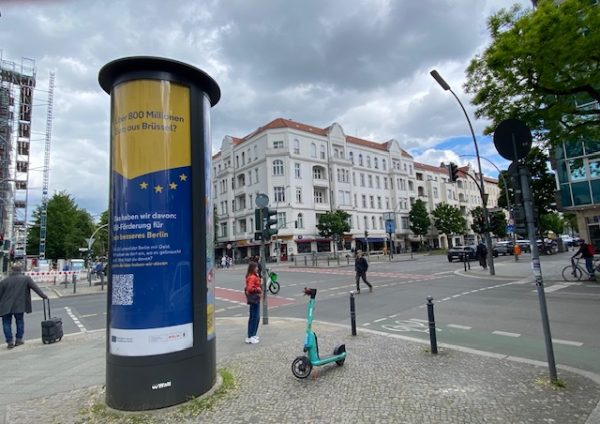
Berlin has renovated some of its early say notice boards and advertising columns. The original „Litfaßsäule“ has already the round column shape where you clued a poster on the sirface so that it was visible to several persons interested to look and read. After more than 150 years after its invention, Berlin has digital advertising columns which resemble the original Litfaß design. Rather than the spectator walking around the column, the column now turns around in a steady manner so that nearby you can see the whole advertising content from all points in the neighborhood. Simple change, but a remarkable improvement in the reach of the advertisement. Retro-lighting increases the duration of the effects as well. Mass communication and commercial innovation can sometimes just improve on an existing marketing channel, and still reach a specifically targeted audience.  

Psych-inflation

The economic narrative and measurement of inflation is incomplete without the proper account of the psychology of the price building process and mechanisms. After the 2 previous oil-crises of 1973 and 1979, the panic about not having enough oil and derivatives within the coming months, has lead to prices increases almost instantly. Despite the fact that there is enough oil floating on ships and in pipelines for 3-6 months, depending on estimates, the psychological effect of being eventually short of oil creates “Psych-inflation”. Oil markets use the “Angst of disruption” to make additional profits on people and enterprises’ hoarding behavior. There are powerful interests to exploit such potential shortages as it is a suitable time to reap some extra profits, particularly for those who knew early about a likely military conflict.

Fossil costs

On 2026-3-5 it has become sufficiently clear that the USA and Israel attacks to topple the terror regime in Iran have repercussions across the world markets of fossil fuels. 1973 and 1979 had told us already the lesson that a reliance on fossil fuels like oil and gas, which is produced in only a small number of countries, can disrupt energy supplies drastically. 50 years later we are much less vulnerable to supply shocks due to the stronger reliance on renewable energy sources. The supply shortages are only likely to happen, but energy suppliers are fast to cash in on these expected shortages. Prove of evidence that energy markets are driven more by expectations than actual availability of fuel stocks.
The advertisement of a Belgian recycling company “Powered by sunshine, driven by electricity” is a perfect summary of how to deal with shortages of fossil fuels (MCA recycling in Brussels, Image: former Brussels stock exchange).

Time in Leadership

We identified already the importance of monitoring in democracies. The same theoretical considerations hold for an analysis of leadership irrespective of the organizational context, be it a government, governmental organization, non-governmental organization, association or private enterprise. In democracies, it is in most cases a constitutional rule that leadership positions are limited in time and it is “best practice” to have clear rules about renewable terms of office as well.
In private enterprises this seems to be of lesser importance, but the issue deserves more close scrutiny, not only by shareholders in case of a shared ownership or stocks. A particular person in the leadership position might be a good match for a company at times of growth or scaling of a start-up, but the same leadership is less likely to be an equally good match for the period of eventual stagnation or shrinkage.
Therefore, as an alternative hypothesis it might be wise to adopt leadership rules similar to filling leadership positions with politicians. Fixed-term and 1 renewal could be worth testing at the leadership level (like in presidential republics, USA or France), even if this does not preclude close monitoring of leadership processes. As a starting point for empirical research, Vogel, Raes, Bruch (2022) offer a toolkit to assess organizational energy and leadership trajectories. Learning from democracies as well as democratic procedures might be a worthwhile leadership model to follow. (Image: ceiling painting in chateau  Vaux le Vicomte)

Regulation and bureaucracy

Economists will celebrate 55 years of the theory of regulation pioneered by George Stigler, which was published in 1971 in 2026. The basic question asked at the time and today is: why do we have regulation? The pubic choice and political economy answer of Stigler (1971) and many scholars after him, is that the industry of a specific sector will acquire the regulation or the public interest in this regulation and, subsequently, the industry will design and operate it to its benefits. At least, this is in a nutshell my summary of the literature inspired by Sam Peltzman (2021, p.20). If we add to this the perspectives of theories of bureaucracy (Sharma, 2020), we become skeptic of an efficient implementation of regulations by governments or governmental agencies.
In the field of pharmaceutical applications, it is the “European Diabetes Forum” which calls for a regulation on reliable “glucose monitoring devices” with industry and user backing. Of course, this asks for bureaucratic control of the regulation, imports and markets of such devices later on. The one (regulation) is rarely coming without the other (bureaucracy). It is about time to acknowledge this for societies as a whole as well.

Premium for silence

People are willing to pay a premium on housing prices for a more silent environment. In the study Enrico Moretti & Harrison Wheeler (2025) estimate that the construction of a silencing wall near a noisy traffic junction or road will increase prices for every decibel of noise reduction by about 3%. Distances closer to the noise shields get higher increases and this mechanism works even up to 400 meters away from the isolation. The investment in decibel noise reductions (not statistical noise) meets a willingness to pay a premium on housing prices. Investment in positive environmental effects (silence) have an obvious marketable premium value. This is most likely just the obverse effect that noise nearby housing is penalized and part of the social mechanism of gentrification. Housing prices and rental costs are known to be powerful drivers of gentrification as well.

Bulimia Capitalism

Each time a wave and speculative bubble in the economy is building up or even bursting there are thousands of people who become drawn into chaos. Let us quickly review: Oil bubbles in the 70s, financial crisis and  subprime lending in housing markets, 1st internet bubble and the year 2000 bugs, AI excesses in 2025. These boom and bust cycles resemble the medical and psychological patterns of a bulimia nervosa. The overly optimistic outlook for AI companies’ future profits and shifts in the size of office space needed for companies announce bulimic behavior when at the same time vomiting by the same companies occurs with regard to investments in nuclear energy plants even in the sites like Fukushima in Japan or Three Mile Island in the USA. Bulimia Capitalism seems to be eating its own children. The upcoming year 2026 will be full of revelations in this respect. (Image: collection of about a hundred barbies exposed on a flea market in Brussels on 5 levels).