

Architecture is all around us. However, we rarely consider the build environment as “conditioning” feature of our life. Architecture is contributing extensively to our perception of “social space” (Bourdieu). Inner cities, suburbs or spacious residential areas have diverse impacts on our perception of, for example, security, modernity, health or sanitary sensations. The corona-crisis has made it clear to most people that a healthy environment is a very essential part of our perception of comfort. Here the psycho-social perception of living and/or working space enters into the co-creation of housing people. Technology is a big driver of change in housing, urban spaces and rural imagination. In order to avoid corona infections a new culture of working from home for the masses become a health-driven imperative. Payment without contact, home delivery of meals, food, books, medicine have changed the living style of many people. Too little movement for our bodies has caused another silent pandemic of obesity. Enough reasons to rethink architecture from a sociological perspective on it. This probably starts with speaking of architecture as architectures. By this we mean to think of architecture from its social origins, functions, impacts and perceptions. Great historical examples of architects have implicitly or explicitly formulated a social theory of architecture or space as the basis of their “concrete” realisations. The sociology of professions of architects and the many construction-related professions needs empirical foundation beyond the cliché of socialisation as artist versus technician. Still recent forms of participatory democracy as part of urban and rural planning as well as realisations. Participatory individual or community housing are likely to stay with us. People want to get involved in co-creating their living and working space as their social environment. Architecture as social process and specific layer of the network society will be the new mantra. It has always been there, implicitly. Up to us to strengthen the social discourse on architecture. 

Technology
Over the 20th century technology has pushed forward in many fields. As there were huge investments needed the public campaigns to support new technology without much further reflection of potential consequences have pulled many western societies into risky technologies. Except the Club of Rome there were very few to question the naïve beliefs that technological change will make societies rich and potentially even more equal. The recent report “Climate Inequality Report 2023: Unequal Contributions to Climate Change” has debunked both of these claims. More flying across the planet, particularly short city hopping, has allowed few persons to reap the benefits of the jet-set world, but contributed to climate change in excessive quantities. This is a fact when we compare major world regions among each other as well as within each country. It has to be the wealthy countries that have to shoulder the biggest share of the costs. It has to be the wealthy that pay higher contributions for their pollution. Society has to reign in technology more than ever before. Moreover, we still have to get the income and pollution distribution organised in a better way. It is not only an implementation challenge, but the major question of the 21st century to repair the damage largely caused throughout the 20th century. 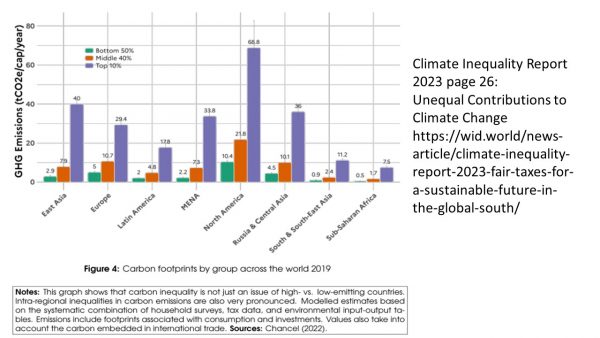
20s
In retrospect from the 1930s and in prospect from the 1910s, the 1920s may well be described as “The tumultuous Twenties”. Several other summary notions are attributed to the 1920s. “Les années folles” in the French speaking world, “The Jazz years” within the U.S. or the “Wild 20s” in Germany coined the decade after the disillusion of the 1st world war. The economic and cultural revival after the period of atrocities has seen thriving city centres and comparatively little economic hardship until the Wall Street crashed on October 24th in 1929 the so-called “Black Thursday”. The party was suddenly over and a lengthy economic crisis spread globally. It was within this free spirit of the 1920s that the Fascist counter movements of the 30s started to take roots.
The 20s saw the skyscrapers soar and the credit-financed speculation was at its highest. Pierre Boudon (1991, pp. 137) characterises the architecture of the 1930s as “l’inversion des signes”. The Bauhaus of the 1920s was later forced into emigration. The film of F. Lang “Metropolis” (1927) prolonged the constructivist lines of the 1920s to a haunting vision of big cities with its daunting acceleration of economic and cultural experiences.
Walter Benjamin later referred to the method of technical reproduction as one of the major foundations for the mass movements and mass culture, which turned the relatively prosperous early and mid 20s into the disastrous 30s. Indeed, many scholars combine the 20s and 30s into one historical period as the rise and decline between the 2 world wars of the 20th century.
Certainly in terms of economic development many countries witnessed a steep rise in prosperity in the 20s followed by deep recession in the 30s. What went up in spectacular terms in the 20s, economic development, democratic participation, came down in the next decade due the rise of Fascist movements.
100 years later in the 2020s we still struggle with many of the same issues. Poverty and “Existenzminimum” were topics of the 2nd International congress of modern architecture in 1929 in Frankfurt. This reflects the lasting need to address “social issues” throughout decades, if not whole centuries of mankind. 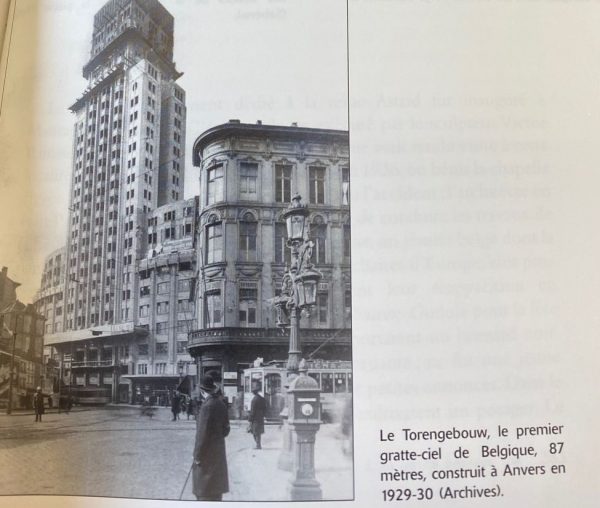
Narrative economics
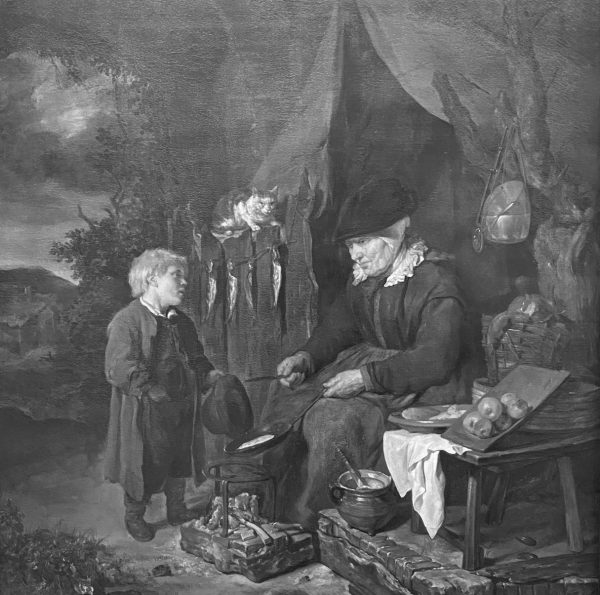
Narratives have been with us as long as mankind exists. They just take different forms and content nowadays. Whereby narratives have first spread orally, then much later through written words, images and movies, they are forceful ways of communicating. Robert Shiller wrote a good story about narratives related to the field of economics. Referring to the writing of the polymath David Hume (1742), main proponent with Adam Smith of the Scottish enlightenment, contagion like in pandemics is mentioned for the first time to explain that “the multitude will certainly be seized by the common affection and be governed by it in all their actions”. (Shiller 2019, p. 58). In order to understand narratives going viral Shiller mentions the importance for narratives to be embedded in “narrative constellations”. Holding truth against spreading false narratives might not be enough in itself. Strong, catching narratives seem to bypass or override even truthful information. Additionally, narratives never die, but rather offer opportunities for repetition. On content of economic narratives Shiller exemplifies stock market panic, consumerism, financial stability, automation and AI fears, speculation bubbles, evil business and labour unions. Topics like lazy unemployed persons, too early entry into retirement, too late entry into the labour market for youth, women or migrants, all have endured stigmatising narratives across time and/or across countries. With emotional and powerful economic narratives all around us, trust and authenticity become a very important meta-currency. The instantly printing camera now serves as proof. Beware of the scenery, actors and action chosen. Medieval painter Gabriel Metsu (1629-1667 Leiden-Amsterdam) had chosen the economic narrative of the “women baking pan cakes and the child as beggar”. Ending up in a museum instead of the White House is probably the opposite of going viral. The same Photo in black and white might have more of a trustworthy documentary character than the suggestive colours. 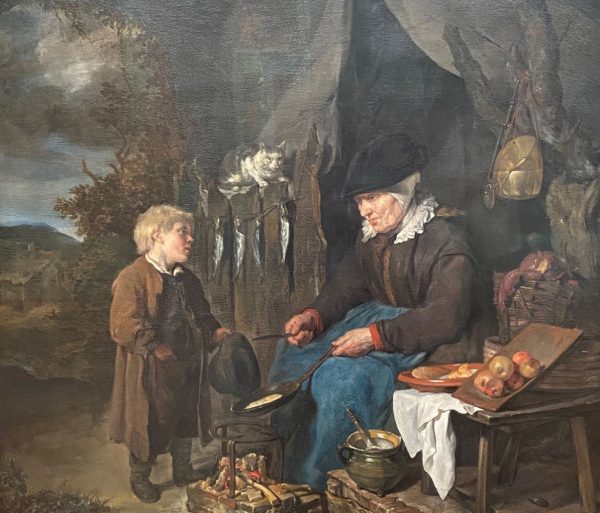
Economic Narratives
Joseph Stiglitz (2003) provided a detailed description and interpretation of the economic history of the 1990s in his book on the roaring nineties. As a member of the Clinton Administration serving as a Chairman of the Council of economic advisers, he had first hand access to the information, debates about interpretations and conclusions drawn during the period. In the preface (2003, p.XII) he provides some of the lessons this work has provided him. “Today, the challenge is to get the balance right, between the state and the market, between collective action at the local, national, and global levels, and between government and non-governmental action. As economic circumstances change, the balance has to be redrawn. Government needs to take on new activities, and shed old ones. We have entered into an era of globalization in which the countries and peoples of the world are more closely integrated than ever before. But globalization itself means that we have to change that balance: we need more collective action at the international level, and we cannot escape issues of democracy and social justice in the global arena.” The surprising approach by Stiglitz, as a winner of the Sveriges Riksbank Prize, to present no data in tables or figures demonstrates the need for telling convincing stories beyond throwing images and shuffled data at your audience. However, this is probably only feasible once you won a quasi-Nobel prize to not lose credibility among economists. Nevertheless, the issue is larger. Stiglitz manages to address the much larger audience of non-economists who construct or constructed their own “collective memory” of the legacy of the nineties as the “global 90s”.
The narrative of the 1990s grossly neglected the value of the biosphere. Asymmetric information (his shared prize winning issue) was and is still used in the market of natural resources to keep polluting the planet and push ahead with careless deforestation. The Exxon case is just one piece in the puzzle of asymmetric information and misinformation. Misguiding economic narratives play a powerful role. Maybe we need to write more about the “roaring failures” of economics and public policies across several decades in the 20th century. (red dots = forests lost on our planet A early 2000s, and there is no planet B) 
V for Value
Value in its singular form refers for most people to the value of things. Since Karl Marx we have been fighting about the surplus value of a worker’s work. Nowadays, we have to deal with speculation bubbles on the value of property or even basic elements of nutrition (Water, wheat, energy). Max Weber introduced us to the rigorous analysis of value judgements. In political science the plural “values” refers to basic human rights as fundamental values of humanity. Many other associations with the letter V pop up and arouse emotions: victory, video, view(s), vision, visit, voice, vote, vulnerability.
Creating lasting value seems to transform itself into part of our system of values later on. The longitudinal dimension of value is often neglected, particularly in the short-term focus of much of economic reasoning. Value over time, in addition to the distribution question, or as part of distribution over time, excites researchers of inequality and policy design for generations. Approaching the end of the alphabet increases the stakes of the “endgame”, it seems. Value for me, might not be of value for others. I hope you have found a person that values much of the same as you do yourself.
Interpersonal value, value exchange and intertemporal value are own fields of research. Since the Scottish enlightenment and Adam Smith’s work on “The theory of moral sentiments (TMS)”, reciprocity in value exchange has been an issue, well before the utilitarian turn in his own writings on “The wealth of nations”. Even Adam Smith refers to happiness and interest as a kind of value and “very laudable principles of actions” (part VII.ii.3.15 in TMS).
Children learn and experience value as natural part of growing up. Material things which you valued highly as toddler, you are ready to trash or exchange a couple of years later at much lower prices. Above which monetary value are you ready to trade in your humanitarian values? Never? History and bargaining theory is full of experiments and experiences that teach us otherwise. Corruption is the prominent example of exchanging or trading material value against immaterial values. Reading Kwame Anthony Appiah on “Experiments in ethics” is highly instructive. This bring me back to the economist joke I used to tell in lectures: You know that you’re an economist, if you ask your child, whether s/he prefers 20 Euros in cash, a trip to an adventure park later, a basket ball set or a pizza party for the next birthday. Economists do all this to find out about the value of each item, the preferences, the time frame of delayed reward or discounting of value also called the net-present value. Reading up to here is equal to the value of, maybe, an online bachelor in economics or social science. In your very own life review of learnings you then can estimate the value of your readings to you, your community or humanity. Alternatively, enjoy the joy of just living in peace with optimism. 
Marx-Wagner
Begleitend zu den Ausstellungen zu Karl Marx und Richard Wagner fand eine vom DHM organisierte Vortragsreihe statt. Die Links (hier) zu den Hördokus sind eine anregende Erweiterung der Ausstellung und stützen die These der Verbindung zwischen Karl Marx und Richard Wagner auf einer abstrahierenden Meta-Ebene. Die Vorträge, Gespräche und Diskussionen informieren und vertreten wissenschaftlich fundierte Thesen. Die müssen gerade nicht von allen geteilt werden, aber eine Haltung zu dem Thema haben die meisten Menschen in der Welt, besonders wenn wir an die Millarden von Menschen jenseits von der westlichen Welt denken. Es ist also auch an uns, diese Diskussion über den Kapitalismus zu führen. Hören wir mal rein. Alle dauern 1h-1.30h!
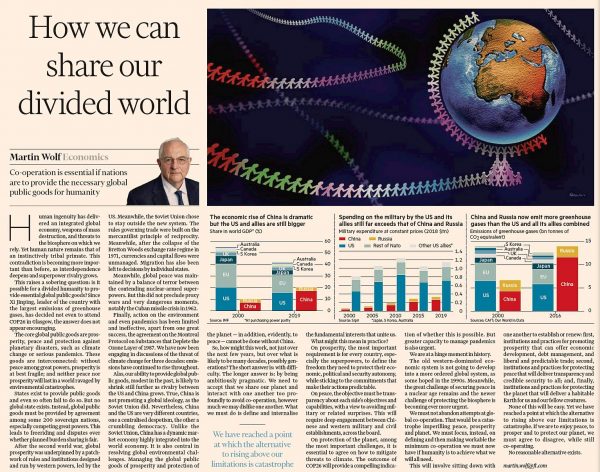
Einleitung, M&W Kosky + Bisky, M&W Nietzsche, M&W Mahatma Gandhi, M&W Viktoria Kaiserin Friedrich, Ein Artikel aus der Financial Times von Martin Sandbu vom 18.8.2021 und Martin Wolf vom 21.11.2021 ergänzen die Diskussion: Wenn der Kapitalismus weltweit gewonnen hat, was war dann noch mal der Wettbewerb? Bitte öffnen Sie jetzt ihren Computer, Sie haben 3 Stunden Zeit für die Beantwortung. $???$ Danach speichern Sie bitte das Dokument in der Cloud und nehmen es zur Evaluation nach 10,20,30,40 Jahren wieder hervor. Hat sich ihre Meinung über den Sachverhalt zwischenzeitlich verändert? THX for your feedback. 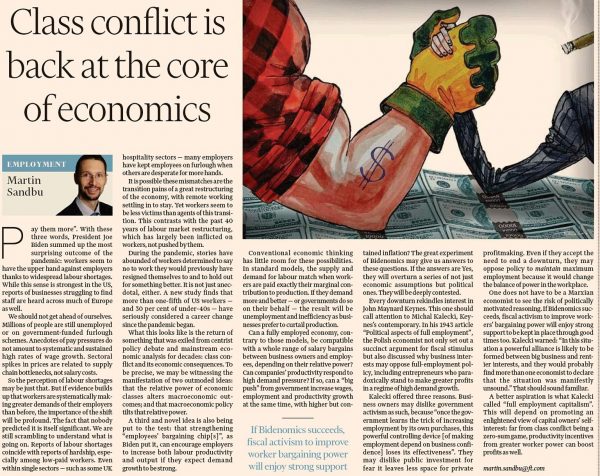
Wagner Kontrovers
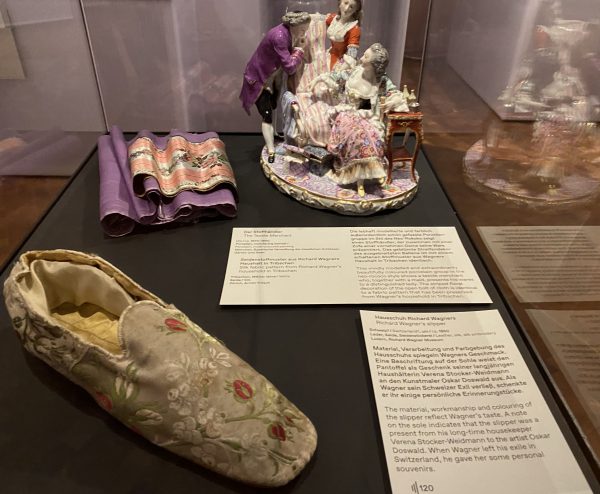
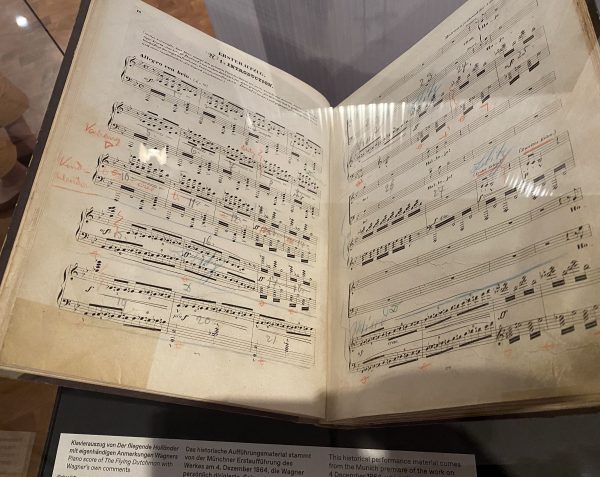
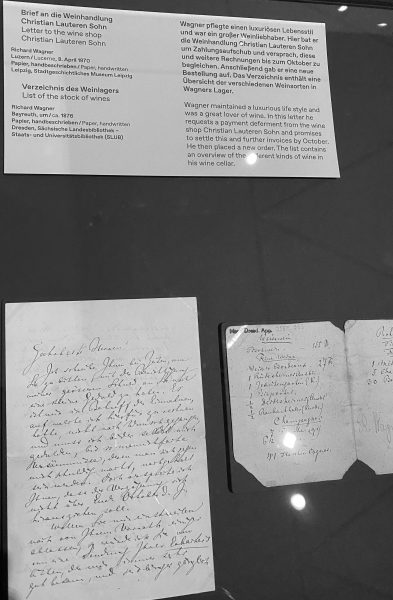
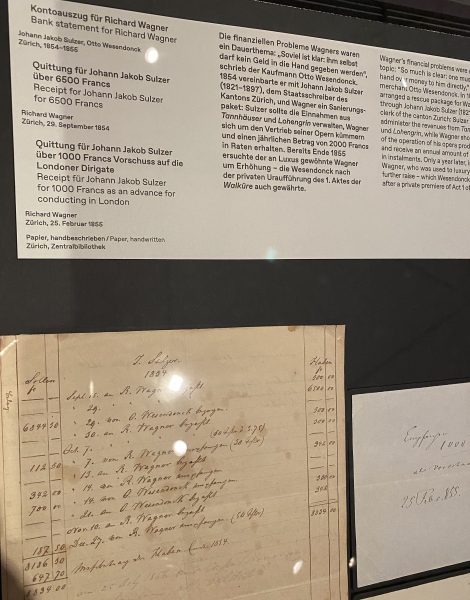
Selbst im 21.-ten Jahrhundert lesen wir weiter von Kontroversen um Richard Wagner (z.B Molnar und Molnar 2022 S.161-186). Dazu hat auch das DHM beigetragen mit einer Ausstellung, die interessante Assessoires aus dem Leben Wagners kürzlich in die Vitrinen stellte (s.u.). Neben Dokumenten zu seinem hartnäckigen Antisemitismus, bereicherten die extravaganten Kleidungsstücke, Maßanfertigungen, Beispieldrucke zu seinen politischen Überzeugungen und Dokumente zur kontinuierlichen Geldnot, die Sichtweise auf das musikalische Schaffen des Komponisten. Verliebtheit in kostspielige Details bei gleichzeitigen Überredungskünsten bei Stiftenden und Gönnern, haben sein überragendes Lebenswerk erst möglich gemacht. Die Zusammenschau von Leben der Person und seinem Werk konnte zeitgleich zur Ausstellung über Karl Marx in Nachbarräumen des DHM in 2022 besucht werden. Die überraschende, aber gelungene, Parallele oder Klammer für beide Ausstellungen ist die von beiden auf völlig unterschiedliche Weise betriebene Kapitalismuskritik, wie ein Begleittext und in Führungen durch die Ausstellungen berichtet wurde. Müssen wir zur Freistellung des Schaffens von Wagner dem Vorschlag Adornos folgen, die Musik des Komponisten frei zu machen von seinem Antisemitismus und der späteren Vereinnahmung durch die Nazis? Es fällt mir äußerst schwer, diese Trennung vorzunehmen. Es ist jedoch Wagners eigenen Schriften zu schulden, dass er einen Absolutismus predigte und darauf hinarbeitete. Das Werk „Muette de Portici“ von Auber, welchem er sogar die Revolution in Belgien zuschrieb (Colas 2012 S.26) hatte ihn schwer beeindruckt. In einem Aufsatz „Über deutsches Musikwesen 1840 S.165, schreibt Wagner, zitiert nach Colas, „La Muette entspricht einem Nationalwerke, wie jede Nation höchstens nur eines auszuweisen hat“. Die kurze Zeit Wagners in Paris ab 1839-1842 hat ihn mehr beeinflusst als er zugeben mochte, vielleicht durch Ablehnung in Frankreich sogar in eine dialektische Entwicklungsrichtung hineinbewegt. Die libertäre und kritische Einstellung Wagners zu politischen und wirtschaftlichen Zuständen seiner Zeit, bei gleichzeitigem Ausleben eines extravaganten Lebensstils, lässt den Tonkünstler in zwiespältigem Licht erscheinen. Dieses Facettenreichtum der Persönlichkeit und des Werks kam in der Ausstellung im DHM gut zur Geltung. Ambivalenz aushalten, lehrte diese Ausstellung. Anregen zu weiterer Befassung mit Person, Werk und Wirkung ist die Folge. Bei mir hat das gewirkt. Die in dieser Zeit sich vertiefenden “Mythen der Nationen” (Flacke M. DHM 1998) in europäischen Ländern, spiegeln den Wettstreit der Komponisten um nationale und überregionale Geltung wider. Ein anderer Komponist dieser Zeit, der als Vermittler zwischen den Kulturen wirken wollte, ist dabei etwas in Vergessenheit geraten, sowie viele andere KomponistInnen dieser Zeit, die sich an dem anzettelten deutsch-französischen Kulturkampf nicht beteiligen wollten. Der Tod von Wagner am 13.2.1883 ist 3 Wochen nach Friedrich von Flotow, 1 Monat vor Karl Marx. In dem Jahr veröffentlicht Nietzsche “Also sprach Zarathustra 1.Band”. Bewegte Zeiten.
Kapitalismus Kritik
Das Deutsche Historische Museum in Berlin (DHM) zeigte vom 10.2 bis 21.8.22 die Ausstellung “Karl Marx und der Kapitalismus“. Die Verbindung von Leben, Werk und Wirkung des in Trier geborenen Sozialwissenschaftlers Karl Marx st eindrucksvoll. In einer knapp gehaltenen Dokumenten- und Exponatensammlung wird die Bedeutung von Marx für die Weltgeschichte durch seine Kapitalismuskritik deutlich. Viele schreckliche Taten wurden in seinem Namen ausgeübt. Dabei geht oft die wissenschaftliche Analyse, die von ihm betrieben wurde unter. Gerade in seinem Verständnis von wirtschaftlichen Krisen hat er Beiträge geleistet, die uns in der Bankenkrise 2007 nochmals klar geworden sind. Weiterhin sind die Arbeiten zur Ungleichheit zwischen Kapitaleignern und Beschäftigten eine grundlegende Herangehensweise geblieben, die von SozialwissenschaftlerInnen auch im 21.-ten Jahrhundert, beispielsweise von Piketty fortgesetzt und mit aktuellen Daten nahezu weltweit untermauert werden. Die Folgen der industriellen Revolution, die er damals erforschte, befasst uns heute wieder in anderer Form zum Beispiel mit den Auswirkungen der Digitalisierung auf Beschäftigung und Lohngefüge. Selbst den von ihm geprägten Begriff der Ausbeutung, verwenden wir weniger auf Beschäftigung, als auf die Ausbeutung der Natur oder unserer Umwelt zugunsten von einseitiger Kapitalvermehrung. Kurz gesagt: Karl hat keinen Murx gemacht, sondern Methoden und Analysen geliefert, die noch die heutigen Jugendlichen und nächsten Generationen beschäftigen werden. Damit wird das DHM einem Postulat gerecht, das bereits bei der Eröffnung des Historischen Museums Frankfurt von Hilmar Hoffmann formuliert wurde: “Ein demokratisches historisches Museum ist kein Museum, das Kriegschroniken in goldenen Lettern schreibt oder die Mächtigen zu Übermenschen stilisiert. Es informiert vielmehr über die Geschichte des Volkes, über die Sozialgeschichte der Durchschnittsmenschen”. (S.33 in DHM Ideen-Kontroversen-Perspektiven 1988). Zu all diesem hat die Ausstellung “Karl Marx und der Kapitalismus” unzweifelhaft einen guten Beitrag geleistet. Was bleibt? x-tausend BesucherInnen und ein dicker Katalog. Reicht das? Wirkungsforschung zu Ausstellungen könnte hilfreich sein. 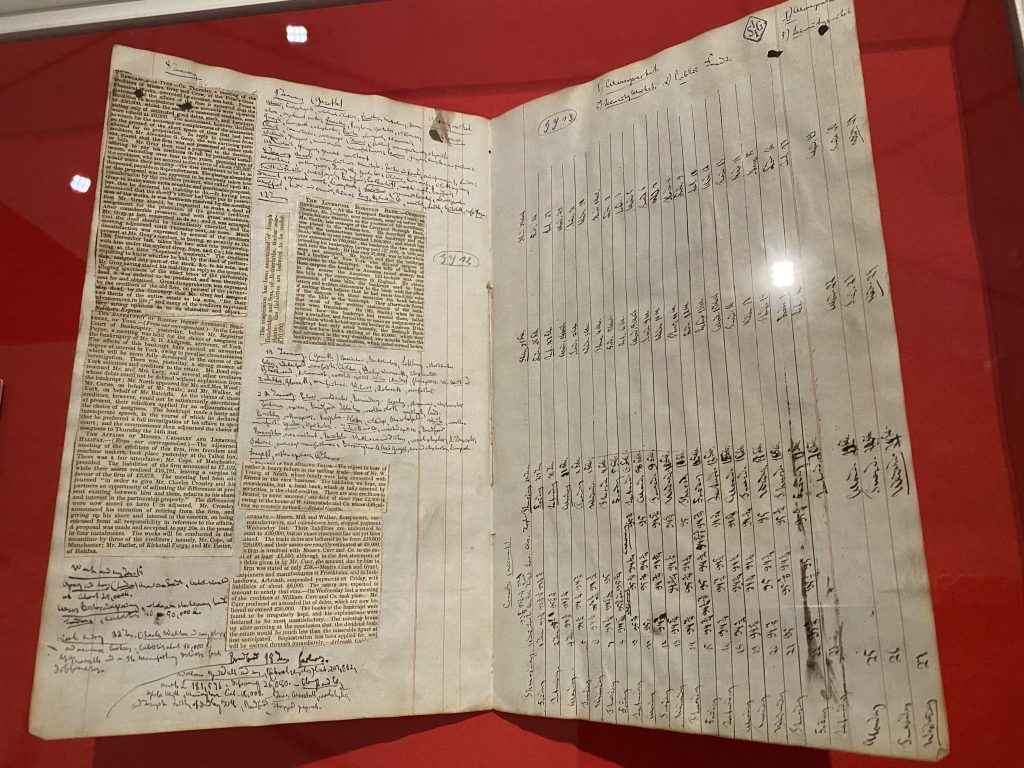
Spitzel
Warum der Tagesspiegel bei meinem früheren alteingesessenen Zeitungshändler “Spitzel” hieß, ist mir lange nicht klar gewesen. Ein ungutes Gefühl bei den gelegentlichen Käufen ist geblieben. Das Schimpfwort “Springerpresse” war schlimmer und “Lügenpresse” ist eindeutig ein Pressefreiheit misachtendes Statement. Der Unterschied zwischen Meinungen, wie und welche Meinungen in der Presse erscheinen kann verzerrt sein. Im großen und ganzen können wir mit unserer Presselandschaft in der globalen Aufmerksamkeitsökonomie noch zufrieden sein. Das Sinken der Zeitungslesenden um ca. 50% in den letzten 20 Jahren ist zwar recht dramatisch, aber hat vielfältige Gründe. Wenn aus Berichterstattung zunehmend Meinungs- oder Stimmungsmache wird, werden Personen, die Informationen suchen sich an andere Medien halten.
Es ist verständlich, Printmedien brauchen andere Finanzierungsquellen als Abos und Laufkundschaft (Grenze irreführende Werbung). Den “local turn” der Lesenden bei gleichzeitig Qualitätsbewusstsein bei überregionalen Zeitungen, was Auflagen steigen lässt, hat der “Spitzel” vollzogen. Da Überregionalität in Deutschland kaum mehr zu erreichen ist, begibt sich der “Tagesspiegel” auf die “Spitzel”-Variante. Mit 12! lokalen Teilen allein in Berlin gibt es fast für jeden Bezirk einen Spitzel. Diese Person berichtet meistens Trivialitäten aus dem Bezirk, erreicht aber wahrscheinlich, wegen dem alternativen Bezahlmodell (à la Google, Facebook etc. mit gezielterer Werbung + viel Eigenwerbung) und nur scheinbar kostenlos, eine breitere interessierte Öffentlichkeit. Gezielte high impact Werbung wird so ermöglicht.
Was heisst das konkret? Naja, auf einen Artikel zu Milieuschutz und Gentrifizierung folgt dann eben eine gezielte Werbung, die als Info getarnt daherkommt. Die vielen Spitzel vom Spitzel spielen das Spiel kräftig mit, indem sie Gentrifizierung als “Kampfbegriff” versuchen zu diskreditieren, obwohl es in der wissenschaftlichen Literatur z.B. der Stadtsoziologie + Geografie weltweit ein analytisches Konzept ist (Ursprung).
Der Treppenwitz der Berliner Geschichte ist dabei, dass Fahrstühle, die in Berliner Altbauten eingebaut werden leider für Rollstühle oft zu eng sind und meistens erst auf einer 1/2 Etage starten. Genau, sie stoppen dann auch wieder eine 1/2 Etage niedriger oder höher, da sie wegen der Treppenhäuserkonstruktion in U-Form eigentlich nur außen angebaut werden können. Wir sollten also die Spitzel mal mit Gehhilfen, Rollator, Rollstuhl oder Kinderwagen solche Aufzüge benutzen lassen, damit eine objektive, nicht von möglicher verdeckter Werbung getriebene Berichterstattung erfolgt. Ich empfehle einen Besuch beim Orthopäden oder Osteopathen, um frühzeitig auf die Gelenke zu achten, mehr aber sollten wir das Körpergewicht (Obesity in EU) im Blick haben. Vorbeugen war schon immer besser als Heilen mit teuren Hilfsgeräten. Das gilt auch für faire mediale Bericherstattung. Noch mehr Spitzel in immer kleineren räumlichen Einheiten braucht wohl keiner, oder? 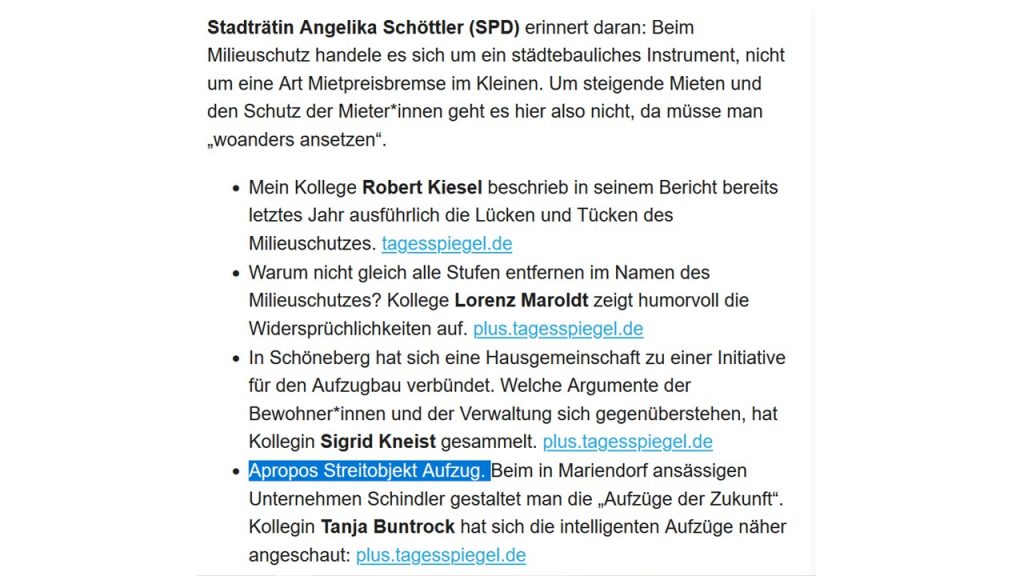 Auszug aus: Tagesspiegel Leute Tempelhof/Schöneberg vom 14.6.2022. Nur zu, machen sie “was mit Medien” aber richtig, nein auch nicht mehr so wie Henri Nannen. Radiobeitrag dazu. Hier.