Climateflation

Central banks have started to deal with the impact of climate change or inflation, short “climateflation”. New and additional inflationary pressures originate in climate change and global warming and they necessitate a closer scrutiny. Heat waves, like 2026-6 in Europe, or earlier ones have created an upward pressure on prices. Loss of agricultural production can be severe due to weather extremes which occur more often and with greater intensity. Such extended hot and dry climates reduce the production of crops and spikes in prices that only reluctantly return to average levels shall cause price inflation (climateflation). These are the short term impacts.
The medium run impacts alter price relations and valuations of in sectors like housing and infrastructure. Badly isolated stocks of housing, schools or hospitals depreciate valuations and the heavy investments needed for isolation of roofs, walls and widows as well as heat pumps to produce cooling shall be in very high demand, which makes price increases more likely across the construction sector. As we expect new devices to be “AI-intelligent”, “mem-flation” will be pushed up as well. These factors can give a push to some economies which are producers of the products in high demand and able to expand production rapidly as well. Just importing higher numbers of air-conditioning systems from other countries shall worsen trade balances.
The major challenge, however, remains our inaction to stop global warming to avoid additional economic and human losses related to climateflation.

Time and money

In the English-speaking world, most people will be familiar with the expression “time is money”. In times of working for money as pay, rather than growing your own crops, we calculate hourly, monthly or yearly salaries. Time is a habitual point of reference in production systems and calculations of economic growth. Inflation and depreciation speak to value over time, just as investment and returns accrue over time. For comparisons of different investments the chosen horizon becomes a decisive factor. Of course, in the long run we are all dead, but in the meantime time matters a lot, doesn’t it? Take out a loan and you realize how much time will matter, suddenly. Now, let’s turn around the causality, Money is time or can be buy time with money? For many processes this seems to be the case. With money you can buy time off working, or pay somebody to do work instead of doing the work yourself. You can “win time” or gain more free time this way. However, towards the end of your life, money might no longer suffice to buy you time before death even with lots of disposable income or cash. From a philosophy of science perspective, we might even question the concept of time-linked causality altogether. The relationship between time and money gets even more interesting if. we take intergenerational considerations into account like inheritance and environmental heritage. … and “the times are a changing”.  

State capitalism

It is the 2025-12-17 edition of the Wall Street Journal (WSJ) that touts President Trump’s governance as “state capitalism”. Through a listing of recent state interference into the functioning of the economy, the branding of this as state capitalism by the capitalist-owned press is without precedent. The President’s office has obliged NVIDIA to pay 25% of revenue from its China business on advanced semi-conductors to the Trump-run government. We might call this a kind of kick-back or blackmailing, if you want to expand or keep your business with a specific client. Major institutions like the Central Bank (Federal Reserve in the USA) are tackled to follow state orders rather than keep an eye on their independent assessment of facts about the economy. Nomination of governor positions have been subject to persistent interference from the president’s office rather than the government taking a moderating role of divergent interests, competences and lobbying.
The medium and long-term inefficiencies of an “at-will economy” have several examples, many in South American economies. The US economy is moving South in several respects, with the loss of the value of the $ compared to the €, maybe even devaluation is used as a strategic economic weapon. (Image: Ballroom in Chateau Vaux-le-Vicompte, France)

БЪЛГАРИЯ Bulgaria

The expectations of the entry of Bulgaria into the EURO-Zone are high towards the end of 2025. On the 1st of January 2026 we have new coins circulating in the Euro-countries. The addition of a country to the European currency yields insights into this country’s own cultural heritage. Piece by piece we learn, if we want to, to take a closer look into the more and more obsolete practice to handle currency in form of coins.
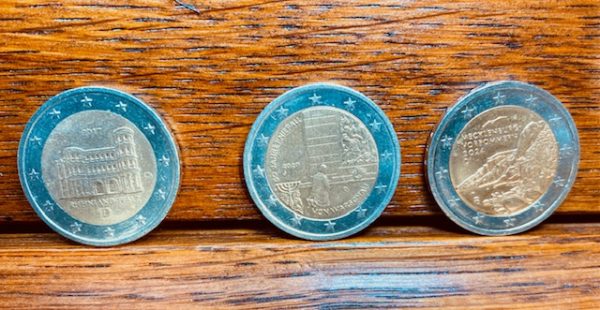
I cherish some of the coins with specific meaning to me (see image below, city of Trier, Willy Brandt, Chalk coast on Baltic sea). My small collection of coins from Greece allow me to refresh my Greek alphabet, words and historical landmarks of democracy. The circulation of Euro-coins with Bulgarian inscriptions in the Cyrillic alphabet will broaden our horizon again. Beyond the national features, we cherish the regional or federal organization in some countries, that feature their regional hotspots within this European cultural heritage. With a highly mobile Bulgarian population, not only within the EU, we shall soon see more Eastern Euro-coins with Cyrillic letters in our pockets and collections. … can’t wait for it … Ukraine in 202x, maybe 203x. 

AI in Central Banks

Yes of course, Central Banks will use AI, and some do so already (Kazinnik and Brynjolfsson, 2025). Beyond the standard application of AI by its employees, there are many potentials to use AI to analyse and publish data at a faster rate or in order to detect financial crimes. Similarly, data collection based on webpage harvesting might yield new indicators of inflation, expenditure for environmental risks (heat waves, flooding etc.) earlier and in addition to the normal set of indicators. Hence, Central banks might be better and faster in forecasting inflationary tendencies using more AI tools in their daily routines. Of course, it is difficult to predict a disruptive tariffs policy of a major economic player in the world economy, but the calculation of more, even hallucinatory scenarios become more feasible. It is feasible to weigh overall risks of different scenarios to the economy.
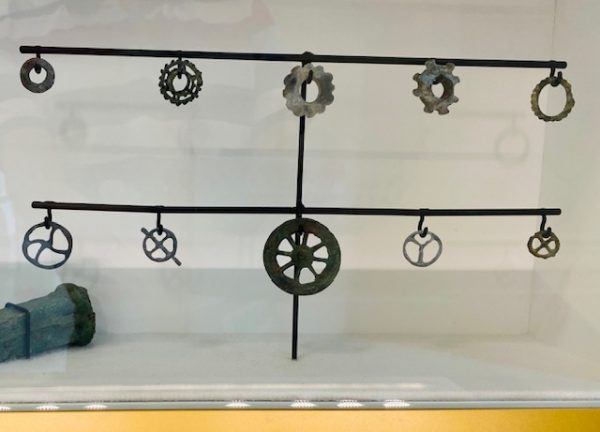
(Image: Celtic coins, Museum of the Belgian National Bank)

Home financing

For most people the biggest investment decision during their entire life course is the decision how to finance their home. The calculation of the costs of a bank loan over 10, 15 or 20 years to finance the acquisition of a home is a necessary part of basic financial literacy. The contract of monthly installments over years, considering economic uncertainties like inflation and interest rate payments, necessitates some basic knowledge of calculus and maybe the use of a spreadsheet to prepare payment plans with different scenarios. According to the Wall Street Journal of 2025-6-25 many home owners in southern states “slipped under water” in recent months in the USA. In short, buying a house when they are most expensive with a high interest loan and little down payment puts you at high risk if the prices for homes decline, for example like in a recession or stagnation. You can find yourself in the situation that the mortgage you have to pay suddenly exceeds the value of your home at actual prices. It is really important to be aware of the overall economic situation and risks of changes, like interest rate or inflation spikes due to a changing policy on tariffs. Reading and learning about financial risks should really enter into the school curriculum, but not left to maths classes as this will frighten off many students to take this topic seriously enough. 

Rich richer

The US economy under Biden had continued to make Americans richer. In an article by Talmon Joseph Smith in the New York Times from 2025-4-3 p. 7 the puzzle that Americans have grown richer, but don’t feel it, has been well explained. The large share of households owning their homes albeit with mortgages from low interest periods have witnessed their increased wealth. However, inflation is eating into their cash available for daily purchases. With another round of tariffs and additional inflationary pressure caused by those, the average person or household doesn’t fell much better off than some years ago. Economic anxiety and our preference for loss aversion or loss avoidance make us react with consumption restrictions to prepare for increased risks as well increased uncertainty about the directions of the whole economy and our very private wealth and consumption patterns. How and when the US economy will get back on track remains to be seen. Higher uncertainty usually reduces investments and with increasing interest rates again the economic recovery might be protracted. The NYT p.7 cites business owners with statements like “we’re not putting our foot on the brake, but we’re taking our foot off the gas.” Betrayel of working class people due to rising unemployment after 3 years of very low unemployment is likely to widen wealth gaps in the US population even further. The rich will get richer, but at high costs to the population as a whole. (Image: ceiling painting in Petit Palais, Paris).

Tariffs trumped

Economists are used to differentiate between micro-and macro-level effects of tariffs. For each buyer of a car, import tariffs raise expectations about prices for a product. Many consumers will then decide to buy lower quality at the same price or postpone buying a new or replacement product for some time. For cars it might mean that many people will then decide to buy rather later than sooner. If thousands of people do so, the market will fall into recession overall and it will take months or years to come back to the same or a higher level. A political economy perspective has taught us that eager politicians are in favor of a short recession immediately after an election which increases the chances of re-election once the economy gets back to normal or catches up on lost growth. 

The US under Trump apparently gambles with such an economic rationale. Short term inflation is already rising, interest rates stay high before the upheaval caused by tariffs starts to settle. 

There is, however, another alternative mechanism at work as well. Thorstein Veblen long ago hinted towards what is not called in economics the Veblen effect. Some fancy cars for example can raise prices well above others because of their cleaving image. Just because they get even more expensive the buyers of such products gain additional attention as part of a social class which does not have to care much about their additional spending. The consequences of tariffs will most likely widen the gap between those saving dearly and those able to splash out cash despite increased tariffs. The most felt consequences, therefore, will be on social inequality within the US (compare WSJ 2025-4-24 A2 by Juliet Chung, “Richest of Rich Gain §1 Trillion”).

Unwinding USA

Stock markets move largely due to expectations. Therefore, the mixing of economics and politics can create lots of signals, which are likely to raise price expectations. Inflationary pressures will call for central banks to increase interest rates which will reduce economic activities that are largely financed through the credit market.
The unwinding of the economy reduces turnover and most likely also profits of companies. The fate of Tesla cars in the last 2 months (Link) and the stock market value of Tesla shares (Link) have plummeted. The unwinding of shareholder value and inflation on the rise as well are a the effects of the MAGA narrative and Musk‘s appointment in politics as chief of GOPE.
The „home made recession“ in the US and the choice to prioritize own products might work in the long run, but the costs of the short-term induced inflation will affect vulnerable consumers more than the people who buy many products that show few price increases. The unwinding of the economy of the USA is likely to cause shock waves rippling through the global economy.
Image: Prices to charge e-cars with solar energy in Germany according to sunshine.

Screenshot


Cheatflation

There are many ways to study inflation. You may start by looking through your collection of bills. Economists like to swear by the consumer price index or indices, if you are even more into inflation. In textbooks like “economics for dummies” we learn about rational behavior and price adjustment mechanisms through the “invisible hand” to find some sort of equilibrium.
Advanced economics courses will teach you about strategic behavior inspired by game theory and the effectiveness/ineffectiveness of cheating. For advanced economists it is, therefore, inevitable that “cheatflation” should be part of the economists’ vocabulary. Of course, a profit maximizing entrepreneur is likely to way the risk of being found out contributing to cheatflation against the potential gains.
How to cheatflate? Too easy. Any producer of a product can cheat by using, for example, other ingredients than those printed on the product label, usually cheaper ones. Instead of fruit juice (wine) you may just sell colored water with lots of sugar (ethanol) in it, but still label it fruit juice (wine) and get away with this, until a consumer protection group makes a fuzz about it. A more sophisticated way is to sell investments in ESG-rated funds, but then include dirty stocks without proper notification in the fund, which probably increases profits based on wrong labels.
There is a specific quality to cheatflation, which makes it different from shrinkflation or enshittification. The drive to “obtain unfair advantages” through cheating across a whole country or region makes cheatflation an economy-wide process and subverts general fairness rules as well as trust in a society.
(Image Saccharometer, DTM Berlin 2024)