Colette Bewitched child

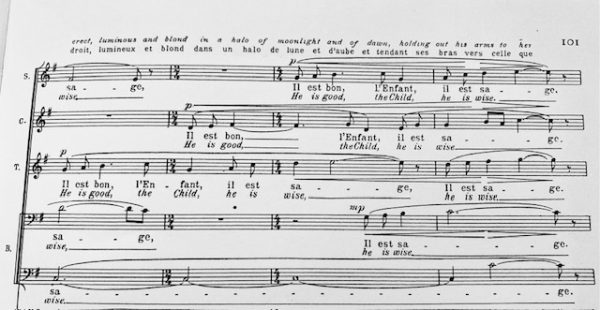
The English translation of the libretto written by Colette “L’enfant et les sortilèges” is translated to “the bewitched child”. The first representation was performed in Monte-Carlo in 1925 before it was represented in Paris at the Opéra Comique in January 1926.  The printed edition of Ravel’s orchestration classified the work as Fantaisie Lyrique based on a poem by Colette. This opus constitutes a forgotten forerunner of the much more popular musical “Cats” . In the end of Colettes narrative the animals call the child her “mama” and praise the good and wise child. It probably remains a forgotten 100’s anniversary, despite the fact that the topic of humans and animals, or nature in more general terms, have become more and more unbalanced over the last 100 years. 
Polyartist Colette

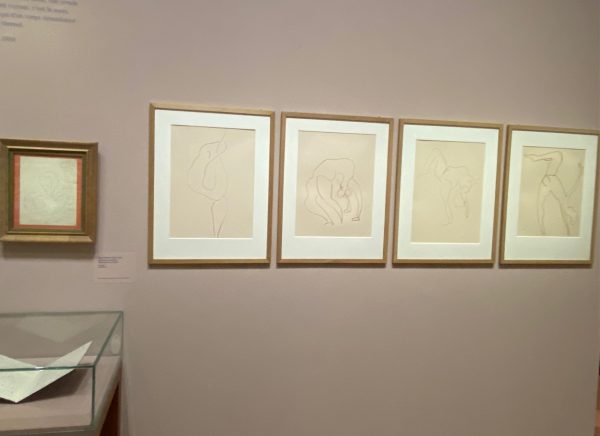
It is a complex task to do justice to a polyartist like Colette. The curators of the exhibition “Les mondes de Colette” (BNF 2025) Bouvard, Dimerman, Le Bras do a great job to present the biography of Colette, the writer, journalist, dancer in music halls, model (for Matisse) and entrepreneur in all facets of her activities. The role model of an emancipated women as early as the 1910s, 1920s and 1930s. The struggle of women artists in the early years of the 20th century to make a living from art is well documented already. To make a living of writing has always been a challenge if you do cherish your independence and liberty of expression. Versatility in artistic production is one escape route. Colette made a strength of this in diving into different forms of art and professional activities close to the artistic and creative world. In a quite unique way, she became her own muse for her own artistic work; and a character and inspiration exploring many facets of live. The economic misfortune experienced her parents became a source and force of inspiration.
Contrary to the expectations of the market of arts and literature, she did not feel like sticking to just one activity. Her most lasting achievements, probably, were her literary accomplishments for most people, although Matisse immortalized her in his specific style of abstraction.
Polyartists just like Polymaths, make more comprehensive contributions to our experiences.
(Image:Lithographie by Henri Matisse of Colette, exhibition Colette at BNF 2025).

Biography Memorial

Some biographies take the form of a memorial. Marie-Luise Conen and Zdravko Kucinar have erected a memorial for the researcher, author and Social Demokrat “Milian Schömann” from the “Moselle” region near Traben-Trarbach and Lösnich. The biography reads like a narrative of crimes, which goes without punishment, before and during the Nazi-terror and the power grip in rural areas in the late 1920s and early 1930s. Milian Schömann achieved his university entry qualification A-levels in Traben-Trarbach before he moved on to study German literature and philosophy in Heidelberg, Bonn and Berlin.
His studies and political engagement were driven by a humanist approach and his letters and publications as literary critic as well as his contributions to philosophy are partly reproduced in this biographical account. This allows to follow in the footsteps of the curious and open-minded person of Jewish descent. As a contributor and speaker at meetings of SPD-members and associated political movements, he risked and eventually lost his life for his humanitarian convictions in 1942 near Belgrade.
It is the merit of Marie-Luise Conen and Zdravko Kucinar to let Milian Schömann live on in our time through the reprinting of some of his work, which is embedded in a  well-written historical account of the political and family setting at that time. The professional psychological training of Marie-Luise Conen helps to reproduce the anxious atmosphere Milian Schömann has lived through, albeit he remained a productive writer despite the economic hardship and living in exile.
This biography accomplishes in a rather unique way to enter into the mind and thinking of the author Milian following his very personal perspective on the “history of ideas” and inner call to action. Similar to the appreciation of Viktor Ullmann in the Jewish Museum in Berlin, where the music of the composer lives on after his death, the writings of Milian Schömann survived extinction, despite that he was murdered. After more than 80 years we still feel the loss of potential other contributions to philosophy and literary studies. The recognition extends to Milian’s academic and personal mentors Oskar Walzel and Arthur Liebert, important sources to understand the reasoning and motivation of Milian.
(Image: Extract from Marie-Luise Conen and Zdravko Kucinar (2024) Milian Schömann, Paulinus Verlag, Trier, p. 139)

Hugo intergenerational

Well, this entry is not about Hugo Boss, whose name is probably known to more people worldwide nowadays than the French poet and writer Victor Hugo. The latter Hugo, however, is likely to be known to more generations to come than the former one. In his 19 years of exile with his family he had the unique chance to get to know his grand children a bit closer, which was rather unusual for the late 19th century. The romantic poet was charmed to an extent that he could help it, but to express himself in a longer poem. „L‘art d’être grand-père“ (The art of being grandfather)“. Victor Hugo experienced the death of own children and his wife before and his grandchildren surely gave him reason to believe in a more joyful tomorrow. Comments on this poem mention the idealised vision of the romantic regard on children and even more so on his own grandchildren. « Leur front tourné vers nous nous éclaire… … Ils trébuchent, encore ivre du paradis. » 

We forget all earthly quarrels just listening to the soothing sound like children’s rhymes. Hugo is a master of all literary classes and he ensured that his intergenerational legacy would be part of this.  (Image: Maison Victor Hugo, Paris, writing desk ro stand in front of)

Text to Image

Long before everybody started to discuss Artificial Intelligence, which in many applications takes the form of transformation of a textual prompt into an Image, Photographers have had literature or quotations in their mind that shaped their images. This was a kind of poetic imagery not always easy to recognize. The exhibition in the „Institut de France“, Bibliothèques Mazarine (LINK), with photographs by Nicolas Fève (LINK) offfers a great insight into this way to conceive of an image and its realization through photography. Exposing the sources of inspiration as well as the photo is like adding textual citations to an image in a much more inspirational and transforming manner than AI is doing these days in 2025. 

Text to image is only one out of the many ways texts might guide imagination, but it is a powerful and gripping one. The history of literature is full of other forms like videos based on novels, comic strips to make classic texts in Latin more accessible. As we shall ask AI products like texts and images to cite their sources and honor authorship, photography as art and science might enhance the literary experience by adding citations to an image. This has the additional advantage that more people will follow up on the sources of inspiration.

Korean Uprisings

With the recent Korean uprising against the imposition of martial law the world has witnessed a successful defense of democratic rule in South Korea. International politics has quickly moved on to other areas of the world where people’s struggle to obtain or sustain the freedom to vote and the freedom of expression.
However, the Korean history of uprisings goes back a least as far as the beginning of the Cold War period with the separation in 2 Koreas. The 1980 uprising of student protests in South Korea was extinguished with brutal force and mass killings. Can literature heal the wounds of uprisings? Only the best of literature can. The Korean female author and poet Han Kang (Nobel laureate 2024) has accomplished this. In the novel 소년이 온다 “Human acts” (English title), “Celui qui revient” (French), ”Menschenwerk” (German) the Gwangju Uprising 1980 is the historic backdrop against which the loss of human dignity during dictatorships is narrated. Han Kang manages to depict the empathy of family members who are confronted with the brutality of the military forces. It is tough on readers as they become the witnesses of the violence described as such and the sorrow of the whole social environment of the victims.
The Nobel Prize for literature 2024 honors the “world literature” aspect of Han Kang’s writings over many years. Many prizes have been allocated for representative writers (80+ % were men) of a country. The different titles of professional translators chosen for this novel reveal the potential to link to very different national narratives and connections to national memory of uprisings. Translating literature from different cultures can be challenging as readers frequently want the narratives somehow to relate to their own “endured” experiences. World literature, just like world history, goes beyond this and takes the reader by the hand and broadens emotional and human horizons.
(Image: Gallery Lee Bouwens, Brussels, exposed Jungjin Lee Voice #02, Voice #26 in 2025, inkjet pigment prints, Jungjin Lee)

Covid Literature

In 2025 it about time to evaluate the medium term impact of the Covid-19 crisis in Europe and world. The various lockdowns caused unexpected “spare time” or time in isolation. Some otherwise very busy persons embarked on literary projects during these months. Most of the outcomes have now been published. Most authors would not label their writings as “Covid literature”, since they do not deal with the Covid pandemic in any sense. However, only due to the additional time resources, and maybe writing as a creative coping mechanism, some persons became and dared to become authors eventually.
For some isolation from the usual work context was a lonesome experience, others realized literary projects. Camille Paulhan (edition Sombres Torrents) for example used freed up time to write “Couper à travers les ronces” published in 2021. Her short stories, like narrative clips, range from introspection to memorable encounters with art works and artists. As an expert on “perishable art” Camille Paulhan is particularly sensitive to the “fleeting moments” of encounters and maybe of life itself. The Covid-pandemic has certainly reminded us on the increased risks to our existence during a pandemic. The literature originating during these months and years might reveal specific virtues only ex post.
You might still be able to buy a copy at the publisher. The bookshop and gallery Yvon Lambert (online retrieved on 2025-1-20) says sold out, but shows several pages online. Although books may become a perishable product, some copies will survive due to the efforts of fans of perishable art and moments.

Ukraine Poets

Difficult times have a long history in Ukraine. However, literature and poetry have flourished since the Ukrainian independence from the Soviet domination in 1991. Periods of hunger under Stalin, Nazi crimes in the 2nd World War, Tschernobyl radiation, Annexation of Crimea and now Russian war on Ukrainian territories, the endurance of hardship is part of Ukrainian culture and society. This has created a strength of resistance and resilience which is exemplary for all countries. The democratic countries stand firmly on Ukraine‘s side and support not only military defense efforts, but also artists and poets in such difficult times.
A collection of translated poems from Ukrainian into English has been published in 2027/2018, showing the horrors of the large scale war that was to come a few years later. In fact from the Ukrainian perspective the annexation of Crimea was the first war initiated by Russia although the Western world did not want to see this as a brutal aggression, which it was. The poems in the anthology are available online for everyone to read and understand that war changes personalities. Suddenly, dying of old age becomes a blessing as many young soldiers and people die on the battlefields (Died of Old Age, by Lyuba Yakimchuk translation by Anatoly Kudryavitsky) .
7 years after the translations where published the poems have kept their sorrow and the reminder for us to continue our support for Ukraine‘s fight for democracy, independence and freedom of speech and the arts. (Image: Front: from War Diaries, Brussels 2025, shown in Gallery of Katarzyna Napiorkowska).

Happy Employee

The research on happiness, subjective well-being or overall satisfaction with your life is also an empirical question. Analyses of being happy donot only focus of overall happiness, but look much more into the details of happiness. Beyond the tricky longitudinal observations of happiness it is common scientific practice to deal with subdomains of happiness like satisfaction of employees with their job, satisfaction with one’s job beyond the honeymoon and hangover effect, best known from family studies.
Each of those subdomains has a significant effect on overall happiness. The novel “Happy Life” by David Foenkinos is an interesting example which focuses mainly on the subdomains of job satisfaction, satisfaction with private and romantic partners as the major domains of a happy life. As developed in the novel, people make job changes to re-orientate professional careers or reset their private life. A low point on the happiness scale in one domain might be compensated by higher levels in another domain. These impact from one domaine to another might have substantial time lags involved as well. More drastic resets (à la Foenkinos) can be avoided through focus on other subdomains of overall happiness as well.
How happy are you with your housing situation, neighborhood, your pet, your physical health? There a multiple +/-spill-over effects to overall happiness. Reading a novel might be one as well, just take time reserved to yourself.(Image BnF expo “women in sport”, 20024)

Happy Life

There are countries in this world that want to prescribe to their citizens what constitutes a happy life. Religious beliefs are another powerful instigation of what may be called a happy life now or in the future. Most people on earth, however, have their very own idea about happiness and how to get closer to this moment, phases or destiny of their lives.

Happy life is also the title of the novel or „une fable optimiste“ by David Foenkinos with the almost programmatic title „La vie heureuse“. It has been qualified as a bit absurd, but at the time of celebrating 100 years of surrealism, this fits into the surreal world episodes and narratives that surround us. The novel is full of ups and downs for the major characters, which reflects the inevitable links of happy relative to unhappy moments in life. The pseudo experience of death allows to press a kind of reset button in life after which love and life can start afresh. This might not work for all us as Foenkinos seems to tell us with the choice of the dedication and citation of Charlotte Salomon „On devait même, pour aimer plus encore la vie, être mort une fois“. Charlotte Salomon, however, lives on through her formidable artistic work accomplished in her short life.