Looking back at the end of every year to what happened in the last 12 months gives mixed feelings in annual repetition. Developments of nature and biodiversity are sometimes troublesome (variants of viruses like omicron). Despite wars and man-made disasters most people have a capacity to bolster with optimism. To view a glass as half-full rather than half-empty is a common description of two different perspectives on the same fact. Additionally from a longitudinal perspective it matters, whether you started from a full glass beforehand or from the empty glass. In experiments we would need to clarify the role of the starting point and evolution before the statement on the 50-50 state of affairs.
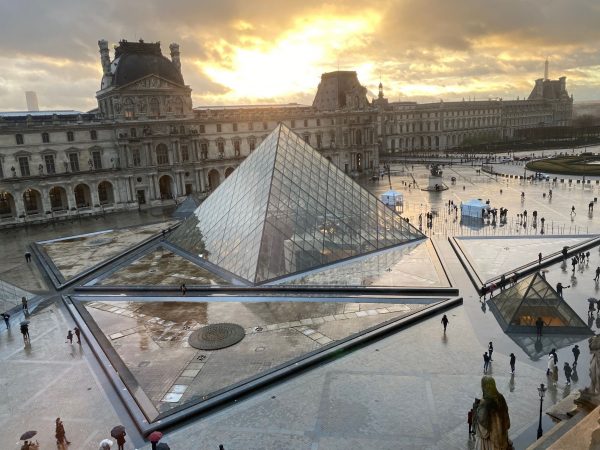
In the French enlightenment, represented by Voltaire‘s “Candide ou l’optimisme“, a critical view on the optimism of Leibniz is expressed. The optimistic claim of Leibniz, “we live in the best of possible worlds” is questioned by Candide who believes taking care of his own little garden is probably the best he can do to preserve nature and the world. These two apparently opposite perspectives and conclusions on the potential of human action we find reflected still nowadays in politics and world affairs. Do we stand up to defend human rights or do we believe the fight is futile? The optimism embedded in Ukranian culture, for example, demonstrates the power that might come out of optimism. It would even go as far as stating that optimism is a precondition for democracy, always striving for the improvement and spread of democratic procedures. Creating opportunities to more freedom to do something is the driving force besides ensuring to curb infringements on one’s freedom. Optimism is a close ally of imagination, imagination of all people living in peace. A nice sunset gives hope for a nice sunrise as well.

M for Memory
Besides the English term memory, which refers to a huge scientific literature starting with cognitive psychology, I like the French version of “mémoire”, because it is more comprehensive with additional meanings, nicely represented by Wikipedia.org. On the German Wikipedia-page you find first the reference to the children’s game memory, turning around images and memorising where the counterpart is/was (play pairs). This diversity hints towards a cultural element in memory. There is a person’s memory or mental capacity to recall and ways to remember. The latter term refers a lot more to collective memories and becomes a more debated issue. Danny Trom uses the term “split memory” in a chapter on France and the “myths of nations” (p.129-151). In David Brook’s reader on “the social animal” he states that grandmasters in chess (p.88) were long believed to have superior memory. This is actually not true as memory experiments showed, but they rather saw formations and “internal connections forming networked chunks of information”.
“Mémoire”, on the contrary, refers also to the writing of a person’s own biography. Nowadays, book shops contain whole sections of autobiographies, the most sold appears to be the one by Michele Obama recently, if I recall correctly. Among the most scandalous is the publication of the “Journal pour Anne (Pingeot) 1964-1970” by Francois Mitterand. All the autobiographical documents make explicit major parts of what might form collective memory later on.
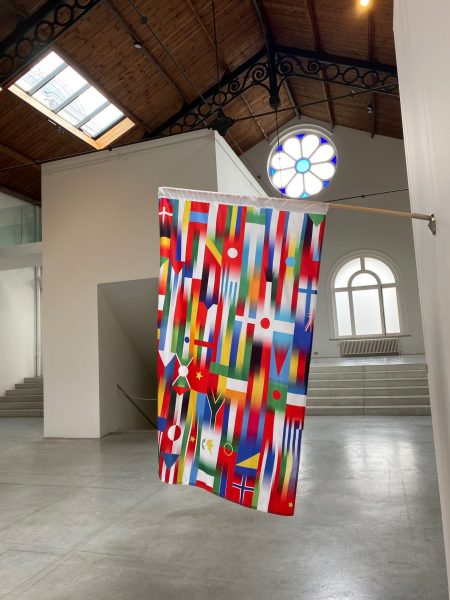
Memory has found its way into engineering and computing. The memory effect in batteries or being “out of memory” frightens users in computing or programming. In short, I wish you the best of memories reading this page and stimulation by visiting memorials (image: Jewish Museum in Berlin 2022, Ullmann exhibition). 
L for Law
Contrary to a popular misunderstanding. Law is not boring. The history of ideas is full of exiting projects based on laws. Starting with the foundation of empiricism, i.e. the comparison of laws governing the different Greek city states pioneered by Aristotle. Considering law from the perspective of legislation gives it an actionable touch and makes it more exciting to many persons. Contrary to a static perception of law, laws can be changed and are subject to interpretation continuously by courts and judges. The fascination with law might start with the philosophers of the French enlightenment like Montesquieu. “De l’esprit des lois” – explains already the need to look behind the literal text of law. What is the spirit of law, becomes the driving question. Not only the categories of countries like republic, monarchy and despotism were argued by him, but also the separation of powers into an executive, legislative and judicial power is his original contribution. These principles govern the German “Grundgesetz” and are a common understanding of the founding states of the European Union as well as a potential breaking point.
A sociological perspective on law is formulated by Niklas Luhmann (short intro in D) and highlights the danger of laws as a self-referential system. This dominated by experts who develop the system further independent of the concerns and understandings of wider society. In order to understand this concern, it is probably useful to think of climate change as an urgent problem. Bio-diversity has for much too long not been of much relevance for legal founding principles of our constitutions. In the same vein, women judges or diversity in the legal profession is a point of concern. Majorities versus minority rights create intrinsic tensions in law, legislation, execution and interpretation. Analysing the half-life of laws is interesting, i.e. how fast do they really change or get abandoned altogether. Equality in front of the law remains a thorny issue. It is a huge issue when moving from law to justice as primary concern. The most interesting point is the view of law as a changing matter, hopefully for the better, but this is another question altogether. Reveillons-nous l’esprit des lois ! (pas seulement au Reveillon). 
K for Knowledge
Readers of the sociology and/or the philosophy of science or knowledge have a hard time. Each discipline is evolving at such a high speed that is terribly hard for humans to follow more than 1 or 2 fields. Perhaps the choice of Karma instead of knowledge would have made it easier here. Alternatively, in German it is easy to find many nouns starting with a capital K. Kapital, Krieg, Kritik or Käsekuchen would have been popular, I guess. Soon I shall open the comments for suggestions for additional nouns, as part of the empirical “swarm knowledge strategy” rather than the theory-driven deductive method applied in knowledge generation on my side so far.
But wait, we are already in the middle of the unsatiable quest for knowledge. On a meta-level we would deal with the multiple ways to acquire knowledge and create new knowledge. Artifical intelligence is certainly one of the hypes at the moment. New data and new combinations of data drive us forward in the expanding universe and knowledge space. We have witnessed the disappearance of the thick printed encyclopedia in most households, replaced by specilised digital dictionaries or the network society’s shared knowledge base of “wikipedia“. Knowledge is linked to the history of ideas and Peter Burke is a prominent figure to rely on as a reference in this field. 20 years after “A social history of knowledge: From Gutenberg to Diderot” he published the much acclaimed: “The Polymath. A cultural history from Leonardo da Vinci to Susan Sontag” in 2020. To synthesise across the many “monsters of knowledge” over centuries is a daunting task. I like quotes like the one from Leibniz (p.77) “the horrible heap of books that is constantly increasing” and then his own continuation: “Printing, once viewed as a solution to the problem, had become a problem itself”. The whole section is devoted to information overload. Fragmentation of knowledge into disciplines and, much worse, the manufacturing of false knowledge create new challenges to knowledge. Maybe transforming the term to “knowledges” rather than knowledge is likely to capture better the differences between artificial knowledge, created by artificial intelligence and specialised algorithms, and human based knowledge. In knowledge storage we have lost the race with computers, but in deciding what are promising combinations between different fields of knowledge, we are still a wee bit ahead of the machines. Klara tell me, where is the exit, or your synthesis of the whole lot. Meanwhile I continue to read – what? books and the like. 
I for Imagination
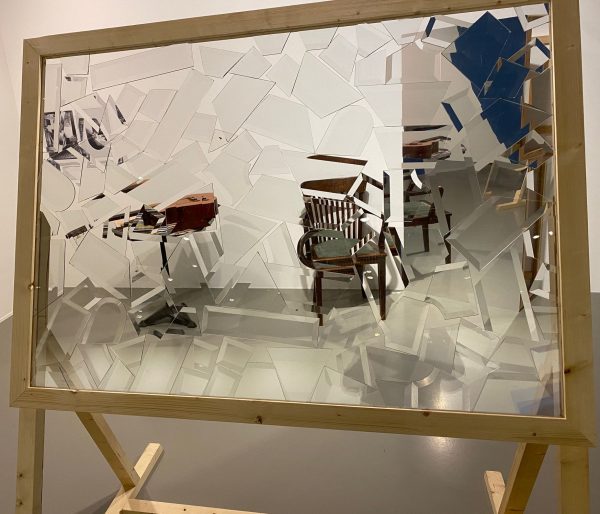
We are all full of imagination. The human brain hardly can do without it. It could be understood as if thinking of oneself is a continuous process of imagining and reimagining oneself. We just developed or were forced to suppress imagination at various instances throughout our lives. Day dreams are rarely tolerated, starting at school, then on the job and probably for a long time also about the way we imagine our own ending or life after death. Just trying not to think, like in meditation, seems to be a very hard exercise and it demands long practice to arrive at longer durations. Abstraction is one of the ways of art to allow imagination to rule the process of creation. In view of the anniversary of Pablo Picasso in 2023, the Brussels Royal museum of fine arts
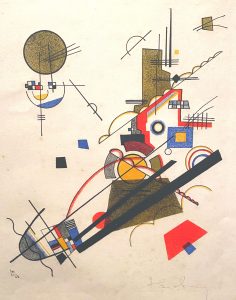
is presenting a paedagogic reflection and demonstration how Picasso emerged on his way towards abstraction as his preferred way of imagination and reimagination as part of the realisation process of his art work. As part of the Cubist revolution Picasso is quoted in this exhibition on how he paints: “Je ne peins pas ce que je vois, je peins ce que je pense.” and “Chez moi, un tableau est une somme de destructions.” Nice imagination, reimagination and de-construction I would say. Like the imagination depicted above from Paul Klee reflects the accomplishment of a new form of pictural language. Try imagination, it isn’t hard to do, “John Lennon” sang once. In Brussels you can try seeing the cubist way in the Picasso exhibition, a good way to prepare yourself for the next visits of fabulous exhibitions in honor of Picasso in 2023. 
H for Health
Health is not just a personal issue. Of course, in modern times most people are primarily concerned with their very own health. Particularly, if pain is involved, we tend to put ourselves first. Only various religions and ideologies put God or some other bigger thing, for example identity, in front of personal pain. This bigger thing is believed to decide wars, like Russia trying to anihilate Ukraine. Russia’s military agression stands against the fight for freedom, democracy and perpetuates corruption.
At the beginning of the Corona-Crisis most persons and societies still believed health and infections are only a very personal issue. Researchers with knowledge about “public health” knew already, viruses have accompanied humanity since its beginnings and maybe continue to do so even beyond our disappearance. Hence, addressing the topic of society and health from a public health perspective has become much more popular as prevention is key to fight pandemics as early as possible. However, for prevention to work you have to involve and rely on individual behaviour. As soon as we leave the personal issue of health, we have to address a whole set of other topics like patient – carer relationships, cooperation, interdisciplinarity, public expenditure, public-private partnerships, corruption or behaviour of large crowds. We have developed antidotes against most difficulties, probably the strongest one is solidarity. Social systems that address inequality of provision (e.g. between regions) or inequality in access to and quality of medical services (e.g. doctors, care or pharmaceuticals) have a strong role to play. Structural, financial and political issues play a powerful role in health. As we think more about prevention and costs we start to understand that we have to start with nutrition, mobility, mortality and our western style of life in more general terms, particularly if we think about health on a global scale. There is no planet B where we could travel to, once it has become impossible to lead a healthy life on our planet. Topics of health over the life course or ageing will need a lot more attention. Findings on the risk of suicide after onset of physical health problems (Link to study) asks for fast responses. Access to digital tools might be part of the solution like “Sympatient” as well as being part of the problem like data leakage. 
G for God
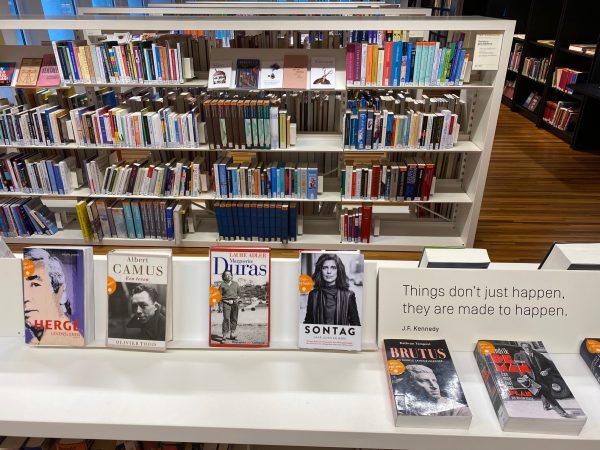
God is dead, wrote Nietzsche about 140 years ago. So, is he, is she, are they? The discussion is ongoing. As science has debunked the myths surrounding birth, the jury is out as humanity is claiming freedom of choice also towards the end of life. Our cathedrals of Modernity, i.e. libraries , or Tempel of knowledge, i.e. universities, offer lots of instruction and Musea artefacts or Anschauungsmaterial to answer these existential questions. Perhaps this is just a lot of noise about “rien”, “nichts” or “Much ado about nothing“.
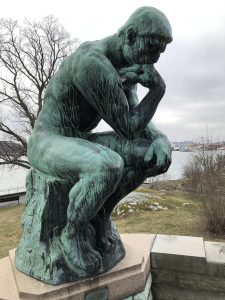
We might have to rethink society from scratch, starting with the definition of social backround and identity , but there are plenty of good sources to build upon, starting with basic human rights and the Schuman declaration for the construction of Europe, rising out of the ashes. Lots of hard thinking to do, Rodin thought so, too. The thinker above the “porte de l’enfer” ready for meditation in the Musée Rodin Paris 7eme arrondisement. 
F for Freedom
This choice is no surprise, or is it? Who is longing the most for freedom? People in the so-called Western world are reported to score highest in the rankings of achieved levels of freedom. However, the longing for freedom often seems the strongest in countries, or regions within a country, where elements of freedom are restricted. Then fighting for freedom becomes an intense struggle, sometimes leading to outright war or fighting back like in Ukraine. Beyond the negative freedom (free from capital punishment) there is the positive freedom to express yourself freely. Both perspectives on freedom are crucial. Being free from prosecution is often only a first step towards the goal of being free to live your way of life as you feel it. It has always been a political struggle and will remain one today as well as in future. Less consensus reigns on the topic to what extent economic freedom is a constituent part of the term freedom. Far-reaching economic inequality within societies frequently limit persons at the bottom of the distribution to fully participate in society and excercise many components of freedom like decent food, housing, health and health care. All this remains the biggest challenge for humanity for years to come. We shall need a lot more heros in the name of freedom like the famous Nobel prize winners. Fighting for freedom in a peaceful way is probably the biggest challenge for humanity also in the 21 century. 
D for Democracy
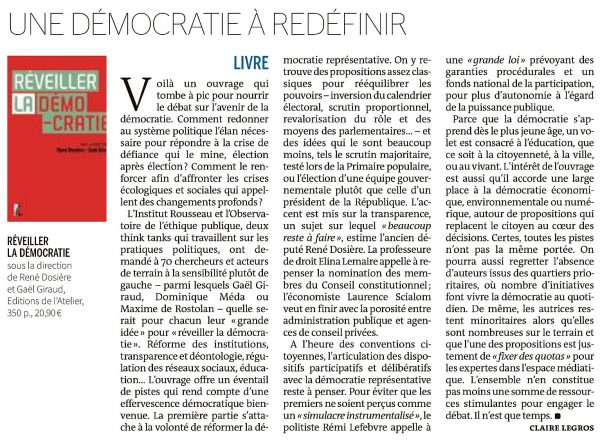
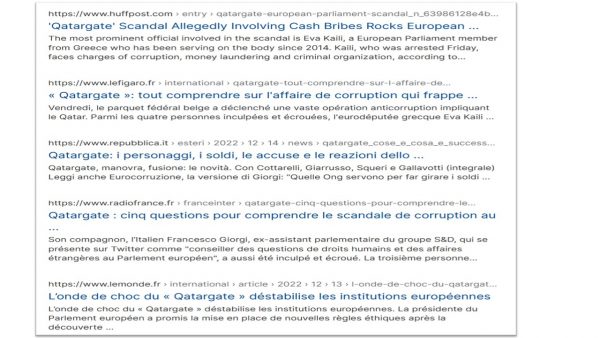
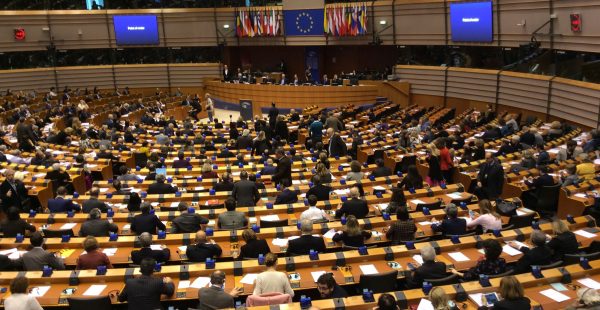
Stand up for Democracy. Give me a D. Yes, we are passionate for democracy. Even if we are not singing Beethoven‘s “Ode an die Freude” every day, we are well aware that we have to defend democracy at numerous places. The essay in the New Yorker by Jill Lepore from January 2020 on the manifold risks to democracy and the way forward is a great inspiration. Democracy is always a “work in progress”. It improves and in most cases rises with the challenges. However, this demands to stay alert and wither the beginnings of threats to its functioning. Beyond the external threats, internal threats to democratic values are abound. The discursive element that is highlighted in the essay remains crucial. Debating in public is key. Transparency of arguments, reasoning and values are constituent parts of democracy. Clandestine ways of corruption, bribery and threatening of violence become apparent when fractions of society retreat from the public to form insider groups. Defenders of democracy need to speak out in public, publish they work, expose and perform their arts, challenge school curricula and be active in any policy field. This is a lot to do, but we have to prevail and rise to the continuous challenges to the democratic way of life. Too many dictators and autocrats around the world would like to see democracy fail. Worse, they work actively, like in “Qatargate” in November 2022 in Brussels to spread illicit practices of corruption. We have to strengthen our “antennas” and sensors to detect such practices. Prevention is key. Tough reactions with the force of the legal system to stop the spreading is also indicated. Let’s rise to the challenge, again and again with the latest technology. 
C for Corruption
After the association of C with crises of corona, climate, consumption and the church we have to come back to one of the original links: corruption. Beyond the work of describing and analysing corruption from the time of the Roman empire to the Americas of today (Link) by Thomas Strunck, the re-reading of Niccoló Machiavelli is recommended by a number of scholars (in latin here). Also, in Asia the work and writings of Niccoló have been rediscovered (Link). “non creando in veritá le cuose nove”. It needs “una ferma experienza”. As people don’t just believe in the truth of new reasons, a firm experience of them is needed. New princes cannot just pray, they have to install a new vision or belief with force (p.25) by literally forcing persons (forzare) or “fare … credere par forza” stated in Chapter 6 of THE PRINCE. If we just complement the term force by force of persuasion, or money as surrogate for both, the writing of Niccoló speaks directly to corruption in our times. History does not repeat itself. However, the history of ideas still teaches “some dogs old tricks” until they are found out by investigative journalism and an independent judiciary, which both did not exit at Niccoló’s time. (inspired by Chaudhuri, S. & Chakravarty, P. (2022) Machiavelli Then and Now: History, Politics, Literature. Cambridge University Press.)