Racine Andromaque

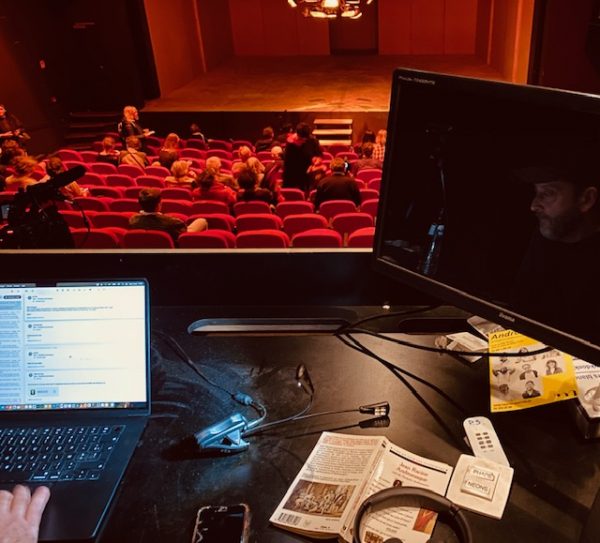
The representation of Jean Racine’s “Andromaque” in Brussels at the Theâtre des Martyrs in 2025 has been an interesting choice, because the revival of a 17th century tragedy dealing with the intricacies of the Greek and Trojan war (mostly remembered for the Trojan horse). Jean Racine turned French theatre back to tragedies with his Andromaque (Résumé and analysis in French!), rather than the comedies or tragi-comedies of previous great authors like Molière.
The literary analysis of Andromaque by Roland Barthes (“Sur Racine”, 1963) identified 3 separate locations: chamber, anti-chamber and exteriors. The real power seems to live in the chamber as the place of respect, but also terror. (Compare also Mithridate). The anti-chamber is the place of diplomacy and the place of exchange of ideas, information and strategies. The exterior world is mostly closed off through walls or balconies as views from above. For Barthes this “symbolizes” even the prison inside or the pure heroic life inside the walls.
Besides this 21th century interpretation of 17th century theatre, Racine is remembered for his tragic love stories where A loves B, but B loves C and, maybe C falls in love with A. (Compare Robert Horville, 1991) The Condorcet paradox (Science of it) described only formally in the 18th century enlightenment, many decades later, had proven mathematically that such combinations of personal preferences are impossible to resolve. Hence, these confusions are great stuff for tragedies to evolve live on stage.  
 

Popular Sociology

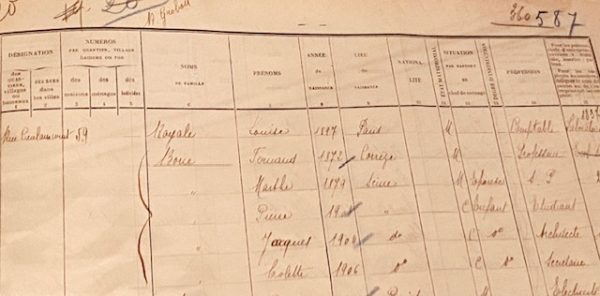
Sociology, like other social science disciplines, has often difficulties in reaching bigger audiences. However, in combination with a museum which specializes in the history of a big city like Paris, the insights can suddenly become very popular. The “Musée Carnavalet of the history of Paris” has mounted an exhibition, which builds on the population censuses of 1926,1931 and 1936. The access to the complete original records of 3x about 2 millions of people has become a national treasure for social scientists and the public at large.
People flock to the exhibition. Some do it to learn about the past of their districts or streets. Others to learn about historical facts, which are sometimes linked to the family anecdotes and broader historical narratives. Out of this interest grows an understanding of macro- and micro-level social processes, which makes use of basic statistics.
People ask themselves: Is your (family) story unique or is it part of a more general pattern or social process like urbanization or social mobility.
(Image: original census recording sheet – Paris)

Opera design

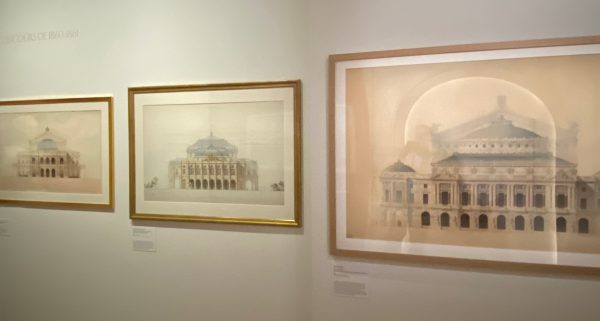
France celebrates 150 years of the National Opera Garnier in Paris. The exhibition in the splendid building traces the history of the building from the competition for the design to the legendary performances and celebrities attending. The stairs outside and even more so inside are built to enhance the glamour around operas and dance. The drawings by Garnier are a highlight as much as the videos about celebrities walking up the stairs of an Opera building.
Charles de Gaulle, as many French Presidents before, dressed and took the famous stairs to impress the official invitees. The image of de Gaulle together with Konrad Adenauer is another interesting example of opera politics showing the authentic friendship after the fierce fighting of the 2 WW, the Nazi-terror and Shoa.
The design of the Paris Opera 150 years ago made for an impressive ritual performance of state diplomacy enhancing international reputation.
(Images: 150 years of Opera Garnier Paris – 3 designs, winning design by Garnier on the right).


Balance and justice

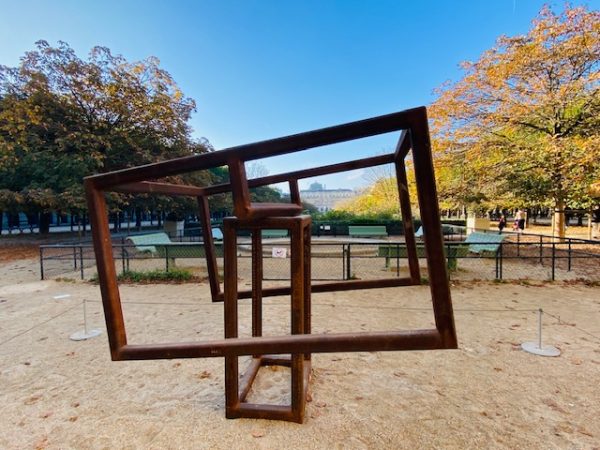
Justice is often represented with the symbol of a balance. This dates back at least to the Roman times when the Roman law reached an unprecedented spread across Europe. The philosophy of law dating even further back to the Greek philosophers, notably Aristotle, founded comparative law with his comparison of constitutional principles in various Greek city states of his time. Striking the right balance, therefore, is encrypted into law, legislation and the American constitutional principle of checks and balances. In Paris the sculpture in the “Parc du Palais Royal” of heavy metal balance at the opposite end of the park is moving as well. Facing the ”Conseil d’état” and the “Le conseil constitutionnel”, this is a forceful reminder of the basic principles of a republic and democracy.
In the 21st century, particularly, since the weights attached at each end of the balance pull more forcefully at the moment in several countries.
Institution building and safeguarding the existing ones have become “the challenge for democracies in 2025 in many “centuries-old” democracies.
(Image: Sculpture by Raul Mourao in Parc Palais Royal, Paris 2025-10)

Fighting the Beast

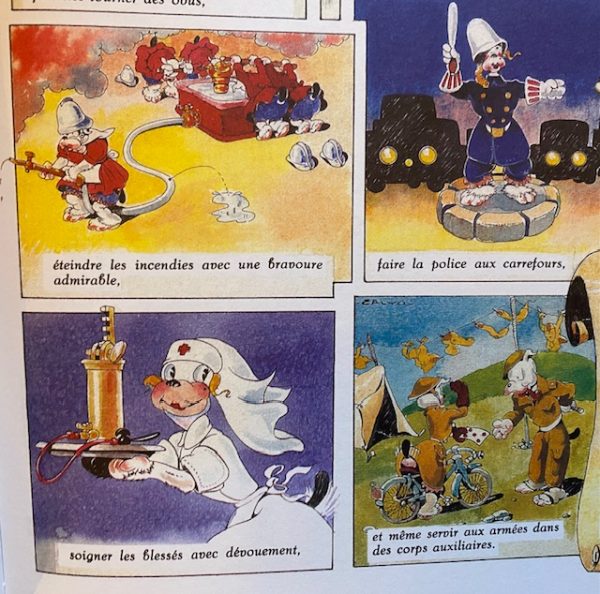
The earliest post 2nd WW cartoon stems from Calvo in France, published in its first edition in 1945. After the first part entitled “When the beast became unchained”, the second part could report on the happy ending “When the beast was overturned”. Amongst the admirable comprehensiveness to talk about the preparation of war, the battles and atrocities committed by the wolves, the allied forces of animals gained the upper hand. The role of women in the fight against the beast takes almost a whole page in the historically precise narrative of the 2 WW. With a fine sense of necessary historical detail, the reporting of British women (the female dogs in the cartoon) as essential part in the war effort to win the war against the beast(s). Women exercised professions were not previously allowed to enter. Gender awareness as early as the mid 1940s was rather advanced at the time.
Great topics to talk about with your children or grand-children.

Deep reading

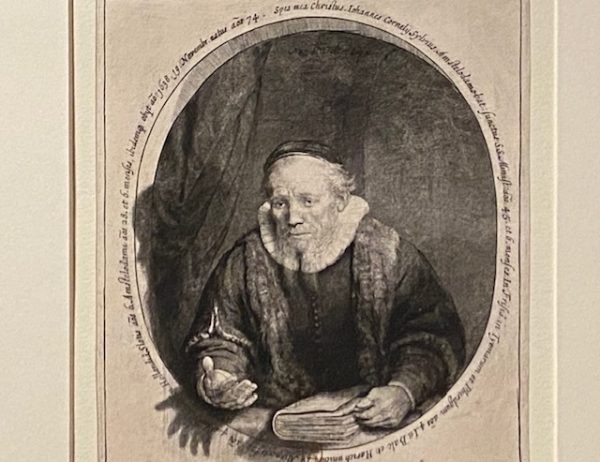
Rembrandt depicted in the 17th century not only the university professor Sylvius, but the reader and presenter based on his readings as well as professional experience. The combination of studies in medicine and philosophy have confronted the lifelong reader with lots of unresolved issues at that time. Nevertheless, he seems ready to argue with his profession, students public or the public. His hand is shown with an outreaching gesture. The scientist is not depicted in the reading pose next to lots of other books in the background or in a library. The image chosen by Rembrandt stresses the discourse and discussion as part of the scientific or research and teaching process. (Image BNF, 2025 exhibition “L’Europe partagé”). 

Colette nature narratives

In the 21st century we know that posting images of cats and dogs yields thousands of likes on the digital social media. Long before today, writers have tried to make us understand our existence through the narratives among animals, also beyond cats and dogs.
Embedded in nature, stories unfolded through the interaction of these animals. Transfigurations and lessons were derived from such fables as well as the tales constructed around the interaction of nature, animals and humans. The commemoration of Colette in the park of the Palais Royal in Paris combines all those aspects.
She grew up in the countryside, wrote “La Chatte” and lived in an apartment at the Palais Royal with a splendid view of the park later in her life.
It is a tiny spot of cultivated nature in the heart of Paris, even a bit isolated from the busy surroundings. Certainly, these days in the centre of Paris you are more likely to meet “Aristocats”, maybe from the 5 star hotels around, rather than the ordinary cat passing by.
(Image, bench in park of Palais Royal, Paris: inscription is a citation from Colette 1925 letter)

The Beast is dead

The BNF and the gallery Auguste Rondel celebrate the acquisition of the original drawings of “La bête est morte” by „Calvo“ at the fabulous Richelieu site. The appearance of the story and cartoon in 1945 was a landmark in artistic achievements for several reasons. (1) Calvo made it possible for whole families to talk about the horrors of war and the Shoa by use of text and images in an form of an animals’ world, well known in France. (2) Because all generations are familiar with the fables written by Jean de la Fontaine, the story set in the world of animals is both appealing and yet a bit more distant than drawing human faces on this traumatizing reality. (3) The cartoons managed to overcome the barriers to understand the beginning and ending of World War II and the geographical spread.
Uderzo, the well known cartoonist of “Asterix” did small services for Calvo when he was still an adolescent in 1945. Learning from the best of a field can give you a head start later on.  (Extract of Image  by Calvo 1945). 

AI as individualizer

In a one pager in the journal “Rolling Stone” (2025, p. 9) Bruno Patino writes about the legendary David Bowie who was the first rock musician to launch a new song on the internet before it became available as CD (Telling Lies, 1996). As a pioneer in co-creation, Bowie anticipated somehow the trend and wish of people to personalize preferred songs even further and distribute such versions among friends. In this process, AI has become a powerful tool to push individualization even further and the digital social media allow even broader audiences beyond a more narrow circle of friends. Music maybe setting the trend  for some in the same field, other creative fields might follow the footsteps. The need to co-create collective experiences and participate in collective musical moments is likely to rise again as well.
Good news for music festivals across the world. Live concerts are the new form “collective individualism”.

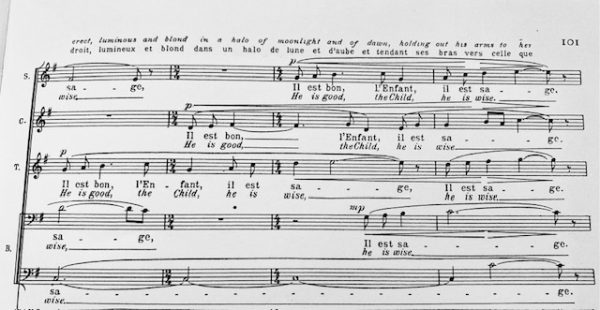
Colette Bewitched child

The English translation of the libretto written by Colette “L’enfant et les sortilèges” is translated to “the bewitched child”. The first representation was performed in Monte-Carlo in 1925 before it was represented in Paris at the Opéra Comique in January 1926.  The printed edition of Ravel’s orchestration classified the work as Fantaisie Lyrique based on a poem by Colette. This opus constitutes a forgotten forerunner of the much more popular musical “Cats” . In the end of Colettes narrative the animals call the child her “mama” and praise the good and wise child. It probably remains a forgotten 100’s anniversary, despite the fact that the topic of humans and animals, or nature in more general terms, have become more and more unbalanced over the last 100 years.