Fighting fires

In our homes and offices we are used to have electric, digital and chemical devices to assist us in fighting fires. Fires can have multiple origins ranging from faulty technical devices to human errors, behavior and volition. Some countries have terrible experiences with city fires engrained into their history. The scale of wild fires in forests in Europe, the USA, Australia or Canada have reached a new dimension. With global warming fires known in southern parts of Europe reach further north and become more intense. The fire near Fontainebleau (Forêt de Sénart, France) in 2018 destroyed 9000 hectares forest. In 2026 the fires near Bordeaux burned 10 times the size (Link). There were about 8 years to get prepared between the 2 large scale incidents. The technocrats’ answer usually is just limited to the immediate surroundings of the fire. Instead larger scale actions have to be prepared and enacted to prevent the next incidents. The technocrat’s answer is more technology like aircrafts and yet bigger aircrafts(still largely insufficient in 2026-7). Satellite and drone surveillance with infrared cameras additionally can go a long way, but the human factor remains a hard to fight beast in all such technical fire fighting scenarios. This setup seems to be somehow like a constant to take into account in all technological propositions.  

Cercis siliquastrum Jardin des plantes Paris, planted 1785.

Preventable Asthma Burden

The global burden of disease data, analyses and projections allow us to identify more clearly the parameters to influence and prevent rising global burdens of disease. Among the so-called non-communicable (i. e. not infectious) diseases Asthma plays an important role.  Heat waves (wild fires) and air pollution (road transport, heating emissions) are major contributors to the burden of disease. In addition to the health related suffering of a population, the economic losses for groups of countries have been estimated by a recent study (Chen et al. 2026).  For the UK another study showed that 2/3 of asthma attributed deaths were preventable. This raises our awareness to the fact that adequate health care systems and the distribution as well application of asthma medications can help a great deal to lower also the economic impacts due to uncontrolled asthma. The labour-induced costs (lost years of production) are likely to be higher in the low-income countries, whereas capital-induced costs (in form of opportunity costs of health expenditure) accrue more in the higher- income countries. With the successive heat waves in 2026 and continued global warming, the estimated global burden of asthma is most likely a lower bound estimate of the economic impact. A focus on asthma prevention becomes a pressing concern today to prepare for the future.

Dementia Prevention

The United Nations reports on countries’ activities like dementia prevention plans. Focus is on the medical sociological analysis in which dementia is not only determined by a person’s individual life course, but it is also a society-level issue. Looking at dementia prevalence and incidence over time as well as major known risk factors, Mukadam et al. (2024) conclude that low education level, smoking, obesity, hypertension and diabetes all contribute substantially to the risk of dementia. The trick with education is simple. If you start on a dementia trajectory from a high level of education, it will take longer until you are fully dependent on other persons. For the other causes there intrinsic or genetic components, but a large share of dementia risks can be reduced through behavioral changes early in life. My all time and all ages favorite is walk whenever and as long as you can.

Time to prevent

If we take a medical life course perspective, we shall become aware that for each event there shall be a time to prevent it. From a scientific and socio-economic point of view, this is the crucial time to prevent failure of an organ, duration of an illness, death or an otherwise disruptive event. Taking our lung or liver as examples we intuitively know that there is a long time spell during which we have a chance to work on prevention. The monitoring of the early onset of disease is (Ge et al. 2026), potentially, a very cost-saving way as well in addition to avoid humans suffering later on in multiple ways. From a theoretical point of view it will be interesting to “think intervention as prevention” already, rather than the predominant way of intervention “post-hoc”, which means after the onset of disease. This implies a rather complete overhaul of medical research just as much as social research to guide policy makers interested in the “survival” of our social security systems as we know them currently in Europe. (Image is illustration in book on fairy tales: Beckmann in exhibition at Kunstbibliothek Berlin, 2026)

Tether thy liver

There are few of us who take our liver seriously. Yet, this big organ plays a central role in our body to regulate metabolism. The obesity pandemic in western countries increases health risks, just as excessive alcohol consumption increases risks of liver dysfunction. Additionally, viruses increase the risk of failure of this organ.
Each of these risks as well as any combination of one of the risks with another one have led to rising public health risks. Several studies since 2020 have highlighted these increased risks for populations in general. The risks, however, have an unequal spread across subgroups of society. A recent comment based on the research of the INSERM U955 team in “The Lancet Regional Health” by Brustia et al. “Liver-related mortality strikes hardest where deprivation is greatest.” Health inequities consist in the lack of income available to buy healthy food or in untreated alcohol addiction, both more common in poor people.
In order to tackle the inequity, the team of medical doctors call for a shift in awareness. Structural reasons like diagnostic delay, remoteness or health literacy are just as important as individual predilections like nutrition or lifestyles. Inequality in access to health and ability to afford a healthy lifestyle have become serious drivers of social inequality in the 21st century.

Olympic Virus

We tend to believe or want to believe that the horrible SARS Covid-19 crisis is completely behind us. However, science signals that we need to stay alert with respect to the mutations of the virus. International events like the Paris 2024 Olympics bring together athletes and spectators from all continents and some of them still seem to carry the virus with or without symptoms. A report in the LANCET Respiratory Health mentioned that dozens of athletes were tested positive for the virus and a largely unaccounted number of spectators had carried the virus FLiRT variants. As tracking is difficult with more or less absent testing strategies the tests rely on waste water analyses and reports from health care institutions. The Olympic Games are over but the virus still lives on and variants keep popping up. Games during the summer months should be much saver than winter games as the time spent outside is much longer. Traveling in crowded transport, however, remains a potential health hazard. Huge crowds at Olympics are inevitable. After all, birds of the same feather flock together.

Olympic Prevention

In the streets near the Stade de France at Seine Saint Denis the team of street workers addressed spectators with little presents. Each of these little items served the purpose to remind people of the prevention of disease or later consequences of the Olympic atmospheres in PARIS 2024. Sex, booze and drugs, but also noise were the topics of the prevention patrol around popular venues. Great way to bring home a message for visitors and the local population as well. Health and Olympic Games is a huge topic with many facets to it. Not only athletes are concerned, but also spectators. The team agreed to pose for media coverage as this is their reason of existence. Reaching big crowds is essential especially if big sugar is among the big sponsors of the games. It is another kind of competition with rather unequal starting conditions. You might loose some fights against yourself, but trying to overcome alcohol addiction or sugar overdose is worth a repeated game. Prevention is key.

Screening Paradoxon

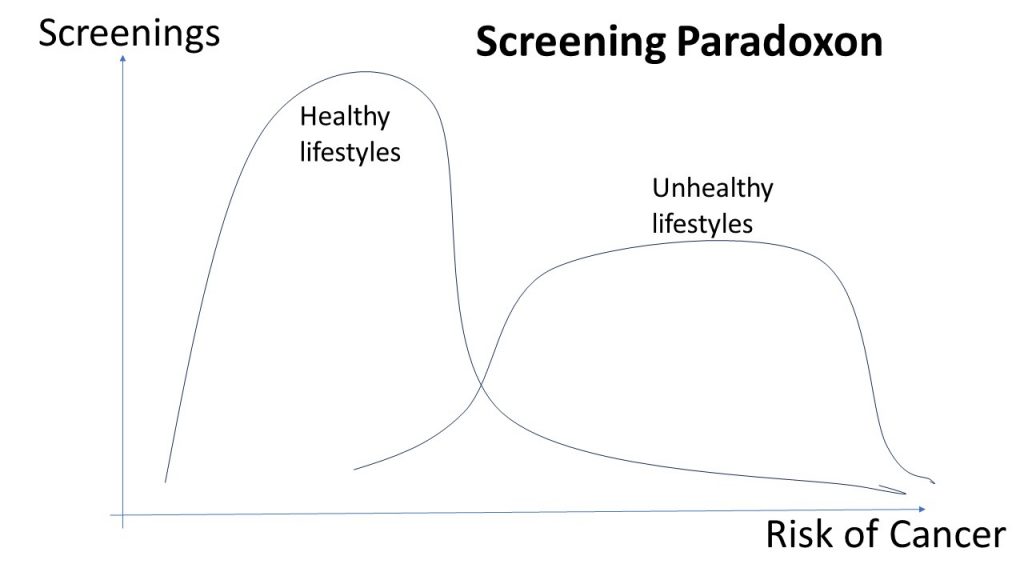
In the field of public health the screening paradoxon is a well-known feature of large scale programs to check for and contain the large increases in cancer among populations. A recent medical study underscores the necessity to curtail the screening paradox in Europe. The screening paradoxon is defined as “the underuse of screening by those with unhealthy lifestyles and high risks”. The opposite cases, “the overuse of screening by those with healthy lifestyles and low risks” only cause a problem for the costs of the health system as those unlikely of attaining a form of cancer make extensive use of screening. In terms of social inequality we have to be concerned about both ends of these distributions. The publicly available screening programs are skewed towards the higher educated with risk awareness as well as healthy life styles. More of them participate in screening. The other distribution of actual risks and detection of cancer is skewed towards the other end of the risk distribution. The 2 probability distributions overlap to an extent that is most likely co-determined by cultural factors like general attitudes towards prevention.
With the increase in cancer rates generally and due to demographic aging of societies, we shall need to target our resources devoted to health more precisely rather than spending too much on screening of people with very low risks. Increasing the duration between screenings might not impede detection rates of those with healthy lifestyles, but could allow to devote more resources to those people who are hard to reach by screening programs so far. Evaluations of such programs are necessary to judge the need for more targeted programs.(Image own representation inspired by Ola et al. 2024)

Personal Health

Most people would agree, health is a personal issue. From the onset of life, we have package of genes that predetermine a number of factors of our personal health. Epigenetics has taught us there are many factors to take into account additionally. Environmental factors have huge impacts as well. Improvements in the availability of medical devices in the hands of individuals as well as AI systems on portable devices like smartphones facilitate the monitoring of personal health. Several indicators of early-onset of illness can be retrieved from such devices. Dunn et al. (2024) show that prior to the onset of symptoms of Covid-19 or influenza portable devices can indicate the presence of infections through indicators of resting body temperature, heart rate/min, heart rate variability/millisecond or respiratory rate/min. Combined with the indicators of air quality, indoors as well as outdoors, the presence of allergens a much more personalized data set emerges which can easily be part of an AI-assisted diagnosis. More abundant personal health data and analytical power allows remote and digital health applications to inform patients, medical doctors and the public at large. Digital health technologies are only at the beginning to unfold their potential. Prevention becomes more feasible using such devices, medical professionals should be allowed to focus on interpretation of data and treatment rather than simple data gathering. Thinking about digital health technologies points in the direction of dealing with climate and environmental hazards as sickening causes more forcefully. Personal medicine and personal health are, after all, still heavily dependent on health and safety at work, commuting practices and all sorts of pollution. Personal health, however, is a good starting point to raise awareness of the potentials of digital health technologies to better our lives.
(Image: AI MS-Copilot: 2 robots run in a city. They sweat. The air is full of smog. 2 other robots rest near pool. All look at their wrist watch showing heart beats)

Flooding

Flooding after abundant rain fall is an almost worldwide phenomenon. This is why research has taken up the issue for some time now. 2 recently published papers hint at direct and indirect consequences of excessive rain and flooding which usually are not taken into account. The Lancet respiratory medicine has highlighted the second round effects of flooding which consists in the latent danger of mould creeping into buildings even after the immediate effect of the flood has vanished. It is the mould with its longer duration that causes major respiratory health and safety hazards on top of the instantaneous casualties and epidemic health risks (Link to study 2024).
The second study focuses on “the need for more systematic understanding of how societal structures and vulnerabilities moderate disaster risk” (Link to study). In wealthy countries the flood mortality is substantially lower than in comparatively poor countries. More sophisticated anticipation systems play a major role in reducing casualties. Flood-induced displacements remain hard to predict despite a reasonable explanatory power of the statistical model as the authors point out. Additionally it remains an important question to estimate the share of people who (want to) return after being displaced due to flooding. The frequency of flooding plays a role in combination with the severity of flooding. Climate change might be an additional hazard in the sense that more frequent flooding will change the propensity of people to permanently relocate rather than returning after displacement. Social networks, support and solidarity with the victims of flooding as well as reconstruction efforts will play a crucial role in dealing with these environmental hazards.
Building higher dikes is a worthwhile solution in regions that can afford them (Rotterdam example). It is hardly a solution for countries with little resources to invest in protection in face of an already suffering and displaced population. Dealing with mould after the flooding only adds yet another health hazard to an already difficult situation.