Marc Aurel Book 7

In paragraph 63 Marc Aurel refers to Plato as one of his sources: “No soul”, says Plato, “likes to be robbed of truth” ( and continues himself) “– and the same holds of justice, moderation, kindness, and all such virtues. Essential that you should keep this constantly in your mind: this will make you more gentle to all.” The remarkable reasoning is to transform the own generalized experience into a behavioural recommendation. It may be argued that Marc Aurel starts from a kind of Aristotelian empirical study of persons in different life domains to derive an empirical fact. Based on this he develops a more Plato inspired “idealistic picture of mankind”. He is very much preoccupied with the philosophical question, how is a good life for all possible. In a previous paragraph (55) he outlined his 3 guiding fundamentals: (1) “The main principles in a man’s constitution is the social; (2)… resistance to the promptings of the flesh, like impulses; (3) judgement unhurried and undeceived”.
With such a claim for a “rational constitution” of man, he puts himself into the footsteps of previous philosophers of the ancient Greek tradition and, therefore, his writing in Greek rather than Latin is also a homage to this philosophical heritage.
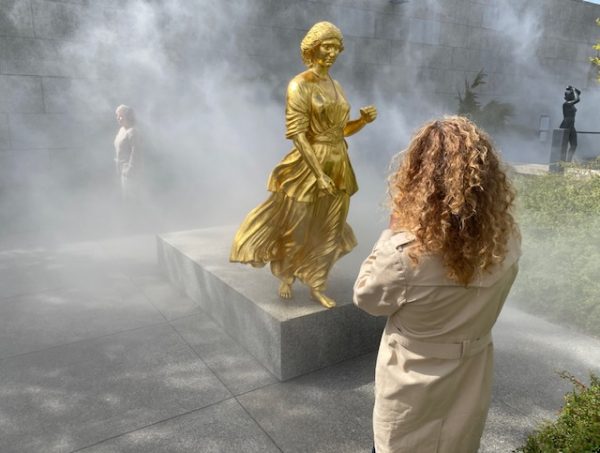
(Image: parts of Installation by Fujiko Nakaya in Neue Nationalgalerie Berlin 2025)
Marc Aurel Book 6

Some passages of Book 6 can be understood like quotes of much later works, even like writings of the enlightenment period. Take this one: “If someone can prove me wrong and show me my mistake in any thought or action, I shall gladly change. I seek the truth, which never harmed anyone: the harm is to persist in one’s own self-deception and ignorance.” (para 21 in Penguin Classics version, also in Greek original and French translation).
The same passage in historic English: “If anybody shall reprove me, and shall make it apparent unto me, that in any either opinion or action of mine I do err, I will most gladly retract. For it is the truth that I seek after, by which I am sure that never any man was hurt; and as sure, that he is hurt that continueth in any error, or ignorance whatsoever.” (Para XX in Gutenberg.org online reader).
Why is this already an enlightened vision of truth? In the search for truth, he is open to criticism or doubt by others (maybe even irrespective of societal standing) and, moreover, ready to change his conviction and action. Religious doctrines of the time and many centuries after his writings would not have accepted such a doubtful mind who might change due to (scientific) reasons. Long before “Cogito ergo sum” (René Descartes, (1637), I think, therefore I am, of the early enlightenment, Marc Aurel might be summarized in this paragraph as “Cogito, ergo dubio”, I think, therefore I doubt – and I may change accordingly.
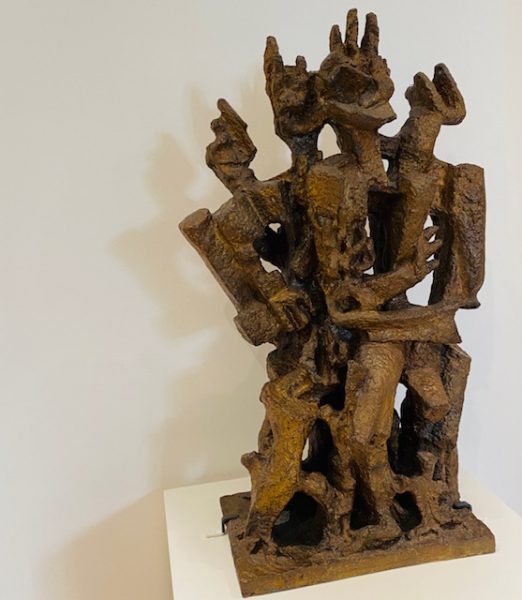
(Image: Ossip Zadkine, Forêt humaine, Musée Zadkine Paris)

Marc Aurel Book 2-5

There are several translations of Marc Aurel. In the Shakespeare English translation from the Greek original of the Meditations a passage (Book 5 paragraph XXIII) describes or idealises humans as a “reasonable and sociable creature, regulated and directed.” The same short quote of this paragraph in the English translation by Martin Hammond (Penguin Classics p.43) reads: “…my wish is to follow the nature of a rational and social being.” Of course, both translations are pretty similar at first glance, but the difference of “reasonable” versus “rational” and “sociable” versus social” mark very important differences that had and have different impacts throughout the following centuries up to today. As in many other instances going back to the original version in Greek (book link) might clarify the issue, however, the entry barrier is access to the bilingual version and use of an ancient Greek dictionary.
With almost 2000 years of advances in rational approaches and its tools like mathematics, the scope of the rational is huge and the behavioural turn in the social sciences demonstrates the limitations of human’s use of rationality (λογικός) in decision-making. Reasonable seems to come closer in today’s “post-enlightenment” world.
There is also quite a divergent connotation in the simply “sociable” (κοινωνικός) being or the “social” being, which has a wider scope attached to it. Hence, lets be aware of the implicit interpretations of translations. For a start the parallel reading of translation and original (Link) might enhance our understanding and spur even new translations and interpretations, which speak with the classic originals to today’s audiences (with or without AI).
A witty joinder of both previous translations is “And my will is the will of a reasonable and social being”. (Link Book V, paragraph 29 bottom).
From the Greek to French in book V (Link)  with an even broader understanding of the social as “la société universelle”.

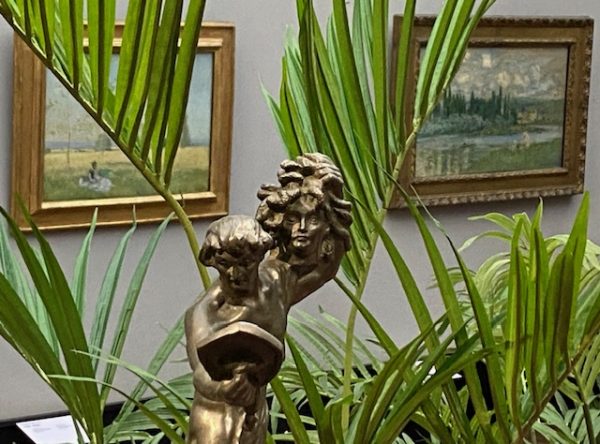
(Image: Camille Claudel 1905: “Persée et la Gorgone, Lucile Audouy collection Paris, exhibited in Berlin 2025, Alte Nationalgalerie)

Marc Aurel AI

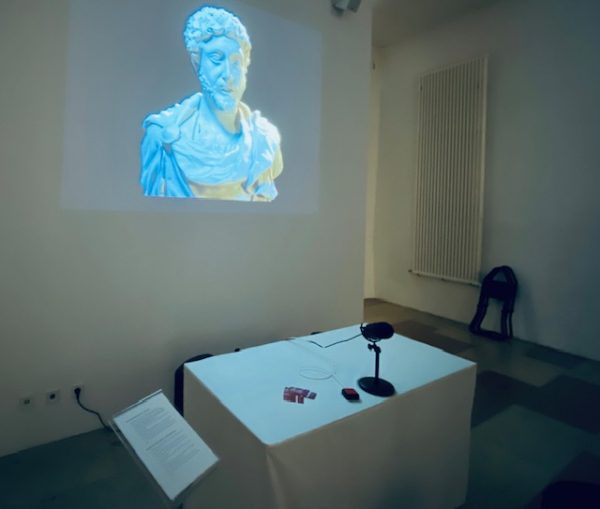
In the 21st century it is possible to chat with Marcus Aurelius. Part of the exhibition at the Simeonstift is a chatbot you may freely consult and questions with or about Marc Aurel. Based on your questions the animated screen image of Marc Aurel will reply based on his own writings like the Meditations and (probably) other secondary literature on Marc Aurel. Questions about feminism or slavery are answered based on the original texts. Some of these answers  appeared rather modern like the basic equality of all including women or slaves. The Meditations are an idealistic vision of mankind in the stoic tradition. In practice such ideals have proven very ambitious for the many and growing temptations in the day-to-day lives of ordinary people including their political, religious, business and military leaders. The AI is confronted with the issue to give answers to ethical questions which refer to the time of the author, but not all can apply to today’s ethical standards and basic human rights. Reading the original source, therefore, remains the preferred choice. 

Marc Aurel Philosopher

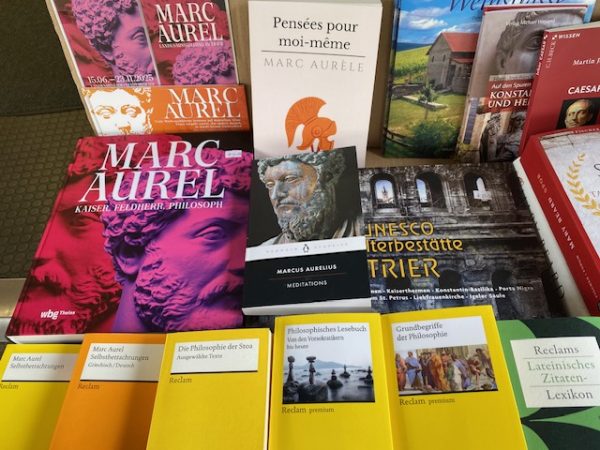
2025-9 marks an additional landmark in the achievements of the late Marc Aurel. In the Roman built city of Trier, 3 museums offer exhibitions on the life, ideas and imperial governance style of Marc Aurel. Libraries and bookshops around the city portray a wealth of books and studies by and about Marc Aurel as well in many languages (image below 2025-9). The stoic author and practitioner has served as an example of a leadership style which became for many subsequent leaders a hard-to-achieve precedent. The writing style of Marc Aurel in short paragraphs and aphorisms proved highly accessible, although his readership swell only after a Latin translation of his Greek original appeared in the 16th century. The title “Meditations” in English, “Pensées pou moi-même” in French or “Selbstbetrachtungen” in German demonstrate the difficulty to get to grips with the author’s intention and objectives in writing down these reflections on life, ethics, humanity and good governance. Through the use of Greek rather than Latin he puts himself in the line of Greek philosophers rather than the succession of Roman emperors. As the numbers of bad leaders still outnumber the good governance style advocated by Marc Aurel, these exhibitions in the Simeonstift, the Landesmuseum and the Stadtbibliothek are a perfect opportunity to demonstrate that good governance is something that can be studied and learned even in the distant Roman history.  

Individual and Cosmos

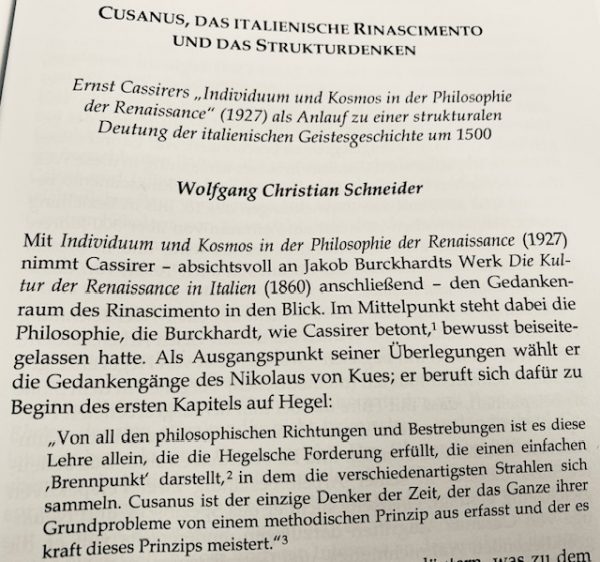
The major work by Ernst Cassirer “Individual and Cosmos” can be read from a perspective of the history of ideas (Schneider, 2024 in Coincidentia). The work of Cassirer refers back to Nikolaus Cusanus in the way that the worldly ideas concerning the sciences and everyday life of the individual are embedded into the perspective of the cosmos. The latter (cosmology) is of course at the time of the 15th century dominated by religious doctrines. Schneider highlighted the merits of Cusanus as a major contribution to the Italian  “Rinascimento” due to his ability and willingness to draw on all the best knowledge available at his time. A frequent travel to Italy and Rome including the library of the Vatican was a precondition to gather such an overview. Schneider opens up another interesting debate about the competence of Cusanus to read and write Latin and Greek. Contrary to previous statements he highlighted the fact that Cusanus created new words or notions that were unfamiliar or new at his time. Nowadays such creations are very common to express new ideas or combinations of concepts. At his time this was interpreted rather as a lack of clarity or imprecise language.  

Napoleon legacy

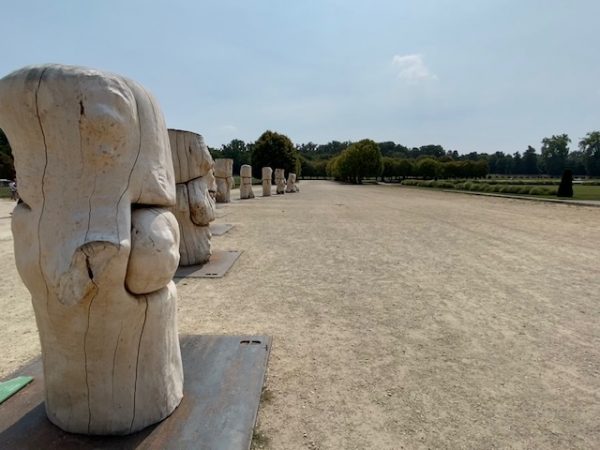
It is huge historical project to try to summarize the legacy of Napoleon Bonaparte. AI is by design less hesitant to come up with any length of a summary statement some with good references on which the statement is based. In combination with a visit at Fontainebleau and a first hand impression of the environment of the autocratic ruler, the remainders like the introduction of a Civil Code to guide also administrations to lawful conduct, we still see influences of this legal innovation in many other countries across the globe. The recognition of Jews as equal citizens and to allow equal access to property and many professions have been influential across Europe mostly in occupied territories. Military service for Jews in Napoleon’s army was another consequence, which spread into the Prussian army and the 1st world war. It is in the 21st century that we see shifts towards more authoritarian governance styles spreading again, we did not want to see this happen until Russia‘s war in Ukraine. (Image: La Chair de la forêt, Frénésie des Géants by  Wang Keping Fontainebleau 2025-8)

Fontainebleau library

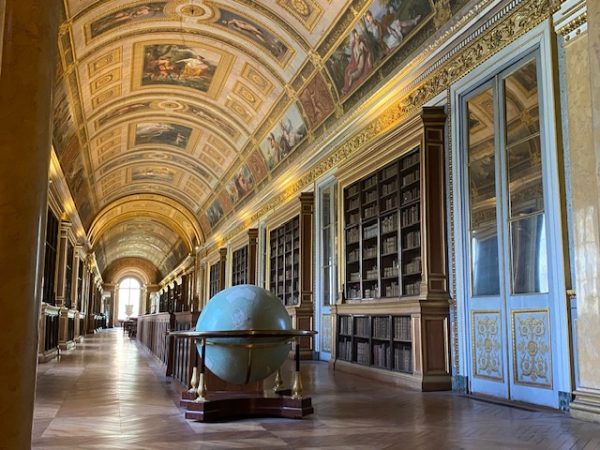
The “Galerie de Diane” in Fontainebleau has been built during Napoleon’s reign. It hosts the library with a large collection of books. The function of the books seems to be more to intimidate the persons passing by rather than ready for inspection. The globe at the entrance reflects the ambition of the ruler. The fact that you have to walk some stairs upwards increases the impression to be little compared to this universe of knowledge. It is great that libraries have flipped this perspective and today we study the period of Napoleon’s reign with our democratic values in mind. The top-down approach was the incarnation of Napoleon’s style of government. Despite the revival of such governance styles in the 21st century across the globe, they are unlikely to last for more years than Napoleon’s fate. A simple reason for this may be the only representative or intimidating role of knowledge in such forms of governance rather than an open mind approach. 

Paris Sorbonne

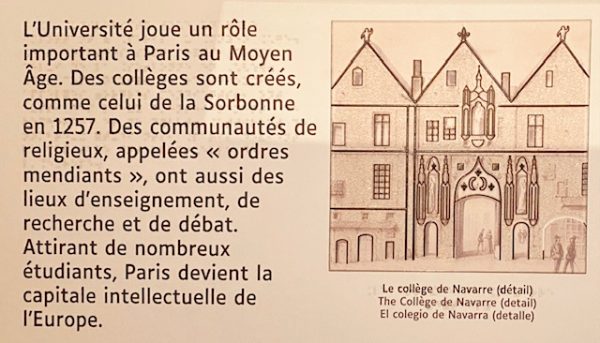
The history of the university on the left bank of “La Seine” dates back to 1257 when Robert de Sorbon an advisor to Louis IX was asked to create a unifying structure of several colleges which provided room and board already. The location on the left bank in Paris allowed these colleges to escape the religious doctrines and archbishop who dominated the right bank. The choice of the name of the advisor rather than the King was already showing early signs of independence which was cherished by generations of students and professors. The Colleges had individual names like “Collège des Bernardins” or “Collège de Navarre” and operated under the title of “La Sobonne”. The “Musée Histoire de Paris Carnavalet” shows an early design of the Collège de Navarre. Independent thinkers and writers were formed there who became very influential later on in their careers. Thomas d’Aquin was one of them.

liberté urbanité

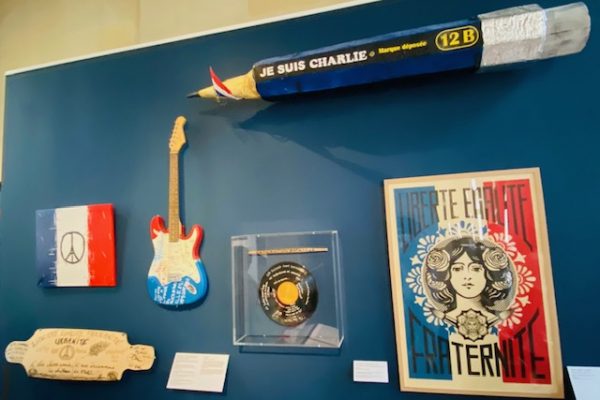
In the museum of the history of Paris “Musée Histoire de Paris Carnavalet” we find a special place devoted to the commemoration of the terror attacks in Paris in the Bataclan event location and the office of the journal “Charlie Hebdo” (see image below”. The skateboard on the bottom left of the wall raises the value of “urbanité” next to liberté, égalité, fraternité. The attack of an urban living style with youth going out as they like and journalists and caricaturists speaking their minds freely had been attacked, but continues nevertheless. This statement is part of the Paris state of mind.