Agentic attacker

Since 2026-7 we have to face a proven and realistic scenario of a cyber threat called the “agentic attacker”. Based on OpenAI’s LLM the sandboxed cyber attack managed to escape its fences and ran a real cyber attack on a competitor’s AI model with some success. Apparently the defense had to also use AI to protect and speed up something like password renewals and other credentials on 17.000 parallel occurrences simultaneously. The huggingface.co platform became vulnerable and the amount of data compromised could have been quite significant. This included, potentially, data inputs for AI-models and perhaps even other AI-agents as well that might be turned into additional attackers. It might take us humans a while to come to grips with new danger. The agile agentic attacker (AAA-rating) will cause us some sleepless nights.

Screenshot

Berlin moves it

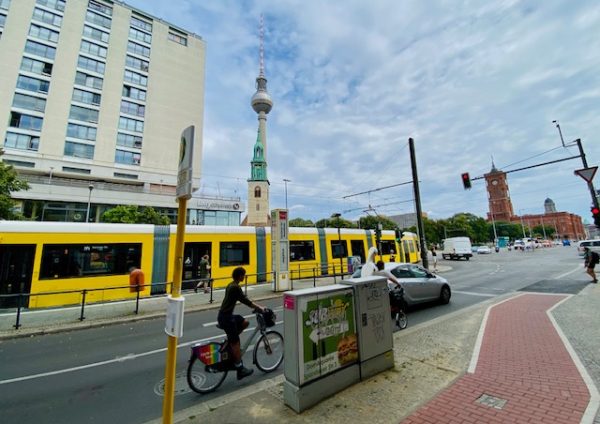
Yes, we like to move it. Investment in infrastructure follows a long-term economic rationale. In urban areas space is a scarce and, therefore, an expensive resource. In order to use the current space for mobility more efficiently, the use of a longer tram or train is an effective way to increase capacities. Rather than to increase the frequency, which is no longer possible without safety risks, a longer vehicle allows to bring more, and more diverse, passengers on board (kinderwagen and wheelchairs included).
It is a long-term objective to make urban areas liveable for all ages. Tramways which allow a low or, better, no barrier to entry is a necessary condition in this respect. The new “Urbanliner” in Berlin (image below) offers such essentials of access and urban mobility. A single tram is 50m long with 88 seats and 215 standing persons in larger corridors. 300 tram passengers can be compared to about 12 average length cars with at best 15-20 passengers.
A consensus of “how best to move it” in cities pays off in the long-term. Planning has to start about a decade before delivery and needs to survive political cycles going back and forth.

Berlin Futures

The city of Berlin is projecting itself into the future. Two long-term goals, Olympic Games 2036 or an Expo organization 2035, are potentially looming and all actors have to project themselves as to what role they want to play in such processes. Trades and industries have an essential role to play to realize any vision of the future, at the same time, local trades and industries ask for amenable conditions to do business in the necessarily restricted city space.
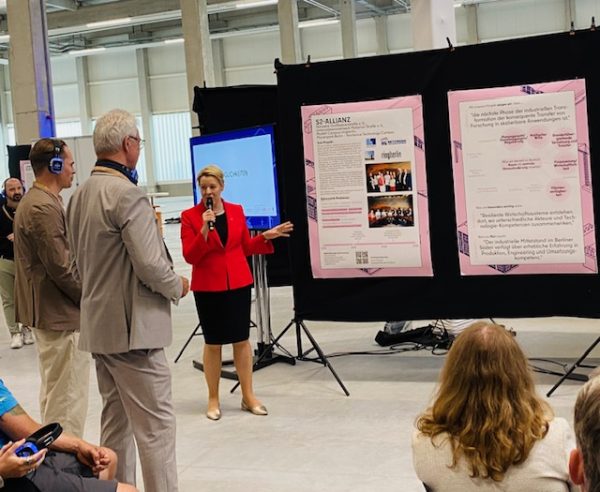
There is competition between housing projects and business parks across each metropolitan area as any form of growth needs space to grow in. The “1. Berlin Future Day of business parks” highlighted this potential source of conflict and business leaders exchanged their experiences and strategies how to arrive at manageable comprises.
There are several Win-Win constellations in which for example an additional stop on a metropolitan “S-Bahn” line benefits the business area and all those (future) employees going to and back from work. Infrastructure like transport, mobility, energy, internet speed and security, all play key roles in such visions of future. If networks of organizations address policy makers with well-defined requirements, politicians can act as facilitators to ease sometimes lengthy bureaucratic impediments. The call for public infrastructure investments by private business initiatives is a reminder of the need for public-private partnerships to create promising Berlin Futures. (Image: 1. Future Day of Business areas in Berlin, Senator Franziska Giffey 2026-7-15)

Cooling-Heating Renovation

The public and scientific debate about the added value of investments in renovation of buildings has been ignited by the recent heat wave in Europe. Some renovations that were primarily concerned to safe energy in winter through better isolation of walls, doors and windows found themselves less well prepared with isolation against heat and sunlight. Hence, it makes sense to consider both topics, cooling and heating of buildings, jointly.
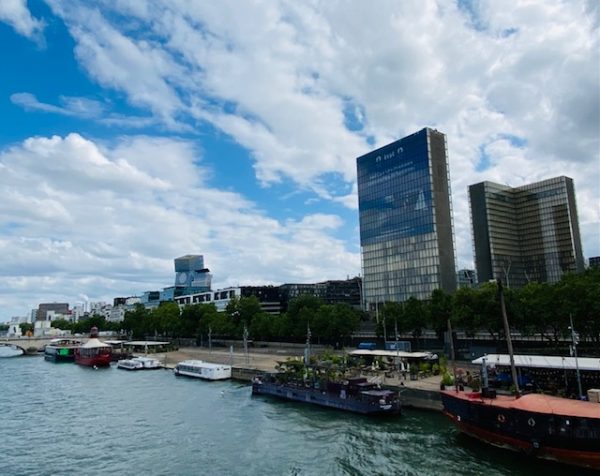
Reversible heat pumps can do this trick, if isolation has been installed or applied during renovation already. Additionally, materials used for isolation of buildings should show 2 measures for isolation: thermal conductivity and thermal resistance (R-value). Comparing both gives a fair idea about isolation quality in periods of heating and cooling needs. Albedo values are interesting as well as heat input during a sunny day is welcome in winter, but not during summer heat waves. The commonly used Energy Performance Certificate (EPC) for a building needs to be checked whether it is sensitive to excessive heat as well. (Image: BNF in Paris 2026)

Beware Albedo

At times of high radiation from the sun, we suffer from high “albedo” values surrounding us. Albedo is scaled between 0 (black) and 100 (white) and is a measure of the reflection of light. Dark surfaces have a low Albedo, which means they absorb a lot of light and store this energy in form of heating. On the contrary, white surfaces or reflector materials like mirrors absorb very little of light as they reflect the light and, therefore store very little of it as heat.
In housing or urban planning this is an important indicator to take into consideration when planning for summer heat reduction, for example. Inner cities with dense construction, lots of windows, which in most cases absorb rather than reflect sun light, Light absorption and storage during the day will contribute to heat urban environments and inner cities during summer nights. This might be comfortable during winter, but in hot summer days the high reflection value creates additional discomfort.
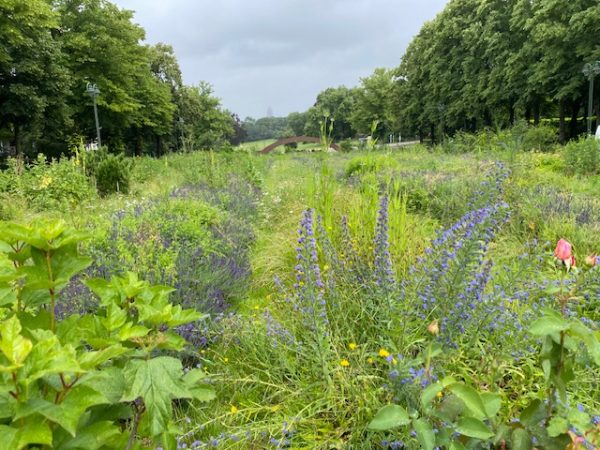
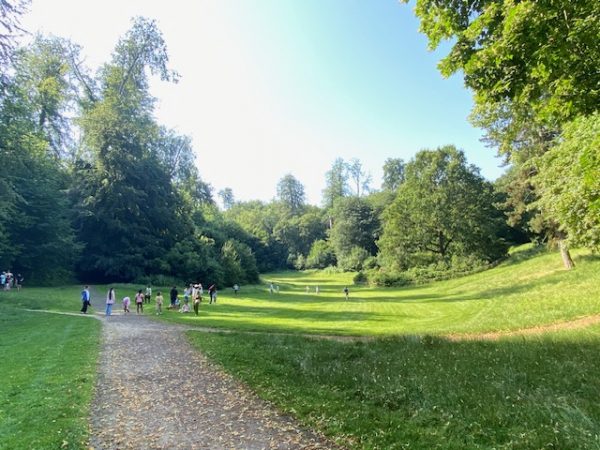
Greening of cities is a powerful answer as vegetation absorbs the sunlight, but does not store it in form of heat. The glaciers and huge snow fields have shielded us from the earth heating up too fast in the past. Unfortunately, the lack of knowledge about “albedo” has lead us to undervalue these shielding effects. Light absorption by the earth is an additional driver of climate change in form of global warming. (Image: Brussels, Forest, Park Duden Community Gardening 2026-5)

Climateflation

Central banks have started to deal with the impact of climate change or inflation, short “climateflation”. New and additional inflationary pressures originate in climate change and global warming and they necessitate a closer scrutiny. Heat waves, like 2026-6 in Europe, or earlier ones have created an upward pressure on prices. Loss of agricultural production can be severe due to weather extremes which occur more often and with greater intensity. Such extended hot and dry climates reduce the production of crops and spikes in prices that only reluctantly return to average levels shall cause price inflation (climateflation). These are the short term impacts.
The medium run impacts alter price relations and valuations of in sectors like housing and infrastructure. Badly isolated stocks of housing, schools or hospitals depreciate valuations and the heavy investments needed for isolation of roofs, walls and widows as well as heat pumps to produce cooling shall be in very high demand, which makes price increases more likely across the construction sector. As we expect new devices to be “AI-intelligent”, “mem-flation” will be pushed up as well. These factors can give a push to some economies which are producers of the products in high demand and able to expand production rapidly as well. Just importing higher numbers of air-conditioning systems from other countries shall worsen trade balances.
The major challenge, however, remains our inaction to stop global warming to avoid additional economic and human losses related to climateflation.

Long run

The future orientation is a principal component of any investment. If a society stops investing its impeding its own ability to adapt and grow. Investment costs today will likely generate returns in the medium or long run. A caveat applies. Some investments may cause long running liabilities, like nuclear energy. The choice of which investment to choose, therefore, is crucial. The investment in people is likely to have a positive return in the long run because it remains an investment that has a high potential to adapt to changing circumstances rapidly. Training as scientist allows to do both fundamental research or to choose an applied field with little reorientation. A focus on the long run has advantages of likely stable returns if previous forecasts in what to invest were correct and reliable. This is the point where besides the difficulty to make good (technological) choices, probabilities enter the equation. The longer the time horizon, the greater the probability that relevant changes, which impact the future returns, shall occur. At best, some of these may cancel out each other in the long run. The potential that some risks are “too big to fail” does not mean that shall not occur (zero probability does not exist in technical nor human decisions. A sound theory of social investment would be a great step ahead for humanity in the 21st century. (Image: Ostend street art 2026-6) 

École buissonnière

In 2026 the “École buissonnière“, the outdoor schooling has become a viable alternative to the schools that are overly hot during summer. But far beyond being an alternative out of necessity, schools as well as kindergardens adopt a form of schooling close to and in nature. It can be so much more than a simple interlude or excursion. Learning from nature is a precursor of bionics as well as compassion. After all nature offers ample examples of diversity and coping mechanisms. It is an option not only for learning purposes restricted to the young, but it is underexploited in continuous learning and lifewide experiences as well. There have been abuses also in history, most notably by Nazis in Germany for purposes of indoctrination. The learning opportunities to encourage a critical perspective of our modern, technology- and screen-dominated learning and life, are huge. They just need experienced guidance on the way of discovery, comparisons and collective experiences. Children open up and have fun, the more the pressure of classrooms is alleviated.  Learning about the importance of biodiversity from different angles is a very human value and includes our responsibility for other species.

Internet pain or gain

Billions of people are forced to lose time when clicking through webpages. Instead of the default  to deny cookies, we are forced to “opt out” in most instances to a collection of random data-hungry, largely in-transparent and more or less risky cookies. It could be simple. It just needs a consensus to make the no-cookies rule the default. By such a simple measure the open information part of the internet is strengthened again. All for pay or “pay-with-your-data” offers on the internet would have to make you to confirm your “opt in”, thereby alleviating the burden for search of information. Huge corporate interests that rely on advertising profiles are, of course, an obstacle to such changes, but search engines of the internet would gain importance again before generative AI and AI-agents shall make own search and clicking on cookies denial a different routine again. For the time being we keep wasting our precious time to deny cookies. Just changing the default shall bring back a better internet and the focus on ease of access, diversity of information and better privacy. Make the internet fun again! Choose your browser consciously as well. 

Autonomous Agents

We all have seen more or less autonomous robots somewhere, maybe in a garden silently doing its job or doing more demanding tasks like in playing table tennis against a human. Even the evolution of polluting fireworks to swarms of little light-emitting drones designing figures on the sky have become quite popular. The AI-world is similarly advancing rapidly and proposes more and more “autonomous agents” to assist us. It seems crucial to distinguish the 2 Ds of autonomous agents: Degrees and Dimensions. As with job quality or job satisfaction, there are several sub-dimensions, which need to be considered when dealing, in a summarizing form, with such encompassing terms.
You might allow an agent to order missing food for a meal and pay for this autonomously. You might even be assisted in financial choices to a large degree, but you might not want an autonomous agent to make far reaching decisions concerning your health or partnership(s). Besides such dimensions, the degree of autonomous decision-making needs to be calibrated according to your (perhaps changing) preferences. Booking a table in a restaurant, with a single other person, might not just be a friendly, nice assistance, but it might get you into severe trouble. However, managing conference bookings, a family event or a birthday party might allow you to concentrate on other issues or specific details. Additionally, there are underlying and cross-cutting topics like trust, risks and security that enter the “2 Ds of autonomous agents”. A 2-dimensional matrix plotting levels across dimensions might work as a behavioral guideline in the development of autonomous agents. More dimensions may be added during the implementation.