Internet pain or gain

Billions of people are forced to lose time when clicking through webpages. Instead of the default  to deny cookies, we are forced to “opt out” in most instances to a collection of random data-hungry, largely in-transparent and more or less risky cookies. It could be simple. It just needs a consensus to make the no-cookies rule the default. By such a simple measure the open information part of the internet is strengthened again. All for pay or “pay-with-your-data” offers on the internet would have to make you to confirm your “opt in”, thereby alleviating the burden for search of information. Huge corporate interests that rely on advertising profiles are, of course, an obstacle to such changes, but search engines of the internet would gain importance again before generative AI and AI-agents shall make own search and clicking on cookies denial a different routine again. For the time being we keep wasting our precious time to deny cookies. Just changing the default shall bring back a better internet and the focus on ease of access, diversity of information and better privacy. Make the internet fun again! Choose your browser consciously as well. 

Gardening culture

There is a specific set of skills attached to gardening culture. You do not have to travel continents to experience the pleasure of gardening from more than just your own culture. Beyond the tradition of the French garden “à la Le Nôtre”, the English garden including the short precisely trimmed lawn and blooming arrangements, the Japanese gardens have a wholistic approach, which pay attention to broader human experiences of nature. A garden is a kind of sanctuary. It resembles more an internal journey rather than a showing off to others. Walls serve to enhance privacy to be able to open-up again later to others rather than a symbol of distinction and exclusion from the less privileged. Small places suffice to give room to a Bonsai experience. The very busy seaside resorts and port of Ostend on the Belgian coast has reserved a small spot for inner peace in its Japanese garden. (Image: Japanese garden “Shin Kai Tei” in Ostend created by Takahashi Sawano) 

Ensor Home

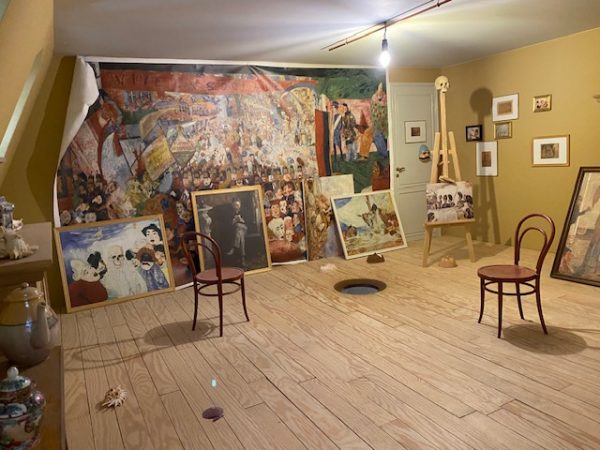
There are few artists who stayed in their home for almost all their life. James Ensor was a personality who was profoundly attached and continually attracted to his native city of Ostend. After a short and unsuccessful spell at the Brussels art academy, he returned to his parents’ home and due to a heritage from an uncle, he could live in a nearby house, which also served him as his atelier. Although I did not come across documents that showed he had traveled a lot, nowadays his art work is spread across the globe. The seaside resort of Ostend was a real tourist destination and, therefore, many famous people of the 1st half of the century passed by and met with Ensor there. Not only fellow artists, but also scientists like Albert Einstein. Critical minds and people searching beyond the trodden paths must have been attracted to him, a personality who dared to challenge conventional painting and techniques of his time. A reconstruction of his atelier and several animations give a lively modern touch to his work and living style. My take home message from the Ensor Home: The search for inspiration might be just around the corner. 

Autonomous Agents

We all have seen more or less autonomous robots somewhere, maybe in a garden silently doing its job or doing more demanding tasks like in playing table tennis against a human. Even the evolution of polluting fireworks to swarms of little light-emitting drones designing figures on the sky have become quite popular. The AI-world is similarly advancing rapidly and proposes more and more “autonomous agents” to assist us. It seems crucial to distinguish the 2 Ds of autonomous agents: Degrees and Dimensions. As with job quality or job satisfaction, there are several sub-dimensions, which need to be considered when dealing, in a summarizing form, with such encompassing terms.
You might allow an agent to order missing food for a meal and pay for this autonomously. You might even be assisted in financial choices to a large degree, but you might not want an autonomous agent to make far reaching decisions concerning your health or partnership(s). Besides such dimensions, the degree of autonomous decision-making needs to be calibrated according to your (perhaps changing) preferences. Booking a table in a restaurant, with a single other person, might not just be a friendly, nice assistance, but it might get you into severe trouble. However, managing conference bookings, a family event or a birthday party might allow you to concentrate on other issues or specific details. Additionally, there are underlying and cross-cutting topics like trust, risks and security that enter the “2 Ds of autonomous agents”. A 2-dimensional matrix plotting levels across dimensions might work as a behavioral guideline in the development of autonomous agents. More dimensions may be added during the implementation.

Autonomy in swarm

Swarm behavior is a fascinating research area. Almost all scientific disciplines feature some interest and publication in this area. The biological origins have been associated a lot with the marvelous behavior and patterns formed by fish moving about in swarms. Some species of birds show similar patterns of collective and somehow coordinated swarm movement. It appears to be tricky to safeguard some form of autonomy in the overriding mass behavior and mass movement.
Recent advances in this field by Li, Li & Zhao (2023) model such behavior within a predator-prey framework to explain the evolution of overall swarm behavior. Whereas “prey” strategies consist in “flocking” and “swirling” to irritate predator(s), the predators make use of “dispersion”, “confusion” as well as “marginal predation tactics”. Additionally, several assumptions go into the modeling of swarm behavioral evolution: agent observation, agent dynamics, and the environment. The mixed cooperative-competitive multi-agent setting applies reinforcement learning, additionally. The framework of evolution has 5 driving forces: (1) homogeneity of a swarm (parameter sharing); (2) actor with decentralized critic network; (3) replay buffer to enhance learning; (4) rewards for predator and loss for prey; (5) learning algorithm.
The modeling approach reveals the impact of an agent-critic network (potential of autonomous behavior) for protection of a swarm in a predator-prey scenario. (Image: fish in fish bowl 2024)

Autonomy in Peripherals

The knowledge associated with the term autonomy has entered for a long time already the IT-world. In order to safe energy and computing power, peripherals can do some number crunching before entering the main CPU. So-called autonomous peripheral operations (“APO”) can run in external devices. The degree of autonomy from the main computing system becomes a matter of design.
We have imagined networks in sociological research mostly in terms of strong and weak ties. Theoretical models of networks have largely neglected the features of autonomous peripheries as we learn from IT hardware design. The autonomous peripheries have entered social science research more in form of “sleeping cells” or individuals who understand themselves as part of a larger network, but act in an autonomous fashion, which makes it difficult to detect them. Core and, or versus peripheries opens a whole additional research agenda. 

Autonomy in Behavior

The learning capacity of humans sets them on a path to acquire and extend their autonomy in behavior. At birth, physical and emotional dependence is highest. Soon learning to handle different nutrition sources and emotional stress allows to gain more autonomy in each of these components of autonomy. Throughout later childhood and adolescence we develop various additional domains as well as degrees of autonomy.
Role-playing, enhanced motor control and interaction with others define and redefine continuously the potentials and limits of autonomous behavior. Social norms start to play an even more important role as of adulthood, just consider financial autonomy as one of the dimensions. The most distinguishing factor from robots or animals until 2026 has been the human ability to form its own autonomous judgment, where value systems and legal norms co-determine or set limits to our autonomy or behavior. Some results from neuroscience have demonstrated that our readiness to act is prefigured in our brain and additional “intelligent” mechanisms are needed to suppress or guide the otherwise autonomous, spontaneous action or reaction.
Our “free will” might not be as free as we wish it to be. Similarly our autonomy in behavior or decision-making might not be as autonomous as we tend to believe. (Image: Social cooperative gardening project, Brussels 2026-6)

Autonomy in literature

As we might imagine, autonomy has been and is a huge topic in literature. From the foundations of democracy to the autonomous state building, historical accounts are full of treaties on autonomy. Literature has taken similar steps by asking can we really be autonomous in our decision-making as we are social beings embedded into varieties of Throne, families and networks. There are ever larger parts that we are conscious about, but the realm of unconsciousness or sleep remains substantial. Maybe in literature, the author Samuel Beckett has gone furthest in dealing with human autonomy in his writings. The search for autonomous action might lead to far-reaching inactivity in “Waiting for Godot”.
However, Beckett’s view about autonomy can also be interpreted as a continuous battle of mankind as demonstrated in the often cited expression by Beckett (“Worstward Ho”, 1983, p.7) “All of old. Nothing else ever. Ever tried. Ever failed. No matter. Try again. Fail again. Fail better.” Our strive for autonomy remains a lifelong struggle. The path to more autonomy is not linear over the life course. In fact, much evidence from gerontologists suggests that it might follow an inverse U-shape, being low at birth and low before death. Literature has guided us in such questions just as much as religious, philosophical, legal and social concerns enter into the underlying concept of autonomy and autonomous decision-making across the life course.

Autonomy as Happiness

The French philosopher Émile-Auguste Chartier, better known as Alain, is a proponent of a rational approach towards fundamental issues. Therefore, we should expect from the reading of “Propos sur le bonheur” a thought-based conception of happiness. In his propositions on happiness, autonomous decision-making and autonomous actions play a decisive role. Rather than writing a voluminous “treatise” on happiness, he had chosen in the 1920s, the form of 93 about 2-page long propositions about happiness. These propositions are a bit more explicit than, for example, Nietzsche’s aphorisms, but they remain short without much literary context to the kind of rational analysis based on observations and anecdotal supporting evidence.
In propositions 42 “Agir” and 44 “Diogène” he deals with autonomy as subject. “on veut agir, on ne veut pas subir” (in short, “act, not endure”, own translation), that is his quintessence. “Tous les métiers plaisent autant que l’on y gouverne, et déplaisent autant que l’on y obéit.” (44). (All professions are pleasant if you govern, and are unpleasant if you have to obey). More than 100 years later, empirical studies on job quality, job satisfaction and happiness still build on this rationale.

China Job Quality

In a small study of 771 Chinese adults, Dong, Wu, Ni & Lu (2021) have reported on the impact of long working hours on job satisfaction. If you work few hours, job satisfaction increases as you work more hours. However, working many hours already, additional work, 40+ per week, does no longer increase work satisfaction in China. In order to preserve the recommended or communist work ethos of a “996 work schedule” (from 9 a.m to 9 p.m, 6 days a week) the authors recommend that managers support more autonomy for workers to fix their schedules as this could increase their job satisfaction. Autonomy to schedule your work and more autonomy in decision-making moderate the impact of long work hours on job satisfaction. Eventually the Chinese comrades might get satisfaction in other areas but work as well.
(Book Exhibits on Karl Marx, Museum Trier Germany Books 2023)