Wähle Wähler, sonst hast du die Wahl verloren. Die wiederholte Wahl geht sicherlich in die deutsche Wahlforschung ein. Murks bei der Durchführung einer Senats- oder Landtagswahl dürfte in etablierten Demokratien nicht in diesem Ausmaß vorkommen. Solche Versuche, demokratische Systeme zu delegitimieren, kennen wir aus demokratiefeindlichen Umgebungen. Die angeordnete Neuwahl hat eine um ca. 150.000 Stimmen geringere Wahlbeteiligung ergeben, bei einer Anzahl von ca. 1.500.000 abgegebenen Zweitstimmen von ca 2.500.000 Wahlberechtigten. Neuwahlen bringen also nicht unbedingt ein faireres Ergebnis im Sinne der Beteiligung an Demokratie mit sich. Im Gegenteil, Frustrationen äußern sich an Wahlurnen in Form von Denkzetteln statt Wahlzetteln. Die Summe der entschieden für Demokratie eintretenden Wählerstimmen, die im Senat vertreten sein werden liegt nur bei 1.170.905 Stimmen. Das ist keine absolute Mehrheit der Wahlberechtigten mehr. Damit sollten die demokratischen Alarmglocken klingeln. Während sich Rot-Grün-Rot im Zentrum behauptet ist der Speckgürtel deutlich schwärzer geworden. Die Neuwahl hat ca 1 von 10 Wählenden abgeschreckt. Sogar die Protestwählenden und ungültigen Stimmen sind rückläufig. Meinungsäußerung über das Parlament wird dadurch weniger repräsentativ und das kann auch gefährlich werden. Interessenvertretung findet dann mehr auf der Straße statt als im Parlament. Partikularinteressen, die Tierschutzpartei hat 36.233 Zweitstimmen gewinnen können, die FDP nicht einmal das doppelte davon, können Parlamente bereichern, in dem sie kleine Gruppenmeinungen ermöglichen. Das fordert die Koalitionsfähigkeit und den Koalitionswillen aller demokratischer Parteien heraus. Allzu knappe Wahlergebnisse von 105 Stimmen, wie zwischen den Grünen und der SPD in Berlin bei den Zweitstimmen schüren kontraproduktive Glaubwürdigkeitsdebatten. Der Gerichtsbeschluss zur Neuwahl 2-2023 ist gültig, verloren hat aber eher die Demokratie als Ganzes, die das Gericht zu schützen glaubte. Vielleicht am Überraschendsten von allem ist, dass die Skandalpresse nicht wirklich von diesem Ereignis profitieren konnte. Die noch Lesenden sind wohl auch von der belehrenden Berichterstattung dazu eher angewidert gewesen. So schreitet das Auseinanderleben der Stadt und der Gesellschaft weiter voran. Solche sozialen Prozesse sind lange bekannt. Sie heißen „Schelling’s process of segregation“. (genauer Gentrification) Eine fortschreitende Entmischung einer städtischen Bevölkerung ist die Konsequenz. Schelling’s Modell ist ein gutes Beispiel. Der Markt alleine, auch mit häufigen Wahlen, wird die Gesellschaft nicht zusammenbringen oder zusammenhalten. Bund gegen Stadtverwaltung gegen Bezirksverwaltung bringt noch mehr Unzufriedenheit in die Stadt. Es ist Karneval und die Berliner Bären tanzen noch gemeinsam, hoffen wir mal. (Datenquelle: Wahlleiter Berlin)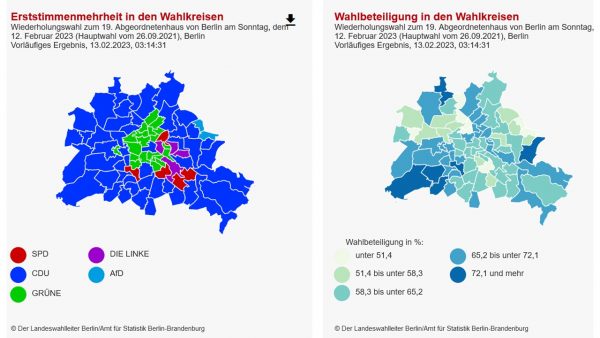
Double bind
Knowledge and knowhow are a pair of notions that have strong links between each other. It is a challenge to see 2 knowledge systems, knowledges, to co-exist sometimes for a very long time. Medicine is a good example. The traditional Chinese medicine continues to exist in parallel to the western style science based medicine. It remains a challenge to analyse the effectiveness, efficiency and equality each system can provide. In terms of public health the border between knowledge and knowhow becomes more blurred. The knowledge about diseases needs to be transferred into knowhow of how to prevent the disease to the population at large. This is a steep challenge as the persistence of alcohol abuse, smoking habits and other drugs abuses show on a global scale. Knowledge alone on the negative consequences is far from enough to prevent abuse. The thin and blurred line between use and abuse of pharmaceutical products equally challenges our traditional views on knowledge and knowhow. In a knowledge graph knowledge would figure, for example, in the core and knowhow as a satellite on the periphery. However, despite the strong link between these 2 notions, knowhow has a lot of additional links to topics like health or yin and yang. Knowhow has a basic link also to notions like memory (techniques) or even war (equipment). The more abstract notion of knowledge, “le savoir”, has been seen for a long time superior to the less abstract notion of knowhow, “savoir faire”. Polymaths have been identified for touching on several fields of knowledge with little concern for the practical side of things, despite the fact that Leonardo da Vinci combined many fields of science of his time to improve technology of his time including visions for the future. The double bind link exists in the recursive element of a link between 2 notions. Rather than denying its existence we have a lot to do to incorporate the more complicated links into our scientific knowledge and the more practical knowhow. 
Bio-medical-sociology
In family histories we like to look on tree-like linking structures. Most frequently the choice is the descendant perspective (Top down). X, Y, Z have been the children of A and B and so on for a couple of generations. Bottom-up perspectives are equally feasible and modern patchwork families have more widespread representations of their families. Those representations were easy to do as families were lifelong bonds. Shorter family bonds, previously mainly caused by pre-mature deaths, are more common as people might have different partners and off-springs at different periods of their life course. Drawing family trees then looks more like a network structure of several families. History and literature is full of stories of how families aimed to keep their genealogy simple to the outside world. Modern days are no exception to this. Law had to adapt to these societal facts and changes thereof. Comparing decades over the last century there is, in my view, the remarkable trend to allow for more complexity in family histories, even after the 60s leading to many complete ruptures of family ties and links throughout the 70s and 80s.
With reducing fertility rates in most, not only western regions of the world, medical demography is back on the agenda. Similar to family trees, new forms of identifying promising pharmaceutical products have moved to more data-driven disease insights. Historically the local medical doctor had an overview about the likelihood of diseases following family’s medical histories over generations. Data-driven analyses, supported by data analytics and/or AI support, can learn permanently about potential and actual risks. New links of diseases are discovered this way extending the family doctor’s view of risks to watch out for in patients. Additional remedy and marketing potentials of existing drugs are also detected this way, beyond anecdotal evidence. Research published in the “Journal of biomedical semantics” by Vlietstra et al. (2020) classifies disease trajectories to construct knowledge graphs of biomolecular interactions. What previously a medical doctor in region could infer from his medical records in a less systematic way, can now be analysed on big data sets of countries, continents or even the global scale. Data is knowledge, and some already know, that this data-driven knowledge is worth a lot of money. Linking previously and seemingly unrelated facts or events, just like becoming aware of more complex family trees through DNA-analyses is the medical part of history. How we deal with this as families or societies as a whole, is the trickier part. Structural changes of societies are marked by decades-like changes, but specific events like “Fukushima”, Tschernobyl or other man-made rather than natural disasters have created new forms of contamination and the spreading of it. In addition to family trees we need broader consideration for knowledge bases to demonstrate, for example, the spread of cancer in the networked society. Additionally this evidence should have a stronger recognition in courts as prove of contamination lines. Statistical reasoning is more likely to become court-relevant. Hence, train the legal profession beyond what “statistical discrimination” is like. Causal mechanisms are manifold. Some are more likely than others. Semantic knowledge graphs remind us of the presence of reverse causality many relationships. Scientists need an optimistic state of mind to abstract from many intervening processes on health, be they tiny micro- or bigger macro-level societal effects. 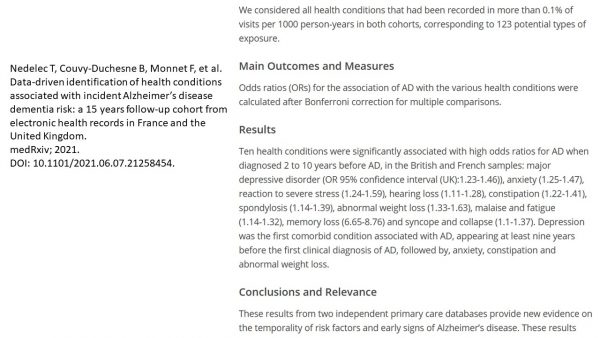
Flotow Europa
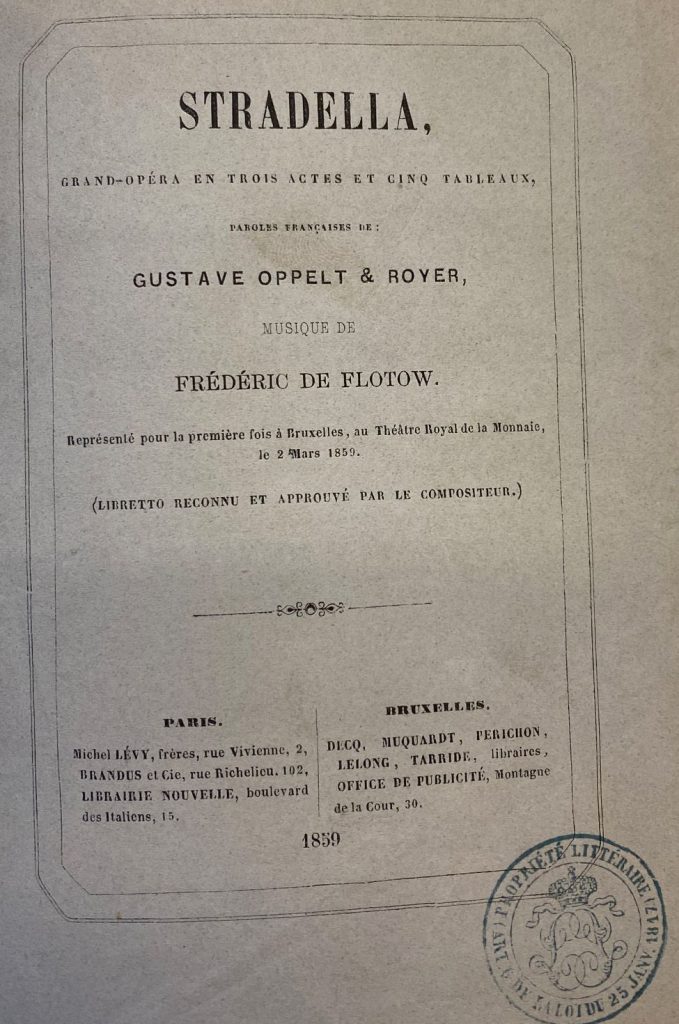
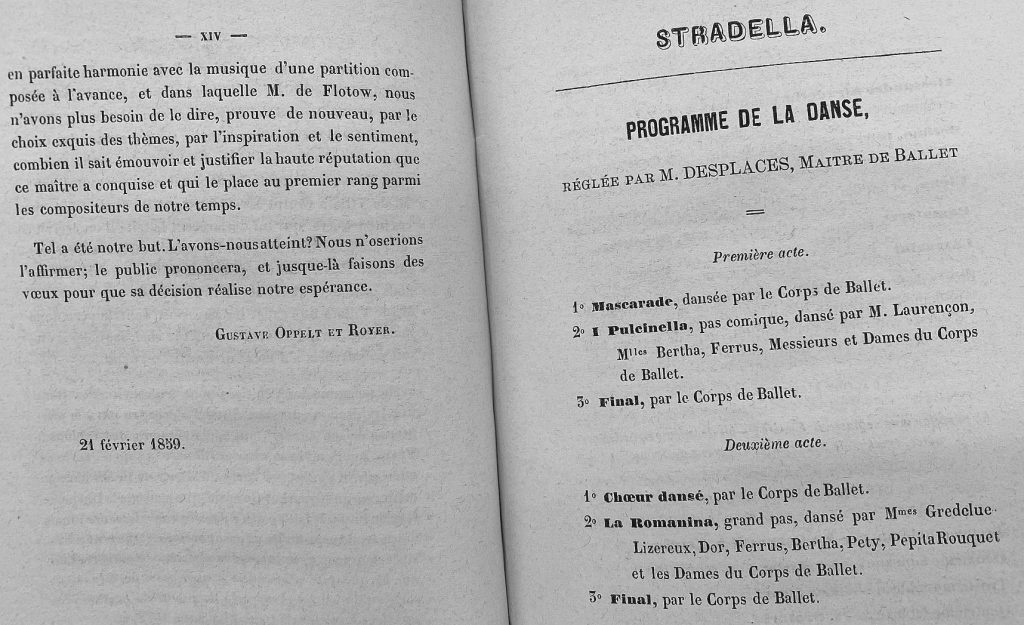
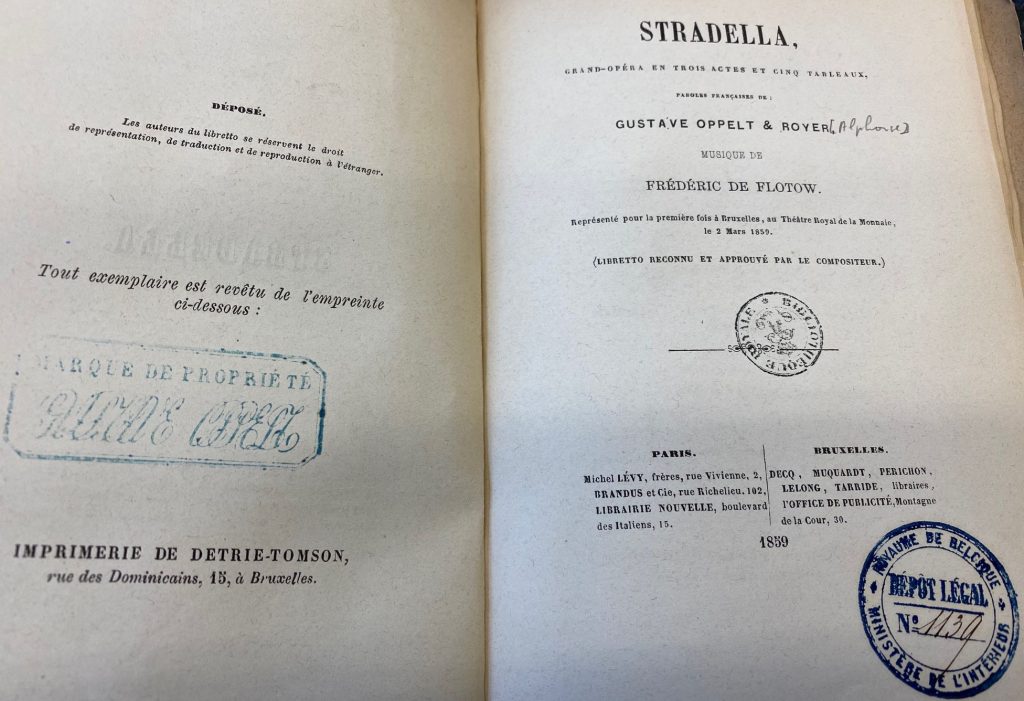
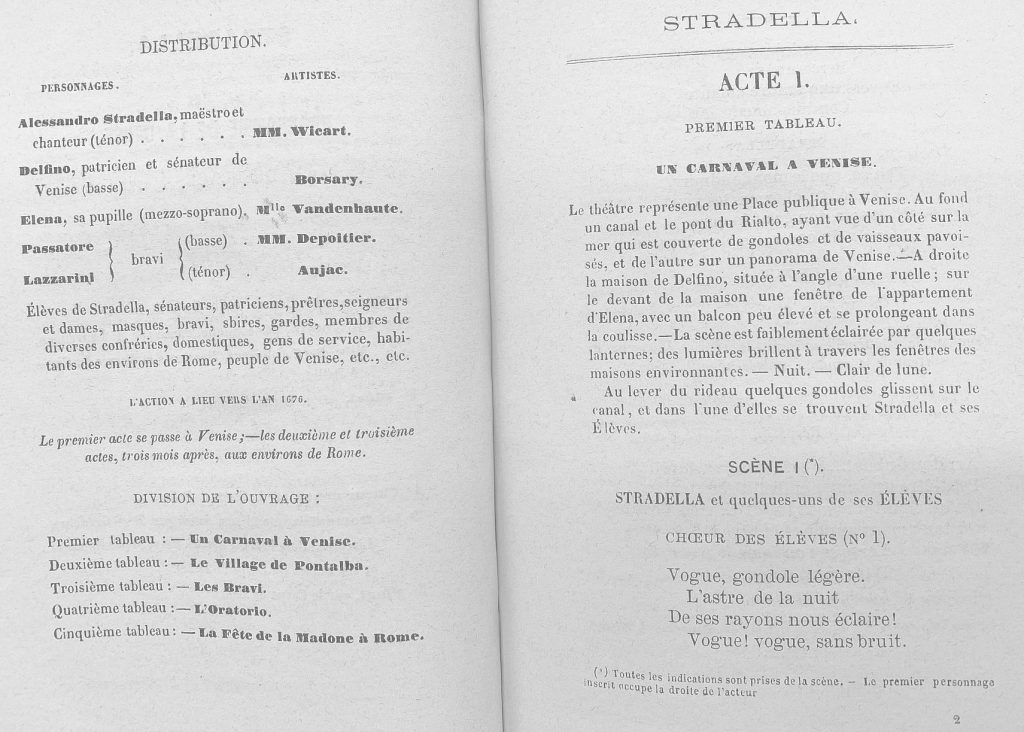
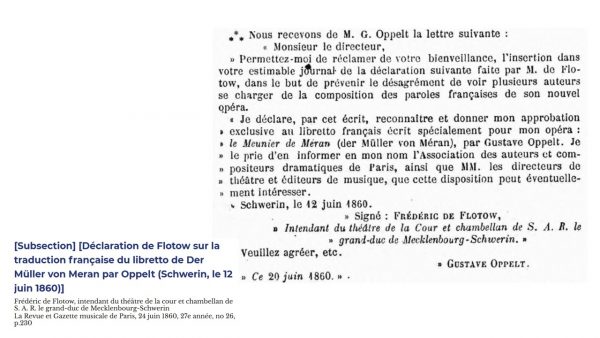
In der späteren Aufführungspraxis des Werks von „Fritz“ von Flotow, wie ihn seine Mutter in MeckPom nannte, sollte es für den in Frankreich ausgebildeten Jugendlichen einige Fallstricke zu überwinden geben. Bereits seine erste Oper „Alessandro Stradella“ hatte mit Produktpiraterie zu kämpfen. Der Übersetzer Gustave Oppelt (1844 Autor zu Stradella genannt BNF), mit Erwähnung auch von Alphonse Royer, hatten die Rechte des Librettos inne (Stempel des Dépôt Légal 1859 Nr 1139). Anlässlich der Erstaufführung in Brüssel am 2-3-1859 au Théâtre Royal de la Monnaie erschien das gedruckte Libretto versehen mit einem Echtheitsstempel. Bereits 1860 gab es dann Anlass, dass Gustave Oppelt mit der Unterstützung von „Frédéric de Flotow“ für seine Übersetzungsrechte kämpfen musste und dazu eine Notiz in der „La revue et gazette musicale de Paris“ veröffentlichen mussten. Autorenrechte waren und sind keine Selbstverständlichkeit. Die Lebensgrundlagen vieler Künstler, besonders der KünstlerInnen, auch heute, bleiben meistens prekär. Flotow war bereits beteiligt an Vereinen, die die Kompensation von AutorInnenrechten vertraten. Die „Dédicace“ an die königliche Hoheit Madame la grande Duchesse Douairière Alexandrine de Mecklembourg-Schwerin, née princesse de Prusse (Link Stammbaum), versteht sich dabei wohl auch als Dank für die Berufung von Flotow als Intendant an das Theater von Schwerin, gleich neben dem schönen Schloss. Mäzene konnten wohl über Stellenbesetzungen KünstlerInnen ihr künstlerisches Arbeiten weiterhin ermöglichen. Flotow brauchte auch die Unterstützung, die ihn zu seinem Lebensende nach Darmstadt umziehen ließ.
Ukraine 360
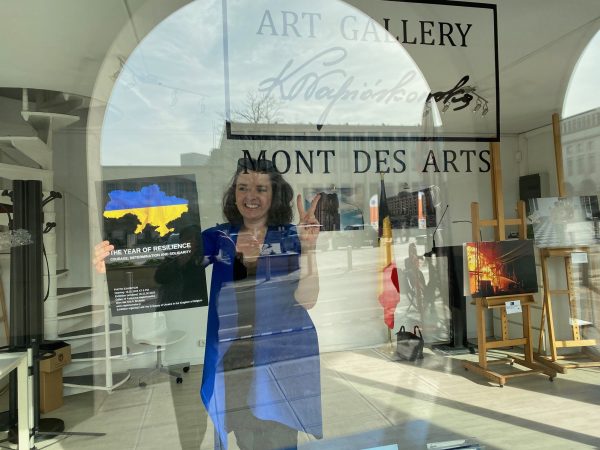
360 days of traumatising war of Russia in Ukraine. Yet, Ukrainians manage to stem the invasion this time for a year. My generation of baby boomers in Western Europe no longer knows the day to day horrors of war. A photo-realistic exhibition organised by Dr. Justyna Napiórkowsak together with the Ukrainian Embassy in Brussels brings to us more than images of destruction. The Exhibition builds on a transparent organisation. All day and night long you can feel and reflect in front of the gallery windows of what war means to people affected. Rather than passing over the daily horrific news, it is important to take in images that will last within you. Since the exhibitions excels in linking to strong own emotions, the images tell lasting stories. Communicating about war is difficult. This exposition at the “Mont des Arts 8” in Brussels, not far from the “Place des Martyres” is symbolic. Ukrainian artists are going to stay with us, showing us what “The year of resilience. courage, determination and solidarity” mean in the Europe of today. Ukrainian youth, like the whole population, demonstrates all of this in posing for their 2022 graduation photo (Stanyslav Senyk, 2022) actually within the ruins of their city. They seem to sing: “We shall build this city on rock and roll” again. Ukrainian culture is unique. Putin’s Russia is still living in the 50s state of mind. The Russian soldiers might soon have their 60s moment “make love, not war”. For persons with Russian roots in Eastern Europe it feels like what you believed or were told was a friend before is now turning around and you shooting at you including committing war crimes (Geneva convention) on you. The exposition is a “homage to Ukraine”, Ukraine’s resistance and resilience. Teaching us lessons, lessons we should like to learn fast for the survival of democracy and our way of life based on freedom not coercion. The sociology of war informs what the term “Zeitenwende” means. Look at it, rather than look away. As previous College Master at Jacobs University Bremen graduation ceremonies were very personal and emotional events meeting students, many with their families. Ukraine 3.0 will prevail eventually. Thanks, Justyna for putting images 360° and 360 days next to this optimistic message. 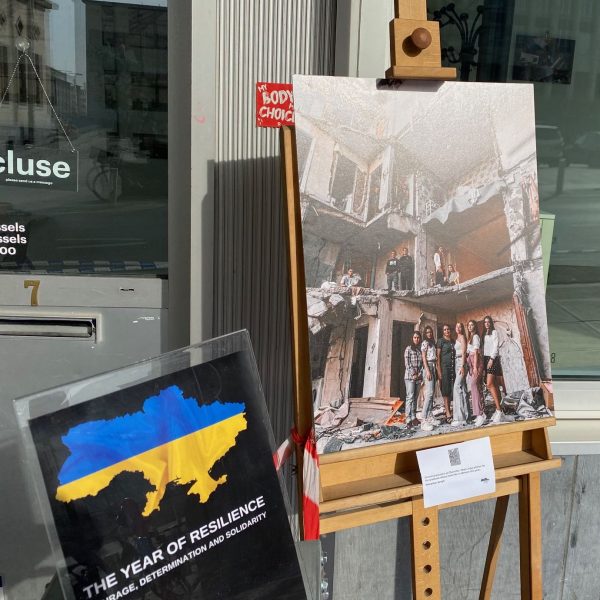
40s
The years spanning from January 1940 to December 1949 are probably the worst to cramp into one decade. However, there are a few historians that use this approach to throw new light on a distant series of historical events in the 40s. The European perspective is dominated by war years and still has to deal with the unimaginable atrocities committed by Nazi-Germany until the end of the Second World War. From a more global historical perspective the war in the pacific also leaves lasting political changes, which are important to understand international politics and affairs of today. After a disastrous beginning with war for the USA for the decade, on the 10-12-1948 the United Nations (Charter Ratification 24-10-1945) General Assembly adopted the Universal Declaration of Human Rights. On the timeline at the end of the 40s we find the founding of NATO (4.4.1949) and (12-8-1949) the Geneva Convention which specifies internationally accepted laws of warfare. The beginning of the Cold War (Yalta and Potsdam Conferences in 1945) with strategies of containment and confrontation (Thomas Tandy Lewis, 2011 p.220), Berlin blockade determined a long-lasting concern for a balance of power across the world. The 40s were a market period of de-colonisation as well. The U.S. enabled struggles for independence to succeed with a sticks and carrots politics towards their wartime allies. The Marshall Plan for European Recovery is the most prominent example of this period. Ronald Goldberg (2012) includes a chapter on the home front in his summary of the forties in the U.S.A. After the 2nd World War all countries had to re-establish their societies and economies that had suffered due to lack of sometimes even caring for the most basic needs. Important lessons have to be learnt from the 1940s (Dave Renton, 2000 p.144) concerning how Fascists could rise and why, for example Britain, could resist the fascist movement. Anti-fascism in Britain during the 1940s and the importance to stop beginnings of an undemocratic political movement early and with the help of the police are 2 elements of the lessons learnt. Goldberg argues that it is less the Fascist ideology that conquered the minds of people, but the organisation as a political and para-military movement that is the more important threat to democracy. 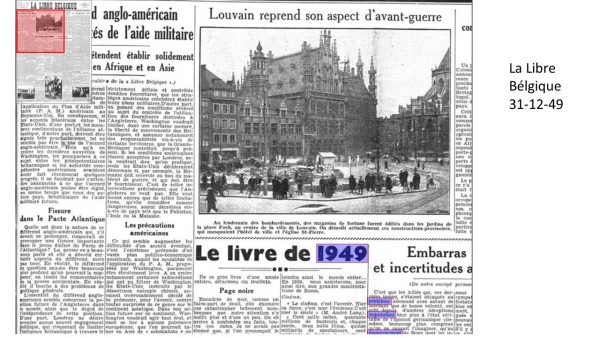
Aphorismen
Eine Sammlung von Aphorismen, wie sie Georg Christoph Lichtenberg hinterlassen hatte, regten viele Denkende an, sich mit seinem Gedankengebäude zu befassen. Die prägnante Form der Zusammenfassungen, Hypothesen oder Vermutungen zu jeweils einem großen Thema hat ihn unsterblich werden lassen. In Form von Gedankenblitzen, Neudeutsch Tweets, vor mehr als 222 Jahren, gestorben ist er im Jahr 1799, zeugen von großem Weitblick, Tiefe und Breite seines Wissens (Polymath). Jede Person, die sich heute in der Schule mit der Infinitesimalrechnung befasst, der mathematischen Annäherung an einen GrenzwertS (Mathe Vorlesungsnotizen pdf), findet bei Lichtenberg zum Beispiel die Anwendung dieser Methode auf soziale Phänomene. Einer Wahrheit werden wir uns auch nur annähern können, selbst wenn wir sie auf unsere Weise, zumindest temporär, als solche definieren. Vor mehr als 250 Jahren hat Lichtenberg bereits in seinem ersten „Sudelbuch“ interessante Gedanken niedergeschrieben, die uns heute noch Nachdenken lassen. „Unser Leben hängt so genau in der Mitte zwischen Vergnügen und Schmerz, dass uns schon zuweilen Dinge schädlich werden können, die uns zu unserm Unterhalt dienen, wie ganz natürlich veränderte Luft, da wir doch in die Luft geschaffen sind.“
Dem modernen Menschen ist das Bewusstsein, in die Luft geschaffen zu sein, fast vollständig abhandengekommen. Unsere Eingriffe, wider besseren Wissens, lassen weltweit jährlich Millionen Menschen vorzeitig sterben am Smog der Moderne. Innovation ist enervierend, wenn sie nicht vornehmlich den Menschen im Blick hat. Es sollte noch einige Jahre nach Lichtenberg brauchen bis Goethe Faust den Satz sagen ließ: Die Geister, die ich rief, ich werd’ sie nicht mehr los. Lichtenberg setzte das obige Zitat so fort: „Allein wer weiß, ob nicht vieles von unserem Vergnügen von diesem Balancement abhängt; diese Empfindlichkeit ist vielleicht ein wichtiges Stück von dem, was unsern Vorzug vor den Tieren ausmacht.“ Aus dem Akt der Balance den jede/r Einzelne zwischen Schmerz und Vergnügen im Lebensverlauf beschreibt ist längst ein gesellschaftlicher und politischer Balanceakt geworden, zwischen gesellschaftlichen Gruppen sowie zwischen Generationen. Die Abweichungen von einem Grenzwert oder von einem ausbalancierten Zustand sind ebenfalls größer geworden, so dass der ganze Akt ins Wanken gerät. Mit dem beschriebenen, unserem Vorzug vor den Tieren, könnte jedoch ebenfalls ein Teil des Problems sein, denn die Vernichtung der Biodiversität ist nun mal noch die Lebensgrundlage des homo sapiens. Seien es Schwankungen um einen Mittelwert oder immer kleinere Annäherungen an einen Grenzwert, wir wanken auf Pfaden, die Lichtenberg angerissen hat. Blogposts sind wohl vergleichbar den Einträgen in Sudelbüchern. Aus vielen Puzzleteilen kann ein Gesamtbild entstehen, muss aber nicht. Die Begriffe „Random Walk“ oder „Brownsche Bewegung“ sind erst lange nach Lichtenberg entwickelt worden. Heute sind wir von dem „Random Walker Algorithmus“ begeistert oder erschreckt, wenn letzterer für „fake news“ statt Wahrheitsfindung missbraucht wird. 
Photo K
The self portrait is a timely topic for an exhibition of photography. As part of the European month of photography (EMOP), the PhotoBrusselsFestival offers a good overview of what photography deals with in the 21 century. The Korean cultural centre (KCC) in Brussels has a long tradition to serve as an exposition in the centre of Brussels (Sablon) and is joining this year’s photo festival. The 2023 photography festival has the “Self-Portrait” as a guiding theme. Rather than entering the debate about “portrait chosen or portrait endured” (Photographica 5,2022) the self-portrait has more degrees of freedom in it. Even if it is apparently a choice to portrait oneself, there are ample examples, where the urge to produce a self-portrait is part of a wider concern for fundamental issues.
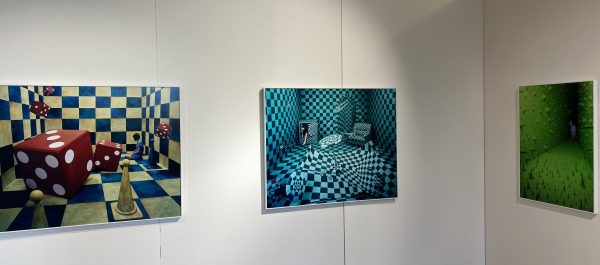
The exhibition of 5 artists from Korea at the KCC invites us to reflect on the pervasive self-portrait practice all around us. The self-portrait is not only a tool of self-reflection, which has a long tradition in art (just think of a famous drawing by Albrecht Dürer of himself), but self-portraits are also pervasive on media and social media today. Additionally, the self-portrait is a powerful tool of thinking and imagining yourself at various stages of the life-course. For centuries it had been a social or political privilege to have your portrait taken. It still is to some extent, but only if the person taking the photograph, has a special reputation. In a market difference to the selfie, the exhibition of artists in the KCC highlights the process of self-reflection that is part of creating the portrait as well as the ensuing reflection by the spectator. In looking at the self-portrait of the photographer, we might involuntarily deal first with our own perception of the image. Danger, dreams, fantasy, sorrow, pain, self-assertion and reconstruction of the self, all these themes come to mind when confronted with the self-portraits of the 5 artists (Bae Chan-hyo, Jeong Yun-soon, Lee Jee-young, Ahn Jun, Choi Young-kwi).
KCC director Kim Jae-hwan names this collection, curated by Seok Jae-hyun, “An odyssey of images leading to self-re-flection”. In referring back to the protagonists in novels from Hermann Hesse, he points our attention to the “unique journey through images as they find themselves”. To embark on the journey visit KCC in Brussels, ask for a copy of the catalogue or start by reading the title of the exposition: “Who Am I” – it is apparently no longer a question after the journey. Is it for you? More reflection on images and photos here. 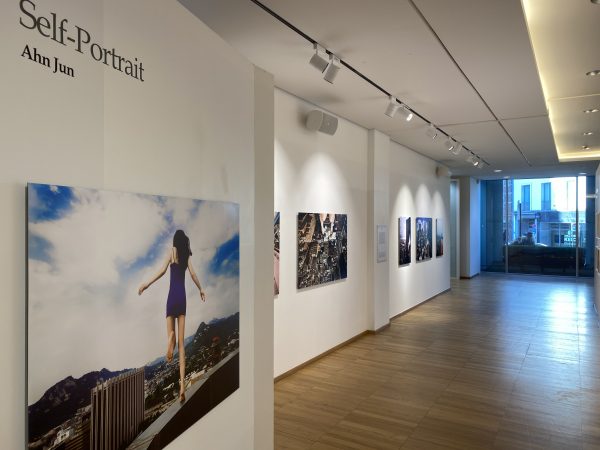
Art Un-Fair
The Brussels Art Fair (Brafa 2023) with its long tradition is certainly a major highlight in the world of art in Brussels. In view of the languages spoken at the fair, mainly French and Dutch, some English with here and there a word in Spanish or German, the international reach is probably still not at the level of before the corona crisis.
The availability of established, internationally recognized art over many centuries on the art market is remarkable. Whereas before the crisis speculators bought art to shield their fortunes from a high inflation and/or politically instable period, nowadays it seems to me, that some art is returning to the market due to the need for liquidity of speculators or risks of confiscation in case of dubious previous acquisitions or ownerships. Renowned galleries, of course, provide impeccable certificates or information on them, a tricky business in itself. Anyway, the tour on the fair is a “parcour” through the history of art, mainly through the Western or European arts across centuries rather than decades. Most persons will find splendid examples according to their preferences of art ranging from paintings, sculpture, prints or other artefacts. Beyond the impressive individual art work, the arrangements and “mise en scene” of art is another learning experience at the fair. Whereas most public museums are happy to make accessible as much as they can of their collections and archives, the private art market has another objective. Effective and convincing presentation of the artefact is likely to “enrich” the value of art work as well as the seller and the dealer. Technology allows great lighting and some otherwise “sombre” artwork becomes a shiny little piece catching eyes, hearts and wallets. For some visitors it works probably the other way round.
For persons overly stimulated by art, I recommend to close the actual or virtual visit with a look at the little bit cheeky artwork presenting Belgian chocolate next to royalty (Gallery Delaive, showing Peter Anton’s “Paradise Variety” next to Andy Warhal’s depiction of a Queen, see below or their Instagram presentation). A sublime moment to repeat the experience at home at moderate prices with your very own box of chocolates. At a price of 10€ each box you can enjoy roughly 2000 of them for the price of the art work. The question is: What is more healthy? Think about mental health as well. Alternative question: Art on a Fair is fair, unfair or fair traide? 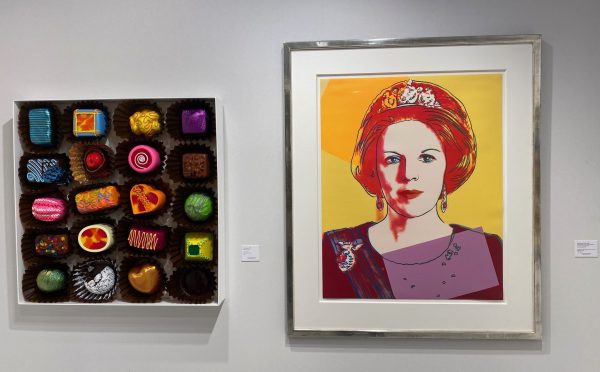
50s
The fifties are remembered as the prosperous and booming years in the 20th century, worthy of nostalgy for some. Indeed, after the 2nd world war and its destruction the time of re-construction had come already some way, thanks to the Marshall plan of the late 1940s. Most countries had to turn huge military equipment industries into civil uses. After the Schumann Declaration, the European Coal and Steel Community was a first successful and lasting institution building in Central Europe. A mass production boom of cars, civil aircrafts, radio and the beginning of public television were landmark changes in the relationship of technology and society. The U.S. became a leading force in this evolution pushing for free trade between countries and consumerism. The deprived generations of the war period in the 40s welcomed the “fabulous fifties” (Arleen Kelin, 1978) as a dynamic and prosperous decade, despite dramatic speed to innovate new more deadly weapons. The atomic bombs were tested from superpowers and nuclear energy started to surface. Solar cells and optic fibres were also inventions of the mid-50s. Strange that we had to wait for another 70 years and multiple crises before these resource-efficient technologies achieved popular success. Integrated circuits, micro-chips, the laser, Tupperware, Coke, Lego, Mickey Mouse and global cinema came upon us during the 50s. The Sputnik effect re-opened an arms race as part of the cold war including outer space beyond airplane reach.
Families longed for and indulged in an as normal as possible family life. Unfortunately, this meant for many women, who had worked outside home during wartimes, to return to a role of housekeeping. Rock n Roll and increasing consumption of mass produced products could compensate for some of this deprivation. Higher divorce rates in the 60s and/or lack of own pensions were the dire consequences for many women. Showtime, and showing-off were the mantra of the 50s. Glamour (Magazine) rose to cult status and prepared popular culture and art. Following fashion and awareness of design spread across societies enabled by the easier access to “sewing machines” allowing more home production for the middle-class persons. The “people of plenty” (Andrew Dunar, 2006 p.167-8, referring to David Potter, 1954) were effectively sold a car culture with the automobile as an agent of change.
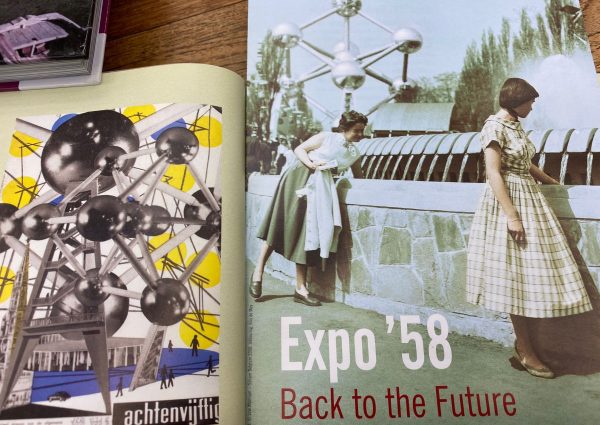
The atomic era was believed to continue prosperity for more decades (Expo 58 in Brussels) and a delicate, but relatively stable balance of power restricted open wars. “The End of Ideologies” during the fifties (Daniel Bell, 1960) lead to focus on Realpolitik and a race for prosperity, oblivious of the ecological consequences for many decades to come.