The Brussels Art Fair (Brafa 2023) with its long tradition is certainly a major highlight in the world of art in Brussels. In view of the languages spoken at the fair, mainly French and Dutch, some English with here and there a word in Spanish or German, the international reach is probably still not at the level of before the corona crisis.
The availability of established, internationally recognized art over many centuries on the art market is remarkable. Whereas before the crisis speculators bought art to shield their fortunes from a high inflation and/or politically instable period, nowadays it seems to me, that some art is returning to the market due to the need for liquidity of speculators or risks of confiscation in case of dubious previous acquisitions or ownerships. Renowned galleries, of course, provide impeccable certificates or information on them, a tricky business in itself. Anyway, the tour on the fair is a “parcour” through the history of art, mainly through the Western or European arts across centuries rather than decades. Most persons will find splendid examples according to their preferences of art ranging from paintings, sculpture, prints or other artefacts. Beyond the impressive individual art work, the arrangements and “mise en scene” of art is another learning experience at the fair. Whereas most public museums are happy to make accessible as much as they can of their collections and archives, the private art market has another objective. Effective and convincing presentation of the artefact is likely to “enrich” the value of art work as well as the seller and the dealer. Technology allows great lighting and some otherwise “sombre” artwork becomes a shiny little piece catching eyes, hearts and wallets. For some visitors it works probably the other way round.
For persons overly stimulated by art, I recommend to close the actual or virtual visit with a look at the little bit cheeky artwork presenting Belgian chocolate next to royalty (Gallery Delaive, showing Peter Anton’s “Paradise Variety” next to Andy Warhal’s depiction of a Queen, see below or their Instagram presentation). A sublime moment to repeat the experience at home at moderate prices with your very own box of chocolates. At a price of 10€ each box you can enjoy roughly 2000 of them for the price of the art work. The question is: What is more healthy? Think about mental health as well. Alternative question: Art on a Fair is fair, unfair or fair traide? 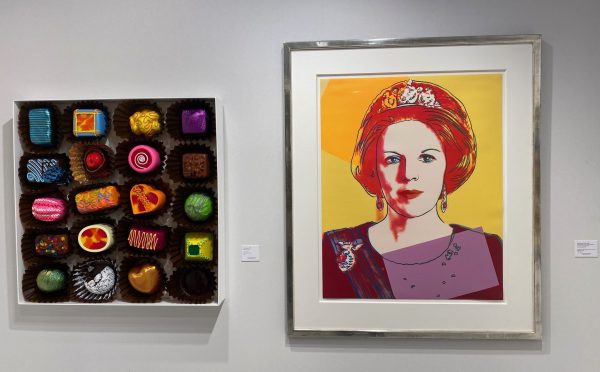
60s
“Make love, not war”, is a summary slogan of all sorts of protests that have moved the sixties. With the spread of television impressive images caught attention no longer just locally, but almost across the whole world. With the inauguration of political debates on TV between Kennedy and Nixon, reaching millions of persons at once and images travelling borders faster than to translate text, spreading of new ideas and political actions was more rapid and more emotional. Commonly the 60s are described as the sex, drug and rock-n-roll period. But there is much more to it. Yes, the sex revolution got started and access to, as well as experimenting with, drugs became more widely spread. Music became a defining moment for young people from teenage years onwards. After Rock n Roll from the 50s, came the rock music and pop culture, which were able to bring together huge crowds of several hundred thousand party-goers. The Woodstock festival and hippie gatherings became a defining moment mainly for the young. Older generations still battled for affordable housing and the “Great society”, as a large-scale anti-poverty program was called.
The phenomenon of the Beatles co-defined the 60s. The Beatles captured more than just one generation with their popular songs and iconic style. Mary Quant, attributed to have designed the mini-skirt, equally co-defined a period with a visual provocation to conservative life-styles. In parallel, the sixties saw the civil rights movement grow, Black Power succeeding with peaceful actions more widespread attention, leading to the abolition of openly racist practices. The peaceful movements and happenings, however, had to face the deadly attacks on J.F. Kennedy and Martin Luther King during the 60s. The whole decade was influential in the field of education as well. Based on a new spirit of altruism and happiness combined with, but also beyond religious feelings, new forms of living together, sharing and the common good were tried out. Anti-authoritarian educational practices were influential beyond the 60s.
Books covering the 60s are manifold. In addition to Arthur Marwick’s impressive, multi-faceted volume “The sixities”, I enjoyed the book by David Burner “Making peace with the 60s”, especially his approach to burn some received wisdoms about the 60s, namely the restriction of it to those 10 years. “The withering away of philosophy”, the beginnings of postmodernism and a theory-driven or conceptual approach to the decade, amongst other topics, is the merit of Fredric Jameson (1984, p.192). “The 60s without apology” is a programmatic title well worth thinking about seriously as the editors and authors did.
Besides the ecological disasters of the 60s already, (nuclear, oil and wars), Mini Cooper cars, Lava Lamps as well as Blow or Ball Chairs, Barbies, Frisbees, Brigitte Bardot and Pippi Longstocking (Patricia Massó, 2010), all were dressed to impress. “The 60s without apology” by a group of editors nicely summarises the review of the 60s and their lasting effects on us, for better and/or worse. 2 generations later in 2023 youth is again threatening mass mobilisation in France as depicted in LeMonde 4.2.2023. It is a kind of “déjà vu experience”. 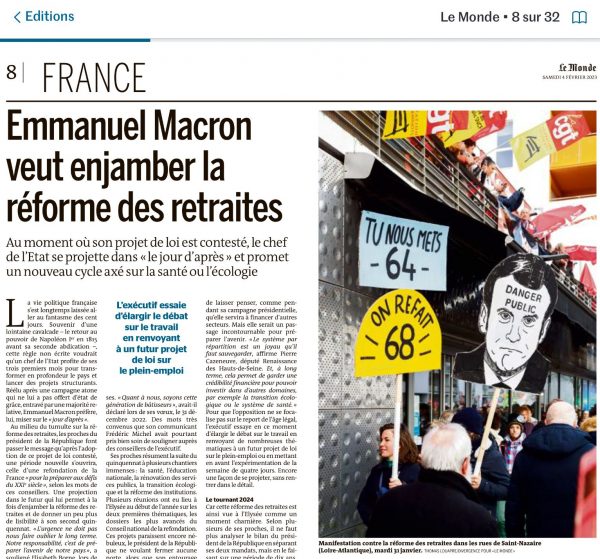
Linguistics2
Languages are simple once you understood the making of them. Take children, they learn the alphabet first, and use notions or images in alphabetical order, which you associate with this list of short words from A to Z in western cultures. From short words like “Cat” and “Dog” the learner moves on to longer ones like “Bird”, just 4 letters now. More advanced learners then use more letter words like “supercalifragilisticexpialidocious” invented for amusement in the Disney-film Mary Poppins. It sounds a bit like one of those never-ending long German words with lots of nouns just added on. This is exactly what we shall do in the following. A bit like in computational linguistics when ChatGPT is predicting the next word, we use algorithmic thining to form new combinations of an alphabetical list of notions. We start in the table below with column 1, then tell our spreadsheet to copy cells A1-01 to Z1-26 list and insert it in the second column just one cell below and insert Z2-27 at the place on the top of the list of column 2, which is A2-01. Then take this column 2 and repeat. Stop after, lets say the repeat counter is N=25.
The first 2 words combination then is “Action Zero”. Take this, enter it into Computer Search and take the top entry. “ActionZero” is an actual company name proposing actions to achieve net-zero emissions. Following this, we produce a whole encyclopedia of pretty up-to-date knowledge from the WWW with hardly any humans involved anymore. We only need to cut out duplicates and nonsense entries. That’s what most editors or teachers are used to do. Knowledge creation might no longer be reserved to the human species. Oh my God – but the machine might eventually sort this word out as nonsense concept, too. The new mantra could be ZeroGod or let us try the reset like in GodZero. In other words we move from HamletMachine to our own KnowledgeMachine. 
Romanatik2
Zur romantischen Periode gehören die bekannten Lieder von Schumann und Schubert. Meine Auswahl dazu liebäugelt besonders mit den Liedern zum Lindenbaum. Die Linde mit ihrem süßlichen Duft an warmen Tagen hat Malende der Romantik sowie die Dichtenden und Komponierenden betört. “Am Brunnen vor dem Tore da steht ein Lindenbaum …” kannte vor 50 Jahren jedes Kind. Etwas weniger bekannt sind die fabelhaften Rückert-Lieder von Gustav Mahler: “Ich atmet’ einen linden Duft …”. Für mich steht dabei die Atmosphäre in der Nähe der Linde im Vordergrund. “Unter den Linden” assoziieren viele nur noch mit der Verkehr in der Hauptstadt auf dem Weg zum Brandenburger Tor. Zum Reinhören und Reinversetzen in die Romantik sind die Lieder ein idealer Weg. Der Frühlingsglaube (Schubert Op.20.2) besingt die linden Lüfte und das Aufblühen der Natur. Es keimt die Hoffnung auf, dass sich alles zum Besseren wendet. Doch etwas Skepsis ist schon angebracht. Im Lied “Die abgeblühte Linde“, ebenfalls von Schubert vertont, ist dann das Altern und die Treue thematisiert. Der Zyklus der Natur und Jahreszeiten nimmt scheinbar unaufhaltsam seinen Lauf. “Nur der Gärtner bleibt ihr treu, denn er liebt in ihr den Baum”. Das weise Herz will Gärtnern und erhalten, was so viele Emotionen und Optimismus hervorgebracht hat. Wir müssen die Bäume retten, aus Pflicht die Romantik inklusiv und erlebbar zu erhalten. Dazu können wir mit den Linden ja schon einmal anfangen. 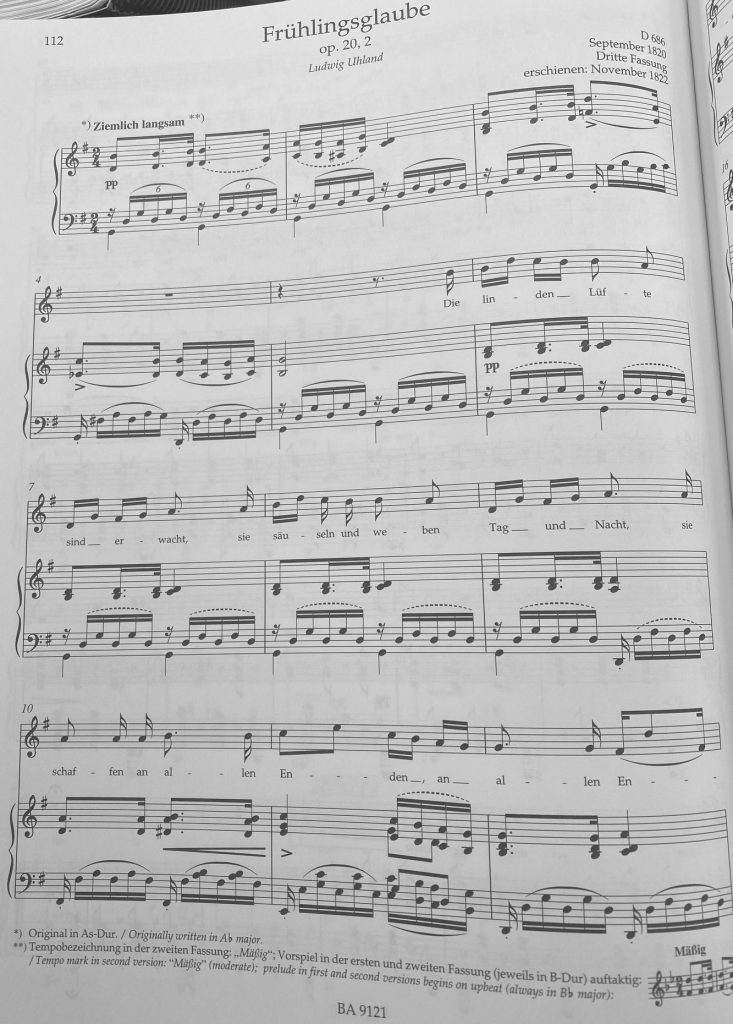
Photo
Photography has captured our imagination for years already.
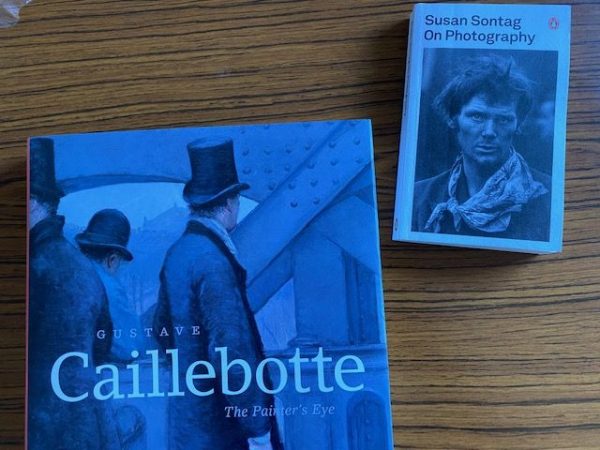
It is now a daily activity of many people to “capture their experience”, if not even their existence in some photographed way. Susan Sontag (1977) coined the phrase that photography “feels like knowledge – and, therefore, like power”. You are in a relation to the world. Taking the photograph in my view is the Mephistopheles moment. You are in control of the object taken by the camera. Arranging the scenery, waiting for the perfect moment, expression, light or colours is like mastering a situation, an atmosphere, an emotion. Photographs have the power to work as a document. Editing has become easy and pervasive with digital tools. However, it was always present in the traditional technical parts of shooting and developing subsequently in the dark room.
“to be taken” on a photograph is more like the Faustian moment of realising that you are manipulated, or at risk of being made use of, for some purpose, unknown to you at that moment.
Beware, a photograph is always just an image of an image. The photographer is the intermediate person using a specific technology to transform his perception or vision of (her/his) reality into another image of it, creating some form of virtual reality.
In addition to this twofold transformation, the third transformation is historically the technical development of the negative into the print (see below). Nowadays, this is the compression and editing into a specific format. Despite these transformations, a photograph is admitted in court cases as providing evidence of guilt or to identify an illicit act (excess of speed limit). Infringements on privacy are the rule rather than the exception. Who is that person sitting next to you, and at what time of the day?
I, personally, apply photographs often like note-taking for research to capture spontaneous ideas or associations, which await further interpretation or may serve (served) as inspiration.
Compared to photography, painting has been a more elite artistic practice for many years. Taking photographs has democratised the image-taking art forms. Instead of originals, many of us have collections of photos from museums around the world. We take “photos of photos” to reveal the world around us and reflect on values. The social construction of the world is directly visible through the process of taking, collecting and curating photographs. Construct your own world or the world will construct or deconstruct you instead.
Politicians (e.g. Angela Merkel), John F. Kennedy or historical figures, all had their defining moment condensed into one or several photographs, what have been famous paintings in art history before. Susan Sontag wrote 50 years ago: “… a photograph can be treated as a narrowly selective transparency”. The third transformation of developing and/editing, shown in the images below, explains what we might learn from this citation in a technical sense. Just as courts have to evaluate, whether a proof is admittable and contributing to finding the truth; viewing photographs is a balancing act between art and truth.
“Even when photographers are most concerned with mirroring reality, they are still haunted by tacit imperatives of taste and conscience.” (Sontag, p.6). Photographs document sequences of consumption. We should frame this as CO2 footprints in the 21st century. Restricting print to a few “best of” was and is necessary to reduce the dirty footprint of photography, particularly since photos have become a mass media as much as the preferred media of masses.
With photographs we certify our own certificates, for example in case of job applications or passports. We encounter “cosmopolitans accumulating photograph-trophies” in all instagram-able locations.
Taking photos is like a “friendly imitation of work” (p.9), you do something useful in documenting the images of a world in danger of being lost. We can give importance to otherwise forgotten realities, attach importance even immortality to something or someone of our choice. We make history through it or try to make it at least. “When we are afraid, we shoot. But when we are nostalgic, we take pictures.” (p.9) Sontag defines photographs as part of the repertoire of surrealism (p.77 ff), “to finding beautiful what other people found ugly or without interest and relevance …”). We are at risk to mistake photographs as reality and experience the original as “letdown” (p.147). The return to polaroid instant photography brings us back to a proclaimed authenticity of the orginal, unique moments, with supposed unfiltered not-edited images. The true moment of having had fun or joint experience without use of photoshop to add the missing member.
“I take photos, therefore I am”, has become the mantra of modern societies. We tend to ignore that we are taken on photos a million more times than we take some ourselves (video surveillance). It is a question of power in the end. Edit yourself or you become edited.
(Image: Prix du Tirage photographique BnF 2022 Laurent Lafolie, photo below). 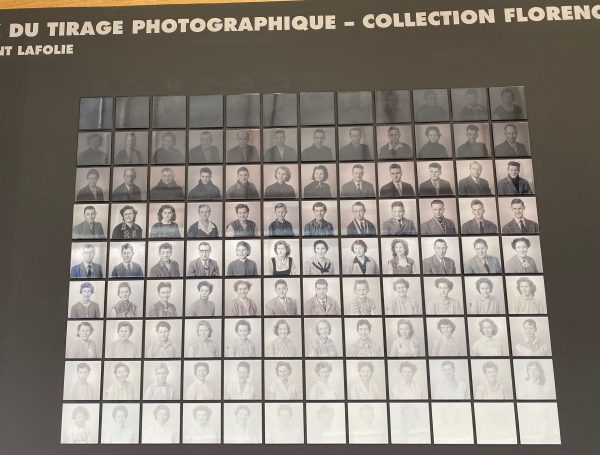
Zigarre
Die Zeiten, in denen Zigarrenrauchen Schlagzeilen machten, sind eigentlich lange vorüber. Heute wundern wir uns lediglich über die Sorglosigkeit der Personen bezüblich ihrer Gesundheit. Friedrich von Flotow hat die Szene im Salon de Marquis de Custine (Paris) in seinen Erinnerungen vorzüglich beschrieben. Die Schriftstellerin George Sand hat die Gemüter mit dieser Rauchszene nachhaltig inspiriert. Frédéric Chopin (1810-1849) hat an diesem Abend seiner (späteren) Mäzenin eine Ovation dargebracht. Flotow hatte sicherlich einen inspirierenden Abend verbracht. Seine unveröffentlicht gebliebenen Memoiren wurden von seiner 3. Frau publiziert. Ein Vorabdruck auf Schwedisch habe ich in der Svensk Musiktidning vom 15-8-1883 gefunden. Datiert ca 6 Monate nach seinem Tod, heute vor 140 Jahren, ist das eine Würdigung des Komponisten in Schweden und eine Anerkennung der Aufarbeitung und Verbreitung seines Werks durch seine Frau. Die Aristokraten und ihre Kreise waren Anregung für viele künstlerische Kreise. Das wohlhabende Bürgertum hat später diese Rolle übernommen. Heute brauchen wir zahlreiche öffentliche und private Stiftungen oder Crowd-Funding für diese Events und Inspirationen.
(Quelle: Flotow, Friedrich von. (1883). F. von Flotows minnen. II. En soaré hos marquis de Custine [Beskrivning av G. Sand (baronesse Dudevant) och Chopin]. Svensk musiktidning, 3(16), 121–122. ) 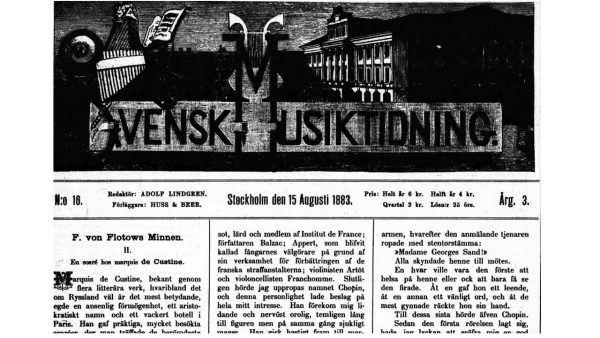
Linguistics
The urge to program human language originates for some in the quest for better explanation or understanding, for others in the improvement of communication. Both approaches have witnessed rapid evolution in recent years. Based on linguistics, psycholinguistics, sociolinguistics or neuroscientific advances, the potential of knowledge creation and communication has risen due to computational models and applications to linguistics. ChatGPT3 and Neuroflash allow us to play around with the commonly available AI-applications. Construction of a linguistically informed Glossary of political and social ideas is a specific application case. In addition to the subject/object list we may add predicates or verbs to link subjects and objects. For this purpose, we construct a basic alphabetical list below which draws mainly on action verbs and is embedded in the socio-cultural environment of the sciences in general. A categorised list of verbs, like the one from Purdue University, is helpful to draw on several relatively distinct fields. With perspective on labour market or societal relevance the list focuses on verbs related to skill sets: administrative/managerial; communication; creative, information/data; caring/helping; efficiency; research; teaching/learning; technical. The categories are not mutually exclusive and may well be supplemented by additional categories like relational skills and transformational skills. Computational psycholinguistics (Crocker, 2006 pdf-file) differentiate the “principle of incremental comprehension” (add one word at a time) from the “concentric theory of complexity” (start from complexity to specificity or vice-versa) and the “deductive sentence processor”. ChatGPT is built on the incremental approach, supposed to be the fastest and probably a more reliable computational approach. We could just attempt to use the other approaches in the simple ABC glossary of subjects, objects and predicates to test for the possibility to build no-nonsense short sentences using random choices as starting points. The Oxford handbook of psycholinguistics highlights in the final chapter the theoretical alternative of connectionism (p.811). Symbolic computation construes cognition as mental states that are symbolically represented. The sequence of operations then runs from one representation to the next one. However, the connectionist model operates more like a neural network and proceeds with the parallel processing of notions, relations or patterns. A list of predicates or verbs might do the trick: Chose a subject, chose a predicate and an object to start playing around: Subjects: action balance corruption democracy enterprise freedom god health imagination joy knowledge law memory nature optimism policy question repairing society time union value war xeno yinyang zero.
Predicates: applies broadens creates directs establishes forms generates helps induces jeopardises keeps likes moderates needs opposes prioritises qualifies represents strengthens tests uses varies weighs x-outs yields zigzags.
Objects: freedom god health imagination joy knowledge law memory nature optimism policy question repairing society time union value war xeno yinyang zero action balance corruption democracy enterprise.
Syntax
Syntax is just one of the categories of linguistics. Carl Lee Baker (1989) wrote a whole book 500 pages on just English syntax, can you imagine. I like his modesty in the introduction stating that English syntax is just a subfield of linguistics (p.12). Other languages have different structures, some might be very different from our ways to communicate even. The ways how animals or plants communicate is an exciting subfield of linguistics, psychology and biology (Carrie Fidgor, Pieces of Mind). The SPO structure of sentences is only one simple way of constructing sentences. Syntax is much more complex. The sociological aspect of linguistics and syntax lies in the “acceptability judgements”, which are present once we establish rules and sort phrases into correct or incorrect sentence structures. Norms and standardisation as well as authority to decide on correctness becomes an issue. Countries used to many dialects or multilingual populations are confronted with these issues on a daily basis. Linguistics as basis of communication is continuously present even in the mental structure. Bilingualism, tri-lingualism and their effects on minds, competences, behaviour, culture and societies are own thriving research fields. Building a sentence or a phrase, following Baker, is built around a head and their complements. Such minimal phrases are comparable to what we coin in a simplified manner the subject-predicate-object structure of a sentence. The definition of the nucleus of the structure of a sentence is also about conventions and acceptability. Staccato speech and rap-music are examples of forms of speech, which are often considered beyond the normal. Computer voices are becoming more normal as we are faced with chat bots all around us now. The image below reflects the simplified “representation of syntactic structure” (p.48 The Cambridge grammar of the English language 2002 review here). To play around with “Clause”, let us analyse the clause: I bought a shirt; I wonder what I bought. You know what I mean Klaus, it is a clause, or is it Dady gone gaga = DADA? 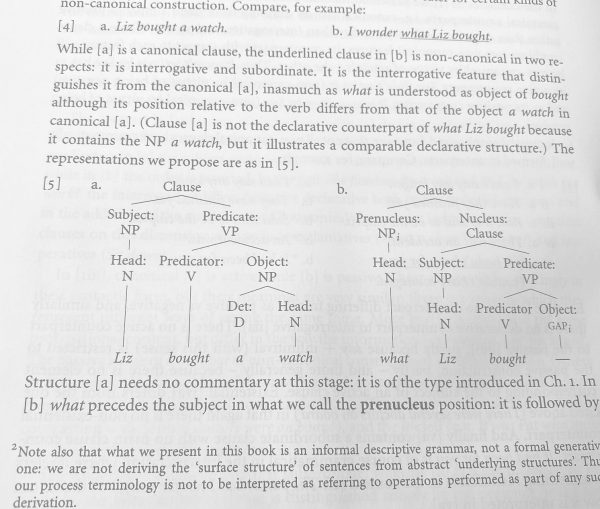
Hypertext
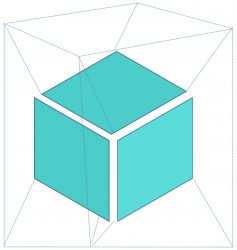
Linking information, explanation and entertainment is the power of the world wide web. The tool used for this is the hypertext format of texts and media in general. Wittgenstein was already dissatisfied not to be able to show the steps of his thinking more explicitly. In the “Tractatus logico- philisophicus (Link to pdf-file de/engl” he uses the a cube (5.5423) to explain that we see to different facts depending on our point of departure of our vision. Try it with the logo of www.schoemann.org you should realize how our vision swops from one way of viewing the cube to another. The white corner is once in the front of the cube and appears to be in the back, when you move your vision further up. In general this leads us to be careful with the choice of our point of departure, not only for our vision. Context, some say background, is important to determine starting points. Adding the hypertext markup language to a document, like in a blog entry, allows readers (+algorithms) to see the cognitive structure surrounding a text as well. Potentially as a reader you enter into a multidimensional space with each blog entry. Any encyclopedia, glossary or index has an apparent alphabetical order to entries, but the links between the multiple entries remain hidden at first sight. With use of hypertext this has changed and each entry is turned into a 3-dimensional space, for example. Additionally, all entries have different numbers of links to other entries including dead-end entries. With the structure of links it is interesting to learn about the self-referencing just as much as about the disciplinary locus of a text, chapters, a book or a library. This helps to still see the forest despite all those trees in front of us ,or we see the geological structure of the mountain while in the middle of the forest. Happy travelling in our new knowledge space! 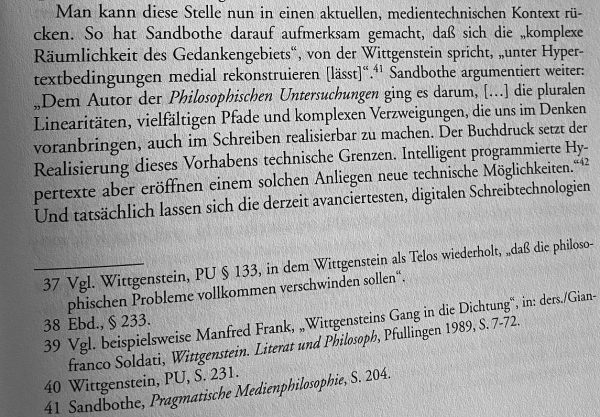
Inspiration
Artists and scientists, all have their sources of inspiration. The most beautiful way of putting this is contained in a poem by Jacques Prévert. “Moi aussi, comme les peintres, j’ai mes modèles…”. The source of inspiration varies from physically present models to imagined ones. Painters and sculptors, we imagine, have their models right in front of them and build on their specific kind of observation, view and vision, seeing more or differently from others, at least since modern times. Poets and authors are believed to draw inspiration from abstraction and imaginative description and narration. Musicians tend to rely on hearing fine-tuned or creative tensions, as much as the resolution in harmonies through sequences of sound. All seem to have a sensitivity beyond the normal and a skill to find a way to transmit to others. Photographers catch representative moments or visualize artifacts and combinations of them in new ways. Scientists are not so different as we might think. Imagination of new hypotheses in established fields is part of their skill set. The transversal skill in all these processes of inspiration is the openness to cross-discipline fertilization. So-called Polymaths reached excellence in more than one field of science, “Polyartists” touch several fields of different arts. Further new innovative combinations of disciplines like they are practices in “centres of advanced studies” are a first step to brings down walls in mindsets and disciplinary ivory tower practices. It will take only a tiny little step forward to come back to the practice of royal courts. The person called “fou du roi” had an important role to play, not only in the game of chess, but in questioning and entertaining leaders. I wish universities, science centres and ministries would allow themselves more of this kind of inspiration. Inspiration is considered here as a source of questioning your own approach from another perspective. Look at your phenomenon of interest with a different model or imagination in mind. New synapses will follow. Let us welcome them to make the world around us a better or more beautiful place. Wait, is more beautiful enough already? Is this a contradiction, better versus more beautiful, or is the latter a subset of the former, or is a tautology anyway? The catalogue of the exposition “Archives des rêves” du Musée d’Orsay gives plenty of insights into images as sources of inspiration for people of all walks of life.