Trust or not to trust

… that is the question. The social science research on trust, distrust or corruption is expanding rapidly. As in some other fields of research the increase in research itself becomes an issue of trust in science as the uncontrolled use of AI has produced an inflation of pseudo-scientific papers as well (Link). However, the finding by Spadaro et al. (2020) that interpersonal trust (trusting beliefs and behavior) is influenced by a general feeling of security as well as trust in institutions is supported by experimental and interview-based research.
There are still many challenges to the research in this field. The “feeling of security” has an overall component, but also several subcategories like the objective or subjective feeling of job security, which is dependent on national and collective systems of employment protection legislation. Economic security or security of a sufficient retirement income might be at times considered more important than (in-)security in cities or the countryside. Differences of the mechanisms by gender and age have to be studied in detail as well, which necessitates large data collections on the issues. Churches that used to be considered as trustworthy institutions or the police forces have been accused of abuses of the high trust placed in them in the last few years. These 2 examples demonstrate that trust itself is a dynamic issue with ups and downs over time, rarely constant over time. Game theoretical considerations add further to the view that trust might be used as a strategy just like economic power. (Image: Cathedrale de Meaux) 

1000+ entries

From time to time it is useful to review whether a project is still on track or has developed biases, which may run for some time without reviews. Just like the United Nations Strategic Development Goals (SDGs) have been set 1bout 10 years ago, I do scan my own publishing project whether I still cover the SDGs in a larger spread. The goals need monitoring and I shall redo my own review as well.
As the number of blog entries on a daily basis has reached 1000+ entries, a review becomes a bit of a statistical exercise. As a kind of anniversary reward, a publication of more collections beyond the AI-reader or the Paris Olympics 2024 reader should be fun. However, there is so much work with checking and updating links, that the e-book, pdf and epub publications have become a time-consuming effort.
The search function implemented on this digital publication format is so fast and powerful that I am myself delighted again and again about the digging up of previous entries, concepts and evidence retained.
Time is a treasure and a value in its own right. Test it!

Visitor retention

For media, platforms, stores, webpages as well as blogs one of the more interesting measures about popularity or spread consists in visitor retention. It is a bit like counting the pages of a book you have read, which you have at home, or have you read them all? The zapping across radio or television channels is also an indicator or unsuccessful retention of viewers. Webpages, online stores or the blog entries here are all more or less directly trying to increase the retention of visitors on the same page. Maybe this can be considered as one of the first steps into a (not-so) social media addiction. The IT-sector offers tools for this.
On this webpage “schoemann.org” we make use of “linkz.ai” a ready-made plug-in that provides overviews on the links entered on this webpage, mainly to avoid that visitors have many additional tabs opened in their browser, do not jump off to follow up the links, but rather stay on the same webpage and “scroll on”. At the same time this means referrals from other webpages, which use the same techniques, will be less frequent.
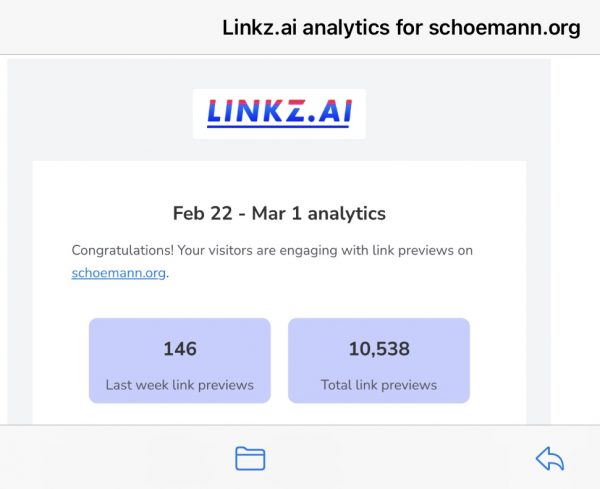
The visitor retention tool used on this webpage is besides the original content 😉 “linkz.ai”. This tool scans other blog entries and links, and proposes the image on the previewed link at the top of the blog preview, for example. Basic weekly frequencies on previews are provided, which might guide a strategy to increase visitor retention, if that is one of your objectives.
The current discussion of addictive potential of social media platforms could be measured through such tools as well and has probably been used already for years with even more sophistication and direct feedback loops into the algorithms.
(Image: basic own statistics Linkz.ai use 2026-2-28) 

Screenshot

Fossil costs

On 2026-3-5 it has become sufficiently clear that the USA and Israel attacks to topple the terror regime in Iran have repercussions across the world markets of fossil fuels. 1973 and 1979 had told us already the lesson that a reliance on fossil fuels like oil and gas, which is produced in only a small number of countries, can disrupt energy supplies drastically. 50 years later we are much less vulnerable to supply shocks due to the stronger reliance on renewable energy sources. The supply shortages are only likely to happen, but energy suppliers are fast to cash in on these expected shortages. Prove of evidence that energy markets are driven more by expectations than actual availability of fuel stocks.
The advertisement of a Belgian recycling company “Powered by sunshine, driven by electricity” is a perfect summary of how to deal with shortages of fossil fuels (MCA recycling in Brussels, Image: former Brussels stock exchange).

Being On Time

“Being on time” has a different meaning,  depending on the society and culture you are living in. Of course, this tends to reinforce stereotypes and raises expectations about the punctuality, the respect of time as a means to effectively synchronize human behavior and its interaction with technology. Train or bus services are commonly referred to in this context. However, our interest here is with the wider margins or, statistically speaking, the normal or not so normal distribution around a specific point in time.
Colloquially we refer to these time periods as being late (more common) or as being early (less common). Add to this perspective that you may be very late (early) or too late (early) and we are going to really deal with the spice of life. Just think of the last instances when you were late, very late or too late.
The same rationale of a “statistical view of time” can inform the sociology of technology. Some innovations can come too early for society to be ready to deal with it, or they may come too late to save us from disaster.
Genetic engineering of human cells is an issue in this regard, both too early for wider applications, but too late for persons in need of curing a specific diagnosis. There is an additional social-psychological aspect to the cognitive process of being on time. It is the cognitive dissonance of what you expect from yourself or somebody else and the actual experience of not being on time which causes stress. Societal norms of being on time can contribute substantially as well to the overall mental load associated with time. Take it easy.  

Defense strategies

Technological developments of drones, aircrafts, rockets and satellites take a lot of time. In order to produce not only prototypes, but ready-to-use weapons, it needs advanced engineering competencies and capacities as well. The arrival of hypersonic rockets, that fly at the speed of 5 Mach necessitate a rethinking of defense strategies to be able to react in ever shorter time spells to external threats. The European Defence Fund intends to spend almost 3 billion € over 7 years to prepare our defense strategies in the EU for the next generation of lethal weapons.
On 2026-3-4 the Iran-regime made use of such a fast rocket, but it was possible to intercept its flight just in time by NATO-allies. Yes, unfortunately “rocket science” is back on the research agenda. In fact, this research has been ongoing across the world, just a bit more below the public radar.
Missions to the moon or mars have been intensified in recent years. This is not surprising or spectacular fact. For some it is surprising, that the number of countries (for example India) which are active in rocket science is increasing and spreading further across the globe. The multipolarity of the international political arena seems more evident in 2026-3.

National interest

Especially in times of international conflicts, it is customary that politicians refer to “the national interest” as a justification for their actions beyond the state borders, commonly named foreign policy. There is a huge literature on the subject, in which the concept of the national interest is useful, (1) because it suggests some higher ranking political goal, (2) because it clarifies and prioritizes a country’s goals, particularly at times of military interventions and (3) because it “arouses the support necessary to move towards a realization of the goals” (Rosenau 1968, Int. Encycl. p.34).
A critical assessment of this concept in international relations should start with the democratic perspective that a country’s government is subject to regular elections, whereby the goals a previous majority had put forward, might substantially change as a new majority takes the lead. Continuation of the same foreign policies is not excluded, but at least subject to revision. In authoritarian regimes the definition of the national interest is probably more stable, because authoritarian leadership does not hesitate to define the national interest in “splendid isolation” from its people.
Overall, the concept appears to serve mainly communication purposes, both internally as well as towards the outside as in communicable foreign policy goals. Conflicts between countries can thus be named and become subject to diplomacy and international treaties. But we have to fill this with substance over and over again as new topics arise like climate change and global warming.

Interconnected multipolarity

In a very long-term anthropological perspective on the balance of power on the globe, the period that mankind lived on this globe has been characterised by an unconnected multipolarity. People lived in their more or less isolated communities before the Egyptian, Roman, Chinese, Australian, African or Japanese empires and people of the world became connected through new means of transport and communication networks.
In the 21st century the world wide web has broad us closer together and suddenly we realize that unipolarity or bipolarity might be options again through the unipolar dominance in airspace and radio frequencies. Even if unconnected multipolarity has been by far the longest period of mankind, the new developments in international politics resemble more a world of interconnected multipolarity than an American dominated unipolar or bipolar world of the Cold War period until the collapse of the Soviet Union. Stephen Walt (2026) and Raja Mohan (2026) discuss the concept of multipolarity in the same issue of Foreign Affairs (Vol. 105 Nr.2). Whereas Walt emphasises the USA as a “predatory hegemon”, Mohan describes the USA as being tempted and actually currently going it alone in international politics.
The current military image of world politics seems to be dominated by unipolarity again, maybe just before the longer run realities of economic, demographic, financial, trade and productivity developments, already reflected already in such data, take the upper hand again. The spectrum of the unipolar, bipolar, multipolar world privots around multipolarity in the long run, even if bipolar or unipolar intermezzi are part of the historical evolution.
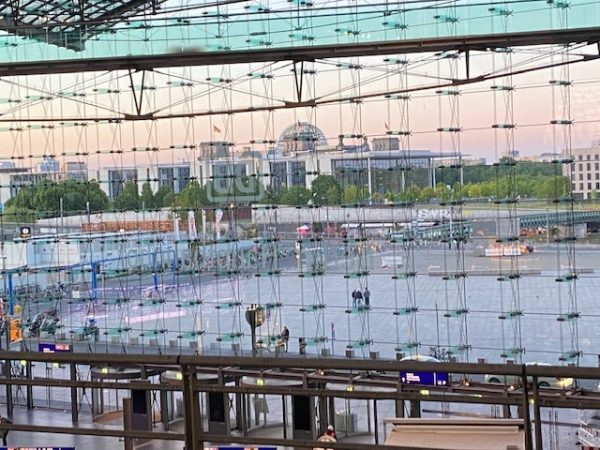
(Image: view of Obzorno-geografceskij globus, Moskau 1994, Stabi Berlin 2026-1)

Holistic public health

Based on case study in Queensland Australia, Boocock et al. (2026) propose the wider application of holistic public health laws. Due to effects of global warming the local burden of disease may rise due to larger scale floods and subsequent growth of for example mosquito populations that transmit infectious diseases. It will be necessary for societies to understand the processes behind the growth of mosquito populations and what can be done to prevent and protect oneself from the consequences. This is not only an environmental issue, but also an issue of continuous learning across all strata of society. Neighborhoods tend to suffer the same impact of chemicals used or the spreading of diseases like Dengue or malaria. The case study makes a convincing argument about the intrinsic relationship between the social and environmental processes at work. 

Construction Deconstruction

The application of dialectic thinking invites us to explore the idea of construction at the same time as destruction. The sequential form reminds us that on most construction, deconstruction will follow eventually. This is obvious in case of the life cycle of human bodies or the animal world. On a more aggregate level, empires have been constructed and sometimes centuries later, they have been deconstructed again. Deconstruction may also take form transformation. In such cases major features remain the same, but the new entity is sufficiently transformed to give it a new name. Often it might also be a kind of synthesis of previous generations or cycles of construction and deconstruction. We enter potentially into the field of genetic evolution or genetic engineering. In any case, dialectic thinking is present in many fields of studies. Well worth to explore the potentials as well as limitations of the basic scientific concept.