

The 26 notions in alphabetical order may determine a subject and/or an object in a sentence. This is just the simple grammar of a language. Add a verb and we have a full sentence subject predicate object (SPO) as they say in English. In the philosophical sense the subject-object relationship is a bit more complicated. Beyond Aristotle’s objectum and subjectum, we think of Descartes “Cogito ergo sum” as the definition of the self as subject, rather than being an object of God’s will and creation. Kant then forms the couple of object and subject in the sense of objectivity and subjectivity. Pure reasoning is the abstraction of subjectivity to achieve an interpersonal objectivity. The master of dialectic thinking, Hegel, conceives an object as objective conscience and a subject as particular subjectivity. Having defined the extreme points of the spectrum makes you think about a joinder or the synthesis. Freud adds the object as result of sexual impulse. Wittgenstein then introduces a kind of hierarchy into the S/O-relationship. Objects become ultimate elements and indescribable in content as kind of basic notions. This follows the mathematical view of objects as indirect description of a mathematical object through axioms stating the basic principles governing the object and then deduce the logical consequences. Gödel’s incompleteness theorem , however, rejects this claim. This is the basis of, for example, algorithmic testing whether deductions are true or false. Condensed mathematics has relied on this testing approach as well.
A pragmatic perspective is added by Marie Gautier (p.719 “Notions”). If we want to reach an objective, we shall need others to realize it. By way of this imagination the S/O-relationship turns into an interactive relationship. Following Habermas, we might claim that the S/O-relationship is also a part of communicative action and therefore the discourse ethics. The definition of who or what is object and/or subject needs open discourse. The arena is not only the parliament, but larger audiences or the world wide web. Beware of the Luhmann systems theory, whereby for example the definition of what is a technical object is, is left to technicians, who then ponder in their self-reflective, reflexive circles amongst themselves. Techniciens in their circles tend to neglect the prime importance of society and laws to determine technological choices. Language with its constituent elements of subject, predicate and object (SPO) is one example of a knowledge system build on axioms or negotiated conventions for grasping and exchanging about phenomena. Nice, now we play around with it.
SPO => OPS. 
Invent
The nice thing about mathematics is that it asks you to invent new ways of thinking. Numbers, percentages, Venn-Diagramms, infinite series etc. have accompanied us at school. The story is far from finished. Under www.spektrum.de there is a nice introduction to the new theory of numbers, called “condensed mathematics“. Their lecture notes (pdf-file) are a tough read. My take home message simply is, the invention of new approaches to old problems, providing more general answers and/or unifying different fields are particularly rewarding. Maths is a fascinating discipline. You study abstract problems, hardly anybody else has had so far, but you are not considered strange as for example some artists at times. Imagine your new world in music, painting or the arts in more general terms or try to become a mathematician. Finding ways to communicate about your predilection and invention is the next challenge. Many scientist, inventors or artists found very few people to talk to about their new stuff. The internet and social media have changed this. Persons with interests or findings beyond the mainstream find colleagues in other parts of the world. Lighthouses from far away become visible through this. Navigation of other possible worlds turns into reality. These specialisations might turn out to be generalisations. The stretch between indepth knowledge and the polymath approach shall accompany us for a long time. Unified theories in several fields are indeed a step to be able to have an oversight about several, but not all fields. Polymaths probably start with condensed maths to move on to other fields of imagination. There is always a risk to get stuck somewhere on the road in a topological space. 
Sound
Each society has its sound. Each person lives in her/his sound cloud or bubble. Cities are generally noisy places, Lots of traffic, mobility and moves leave sound bytes all over the place. Each city though has its own sound and spectrum of frequencies. Libraries, museums, places of worship, all build their special atmosphere due to specific sound design. The Singing Project by Ayumi Paul (Gropiusbau Berlin) created its own sound environment. Reminding us to consciously design our exposure to and experience of sound is welcome. John Cage started to build his very own language of music, similar to Schoenberg, from scratch. His writings Empty Mind explain his view and techniques a bit. Starting with silence and the time between sounds we recreate our own sound experience. Notation of it comes second in place. only for the potential to repeat the experience notation is useful. But it is only one form of conservation for posterity. Noise canceling is the amazing tool from sound physics which allows you to neutralize noise by adding specific frequencies to noise which cancel out each other. Design your personal sound experience beyond noise if you like. Nature recordings or familiar person voices allow you immersive experiences when and where we want. your home sound can be everywhere nowadays. 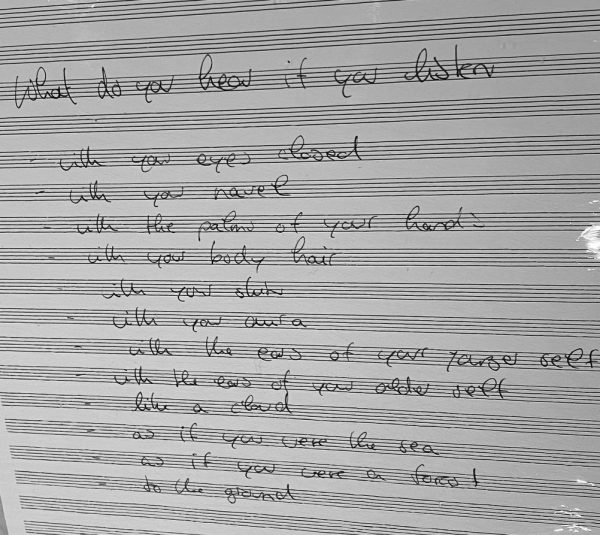
ABC Overview
Digital formats allow flexible organization of lists like alphabetical lists. Opening several pages, at the same time, of the same dictionary is easily feasible. In science the proceeding in this way is coined the inductive method. The entries of each letter stand on their own, but jointly they form a whole set of topics. Random choice is facilitated this way. New sequences or preferences of topics are the way forward. Alphabetical order or chronological order are only one out of many variants of possible sequences. Chose your own 3 favourite topics, maybe. On a big computer screen you might even organize your own poster – beam it on the wall – walk in the virtual exhibition of the metaverse with it. It could feel like you are strolling within parts of my brain. Frightening? For whom? The universe is within us.
| action | health | optimism | value |
| balance | imagination | policy | war |
| corruption | joy | question | xeno |
| democracy | knowledge | repairing | yinyang |
| enterprise | law | society | zero |
| freedom | memory | time | |
| god | nature | union |

L for Law
Contrary to a popular misunderstanding. Law is not boring. The history of ideas is full of exiting projects based on laws. Starting with the foundation of empiricism, i.e. the comparison of laws governing the different Greek city states pioneered by Aristotle. Considering law from the perspective of legislation gives it an actionable touch and makes it more exciting to many persons. Contrary to a static perception of law, laws can be changed and are subject to interpretation continuously by courts and judges. The fascination with law might start with the philosophers of the French enlightenment like Montesquieu. “De l’esprit des lois” – explains already the need to look behind the literal text of law. What is the spirit of law, becomes the driving question. Not only the categories of countries like republic, monarchy and despotism were argued by him, but also the separation of powers into an executive, legislative and judicial power is his original contribution. These principles govern the German “Grundgesetz” and are a common understanding of the founding states of the European Union as well as a potential breaking point.
A sociological perspective on law is formulated by Niklas Luhmann (short intro in D) and highlights the danger of laws as a self-referential system. This dominated by experts who develop the system further independent of the concerns and understandings of wider society. In order to understand this concern, it is probably useful to think of climate change as an urgent problem. Bio-diversity has for much too long not been of much relevance for legal founding principles of our constitutions. In the same vein, women judges or diversity in the legal profession is a point of concern. Majorities versus minority rights create intrinsic tensions in law, legislation, execution and interpretation. Analysing the half-life of laws is interesting, i.e. how fast do they really change or get abandoned altogether. Equality in front of the law remains a thorny issue. It is a huge issue when moving from law to justice as primary concern. The most interesting point is the view of law as a changing matter, hopefully for the better, but this is another question altogether. Reveillons-nous l’esprit des lois ! (pas seulement au Reveillon). 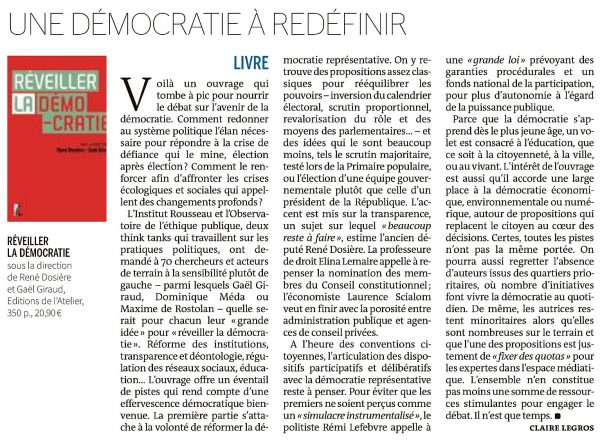
K for Knowledge
Readers of the sociology and/or the philosophy of science or knowledge have a hard time. Each discipline is evolving at such a high speed that is terribly hard for humans to follow more than 1 or 2 fields. Perhaps the choice of Karma instead of knowledge would have made it easier here. Alternatively, in German it is easy to find many nouns starting with a capital K. Kapital, Krieg, Kritik or Käsekuchen would have been popular, I guess. Soon I shall open the comments for suggestions for additional nouns, as part of the empirical “swarm knowledge strategy” rather than the theory-driven deductive method applied in knowledge generation on my side so far.
But wait, we are already in the middle of the unsatiable quest for knowledge. On a meta-level we would deal with the multiple ways to acquire knowledge and create new knowledge. Artifical intelligence is certainly one of the hypes at the moment. New data and new combinations of data drive us forward in the expanding universe and knowledge space. We have witnessed the disappearance of the thick printed encyclopedia in most households, replaced by specilised digital dictionaries or the network society’s shared knowledge base of “wikipedia“. Knowledge is linked to the history of ideas and Peter Burke is a prominent figure to rely on as a reference in this field. 20 years after “A social history of knowledge: From Gutenberg to Diderot” he published the much acclaimed: “The Polymath. A cultural history from Leonardo da Vinci to Susan Sontag” in 2020. To synthesise across the many “monsters of knowledge” over centuries is a daunting task. I like quotes like the one from Leibniz (p.77) “the horrible heap of books that is constantly increasing” and then his own continuation: “Printing, once viewed as a solution to the problem, had become a problem itself”. The whole section is devoted to information overload. Fragmentation of knowledge into disciplines and, much worse, the manufacturing of false knowledge create new challenges to knowledge. Maybe transforming the term to “knowledges” rather than knowledge is likely to capture better the differences between artificial knowledge, created by artificial intelligence and specialised algorithms, and human based knowledge. In knowledge storage we have lost the race with computers, but in deciding what are promising combinations between different fields of knowledge, we are still a wee bit ahead of the machines. Klara tell me, where is the exit, or your synthesis of the whole lot. Meanwhile I continue to read – what? books and the like. 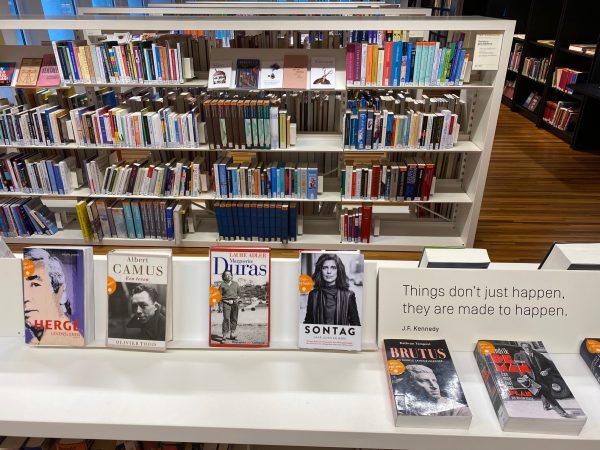
D for Democracy
Stand up for Democracy. Give me a D. Yes, we are passionate for democracy. Even if we are not singing Beethoven‘s “Ode an die Freude” every day, we are well aware that we have to defend democracy at numerous places. The essay in the New Yorker by Jill Lepore from January 2020 on the manifold risks to democracy and the way forward is a great inspiration. Democracy is always a “work in progress”. It improves and in most cases rises with the challenges. However, this demands to stay alert and wither the beginnings of threats to its functioning. Beyond the external threats, internal threats to democratic values are abound. The discursive element that is highlighted in the essay remains crucial. Debating in public is key. Transparency of arguments, reasoning and values are constituent parts of democracy. Clandestine ways of corruption, bribery and threatening of violence become apparent when fractions of society retreat from the public to form insider groups. Defenders of democracy need to speak out in public, publish they work, expose and perform their arts, challenge school curricula and be active in any policy field. This is a lot to do, but we have to prevail and rise to the continuous challenges to the democratic way of life. Too many dictators and autocrats around the world would like to see democracy fail. Worse, they work actively, like in “Qatargate” in November 2022 in Brussels to spread illicit practices of corruption. We have to strengthen our “antennas” and sensors to detect such practices. Prevention is key. Tough reactions with the force of the legal system to stop the spreading is also indicated. Let’s rise to the challenge, again and again with the latest technology. 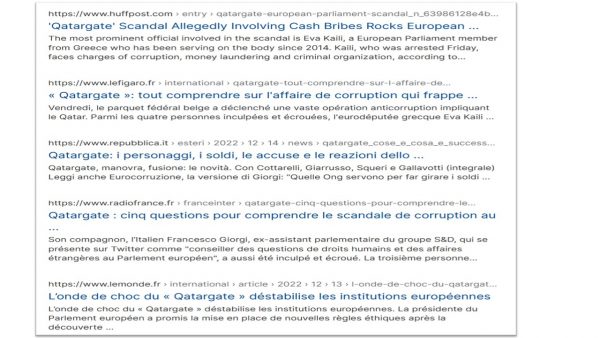
C for Corruption
After the association of C with crises of corona, climate, consumption and the church we have to come back to one of the original links: corruption. Beyond the work of describing and analysing corruption from the time of the Roman empire to the Americas of today (Link) by Thomas Strunck, the re-reading of Niccoló Machiavelli is recommended by a number of scholars (in latin here). Also, in Asia the work and writings of Niccoló have been rediscovered (Link). “non creando in veritá le cuose nove”. It needs “una ferma experienza”. As people don’t just believe in the truth of new reasons, a firm experience of them is needed. New princes cannot just pray, they have to install a new vision or belief with force (p.25) by literally forcing persons (forzare) or “fare … credere par forza” stated in Chapter 6 of THE PRINCE. If we just complement the term force by force of persuasion, or money as surrogate for both, the writing of Niccoló speaks directly to corruption in our times. History does not repeat itself. However, the history of ideas still teaches “some dogs old tricks” until they are found out by investigative journalism and an independent judiciary, which both did not exit at Niccoló’s time. (inspired by Chaudhuri, S. & Chakravarty, P. (2022) Machiavelli Then and Now: History, Politics, Literature. Cambridge University Press.) 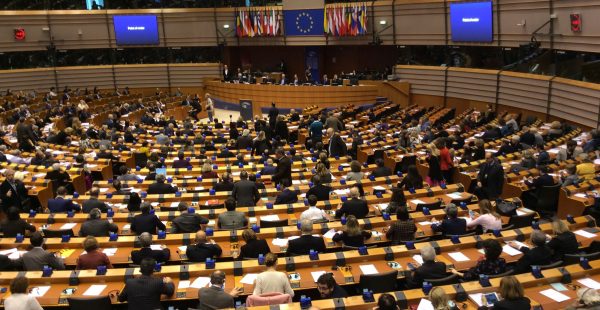
Human Rights
It is 10 years after the publication of a Ph.D. thesis on “Corruption: a violation of human rights and a crime under international law?” by Martine Boersma that at the top level of the European Parliament and the International Trade Union Congress the smell of corruption is investigated by police and judges. Following “Qatargate” (Radio France Link) this means that the persons accused of corruption, forming a criminal group and money laundering have changed their lobbying in return for accepting cash. Exploitation of workers and more than 100 deaths in Qatar was the result, due to the heat when building the stadiums for the Football World Cup which took place in 2022. Following the recommendations of Boersma corruption in this respect can be interpreted as these persons contributing to and being guilty of abusing their political positions to silence criticism and whistle-blowers, and the right for defendants to a fair trial for example. The advocacy to counter corruption with developing international human rights legislation and persecution in this respect is dearly needed now. “This line of reasoning transforms a corrupt act into a possible starting point for legal action, be it at the national level, …, or at the international level by submitting a complaint to a regional or global human rights monitoring body.” (Boersma, 2012 p.376) The International Criminal Court or “alternative such as the establishment of a permanent anti-corruption court, or anti-corruption commission to monitor compliance with the UN Convention Against Corruption should be kept in mind, as well as the possibility of setting up ad hoc anti-corruption tribunals” (p.380). Not much to add to this, act now, before the practice spreads.
Francesco Merloni wrote in his book (2019, p.132) on corruption with Italy in comparative perspective: “when corruption is defined in its wider meaning of maladministration, we are looking at a mass phenomenon which is “sub-criminal”, yet nonetheless with strongly negative implications for the efficiency and effectiveness of public administration and democracy in general.” The practice of excessive salaries of the Italian parliament (p.131) is mentioned in the list of case histories of corruption just like the international event of the EXPO 2015 in Milano with huge construction projects (LeMonde on Panzeri l’ex-eurodéputé). Learning from case studies is best practice in many business schools and probably beyond. Finally, attention should be drawn to prevention of corruption. Here the reading of Corruption and Anti-corruption by Larmour and Wolanin (2001, p.235) offers good advice. The micro-economics of corruption (pp. 119) states for example that “If expected penalties are sufficiently high, bribery is deterred” (p.126). Equally the real threat of a full and explicit audit of operations, promotions and financial transactions might deter corrupt activities. Most importantly the authors state, “the social networks approach to corruption allows the corruption investigator to conceptualise the operation of corrupt networks in terms of power flows and relationships rather than the attributes of actors. The question to be asked by the corruption investigator is not whether actor A is corrupt. The question should be, what is the relationship between actor A and other potentially corrupt actors in the network.” Re-reading some classics of sociology like Max Weber on bureaucracy, but also James Coleman’s foundation of social theory provide basics for understanding social interaction when things go fundamentally in the wrong direction. We might even need to use artificial intelligence to detect corruptive practices to shield and support the trade union movement. 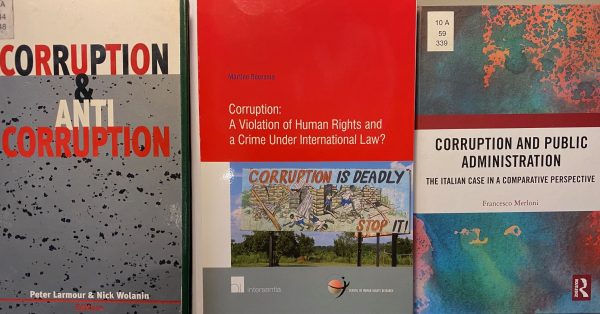
State of the Union
“The times they are a changing”. Currently, we witness that democracies are at multiple risks. One existential threat is, of course, war of external origin. Democracies have been perceived as often to slow to mobilize military forces sufficient to resist “Blitzkrieg”. What Nazi-Germany applied successful at the beginning took a long time and millions of dead persons to rectify. Similarly, the threat to Ukraine’s independence and liberal aspirations are threatened by Russian imperialism. The other existential threat is that of “the enemy within”. This is the conclusion by Canova (2011, p.213) when he writes on “democracy’s disappearing duties”. Whereas he has primarily in mind, that citizens need to participate more actively in the duties to democracy’s survival. These are “the duty to become informed and to vote, as well as rights and duties related to civic and/or military duties. The discussion, whether we need an army of the many or an army of specialists has shifted largely in favour of the need for specialists, simply think of cyber or drone war technology. However, the threat of the enemies from within becomes clear if we remember terrorist attacks targeted at democracies practice of free movement, free speech or art. Another centuries-old threat has come to our attention again. Corruption. The slow-motion erosion of democracies is hard to fight against as it operates not with visible tanks and weapons, but with clandestine and psychological ways of slow corrosion of organisations and institutions. Combatting corruption is even more tricky in cross-country settings like the European Union. Reference to cultural practices and exclusive or inner circles as cultural exceptionalism make it hard to introduce non-discriminatory monitoring and controlling mechanisms in democracies. Only a well-equipped security, police and judicial system can stem the risk to democracies from corruption and organized crime. It is not only a matter of state responsibility, but our democracies rely on an alert public to stand up continually for our basic values. Just singing the national and European anthem is not enough, fighting corruption is laboursome and cumbersome, particularly as corrupt circles do not refrain from using brute force and weapons (Reichsbürger, Mafia, etc.). Addressing inner and outer enemies at the same time remains high on the agenda for the surviving and thriving of democracies. The foundation ideas of the European Union were constructed by Monnet and Schuman on a sustainable democracy. Let’s not endanger this through a sluggish response on corruption.
inspired by Canova, T.A. 2011: Democracy’s disappearing duties. In: Democratic Citizenship and War. Peled, V. et al. (eds.) pp. 199-216.