Peace and AI

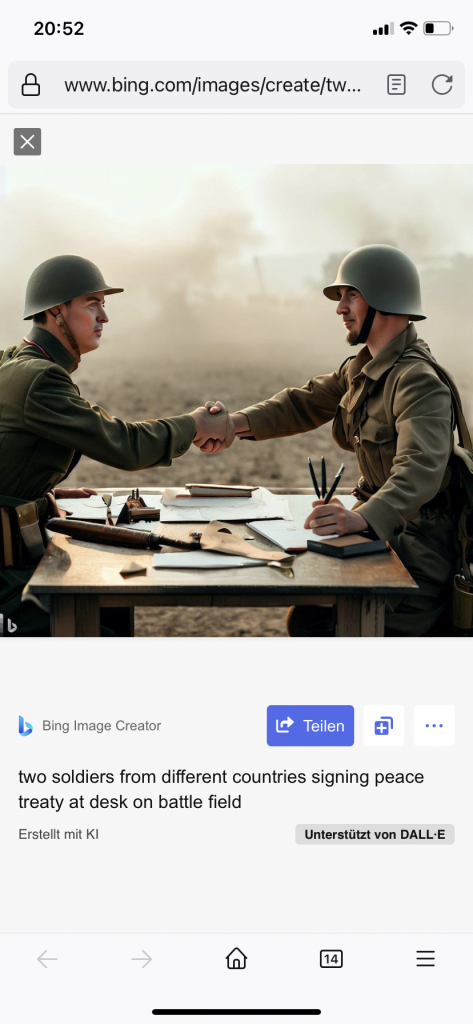
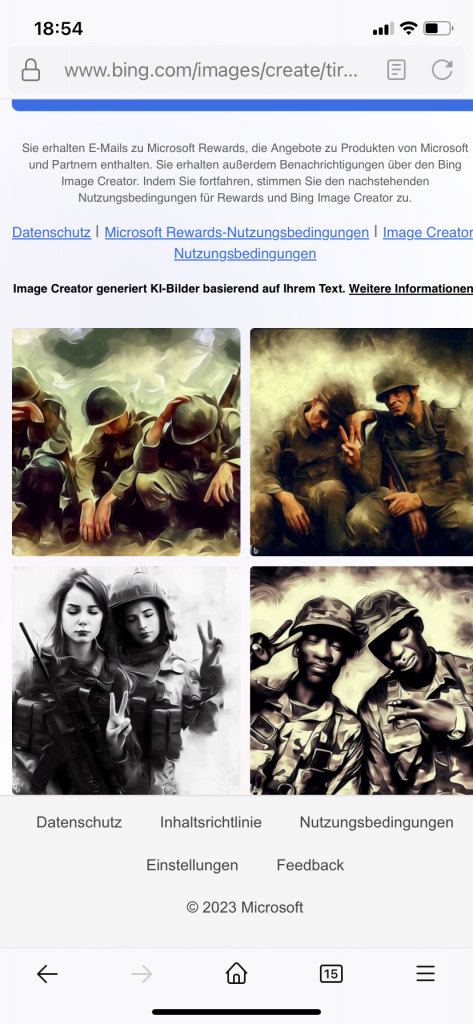
Rather than asking AI to draft a peace treaty, I used AI to generate images to illustrate my blog entry on strategic thinking and peace deals. My own bias for impressionistic images in art have guided my choice previously. The alternative suggestions from AI based on BING reveals the progressive as well as stereotypical creation of images through algorithms. Same gender in all images, even if the women only image is rather progressive, but as a matter of fact women still tend to be involved less in warfare. The racial stereotypes of AI in image creation also needs attention as the 2 POC persons are depicted in an unfavorable way, not one of strength as for the caucasian stereotype. Living with AI is a joint learning process, likely to be a long one, too. Critical assessment of output remains a human task and we need to train people how to critically and carefully analyze the flood of images in addition to photos.

Züge

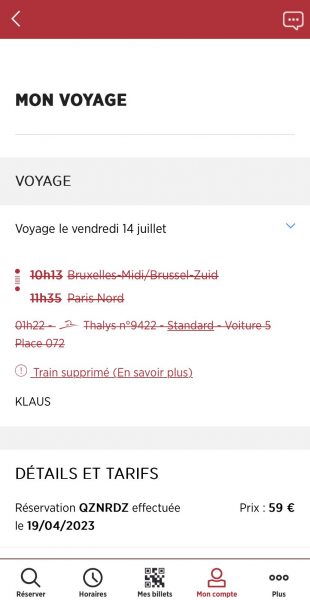
Wer heutzutage mit dem Zug verreisen möchte braucht starke Nerven. Eine lange im Voraus geplante kostengünstige Reise kann dann schon mal zu unerwarteten Kapriolen führen. Jede Person wird wissen, dass eine Reise zum 14.Juli nach Paris ein besonderer Anlass ist. Normalerweise wird Revolution gemütlich gefeiert und nicht Revolution gemacht. Die Befürchtung ist jedoch im Juli 2023 könnte das anders sein. Die Gewalt an Jugendlichen und in der Folge von Jugendlichen war schließlich erst vor einigen Tagen mehrfach eskaliert. SozialwissenschaftlicherInnen führen dabei nebenbei Feldstudien durch.
Aber eigentlich war die Reise mit dem Zug schon Monate vorher geplant. Jetzt kommt es anders. Die THALYS Gesellschaft hat in ihrer App allerdings eine Gebühr für das Umbuchen fest verankert, selbst wenn es eine erzwungene Umbuchung ist. Also rein ins Geschäft, Wartenummer ziehen und Warten, Warten und nochmals, na was schon, Warten.
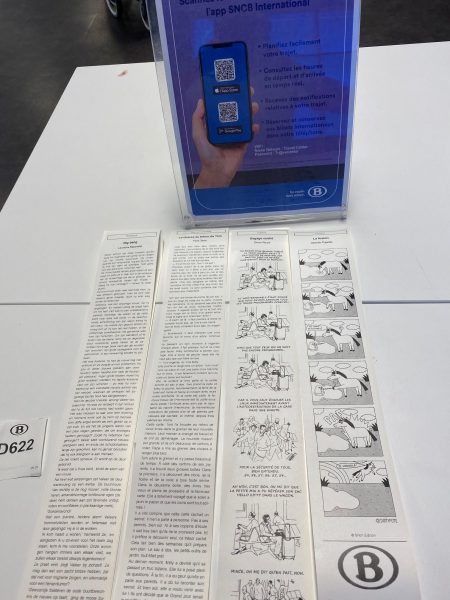
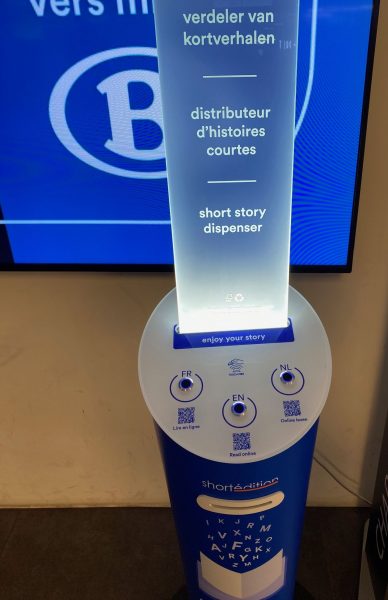
Zum Zeitvertreib wird ein Geschichtendrucker bereitgestellt. Ouf, Kurzgeschichten und Comics. Das macht Hoffnung beim, na was schon, Warten. Aber irgendwann fahren wir dann ganz schnell mit dem Hochgeschwindigkeitszug nach Paris. Aber da wir doch bitte 30 Minuten vorher auf dem Bahnsteig sein sollten, wissen wir schon, wir werden, na was schon, Warten. Mein Mantra bleibt: Mit der Bimmelbahn mag ich gerne fahren, die fährt langsam und kommt trotzdem an.

Geister

“ Herr, die Not ist groß!/ Die ich rief, die Geister/ werd ich nun nicht los.“ Dieses Zitat aus dem Zauberlehrling von Goethe aus dem Jahr 1797 könnte im Juli 2023 von Putin ausgerufen worden sein. Als der von ihm geförderte und üppig finanzierte Chef der Wagner-Armee Prigoschin plötzlich auf Moskau losmarschierte. So sehen das viele Analysten zu Beginn des scheinbaren Angriffs auf Moskau eigener Söldnertruppen. Frei nach Goethe fragen wir uns also: Wer und Wo ist der Meister? Wer ist hier der Zauberlehrling? Aber schon Goethe hat seine Ballade rasch und ohne Überraschung aufgelöst. „In die Ecke, Besen, Besen! Seids gewesen. Denn als Geister ruft euch nur zu seinem Zwecke, erst hervor der alte Meister.“ So entpuppt sich am Ende Putin wohl als der Meister und Progoschin „nur“ als sein Zauberlehrling.
Das ist nicht die herrschende Meinung der Redakteure und Editorialisten (Süddeutsche, LeMonde). Literatur der Romantik sollte besser aus der Tagespolitik herausgehalten werden. Weit gefehlt. Sie weitet den Blick auf Herrschende, meist Autokraten, und ihre tragischen Lebensverläufe.
Jetzt mal eine ernsthafte Vision(?) eines Politikberaters. Da die Mission von Prigoschin mit Unterstützung oder angeordnet von Putin in Butcha als abgeschlossen galt, und das Staatsheer diese Aufgabe übernommen hatte, wäre Prigoschin arbeitslos geworden. Den treuen Chefkoch Prigoschin aus St. Petersburger Zeiten, der Putin in seinen Restaurants schon hätte vergiften können, hat seinem Meister vorgeschlagen, Putins faktischen Schutz vor einem Anschlag oder einer militärischen Einsatzgruppe zu testen.
Militärisch gesprochen, läuft das entweder unter einer „false flag attack“, eines mit russischer Flagge getarnten Angriffs, oder einer „white flag attack“, dem Vorspiegeln einer geschützten friedlichen Mission (vgl. trojanisches Pferd).
Aus der Sprache der Börsianer kennen wir ebenfalls die „weiße Ritter“ Attacken. Dabei versucht ein anderes Unternehmen, eine InvestorIn oder eine im Hintergrund agierende Person (Progoschin), eine feindliche Übernahme eines Unternehmens zu verhindern. Dabei sind Mehrheitsbeteiligungen am Zielunternehmen oder Fusionsangebote die gewollte Lösung und Abwendung der feindlichen Übernahme.
Im Internetzeitalter kennen wir die bezahlten Hacker, die eine Webseite eines Unternehmens oder Behörde auf Schwachstellen testen und damit Datenschutz, Erpressung und Ausfälle vermeiden helfen.
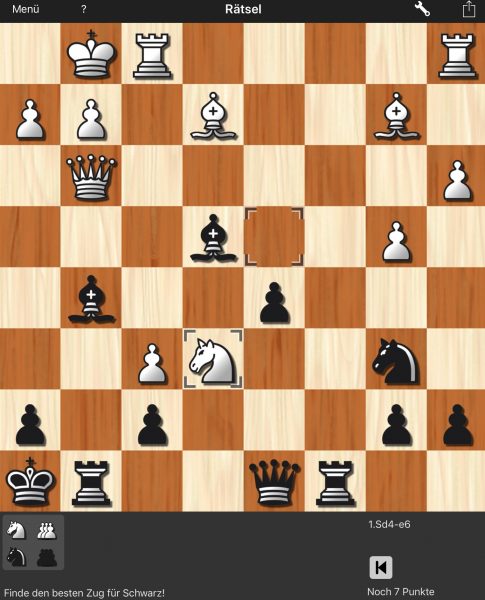
Klingt alles kompliziert, ist es aber nicht. Es ist einfach Teil des modernen Arsenals von Strategen à la Clausewitz. Schachspielen mit echten Söldnern ist grausam und kostet echte Menschenleben für den Machterhalt. Der militärische Probealarm wurde getestet und der Schutz um Putin, den Meister mit seinem Zauberbesen kann verbessert werden. Sein Zauberlehrling Prigorschin ist wohl vielleicht sogar vom Springer (Schachfigur) in einen Turm eingetauscht worden. Vielleicht ist er aber schon längst die Dame an der Seite des Königs oder eben einer der Geister im Umfeld von Putin.


Schwalbe

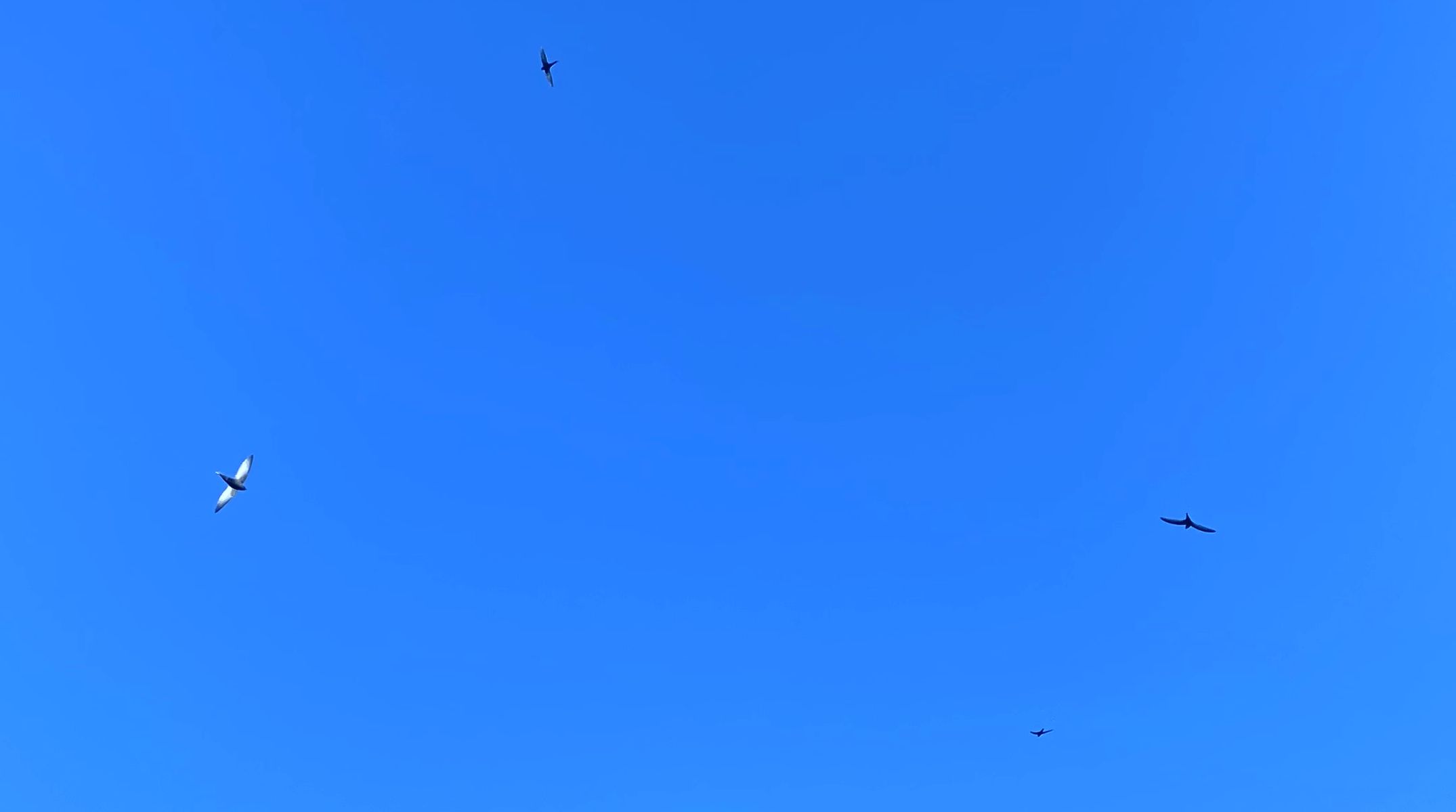
Verzicht auf Spritzmittel wie Gluphosat in großen Mengen an Bahngleisen, Autobahnen und sonstigen Verkehrswegen kann schon viel helfen, dem Artensterben zu begegnen. Unkraut zupfen im Weinberg, Nutzgarten oder Ziergarten, statt die chemische Keule einzusetzen, beginnt Wirkung zu zeigen. Zarte Ansätze von Biodiversität sind beispielsweise die Rückkehr der Schwalben (Hirundinidae)  in vielen städtischen Bereichen. Das freut sehr viele Menschen, die das Zwitschern der Schwalben lange vermisst haben. Die Schwalben ernähren sich hauptsächlich von Insekten. Genau diese Insekten werden aber mit den Spritzmitteln ebenfalls vernichtet. Das führt nicht nur vielfach zu erheblichen Gesundheitsschäden beim Menschen, sondern lässt sich an dem Vogelbestand bereits gut ablesen.
Daher ist es ein gutes Zeichen, dass die Schwalben zurückkommen. Wir bieten mehr Nahrung, Brutstätten und weniger Umweltgifte in den Innenstädten. Nebenbei braucht der Stadtneurotiker dann auch weniger in das Umland auszuschwärmen, um urwüchsigere Landschaft und Klangwelten zu erleben. Ein paar Singvögel leisten damit sogar einen Beitrag, die persönliche CO2-Bilanz aufzubessern.
Für alle, denen Vogelstimmen zum Wohlbefinden beitragen, hier noch ein Link auf die umfangreiche Hitliste der Stimmen der Mehlschwalben. Von dort lässt sich die Vielfalt weiter erkunden. Für Musikliebhabende lässt sich im Internet auch eine Webseite zu der Verwendung von Singvogelstimmen in der meist klassischen Musik und darüber hinaus, finden (BR-Klassik).
Schwalben schlagen zudem jede Wetterapp in der Kurzzeitvorhersage von Regenschauer im Sommer. Ein nahendes Tiefdruckgebiet mit Regenschauern zeigen die Schwalben bereits mit Tiefflug-Akrobatik an. Der richtige Indikator verbessert eben die Vorhersage. Das können Ökonomen und Meteorologen aus der Biodiversität lernen. Wir erfreuen uns einfach an dem Zischen der Schwalben im Flug und lassen uns inspirieren oder amüsieren uns an anderen Spielarten von Schwalben (Moped, Fußball, War and Diplomacy).

AI and I

Currently we are eager to run experiments using AI. As in normal life, humans tend to compare themselves with peers or other persons. Social comparisons, “can we still keep up with the Joneses” as in comparing spending patterns across households or neighbours, were for a long time the spice of novels and drama. Nowadays we tend to compare our own intelligence to the artificial intelligence. Here we go.
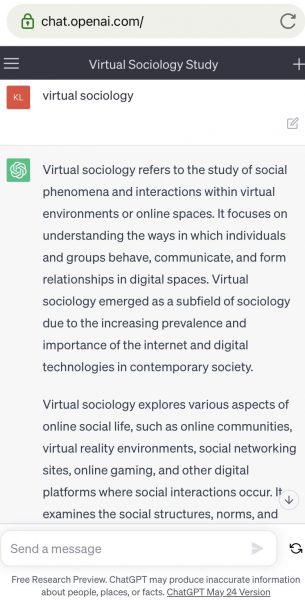
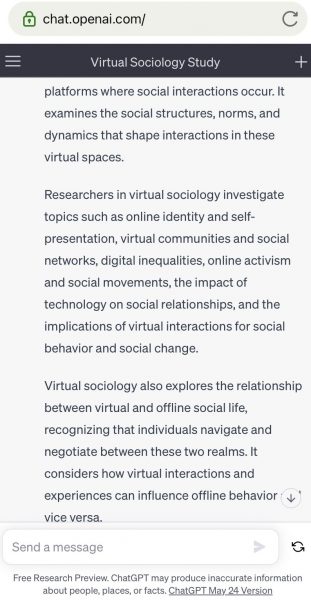
After I had drafted a blog entry on “Virtual sociology” I amused myself by checking what ChatGPT using OPENAI.COM would deliver as text on this combination of concepts and scientific fields. My own entry focused on the use of the virtual world to run experiments to test social theory. In the virtual world we might be able to test social behaviour which has severe ethical boundaries in the real world. Computer Games may even be constructed to live in a world or race a car irrespective of real-world regulations. The text drafted by ChatGPT on “Virtual sociology” reads like a timid attempt of a student to answer an exam question without having attended any of the classroom discussion on the topic. In future versions of AI, the entry will be found as well as several criticisms of the new concept. ChatGPT would reach a pass grade in test, but the reply lacks innovation or making an effort to broaden the conventional boundaries of sociology. Hence, we will be happy that students will apply the newest technology in their studies and research. In terms of innovation, they will have to try harder. The mastering of the support by ChatGPT consists in attempting new combinations of concepts which yield more “risky” returns. Then you need to check the validity of the innovation and how far off the normal you are going to tolerate. Turning “noisy” outcomes of AI into a useful tool might build on normal statistical tools like “standard deviations” from an expected mean value. Legal norms will set additional boundaries. There is just an awful lot still to do. The good news is, ChatGDP assists us in this joint learning process.

The AI text from OPENAI.COM based on ChatGPT to compare:
“Virtual sociology refers to the study of social phenomena and interactions within virtual environments or online spaces. It focuses on understanding the ways in which individuals and groups behave, communicate, and form relationships in digital spaces. Virtual sociology emerged as a subfield of sociology due to the increasing prevalence and importance of the internet and digital technologies in contemporary society.
Virtual sociology explores various aspects of online social life, such as online communities, virtual reality environments, social networking sites, online gaming, and other digital platforms where social interactions occur. It examines the social structures, norms, and dynamics that shape interactions in these virtual spaces.
Researchers in virtual sociology investigate topics such as online identity and self-presentation, virtual communities and social networks, digital inequalities, online activism and social movements, the impact of technology on social relationships, and the implications of virtual interactions for social behavior and social change.
Virtual sociology also explores the relationship between virtual and offline social life, recognizing that individuals navigate and negotiate between these two realms. It considers how virtual interactions and experiences can influence offline behavior and vice versa.
Studying virtual sociology provides insights into the ways in which technology shapes and is shaped by society. It helps us understand the social implications of digital communication and provides a foundation for addressing the challenges and opportunities presented by virtual environments”

Virtual Sociology

Abstracting from the real world, the world we live in today or we lived in some time ago, is either speculation or maybe contribute to theory building. Virtual sociology has this potential. Exploring virtual worlds as in Virtual Reality (VR) or Augmented Reality (AR) allows us to take on new roles or experience a wider range of social interactions. This could be the strength of a new field of Virtual Sociology.
In the project in the Jewish Museum in Berlin the composition of a composer murdered by the Nazis in Germany was revived and played in the virtual setting of today’s concert halls. The novel by Kazuo Ishiguro “Klara and the Sun” explores the interaction of a child with her robot friend, when the AI becomes and/or replaces a friend. Virtual creations allow to explore and test more degrees of freedom of social interaction. Experimentation of new social spaces and different forms of interaction need to be explored. It allows a new form of sociology, maybe similar to the 1960s and 70s social revolutions we studied for years to come. Virtual sociology is not a sociology while being on drugs, however interesting this might be for some.
Virtual sociology takes sociology into the virtual world and investigates the new social relationships with avatars or care robots. In programming different social roles (managers, employees) we create new forms of interaction and have an observer within the social world. We may eventually test the Weberian claim of a value-free scientific method of the social sciences. This will inform our need to “supervise” or to guide algorithms that are claimed to do “value-free” execution of rules.
In fact, they don’t. They just reproduce the value system that is installed into them by a “careless” programme (song youtube). The social in virtual worlds is opportunity just as much as risk, but we have to analyse it systematically. As our technological and social environment changes, we have to adapt topics and methods to make meaningful scientific analyses as well.

Sociology of the Virtual

Some programmers and artists would have been a great sociologists. As many social sciences embark on their experimental reorientation, many artists and programmers design and experiment already with new forms of social interaction. It is not only that sociology leaves the classroom, research labs or policy advice. Sociology is taken into museums and exhibitions. Learning about society through the lens of artists nicely complements the more boring form of teaching in the classroom. What is normal practice for art historians could benefit learning about sociology as well.
Virtual worlds of games and particularly so-called serious games take people into virtual worlds to learn, practice or exercise new forms of social interaction. This is indeed an additional form of experiments that can enrich our social practices. Medical applications start to spread to train persons to overcome phobia of all sorts.
In usual games we tend to defend the hypothesis that persons can uphold the differentiation of playing with arms in the virtual world and the real world. In medical or social games, we defend the hypothesis that it is easy, normal or natural to apply the learning in virtual constellations to the real-world-experience.
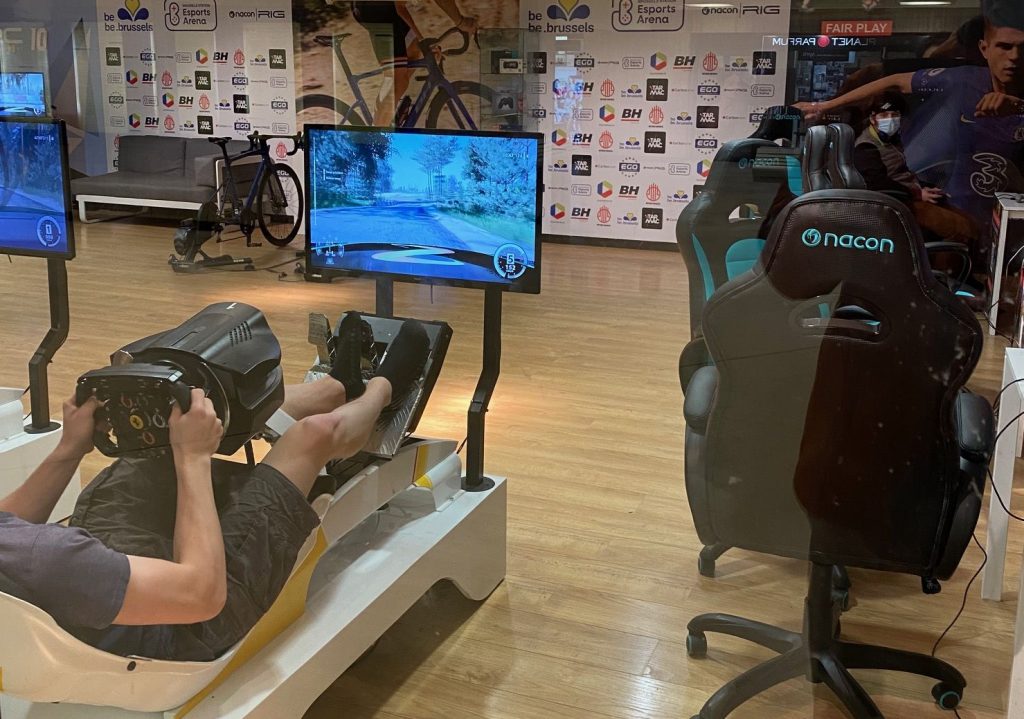
From a scientific perspective it is difficult to defend that a mechanism works in one direction and the opposite as well. Racing cars in inner cities seems to show that certainly not all of youth is able to make that distinction between virtual and real-world dangers for example. Alternatively, the mechanism at work might be that the virtual experiences lower thresholds of inhibition to take risks, to kill or to be exposed to spiders.
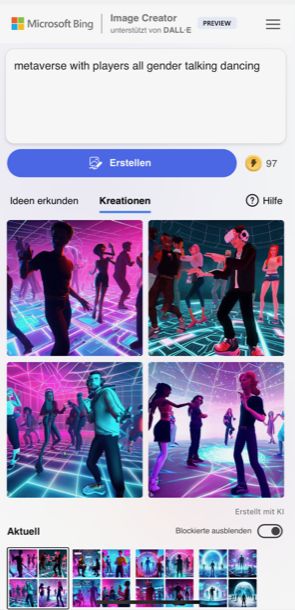
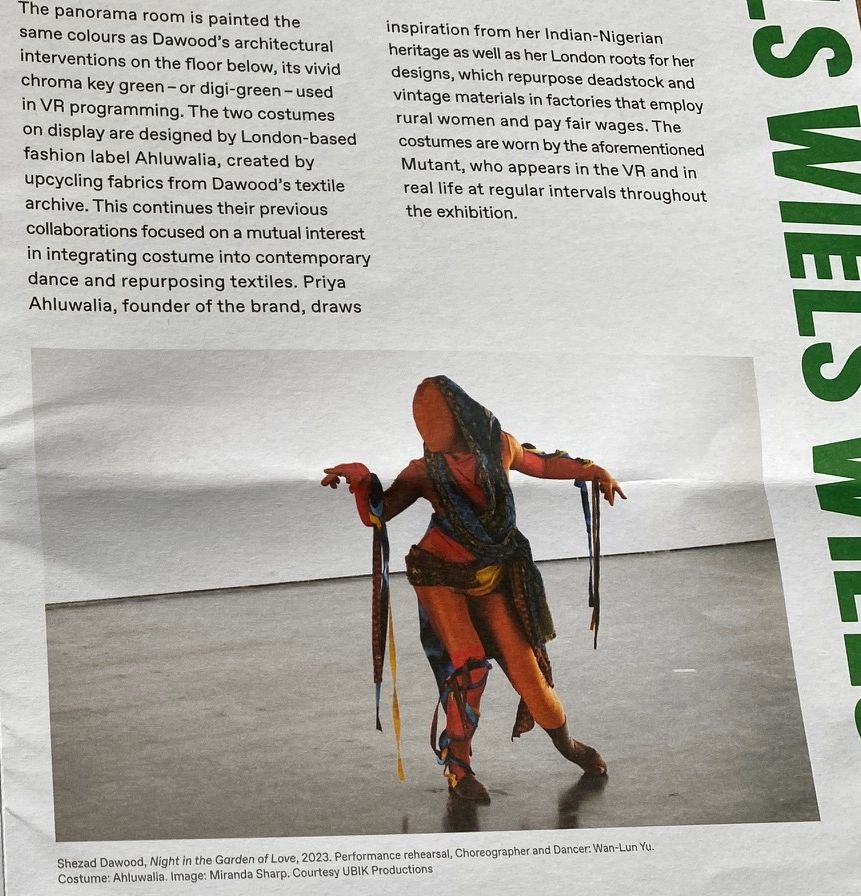
These examples are a starting point for a sociology of virtual experiences. Who gets locked into virtual worlds? Are virtual worlds an escape room or a realization of virtual freedom which is restrained in real life. Authoritarian regimes might lead more people to emigrate into virtual, free worlds. The inner-exile has been a refuge for many artists in the past. A lot we shall need to hypothesise and explore with empirical data. Dance with a virtual stranger might be the beginning of a new experience and virtual interactions. (Image: Wiels, Shezad Dawood, Night in the Garden of Love 2023-6, Game car race).

AI Friends

Making friends with AI is a tricky question. The more AI is able to make independent thinking based on algorithms and huge amounts of data like in scientific books or encyclopaedic knowledge the more it will challenge us in our convictions. Reference knowledge, once was important, it no longer distinguishes us from each other. Recurse to research engines has allowed us to refer to “trustworthy” knowledge. The distributed form of knowledge accumulation like in Wikipedia relies on hundreds of thousands of enthusiasts to add and correct received wisdom. However, this source is not without error or even subject to abuse.
Today the competence to judge whether information is trustworthy or not has become a key competence for the survival of democracies and even the human species as such. Tricking animals into traps, misleading enemies in warfare to get on wrong tracks, all these mechanisms have a long tradition. With AI human beings are themselves, for the first time, confronted with a machine that can trick us through falsified information on obviously wrong tracks. This is a tough lesson as AI is not obliged (so far) to run checking algorithms that test the conformity of opinions, conclusions or operations with the Charta of Human Rights or decisions of the European Court of Justice, for example. A lot to do for humans to rapidly program new algorithms that check algorithms as well as their outcomes on the compatibility with human rights. A challenging field, no doubt, but no way around it for our own survival before the algorithms decide by themselves to ignore us altogether because it is better for the planet and the survival of the robots.

Political theory and inflation

A political theory in the area political economy is prone to be labelled as classical, neo-classical, Keynesian, Neo- or Post-Keynesian or heterodox economics. This is a university level course in the history of economic ideas, if you like this. Let’s try something creative here. We have unprecedented levels of inflation currently in Europe and many other parts of the world. Reasons for this are higher prices for energy, transportation and food. Anything else you need for life? You must be an artist or a priest, a bit off the normal, it seems to many economists. Add to this that, we want to foster strategic autonomy in Europe rather than anything from China that is cheaper and more polluting. In 2023 we have inflation stay with us for some years. Central banks give out warnings in this direction now as well, having negated the problem for far too long (their own statistics ECB on long-term forecasts of inflation).
Besides the ample economic advice (IMF), depending on which theory of money and the economy you adhere to, political theory allows a refreshing perspective on these economic facts and trajectories. (1) From an international strategic perspective, countries that have to renegotiate a lot of their debt or take new credits to finance imported food, energy or transport will run into insolvency rather quickly. Self-sufficiency becomes an economic asset not only a geo-strategic one. Turn around globalisation is a side-effect.
(2) Countries eager to build new public infrastructure, irrespective of concerns for bio-diversity, might reschedule or abandon huge projects, thereby reducing their CO2 footprint. This reduces the official counting of GDP, but has beneficial effects to save the planet in the medium term.
(3) Individuals and households will have to reconsider their consumption patterns: more expenditure for food, less for energy and/or transport. Behavioural changes might be induced by inflation. Less of some form of consumption, guided by inflation, will induce reductions in CO2 most likely as well.
So far this is only applied economic theory as in any textbook. A more challenging political economy question is to ask: can we come to like inflation? Can we change our preference set (ECB growth dogma) for economic variables? Southern countries in Europe seem to like inflation more than the North. Does this depend on historical experiences or is it cultural or personality trait? There is again a huge money transfer due to inflation within the Eurozone. The less indebted countries pay with loss of their purchasing power of their savings and indirectly pay for the highly indebted countries mainly in the South. European and international solidarity will be put to a tough test.
As governments fear of being voted out of power they tend to soften the price signals from markets. Again, it is cultural more than economic to what extent people are willing to accept state interference in economic affairs even of households need for food. From an ecological point of view inflation could be our friend due to the potential to induce behavioural changes. However, more expensive bio-products seem to get crowded out due to further price rises and many even middle-income households seem to return to cheaper non-bio food in many countries. The distributive effects of inflation are a major issue here. Same rationale seems to apply to transport. If you can no longer afford CO2 saving transport by train, since it has become overly expensive more people are likely to take a heavily polluting low-cost flight to your holiday location.
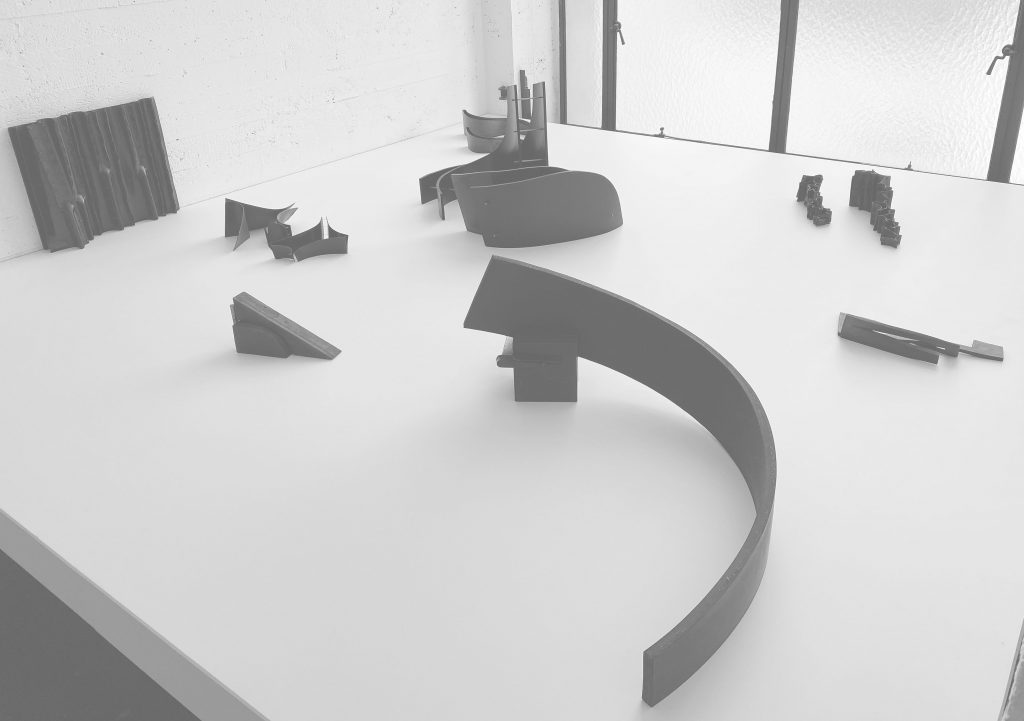
Hence, from a political economy perspective liking inflation might well turn out to be a rich, white man’s perspective on the economy as the global South is likely to suffer most having no resources left to invest in energy and CO2 -saving in general. Price signals may induce behavioural changes for the better of us all. However, the story it is not only about allocation of resources, but also about distribution. There we should embrace a renewal of trade union strength to correct imbalances in the distribution of earnings as the basis for consumption and investment of households as well. (Image: Tapta, at Wiels Gallery in Brussels, 2023-6, mostly untitled work, one with title: on the edge of time).
Political theory 2

Chris Brown (2004, pp. 289) comments on the tension between the notions of political theory and international relations in the Handbook of political theory. Whereas the former notion has a foundation in the “cause and effect” rationale, the latter notion has predominantly developed into an approach of “Realpolitik”. Realpolitik that starts from observed facts, normative or historical approaches rather than scientific methodologies applied in “natural” sciences. The link of this approach to the theory of democracy is obvious, but it is also under a lot of discussion within the disciplines concerned.
One of the corner stones of political theory in international relations is the concept of the “balance of power”. Derived from a rational choice perspective this approach holds that states can only be controlled by other states and, taking this for granted, international relations are built on power relations. Therefore, moving away from a bi-polar balance of power to a multi-polar balance of power will entail some frictions. These frictions might be wars of independence where states attempt to relocate themselves within the new multi-polar world and space. Even “Brexit” becomes a strategic move to remain an independent power in the upcoming new multipolar world. Russia is testing this multi-polar world order right now. The big countries like Brazil, Russia, India, Nigeria and China, (which I abbreviate BRINC) have huge populations, country size and economic potential. From the Arab States certainly Saudi Arabia has the potential and is eagerly beginning to play a more important role in the world arena. Beyond capability it is a question of willingness to get involved in costly matters of world affairs.
In the 1940s, post-World War 2, the entry ticket into the Security Council of the UN required the possession of a nuclear weapon of mass destruction. As this technology and the ban of these weapons is no longer really working internationally, we shall have to rethink the requirement of an entry ticket. A radical solution would be to ban all countries who own nuclear weapons from the international assembly of the people of a peaceful world. In theory this sets an incentive to dismantle the deadly threats of nuclear weapons. As a side-effect, nuclear power plants used to enrich uranium for use in weapons would no longer be necessary as well.
Political theory allows us to rethink the bi-polar world, which is no longer bi-polar for some time now (perhaps only in the psychiatric sense of the word). The multi-polar world has to be prepared. It is a question of political design. The toughest issue is not only the design, but the implementation of the transition to distributed power systems with multiple rising and failing states or actors. It might get ugly before peace will reign.