Autonomy in literature

As we might imagine, autonomy has been and is a huge topic in literature. From the foundations of democracy to the autonomous state building, historical accounts are full of treaties on autonomy. Literature has taken similar steps by asking can we really be autonomous in our decision-making as we are social beings embedded into varieties of Throne, families and networks. There are ever larger parts that we are conscious about, but the realm of unconsciousness or sleep remains substantial. Maybe in literature, the author Samuel Beckett has gone furthest in dealing with human autonomy in his writings. The search for autonomous action might lead to far-reaching inactivity in “Waiting for Godot”.
However, Beckett’s view about autonomy can also be interpreted as a continuous battle of mankind as demonstrated in the often cited expression by Beckett (“Worstward Ho”, 1983, p.7) “All of old. Nothing else ever. Ever tried. Ever failed. No matter. Try again. Fail again. Fail better.” Our strive for autonomy remains a lifelong struggle. The path to more autonomy is not linear over the life course. In fact, much evidence from gerontologists suggests that it might follow an inverse U-shape, being low at birth and low before death. Literature has guided us in such questions just as much as religious, philosophical, legal and social concerns enter into the underlying concept of autonomy and autonomous decision-making across the life course.

Smoking Vaping

Both smoking and vaping are big business. Nicotine is well known for its addictive capacity. Once started, it is very hard to give it up again. For many decades we devote considerable efforts and costs to encourage people to give up on smoking or, better, not to start smoking in the first place. The young are particularly vulnerable as damages persist for a longer time. Progress has been made to reduce passive smoking of children and people in restaurants, at work and public spaces. The relatively recent trend of vaping instead of smoking is considered less harmful, but scientific long-term evaluations, whether these effects are lasting for several years, are still missing.
A repeated cross-section study in England (Tattan-Birch et al. 2024) has revealed that the declining trend of nicotine use has already been reversed among youth due to the rise in vaping. Vaping seems to move from the fashionable niche product to the popular mainstream among youth. The addicts are only cost-sensitive on the margin. The relative prices of smoking and vaping might play a role to put people on different health trajectories. The question is not between either smoking or vaping, but for some it is both, although it should be none of both. The question of smoking yes/no is likely to be framed as either vaping/or smoking.  The re-framing of the question shows the harmful potential in the longer run. We shall have a hard time to convince people and particularly youth not to be tempted by either/or but to focus on their long-term health trajectory and potential. (Image: Extrait from Arnold Böcklin, Self-portrait with death playing the violine 1872, Alte Nationalgalerie Berlin)

Testing

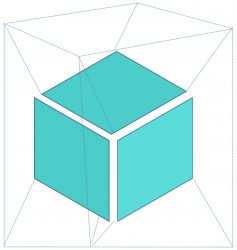
In winter times we rely more frequently on test to find out about sickness. Covid-19 testing has proven pretty effective in this respect. Often it is preferable to test more persons positive if at the risk of having many false positives. False negative tests can have many fatal consequences. Hence we have to weigh the risks of both kinds of false tests. This applies to many other diseases and diagnoses as well. There is no certainty but only a probability of each of the test results. The true result may deviate from the observed or tested result. FF FT TF TT are the possible outcomes of (1) the underlying true or false outcomes, which can have test scores of true or false as well. Not much new here the rest is statistics or probabilities to be more precise.

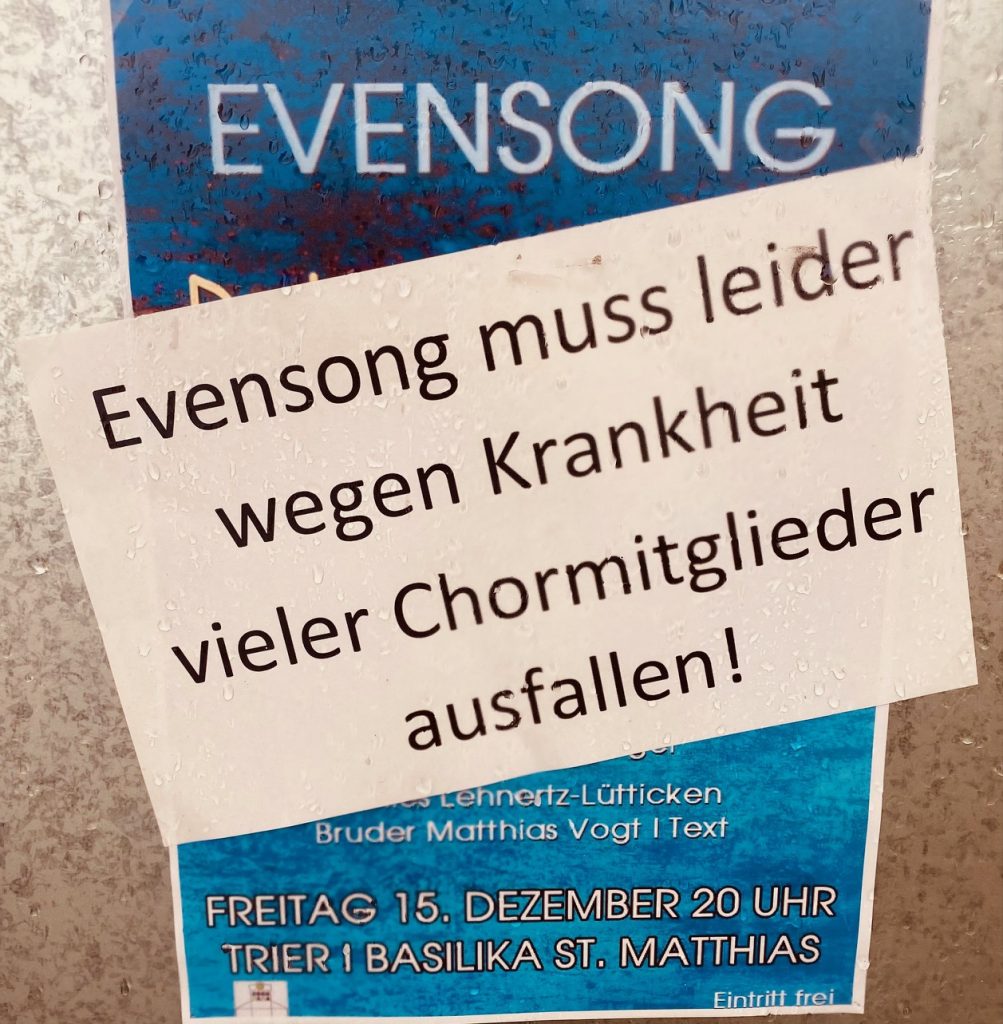
The overall outcome of testing or true sickness for some only God may know. Cancellations of events may be the result of one or the other reasoning.