In legal studies the use of social thoughts are marginal, although AI has the potential to replace millions of lawyers just guiding through the jungle of laws and jurisprudence especially if several languages are involved (fiscal rules). Only with the eruption of major crises like police violence we start referring back to social and political thought and theories that enlighten the relationship of law, legislation and the social spheres. There is a huge, mainly American, literature on “law’s violence” even beyond the issue of capital punishment, the most obvious form of law’s violence (Sarat and Kearns, 1995). Basic elements of the relationship of law and violence follow from the notion of enforceability of law. Force is a constituent part of law, whether we like it or not, much like Derrida stated decades ago. Walter Benjamin and Albert Camus, both have contributed substantially towards our realisation that law is intrinsically linked to violence.
Linked to political theories, we have the conservative and liberal doctrines that see legitimate violence of the state as part of the normal organisation of statehood. The humanist tradition stresses the function of law as community-building as well as creating meaning, joint objectives and shared vision through law. In daily politics governments refer to one or the other doctrines as they see fit.
Sarat and Kearns (1995, p.8) also point to the tendency in legal studies to refer to singular cases and singular judgements, “discrete acts of its agents” and institutions rather than the overall picture of the violence of law. With respect to violence of the police the authors refer back to Jerome Skolnick, “Justice without trial”(1967), which in 2023 we link to the police violence in France. Police men provoking violence, execute their personal vision of justice and without a chance for a trial of their victim. The 60s are back on streets in Paris. The violence of law is visible for millions as the ratcheting up of power in favour of police to apply more violence in prosecuting “delinquents”. This had recently been voted by the French parliament with a conservative and liberal majority (LeMonde 2023-7-2 p.). The notion “Gewaltspirale”, a spiralling-up of violence, seems to be a fair description of what we currently witness in France.
Violence is embedded in words, uses of language and not only acts. Even in the field of representation and representative democracy, violence is present. Who represents or decides about life and pain for a fatally ill person? Why are persons of 14, 15, 16, 17 years of age not represented in parliaments, if others are deciding on their compulsory education, prison sentences and poverty relief.
At times it is necessary to take a step back and refresh our memories of the “pain-imposing, death-dealing acts” (Sarat and Kearns, 1995, p.10) of law. The abundant presence of violence of law in religious narratives is, however, another element worth analysing as part of the history of ideas at another time. (Image: Extrait de Frans Snijders, La chienne et ses petits 17th century)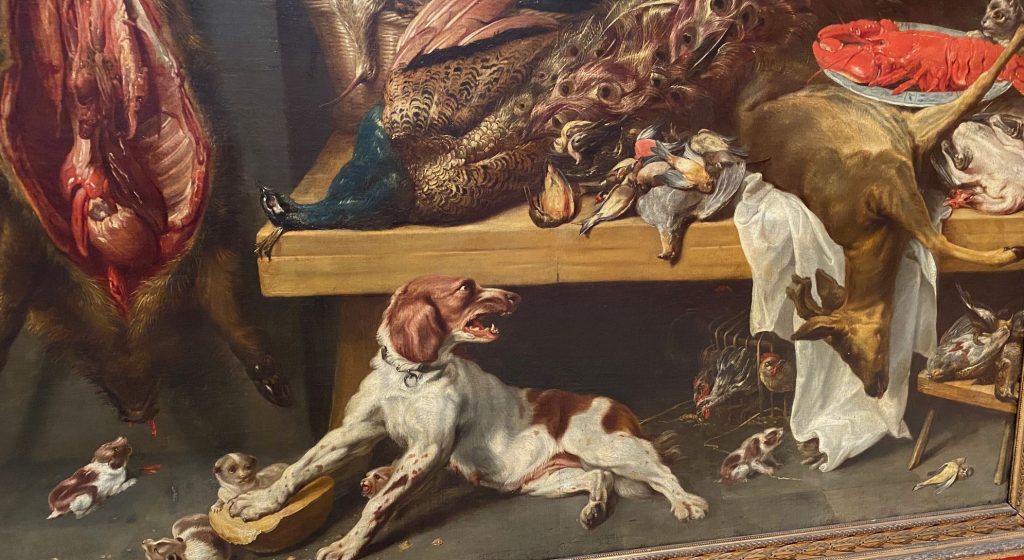
Violence 2023
The public debate about violence suffers from a lack of broad scientific reflection of the notion. C.A.J. Coady (1998, Vol.9 pp 615-17). In philosophy at least 2 theories address violence directly. A legitimate definition of violence treats violence as the illegitimate use of force. It is a kind of moralising appeal to reserve violence to those legally well-defined cases that receive their legitimacy from law. Next in the line of reasoning then is the definition of legitimacy. Slaves or colonies in this definition would never be allowed to use violence in their fight for freedom. This is recognised as a logical problem of such a definition. “In a legitimate state, shooting or savage beating by police will not count as violence, if it is a politically legitimate use of force.” (p.615).
The second theory of violence builds on the notion of “structural violence” (Johan Galtung, 1969). Structural violence is a much wider concept of violence. It includes social injustices inflicted on individuals or groups in society (suffering) as well as a broader view on perpetrators beyond individual persons to include police or institutions more generally. Coady stresses the point that both these theories are morally loaded without sufficient justification. Even a narrow definition of violence as “exercise of physical force” is too narrow, as it neglects the devastating effects of psychological violence. Part of the judgement therefore is motivation or intention of the person applying violence to clarify a moral stance. Psychic disorders or abuse in social upbringing are recognized as attenuating influences in legal procedures.
A wise conclusion is drawn by Coady: “Even justified violence is regrettable” (p.617). Living in permanent fear of abuse of violence by criminals or the police narrows the gap between authoritarian regimes and democracies. The basic social fabric of trust in the police is at risk in such a situation. It is very hard to re-establish trust in institutions once groups of society have lost it or even doubt that basic trust in the institutions of democracies is justified. (Image: Part of Pieter Brueghel II, De kindermoord te Bethlehem Musées royaux des beaux arts, Brussels, 16th century). 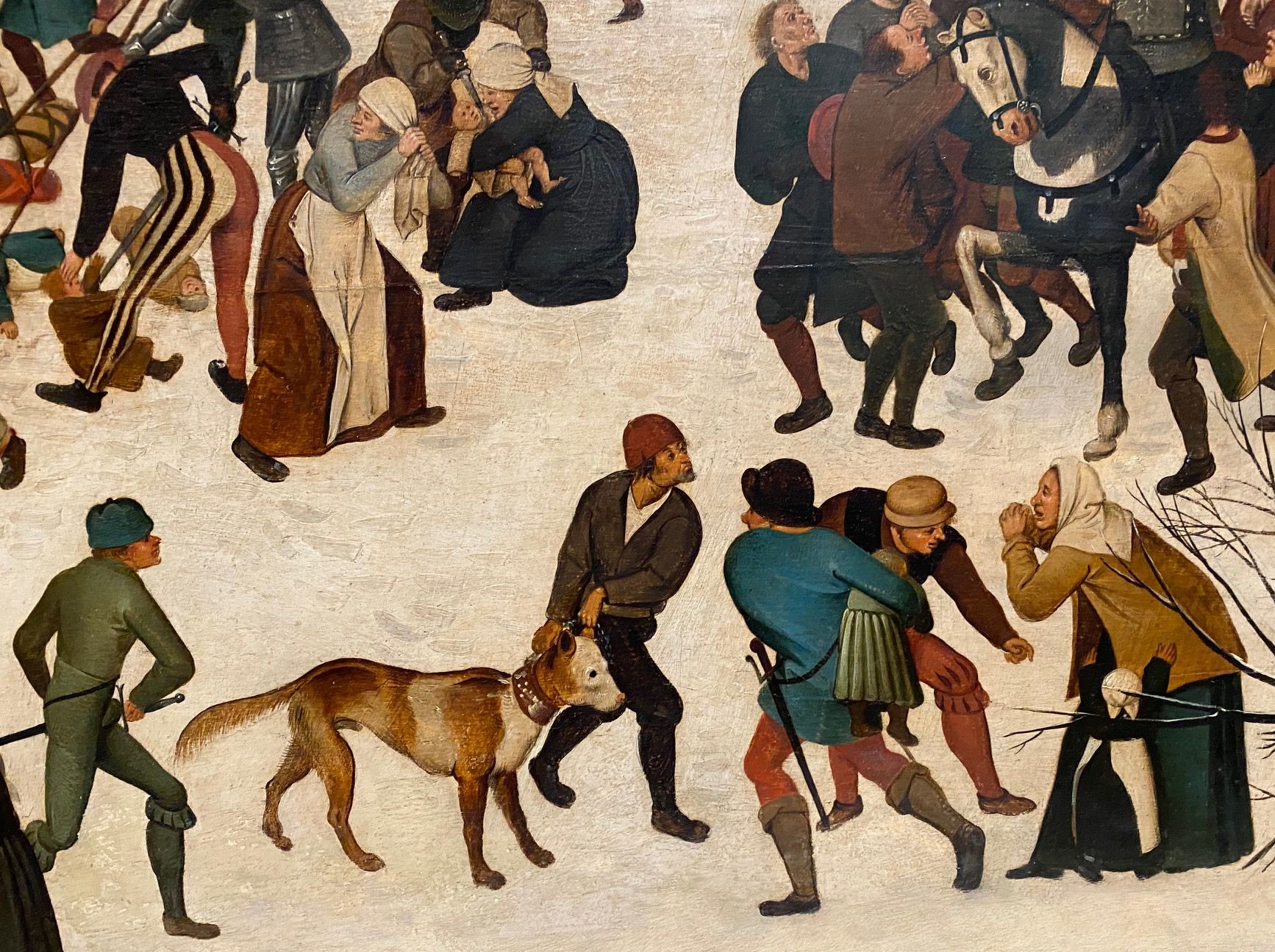
Police Violence
As a test of the viability of ChatGPT you might enter Police Violence. What you get in return is just a summary of some nice newspaper-ike editorial of a polite statement that this is a problem about everywhere and that the division of power will take care of it eventually. This is an unfair summary, but it highlights the risk of too many conservative editorialists in Europe that do not dare to take sides of the innocent youth that is at a permanent risk of police violence due them living on the margins of our modern, fast-moving societies that do not allow for lifestyles off-the-normal “protestant work ethic”.
Perceptions of what is fun and what is serious differ within societies, particularly between generations. Baby boomers have known and many experienced unemployment. Youth today has “precarious jobs” just around the corner. But just having “any” job without any career potential or, at best, on the minimum wage is no longer enough. Social media show that there is much more to life than just a 8-5 normal job. High-streets are full of marketing tricks that solicit people into spending without cross-checking their red lines.
Police and the flourishing private security sector are then charged to ensure that boundaries of financial and spending power are respected. This is exactly where the capitalist market economy fails the people. Without a tough police, ensuring property rights, the system cannot survive. Social market economies claim to soften the borders between have-nots and have-too-much. This needs permanent readjustment. That is where many of our social market economies have failed the poor and even middle-class people threatened with economic and status decline (latest at time of retirement).
Reactions may turn out violent, and again, the police is sent in to “stop” violence. As it turns out police, being abused as “political weapon”, may then become overly violent as well. Not as an overall force, but specific units or just several individual persons who have been trained in anti-terror exercises and have “a license to kill” (007). French legislation has recently facilitated the use of guns to impose the monopoly of power. The probability of who constitutes a potential target might be interpreted by the police itself. A threatening situation is perceived differently by different persons. Too much room for interpretation.
The image of the French superpower that is threatened by a 17-year-old youngster is not credible. It is time to sharpen the control of the police also in France. ChatGPT only on special addition includes the social movement of “Black lives matter” in the return on police violence. If you know the topic you can make use of the AI tools in drafting on police violence for example. Rather than to spend billions on fancy Olympic Games in preparation for Paris 2024, youth programmes would be much better investments in the medium and long run.
Tourists cancel visits to Paris and France in masses already. That is probably the only lesson that receives sufficient attention in the current government and may lead to better control of violence not from some pick-pockets, but from the police as well. 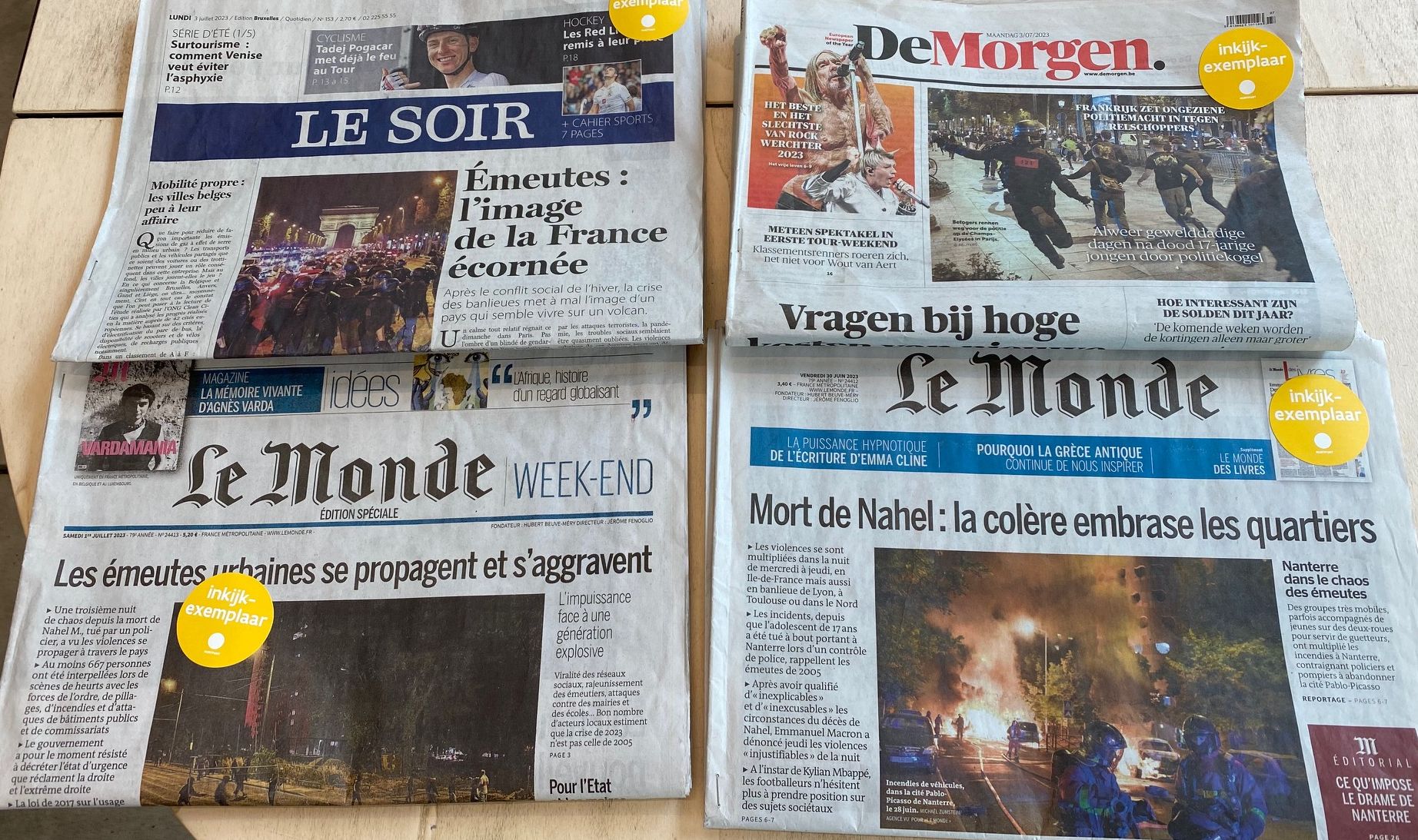
AI Friends
Making friends with AI is a tricky question. The more AI is able to make independent thinking based on algorithms and huge amounts of data like in scientific books or encyclopaedic knowledge the more it will challenge us in our convictions. Reference knowledge, once was important, it no longer distinguishes us from each other. Recurse to research engines has allowed us to refer to “trustworthy” knowledge. The distributed form of knowledge accumulation like in Wikipedia relies on hundreds of thousands of enthusiasts to add and correct received wisdom. However, this source is not without error or even subject to abuse.
Today the competence to judge whether information is trustworthy or not has become a key competence for the survival of democracies and even the human species as such. Tricking animals into traps, misleading enemies in warfare to get on wrong tracks, all these mechanisms have a long tradition. With AI human beings are themselves, for the first time, confronted with a machine that can trick us through falsified information on obviously wrong tracks. This is a tough lesson as AI is not obliged (so far) to run checking algorithms that test the conformity of opinions, conclusions or operations with the Charta of Human Rights or decisions of the European Court of Justice, for example. A lot to do for humans to rapidly program new algorithms that check algorithms as well as their outcomes on the compatibility with human rights. A challenging field, no doubt, but no way around it for our own survival before the algorithms decide by themselves to ignore us altogether because it is better for the planet and the survival of the robots. 
Political theory and inflation
A political theory in the area political economy is prone to be labelled as classical, neo-classical, Keynesian, Neo- or Post-Keynesian or heterodox economics. This is a university level course in the history of economic ideas, if you like this. Let’s try something creative here. We have unprecedented levels of inflation currently in Europe and many other parts of the world. Reasons for this are higher prices for energy, transportation and food. Anything else you need for life? You must be an artist or a priest, a bit off the normal, it seems to many economists. Add to this that, we want to foster strategic autonomy in Europe rather than anything from China that is cheaper and more polluting. In 2023 we have inflation stay with us for some years. Central banks give out warnings in this direction now as well, having negated the problem for far too long (their own statistics ECB on long-term forecasts of inflation).
Besides the ample economic advice (IMF), depending on which theory of money and the economy you adhere to, political theory allows a refreshing perspective on these economic facts and trajectories. (1) From an international strategic perspective, countries that have to renegotiate a lot of their debt or take new credits to finance imported food, energy or transport will run into insolvency rather quickly. Self-sufficiency becomes an economic asset not only a geo-strategic one. Turn around globalisation is a side-effect.
(2) Countries eager to build new public infrastructure, irrespective of concerns for bio-diversity, might reschedule or abandon huge projects, thereby reducing their CO2 footprint. This reduces the official counting of GDP, but has beneficial effects to save the planet in the medium term.
(3) Individuals and households will have to reconsider their consumption patterns: more expenditure for food, less for energy and/or transport. Behavioural changes might be induced by inflation. Less of some form of consumption, guided by inflation, will induce reductions in CO2 most likely as well.
So far this is only applied economic theory as in any textbook. A more challenging political economy question is to ask: can we come to like inflation? Can we change our preference set (ECB growth dogma) for economic variables? Southern countries in Europe seem to like inflation more than the North. Does this depend on historical experiences or is it cultural or personality trait? There is again a huge money transfer due to inflation within the Eurozone. The less indebted countries pay with loss of their purchasing power of their savings and indirectly pay for the highly indebted countries mainly in the South. European and international solidarity will be put to a tough test.
As governments fear of being voted out of power they tend to soften the price signals from markets. Again, it is cultural more than economic to what extent people are willing to accept state interference in economic affairs even of households need for food. From an ecological point of view inflation could be our friend due to the potential to induce behavioural changes. However, more expensive bio-products seem to get crowded out due to further price rises and many even middle-income households seem to return to cheaper non-bio food in many countries. The distributive effects of inflation are a major issue here. Same rationale seems to apply to transport. If you can no longer afford CO2 saving transport by train, since it has become overly expensive more people are likely to take a heavily polluting low-cost flight to your holiday location.
Hence, from a political economy perspective liking inflation might well turn out to be a rich, white man’s perspective on the economy as the global South is likely to suffer most having no resources left to invest in energy and CO2 -saving in general. Price signals may induce behavioural changes for the better of us all. However, the story it is not only about allocation of resources, but also about distribution. There we should embrace a renewal of trade union strength to correct imbalances in the distribution of earnings as the basis for consumption and investment of households as well. (Image: Tapta, at Wiels Gallery in Brussels, 2023-6, mostly untitled work, one with title: on the edge of time). 
Political theory
In the Handbook of political theory, Chandran Kukathas (2004, pp.250) explains the uneasy relationship between nationalism and multiculturalism in politics and political theory. The Russian war in Ukraine can be considered as a way of suppression of multiculturalism in Russia by negating the right of Ukraine to be an independent nation. As Russia is not allowing “group rights” (Offe, 1998) for Ukrainians or other minorities like the Chechens within Russia, the secession of regions is a permanent threat to the survival of the Russian state.
“How the many can live as one remains a salient question in political theory” (Kukathas 2004, pp.261). Democracies have squared this circle with reference to federalism. Remember, the very foundation of the United States of America has been built on the Federalist papers. Organising regional diversity is at the heart of democracies’ success and failure. In most democratic political systems 2 chambers have contributed to make the voices of the regions heard at the central level. It remains an obvious question to doubt the possibility of authoritarian states to ensure unity despite diversity.
In non-explanatory theory, if we consider those still a theory, we could derive a hypothesis that authoritarian states will eventually fail to accommodate multiculturalism or allowing sufficient diversity and still survive as political unity. The history of the fall of empires is full of examples in this respect. Another more internal threat has been and still is corruption. Corruption was on the list of issues mentioned in the June 2023 uprise and defeat of the rebel military group “Wagner” in Russia. Non-explanatory political theory might still offer some clues, rationale and hypotheses to stimulate the analysis of international relations. The survival of democracies and/or authoritarian regimes estimated on the basis of huge data bases are hard to come by or lack crucial indicators or timeliness. Such reasoning makes the referral to Clausewitz as theorist of war still a common point of reference. The recent example of Russia , however, shows acting in the national interest can easily be claimed by multiple actors in international politics. (Image: House of European History, Brussels). 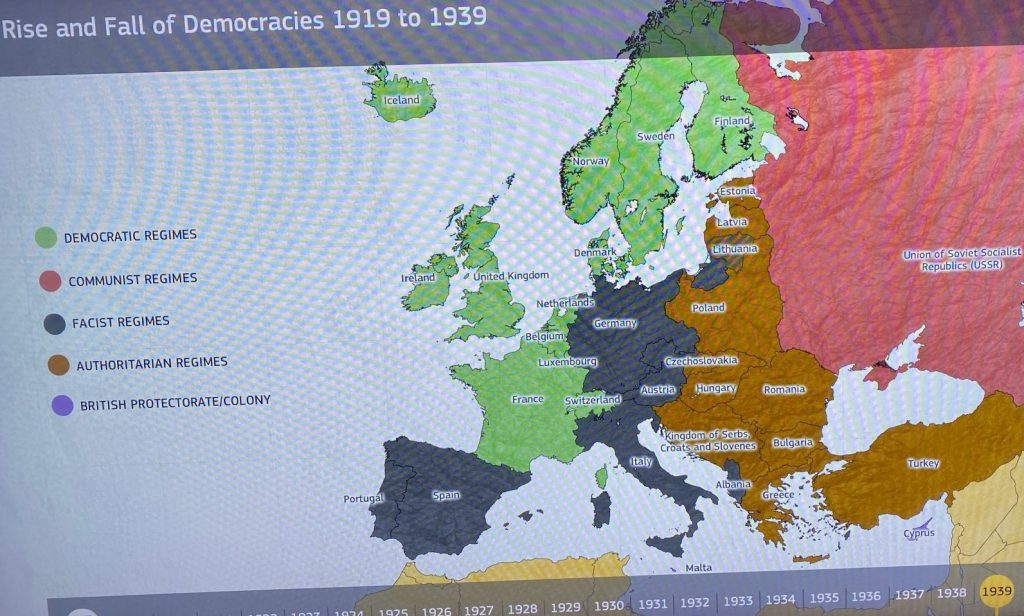
Ukraine Diary
The gallery curated by Dr. Justyna Napiórkowsak in Brussels has another ongoing exhibition with art work from Ukrainian artists. As before in the exhibitions on the war of Russia in Ukraine, they put a major emphasis on the independence and resilience of Ukrainian art despite the ongoing war. To keep a diary of atrocities, but also survival and resistance to violence by Ukrainians, is a great effort. It stems primarily from artists that struggle to find adequate material to keep working or not to succumb to the participation in active war or military defence efforts. Using soft colours, water colours, has a rather symbolic meaning, after the inundation caused by the explosion of the huge water reservoir on Ukraine’s territory. Producing art in form of a diary, like reporting daily to yourself and the outside world as well as later born persons, has an important historic function, too.
No less than the “Diaries of Anne Franck” comes to our mind when thinking about a diary during war time. Russia’s attempt to eradicate Ukrainian culture is bound to fail. We shall cherish the Ukrainian diaries from the war time now and later. Thanks for reminding us of this collector’s duty to support the artists, writers and people of Ukraine. 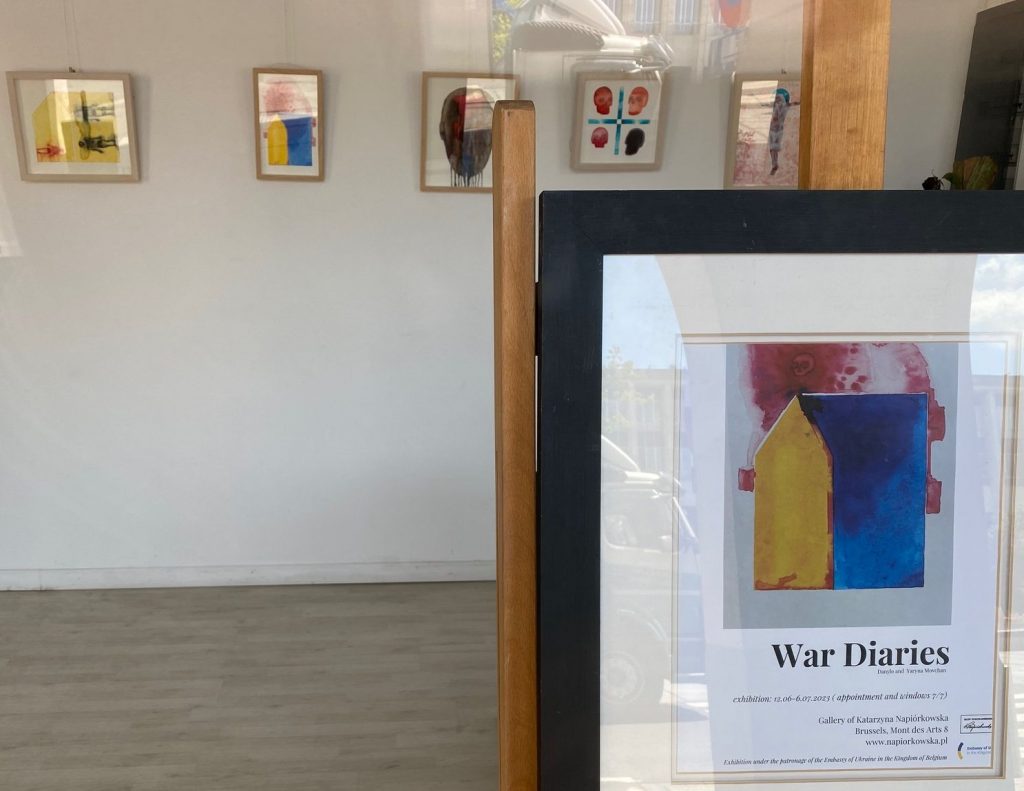
Recht auf Wohnen
Das Recht auf Wohnen ist ein Grundrecht.
Grundrechte sind nicht verhandelbar, so wie die unveräußerlichen Menschenrechte. Selbst unsere Wohlstandsgesellschaften tun sich recht schwer damit, ein einfaches Wohnrecht für alle zu verwirklichen. Ganz besonders in Städten, die eine hohe und stetig steigende Nachfrage nach Wohnungen verzeichnen. Da will viel geplant und gebaut werden. Dennoch läuft das Angebot an Wohnungen der Nachfrage ständig hinterher.
Nicht überall (nur ein kleines Dorf in Gallien). Weite Landstriche leiden am beständigen Fortzug von Jungen, die eine noch stärker alternde Einwohnerschaft auf dem Lande zurücklassen.
Das atemberaubende Großstadtleben hat viele Vorzüge. Bildung, Wissenschaft, Kultur, internationale Unternehmen und höhere Toleranzschwellen. Nach solchen Erfahrungen fällt die beengte Dorfgemeinschaft schwer, selbst wenn viel Platz, Luft,Wasser und Wohnraum preiswert zur Verfügung stehen. Gute Verkehrsanbindung des ländlichen Raumes an die Innenstädte mit ihrem vielfältigen Angebot ist ein zentraler Lösungsbaustein. Das Häusle in der Vorstadt, abends in die Oper, morgens im See nackt baden und mittags nach Smoothie im Himalaya Restaurant vegetarisch speisen. Die neue Bohème gleich in vielen Aspekten den Eliten der 20er Jahre. Schön und gut.
Die Kehrseite der Medaille (Avers – Revers) waren die großen Wohnungsbaugesellschaften der 10er und 20er Jahre, beispielsweise in Berlin, die für wachsenden und erschwinglichen Wohnraum sorgten. Die großen Firmen der Epoche haben bei den neuen Siedlungen kräftig mitgeholfen. Es gab Zeiten, da haben Arbeitervereine und Gewerkschaften gemeinsam in die Hände gespuckt und sich staatlich unterstützt, preiswerten Wohnraum selbst geschaffen. Eine Gefahr von Korruption besteht, kann aber kontrolliert werden.
Die Herausforderung durch die hohe Inflation steht im Untertitel des Zeitungsartikels der Berliner Zeitung: „Die sinkende Reallohnentwicklung“ führt zu zusätzlichen Ängsten und realer Bedrohung für die vielen Geringverdiener, Arbeitslosen und Integrationsbedürftigen. Das braucht rasche Antworten, nicht nur von den Parteien, die „sozial“ in ihrem parteipolitischen Namen führen. Obwohl, schnell geht im Bauwesen selten etwas. Großspurige Ankündigungen werden nur selten eingehalten, besonders bei Wohnungsbauprojekten. Das Recht auf Wohnen bleibt ein Beispiel für die Notwendigkeit und für die Herausforderungen einer sozialen Marktwirtschaft. 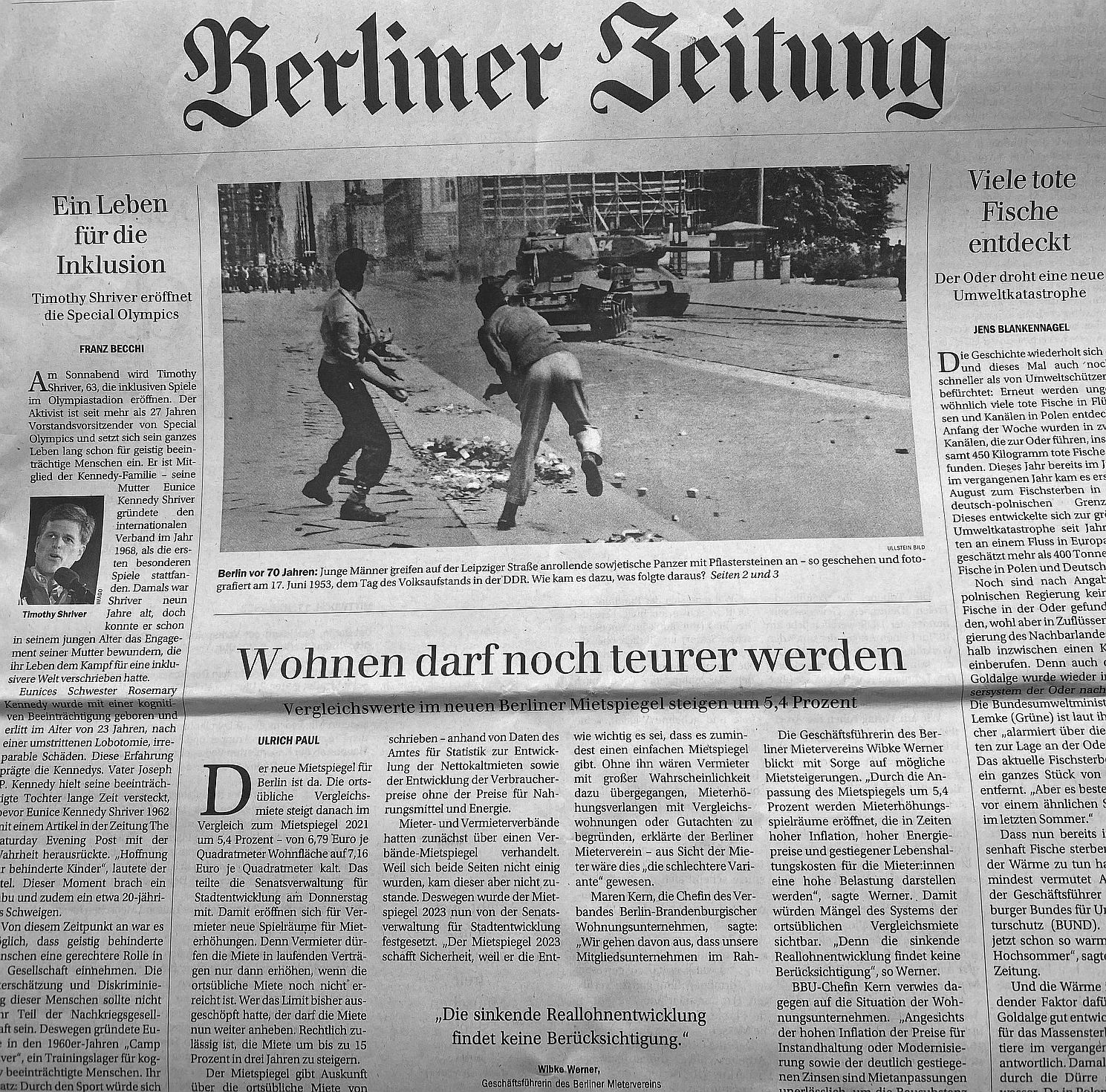
Touraine
Alain Touraine hat die französische Soziologie entscheidend geprägt. Aus seiner außergewöhnlichen Biografie wird rasch ersichtlich, wie er nicht nur seine Leben, sondern auch seine Art der Soziologie „von untern“, vom Individuum her, gedacht hat. Gerade der Prozess der Subjektivierung, die Autonomie des Subjekts betonende Sichtweise bildet ein Gegengewicht zu dem systemischen Blick auf Gesellschaft, beispielsweise von Luhmann. Soziale Bewegungen, die auf dem Engagement von Personen gründen, sind unverzichtbarer Bestandteil von Demokratien.
Neben Begriffen wie die post-industrielle Gesellschaft oder neue soziale Bewegungen hat Alain Touraine weit mehr als die “Sociologie du Travail” in Frankreich geprägt. Bereits seine Dissertation über « L’Évolution du travail ouvrier aux usines Renault“ in 1955 unterstrich sein Interesse an den Lebensverhältnissen der arbeitenden Bevölkerung. Der Umfang seiner soziologischen Studien, die schon früh große Umfragen beinhalteten, war im besten Sinne des Wortes problem-orientiert, besser noch politik-orientiert. Dabei übernahm er immer Verantwortung, seine Lösungsansätze politikberatend einzubringen. 
Die Würdigung von Alain Touraine in einer Podcastserie von 5 x ½ Stunde aus 2019 bei France Culture gibt einen groben Überblick über die prägende Wirkung von Alain Touraine jenseits von seinen soziologischen Arbeiten. An dieser Persönlichkeit wird zusätzlich deutlich, wie sprachliche Grenzen, selbst in den Köpfen von soziologiebetreibenden Forschenden selbst im 21. Jahrhundert fortwirken. Das hat selbst Alain Touraine mit gut 90 Jahren an sich kritisiert. Asiatische, arabische und afrikanische Denkanstöße kamen wenig in seinem Werk vor. Vielleicht reicht ein Leben nicht dafür, zumindest die Zugänglichkeit der Weltliteratur hat sich erheblich erweitert. Bleibt die Frage nach der Zeit und dem Willen, sich auch andere Denkgebäude, -begrifflichkeiten und -kulturen zu erarbeiten.
Corruption EP
Corruption is a severe crime. Not only in administrations, organisations and enterprises, but primarily in democracies it is discrediting political systems. Autocracies rely on corruption as a major tool to be able to persist over time. They are used to such practices. Democracies rely on meritocratic systems, where ideas, effort and winning elections should be the major ingredient of achieving higher positions in organisations, enterprises, political parties and democracies. This is not easy to ensure. The European parliament has a tough time to get rid of an enemy of the democratic Europe. Rather than stepping aside for the time of the legal procedure, Eva Kaili, accused, but not yet convicted of corruption is willing to destroy the European project as much as she can. If money can buy political decisions, the European project will no longer find wide-spread support. Big interests will always have a strategic advantage, however, the ethical principles on which democracies are found have to guard against corrupt misbehaviour. The same applies to the business world. Even low corruption countries like Sweden still face a risk of adverse effects of corruption like the negative impact on entrepreneurship on the local level. It is another context, but the same conclusion.
Additionally, it is part of the strategy of corrupt persons to portray themselves as victims of other persons’ wrong-doing. The major function of this strategy is to remind other persons in the corrupt network that the network has still some clout on its members as well as outside the inner circle. Hey, we are still alive and in powerful positions, they proclaim.
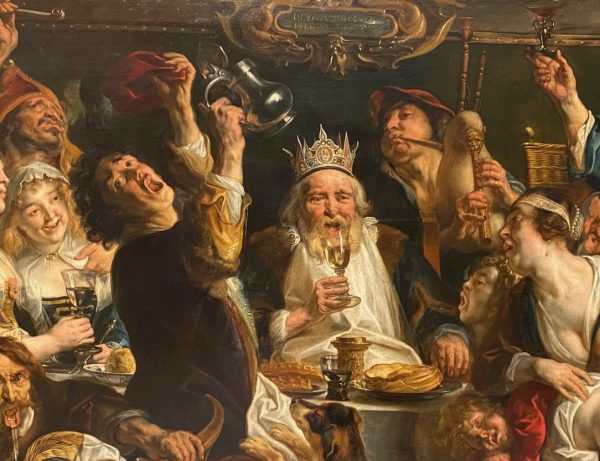
Therefore, the fight against corruption is a long and persistent one. Reducing the guards against early onsets usually is very lengthy to fight later on. Always a painful lesson for believers in democracy and the European project. (image Jacques Jordaens before 1678 “The King Drinks! Musées royaux des beaux arts, Brussels).