Artists and scientists, all have their sources of inspiration. The most beautiful way of putting this is contained in a poem by Jacques Prévert. “Moi aussi, comme les peintres, j’ai mes modèles…”. The source of inspiration varies from physically present models to imagined ones. Painters and sculptors, we imagine, have their models right in front of them and build on their specific kind of observation, view and vision, seeing more or differently from others, at least since modern times. Poets and authors are believed to draw inspiration from abstraction and imaginative description and narration. Musicians tend to rely on hearing fine-tuned or creative tensions, as much as the resolution in harmonies through sequences of sound. All seem to have a sensitivity beyond the normal and a skill to find a way to transmit to others. Photographers catch representative moments or visualize artifacts and combinations of them in new ways. Scientists are not so different as we might think. Imagination of new hypotheses in established fields is part of their skill set. The transversal skill in all these processes of inspiration is the openness to cross-discipline fertilization. So-called Polymaths reached excellence in more than one field of science, “Polyartists” touch several fields of different arts. Further new innovative combinations of disciplines like they are practices in “centres of advanced studies” are a first step to brings down walls in mindsets and disciplinary ivory tower practices. It will take only a tiny little step forward to come back to the practice of royal courts. The person called “fou du roi” had an important role to play, not only in the game of chess, but in questioning and entertaining leaders. I wish universities, science centres and ministries would allow themselves more of this kind of inspiration. Inspiration is considered here as a source of questioning your own approach from another perspective. Look at your phenomenon of interest with a different model or imagination in mind. New synapses will follow. Let us welcome them to make the world around us a better or more beautiful place. Wait, is more beautiful enough already? Is this a contradiction, better versus more beautiful, or is the latter a subset of the former, or is a tautology anyway? The catalogue of the exposition “Archives des rêves” du Musée d’Orsay gives plenty of insights into images as sources of inspiration for people of all walks of life. 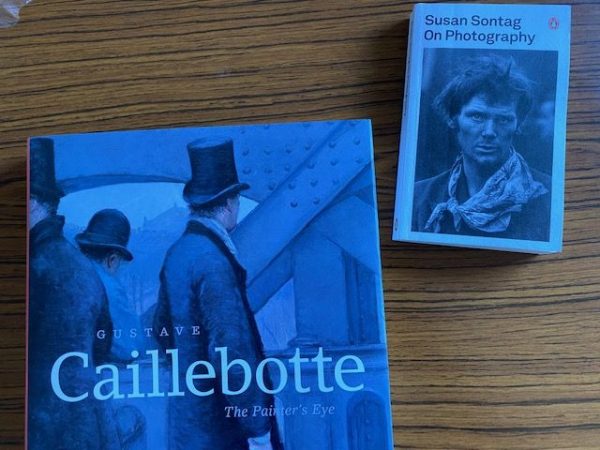
Employment
Employment is back on top of the agenda. Not as we used to think, though. Previously unemployment had dominated societal concerns. Now it is the lack of persons seeking or available for employment. What has happened? The Covid-19 crisis has demonstrated the need of persons qualified to work in the health sector. From health care and urgency care, we are short of personnel in all these fields, everywhere. 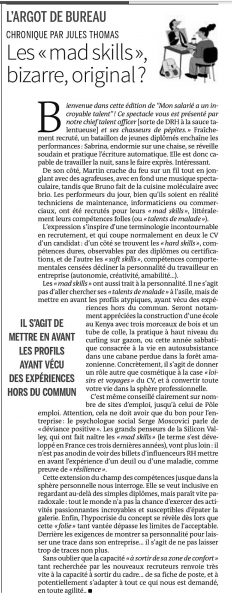 Then we discovered the role of essential services and the need to equip crucial infrastructures like ports, transport, shops, schools and ambulances with service persons resisting despite work overload. Larger cohorts leave employment to retire, some even early due to illness or burn-out. Additionally, war is back in Europe. Military personnel is in high demand again, drawing largely from younger cohorts. The need for conventional weapons. long thought to be oblivious, is forcefully back on the agenda.
Growth potentials are everywhere. However, these pre-modern facts encounter a population in the western democracies that insists on new approaches to employment. Beyond hard and soft skills, recruiters seek atypical skills, competences and trajectories. A parachute jump from an airplane, cooking and dining experiences, caring spells, periods in self-employment, all are directly or indirectly relevant for employment and teamwork. So, what is your specialty? Collecting stamps? Surely you are able to spot tiny differences in images with specific content. Fake news and fake image detection or video surveillance is in high demand, just try an application and discover the employment potential of your MAD skills. Sounds crazy? No joke. Skill needs are everywhere, just give it a start again and again. Read a serious newspaper regularly (here LeMonde 19.1.2023) for inspiration.
Relation
Several inputs from logic will assist us to establish relations between 2 objects, 2 subjects or 1 subject and 1 object as in simple relationships to form sentences. The most obvious is A = B. The most common, depending on definitions, A is not equal to B, hence A >B or B>A. Medieval logic adds the consideration of consequences and suppositions to relationships. A determines or leads B. We might suppose that A is a precondition for B. Logical arguments often attempt to explain. Mathematical proofs chose ways to deduce or induce, whether a statement is true or false. To reduce the number of lines to explain a theorem is a mathematical virtue, just like in a game of chess to find a check and mate in fewer moves.
Leibniz increased the repertoire considerably. In geometry objects are parallel or in the infinitesimal calculus they approach each other without ever reaching each other. With the art of combinations he describes a language than contains groups and elements. The binary revolution, to express numbers, letters, images in form of pixels as multiple assemblies of 0 and 1, has revolutionized our potentials. Beyond these determined relationships there are stochastic relationships, they happen more or less likely. The centre of logic relationships remains deductability = to deduce, consistency = to consist of and completeness = to complete (Encyclopedia Universalis 14, p.653). Time adds another dimension to our concern to exemplify relations. A pre-empts B, or B follows A in time, but not in respect of deterministic logic. Additionally, locations in space of 2 objects allows us to imagine additional abstract forms of relationships, artists play around with this continuously. Some artefacts have created fantastic new ways to challenge our learned ways to consider relations. Last but not least, sound has contributed to how we perceive relations. To superpose, transpose or dissociate relations leaves different emotions. Relations are all around us. They certainly link subject and object in a sentence in multiple ways, copying or imitating nature. For further reading: HERBERT HOCHBERG; KEVIN MULLIGAN. Relations and Predicates. Frankfurt: De Gruyter, 2004. ISBN 9783110326536. Disponível em: https://search-ebscohost-com.kbr.idm.oclc.org/login.aspx?direct=true&db=nlebk&AN=603683&site=ehost-live&scope=site. Acesso em: 23 jan. 2023.
Deconstruction
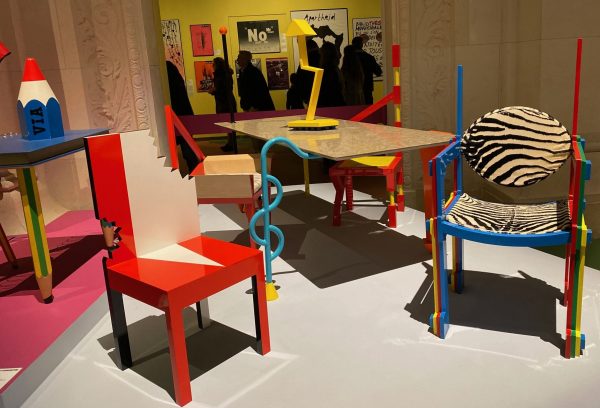
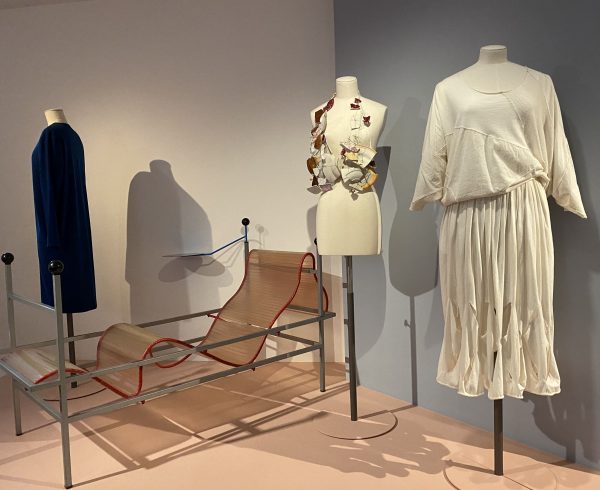
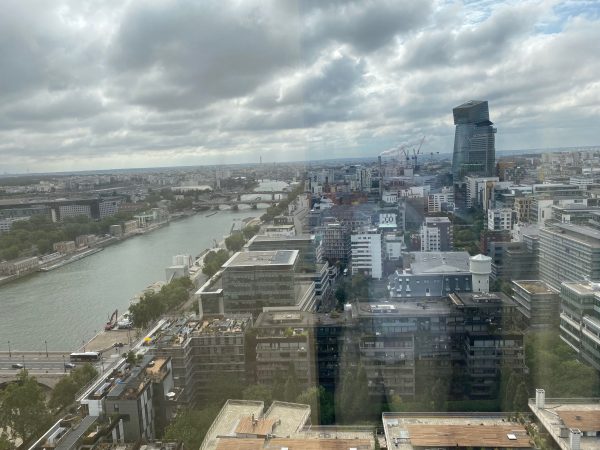
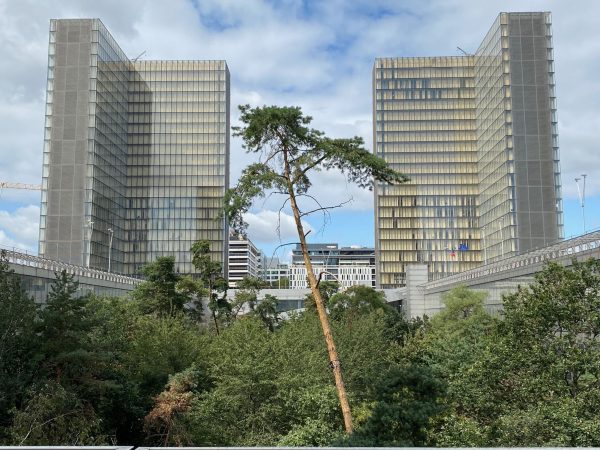
Deconstruction is a powerful tool or even method. Beyond imagineering, deconstruction in the literal sense means take to pieces. In most cases a physical object consists of several objects or parts. By deconstruction we attempt to understand the whole object as the sum of its parts. Before a new product or design is created, many scientists, engineers and artists start to deconstruct existing artefacts. Understanding how the object is assembled, for example, allows you to play around with pieces and maybe come up with an alternative way of constructing the object. The architecture of “deconstructivsm” has left us fantastic buildings. In furniture design there are also nice examples of deconstruction. Paris is a good place to study deconstruction (Explained), perhaps many still read Derrida there. It is a fruitful method beyond its engineering sense for example in law, literature or many other social science disciplines. If you are not mad yet, visit the MAD in Paris to see examples of deconstruction or construct your own deconstruction. Both have a dialectic relationship to each other anyway.
Sound
Each society has its sound. Each person lives in her/his sound cloud or bubble. Cities are generally noisy places, Lots of traffic, mobility and moves leave sound bytes all over the place. Each city though has its own sound and spectrum of frequencies. Libraries, museums, places of worship, all build their special atmosphere due to specific sound design. The Singing Project by Ayumi Paul (Gropiusbau Berlin) created its own sound environment. Reminding us to consciously design our exposure to and experience of sound is welcome. John Cage started to build his very own language of music, similar to Schoenberg, from scratch. His writings Empty Mind explain his view and techniques a bit. Starting with silence and the time between sounds we recreate our own sound experience. Notation of it comes second in place. only for the potential to repeat the experience notation is useful. But it is only one form of conservation for posterity. Noise canceling is the amazing tool from sound physics which allows you to neutralize noise by adding specific frequencies to noise which cancel out each other. Design your personal sound experience beyond noise if you like. Nature recordings or familiar person voices allow you immersive experiences when and where we want. your home sound can be everywhere nowadays. 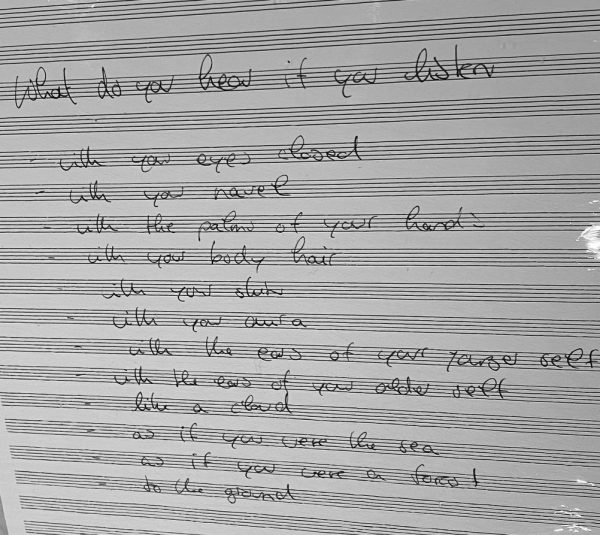
Action Verbs
Action words are in other words called action verbs. Each complete sentence has one. Hence, they are part and parcel of the basic construction of sentences.
“The purpose of an active verb is to create a clear, concise sentence. By using an active verb, you can eliminate unnecessary words and make your writing more direct. In addition to making your writing more concise, active verbs also add punch and clarity. They can make your writing more interesting and persuasive. Additionally, active verbs can create a sense of immediacy which is often useful in persuasive writing. When it comes to writing, there is nothing more important than using strong, active verbs. Not only do they make your writing more interesting and engaging, but they also convey a sense of confidence and authority. In addition to being more descriptive, active verbs also add a sense of movement and action to your writing. Rather than simply stating that something exists, you can use active verbs to show how it exists. For example, rather than saying “there is a chair in the room,” you could say “the chair sits in the corner of the room.” This may seem like a small change, but it can make a big difference in how your writing comes across. Finally, active verbs can also help to set the tone of your writing. If you want to convey a sense of wit and humour, then using playful, lighthearted verbs is a great way to do so. On the other hand, if you’re aiming for a more serious tone, then using powerful, authoritative verbs will help you achieve that.”
After the 3rd sentence this blog entry (Link) has been written by the artificial intelligence app “Neuroflash”. They promise that it is not just copy and paste, but rather written following some instructions I gave like title, table of content, style and then selected among several choices. It makes sense to me, although it is just like many other textbook entries I have found on the web. It may well serve as an introduction. Lazy journalists, priests or lawyers in case they do little research will be replaced soon by AI, who else, who is next? Big brother drafts the brave new world for us already. 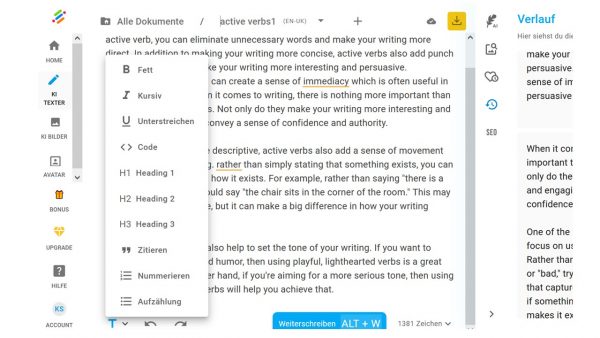
ABC Overview
Digital formats allow flexible organization of lists like alphabetical lists. Opening several pages, at the same time, of the same dictionary is easily feasible. In science the proceeding in this way is coined the inductive method. The entries of each letter stand on their own, but jointly they form a whole set of topics. Random choice is facilitated this way. New sequences or preferences of topics are the way forward. Alphabetical order or chronological order are only one out of many variants of possible sequences. Chose your own 3 favourite topics, maybe. On a big computer screen you might even organize your own poster – beam it on the wall – walk in the virtual exhibition of the metaverse with it. It could feel like you are strolling within parts of my brain. Frightening? For whom? The universe is within us.
| action | health | optimism | value |
| balance | imagination | policy | war |
| corruption | joy | question | xeno |
| democracy | knowledge | repairing | yinyang |
| enterprise | law | society | zero |
| freedom | memory | time | |
| god | nature | union |
V for Value
Value in its singular form refers for most people to the value of things. Since Karl Marx we have been fighting about the surplus value of a worker’s work. Nowadays, we have to deal with speculation bubbles on the value of property or even basic elements of nutrition (Water, wheat, energy). Max Weber introduced us to the rigorous analysis of value judgements. In political science the plural “values” refers to basic human rights as fundamental values of humanity. Many other associations with the letter V pop up and arouse emotions: victory, video, view(s), vision, visit, voice, vote, vulnerability.
Creating lasting value seems to transform itself into part of our system of values later on. The longitudinal dimension of value is often neglected, particularly in the short-term focus of much of economic reasoning. Value over time, in addition to the distribution question, or as part of distribution over time, excites researchers of inequality and policy design for generations. Approaching the end of the alphabet increases the stakes of the “endgame”, it seems. Value for me, might not be of value for others. I hope you have found a person that values much of the same as you do yourself.
Interpersonal value, value exchange and intertemporal value are own fields of research. Since the Scottish enlightenment and Adam Smith’s work on “The theory of moral sentiments (TMS)”, reciprocity in value exchange has been an issue, well before the utilitarian turn in his own writings on “The wealth of nations”. Even Adam Smith refers to happiness and interest as a kind of value and “very laudable principles of actions” (part VII.ii.3.15 in TMS).
Children learn and experience value as natural part of growing up. Material things which you valued highly as toddler, you are ready to trash or exchange a couple of years later at much lower prices. Above which monetary value are you ready to trade in your humanitarian values? Never? History and bargaining theory is full of experiments and experiences that teach us otherwise. Corruption is the prominent example of exchanging or trading material value against immaterial values. Reading Kwame Anthony Appiah on “Experiments in ethics” is highly instructive. This bring me back to the economist joke I used to tell in lectures: You know that you’re an economist, if you ask your child, whether s/he prefers 20 Euros in cash, a trip to an adventure park later, a basket ball set or a pizza party for the next birthday. Economists do all this to find out about the value of each item, the preferences, the time frame of delayed reward or discounting of value also called the net-present value. Reading up to here is equal to the value of, maybe, an online bachelor in economics or social science. In your very own life review of learnings you then can estimate the value of your readings to you, your community or humanity. Alternatively, enjoy the joy of just living in peace with optimism. 
U for Union
Union, understanding, undo, unknown, uncertainty, universe, urbanization, use, u-turn. All those u-words spark imagination. Additionally, the short forms of u as abbreviation for you, ur = your, youth and smartphone typing are creating for us abbreviations to communicate even faster and shorter via social media. Union is my favourite of this list for several reasons: (1) Marital union, passionate topic not only for family sociologists, (2) trade unions, as collective form to organize solidarity in and across societies, (3) European Union, the formidable tool to create, conserve and ensure peaceful developments in Europe. We have to prolong this list with the union jack, the united states, the united nations and …, please continue the list.
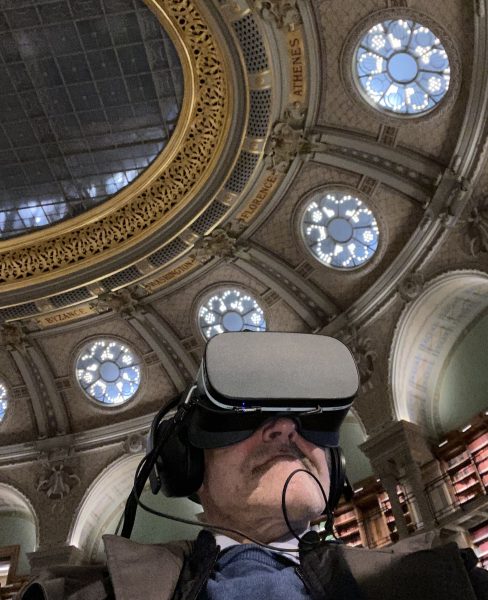
For me, in union I see a whole film running, a process proceeding, or persons uniting. Unionization, just like two persons deciding to pass more time together, has some magic in it. Match making is the modern term for it. No Union without reunion, dissolving a union might be part of the process as well, as painful it can turn out to be. Most of the times we grow throughout the process. Forming a union, in all senses of the word and of all sorts of forms, is a kind of teleological urge of us as a species. We share this with many animals but have also developed strategies and weapons to force others into union. Unfortunately, no u-word without its potential to be used in the sense of abuse. Unite to defend the union of fans of unions. (Evolution of Union of Tweets own Video 12-2022). IMG_4611
T for Time
“The times they are a changing“, end of blog entry T.
We live time forward, but we seem to understand it only backwards or in retrospect. Towards the end of each year, it is common practice to look back and review the last 12 months. Then we imagine what will the future be like. Our concept of time is past, present or future oriented. In classical physics we reflect this with a depiction of time on a linear axis. However, modern concepts of time include Einstein’s relativity theory, whereby in 2 different places time may run with different speed. Similarly, quantum physics allows that the causal relationship between 2 physical states is no longer observable in a logic that follows linear time. A particle may exit in 2 states in parallel. Hard to imagine, maybe, but demonstrations of these effects are found in textbooks for pupils already. Our grasping of the world around us is enhanced through scientific rigour.
Story-telling also plays with time frames. Analepsis and prolepsis are common techniques constructing a story, a film or any form or narrative. We tend to perceive chronological time even as boring. Our memory is also playing tricks with us on time scales. When was …? Additionally, we have multiple clocks ticking away. Time to submit a report, pay taxes, until the next medication or the psychological concept of “time until death”. Strangely enough, depending on which ticking clock we focus most, our behaviour is likely to change. Mobile time management tools have been created for centuries for us to handle all this jazz (call them a watch). They all have not changed our concept of time, only the precision to measure and cramp more activities or the same one faster into our daily life. Happier since? Test your self-efficacy, more general than time management! Try meditation to slow down the pace, use an app!? I started to clone myself with a virtual presence to experience the quantum effect of my life. Podcasts are played with 1,5x the normal speed now. Rhythm and music are the remaining traditional metrics of time. Even there, John Cage’s piece “silence” managed to abandon the time reference, partly at least. Okay, time is up, next letter, please.