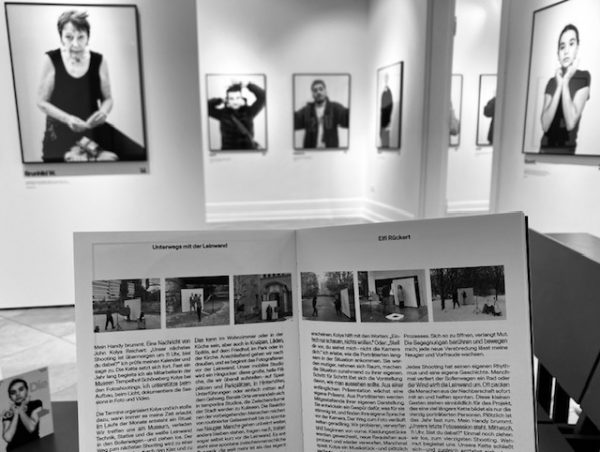

In empirical approaches to sociology we occasionally apply “latent variables analyses”. The aim is to uncover links between data that are not obvious in standard analyses of data. We are pretty convinced by evidence that age correlates with the probability of death. However, most tragedies are created around exceptional counter examples to this “rational expectation”. We also somehow have an intuition about the positive effect of social networks or the social fabric in a more general sense on living and survival. In some of those latent variable models we find evidence for an underlying factor without being able to properly name or frame it. Hence, as social scientists we continue to be interested in ways to make latent social structures more visible. With such an approach in mind I visited the exhibition by author and photographer “John Kolya Reichart” in the “Schöneberg Museum” entitled “Die Kette” (The Chain, 2026-5). The start of the chain is a familiar person in your neighborhood who leads you to the next person and so on. It is explicitly a non-random procedure, which complements proceedings of strictly random sample selection of survey methodologies. The sources for bias outcomes are multiple, however, an underlying or latent social fabric of a friendship and support mechanisms can be shown. Besides the b/w portraits and audios, giving a justification for the choice, the documentation of the process of production gives more insights into the risks and potentials of this form of insights into latent social structures.
(Image: Schoeneberg Museum, “Die Kette” by John Kolya Reichart)