Interests in failures

Decades or centuries after a successful or unsuccessful innovation, an evaluation of the reasons and circumstances of a temporary or permanent failure is informative. In the energy sector we observe another round of a power play in 2026. The more decentralized energy production and energy consumption models have been quickly put aside shortly after the oil crises of 1973 and 1979. The innovations using wind energy or solar energy of the 1980s have been discarded and were commonly considered as failures to provide cheap and reliable energy. An open international economy with expanding global markets for energy were perceived as a superior conventional solution. A country’s balance sheet of imports of energy and exports of higher value goods and services was the predominant economic rational and standard knowledge of the mainstream theory of trade. Other solutions, like a distributed “prosumer” model of energy might have ecological benefits, but would not show up in national GDP-statistics as a large part is home-produced energy and not accounted for in statistical measures of GDP, just like the home produced meals, health and care provided by mostly women. Societies, however, have a choice and an obligation to evaluate the interests in failures as economic and social development hinges on it in the medium to long run.


Failure as criticism

The production of an object, which does not abide by the norms and conventions of its designated use, can either be considered a failure, a commercial flop or a critical comment on consumerism. In some instances it may even have the intention to produce art rather than a useful product. A tea or coffee pot may serve as such an example of it (see image below). It is designed not to serve tea or coffee in a conventional way. Such an object invites us to think around the corner,  whether we could still use it in the “normal” way. We are forced to innovate as user or we just leave the object aside. The Flops exhibition also included early car examples which used a “Wankel car engine” and the aerodynamic adjusted car model (shape of a peach) of the R14 in its flops collection which were early precursors of a, later on widely followed, car design principle. Such an aerodynamic car design saves energy and therefore increases the reach of the car without refueling or battery charging.

Overall, some supposed failures are more indications that we are not easily prepared to accept behavioral changes or alternative visions of products.

Learn from failures

It is easier said than done. Acknowledge a failure and most people will probably pretend to know better already. Don’t worry. This is not the case. Many of the best “learnings” have come from learnings from failures, be they own mistakes or of other persons, organizations or institutions. If you really want to learn from a person, try to get honest take home messages from their “best” failures. Marc Aurel has proposed this in his writings on governance and, prior to him, Aristotle compared Greek constitutions to derive the most adequate, or the best of the many failures to achieve democracy. This is a perspective if you aim to improve on the achievements of current or past actors. Incumbents can only tell you about how they got where they are currently, not about any likelihood of future occasions. Hence, current failures are a very valid source for learning.

Time dependent failure

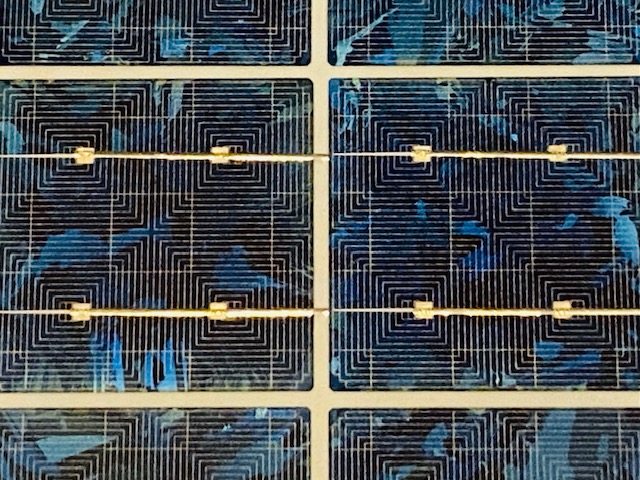
The collection of failures has an ambiguous relationship with time. Some innovations that are celebrated at a specific point in time shall be considered failures at some later point in time. The Musée des Arts et Metiers has an early version of a solar panel on display dating back to 1996 (see image below, Photowatt 1996). This example reflects the cycles of public as well as expert opinions about technical innovations that either are en vogue or at disgrace. Ecological, design and economic considerations enter into the consideration of what constitutes a failure. Claims of European energy sovereignty may additionally enter into the failure equation. The time horizon over which energy savings are generated is yet another element in the judgement. The more general perspective should take sustainability and depreciation of quality of an object into consideration. The Flops exhibition just scratches a bit on the surface of an important and rather complex issue of the relationship of society, technology and innovation.  Surely, there is more to come in terms of flops and failures, and this is okay in most cases. 

Fail collection

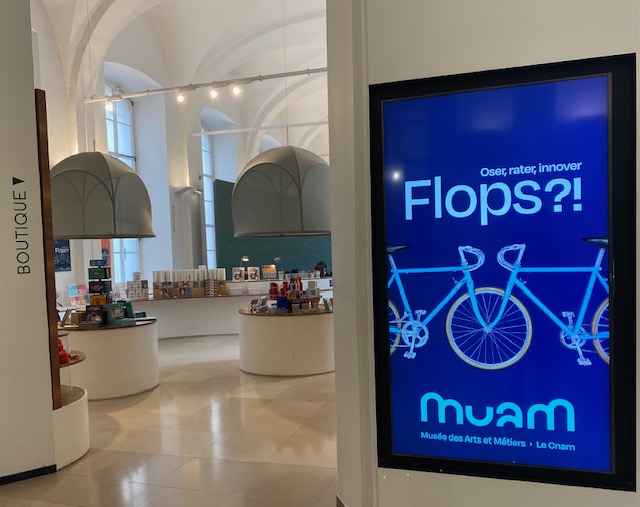
The not-so-social media have been flooded with collections of failures. The success of this short video format is mostly due to its entertainment value. A quick laugh is guaranteed if a certain intention is turned into its opposite. You want to take a witty shortcut but effectively you end up with a lengthy or painful lesson of the opposite. The fail collection of the CNAM in Paris has a similar attraction. The “Flops” exhibition in 2026 exposes a larger number of technical innovations that either did not reach the mass markets or that were “flawed good ideas”. In fact to put an innovative idea or design into practice it takes a lot in addition to engineering intelligence and professional competence and experience. The collection of documentary evidence invites us to explore the topic of what constitutes a failure and why failure is an intrinsic part of the creative process of trial and error, fail, fail again and fail better. (Image Musée Arts et Metiers 2026).