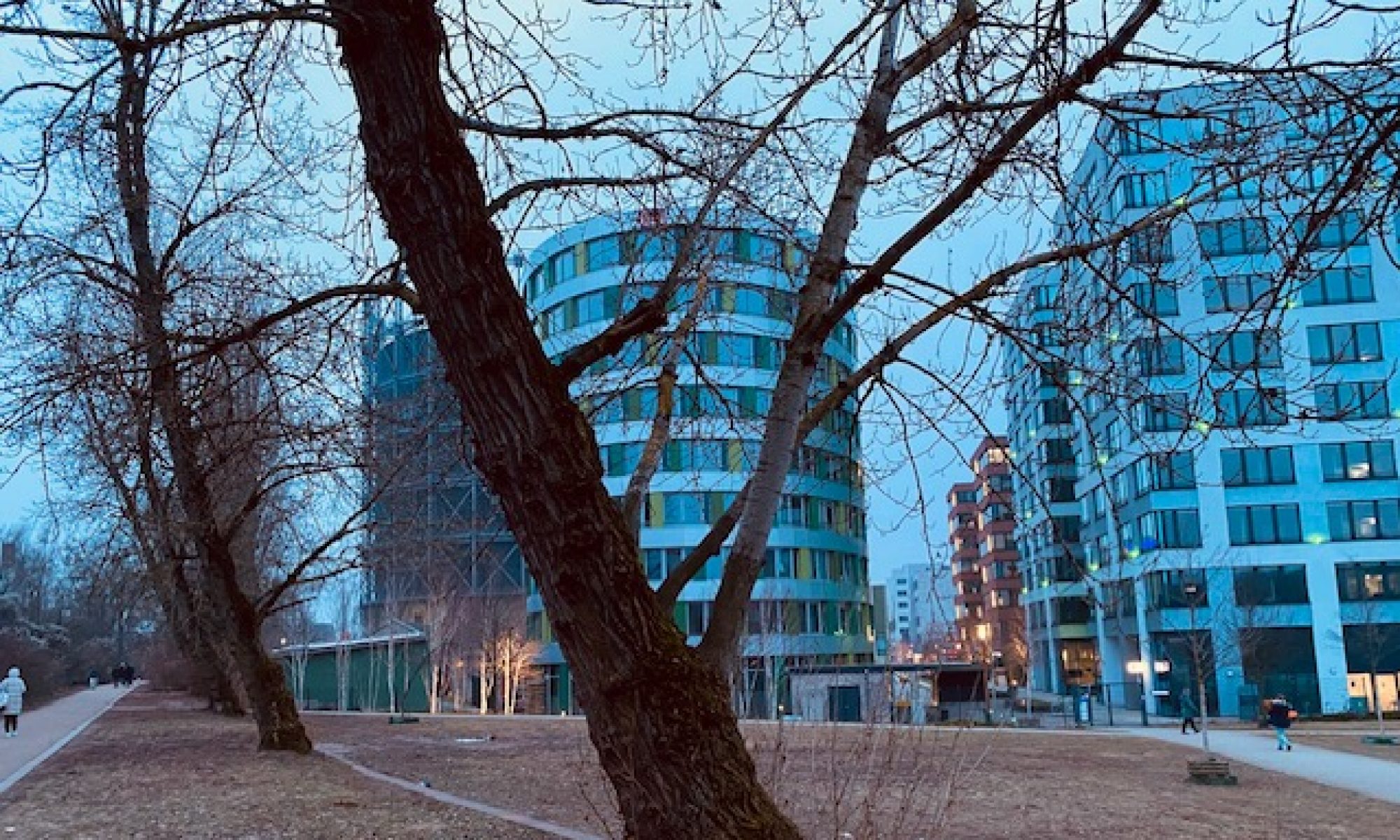

It is a moving image to see a hundred demonstrators at „Unter den Linden“ in Berlin just next to the Russian Embassy. The Georgian flag and Georgian people actively seek the association with the European Union and the values it stands for. Irrespective of a large majority of the people of Georgia‘s wish to become part of the EU they have to fight hard to be heard. Next to the Ukranian protests in Berlin it becomes very evident that these two nations fight for living standards and values which are so „self-evident“ for us European citizens that it is all to easy to forget about our neighbors who have to endure hardships with uncertain outcomes. The experience of having lived together under one roof with people from other countries allows to realize that we have so much more in common than what separates us. Our house and home of the EU has much to offer, more than we tend to believe in our daily routine. 
Career Criminals
From a life course perspective it is not easy to define a colloquial term like career criminal. A person who has been convicted for a single crime and has served his/her sentence should be allowed full integration into society. Even a repeated offender should not be stigmatized or labeled as career criminal. However, this is exactly what the NS-state did (traveling exhibition across Germany and Austria: „Die Verleugneten“). These persons were subject to targeted charges for criminal offenses they „might“ commit eventually. The term „community alien“ or „asocial“ were also used to refer to persons that did not fit into the dominant Nazi doctrine of „Volk“. It took 75 years until these persons could receive a recognition and a recompense for their unfounded discrimination and incarceration. In concentration camps the so-called asocial or career criminals were at the highest risk of further prosecution and death. Great that the stumbling Stones include these victims as well, as a way to remember these crimes against humanity. Beware of definitions of social groups which are based on totalitarian ideologies. 
Cumulative Mandates
Since 2010 and with 18 volumes the documentation of perpetrators assistants free riders during the Nazi rule in Germany has been valuable and reliable source of information (Kugelberg Verlag). The book series defines the perpetrators as the persons excuting crimes themselves or were in command of those who committed the crimes or gave orders to do so. It is not surprising to find evidence of many crimes, but rather that it took such a long time until the documents were published and the descendants were confronted with the facts and the difficult heritage. There are still many who undertake all efforts to deny the facts or try to minimize the guilt of perpetrators. With the real dangers of new right-wing extremism on the rise across Europe and even beyond, it becomes more important to uncover the strategies and biographies of the perpetrators. Certainly the members of the SS were executives and in command of atrocities, so-called NSDAP party officials were also mostly convinced followers of Nazi doctrines and instrumental in the implementation of crimes. Additionally, several professions (line soldiers or medical doctors) were key in the process to ensure the power of the totalitarian regime until the final days. Some persons were cumulating roles and became thereby inescapable spiders in a web of control and crimes. The lessons for today consist in hindering excessive cumulation of mandates, political, professional, military and in other work or civil society related functions. Distribution of power is one form to safeguard the survival of democratic structures. 
Conducter Careers
The careers of conductors during the 1930s and 1940s have been propelled by joining the NSDAP on Germany. Even if not too outspoken as conductors on Nazi discriminatory policies many openings arose only due to banning Jewish conductors and musicians from performing in public. The acceptance of vacancies due to such restrictions advanced the careers of Karl Böhm as well as Herbert von Karajan. A theatre play Böhm at the Deutsches Theater in Berlin takes up this topic and puts the professional career in perspective of an anti-humanist leadership style. Karajan has also come into critic, because of his role in selecting musicians who were conform to the prevailing Nazi-antisemitism. It is important to work on these biographies and their implications for hundreds of lives of other musicians. Many careers have been destroyed due to these two prominent conductors ready to do almost anything to advance their careers. It puts their interpretation of music in a different light knowing about their instrumentalist approach to music, their own careers and the disrespectful Nazi doctrines. Image New Berlin Philharmonic, View from Kunstgewerbemuseum 2020. 
Question Tomorrow
« Tomorrow is the question ». This is the imprint on the 8 table tennis tables in the Martin Gropius Bau 2024. As part of the Contemporary art exhibition by the artist Rirkrit Tiravanija, the tables are very busy throughout the day and invite people to meet, play and greet. If tomorrow is the question, today is the answer. Is it? Maybe the answer is the day after tomorrow? Time appears to be the answer and the question. Such questions touch on basic philosophical questions about our relationship to and concept of time. Future orientation or even the belief in life after death touch upon basic religious beliefs. Intergenerational transmission is useless if there is no tomorrow or concept of tomorrow. Sustainability is most relevant if we are convinced there will be a tomorrow. Fatalists or warmongers rate today so much more than tomorrow that everything is subordinated to the urgency of now. Not easy to strike the right balance between „for now“ and „for tomorrow“. Simple financial discounting of benefits which accrue only tomorrow do not solve the urgency issue of behavioral concerns. My personal discounted value of ice cream tomorrow might be superior to ice cream now, but it is based on the tacit assumption that the shop still exists tomorrow or any other time in the future. The exhibition invites people not only to play table tennis but also to discuss the question of tomorrow across language barriers and across tables and cultures. 
Sociology in Art
Sociologists study and teach a lot about social capital. James Coleman and Pierre Bourdieu each have coined social capital as a major foundation of societies. Therefore, the exhibition of the artist Rirkrit Tiravanija “happiness is not always fun” in the Martin Gropius Bau (Image below) is interesting beyond a justification art for art’s sake.
What does Tiravanija tell us about happiness and social capital we did not know before? The artist went to a Chicago based art school, hence, it is likely that he has been confronted with the concept of “social capital” by Chicago sociologist James Coleman. The Berlin exhibition of Tiravanija can be walked along and experienced through the lens of the creation of social capital as a form of art. Art raises awareness to the importance of social capital for the ways we live together and form communities. The Berlin exhibition, meeting place or play ground is worth multiple visits as the participatory experience changes each time. In each of the rooms we reflect on our cultural practices like sports, music, printing or cooking as forms to create community. Each time we take home a little bit of social capital as well. “Happiness is not always fun”, but for sure You’ll have many happy moments throughout the visit of the exhibition. The guided tour by curator Yasmil Raymond (2024-12-19) added yet another little bit of spice to the exhibits. For a few moments we felt like a strong link between Chicago and Berlin, just like those sociologists in Berlin who studied and continue to study James Colemen’s foundations of social theory.

Reconciliation
European history is a long history of atrocities committed against humanity. The Documentation Centre for Displacement, Expulsion, Reconciliation in Berlin (Image below) captures this history in a comprehensive manner. We are quickly overwhelmed by this weight of history and the implications this has for the understanding of the people on the globe. This relatively new learning centre has, beyond the memorable permanent and temporary exhibitions, a room of silence to recover from the hard work of remembrance, always in view of reconciliation.
The library allows personal search and research of migration documents and biographies. All centuries have their history of displacements, but the Nazi terror surpassed all prior records and forced millions into displacement or death. We are still working on this heritage and the enlightenment of how these atrocities could take place. Full consciousness of the terror and horror of the 30s and 40s is necessary to guard against the many attempts to falsify historical events or discard the sorrow of millions of people and their families.
Reconciliation remains a continuous challenge. A large part of diplomacy has to deal with reconciliation beyond concerns of daily affairs. It is not just a matter for head of states and days-off during a year. Stillness helps to deal with the challenge, especially if it is very difficult to find adequate words. 
Kids Space
Political claims to reserve more space for kids in cities have a tough time. Kindergardens or child care in general are scarce and the lobby for kids is often limited in time and extent, since it is the parents that usually are the ones to advocate while their children are small. Jointly parents and children of young age experience the tough atmosphere to find, preserve or extend the space for kids.
The Gropius Bau in Berlin has opened up an exhibition space reserved to children 3+ as part of an art project “BauBau” designed by Kertin Brätsch 2024. A colorful room and installations as “loose parts” are the starting point to delve into a real/fantastic world were kids reign. There are a few so-called “playworkers”, who accompany the endeavours, if need be. At the end of the day the room was still in pretty good shape I would say assuming that “children set the tone and decide what happens in this place”. Safe and supportive environments for children are scarce and parents are always challenges in their attention to watch out for risks of all sorts in public city spaces.
Even if the “play space” is free of charge, it takes parents or kindergarden managers to reserve the space.
An early experience of a museum from the inside is likely to have lasting effects on children and the parents. They might have fond memories of a museum as an exciting space also for them. It constitutes a nice continuation of the outdoor “radical playground” project during summer 2024.

Korea relieved
On Saturday 14th of December 2024 the Parliament of Korea voted with 204 out of 300 votes, the required 2/3 majority of the parliament to dismiss the president. The declaration of martial law has been the most serious attack on democracy in Korea since its founding in 1987. It is the 3rd impeachment of a Korean president in this short time of democratic life cycle. After impeachment the constitutional court has to confirm the impeachment also with 6 out of 9 judges in favor of impeachment. In 2017 the judges confirmed the impeachment of a president due to corruption charges, but in 2004 another president was reinstated after illegal campaigning charges were retracted. Democratic procedures hinge on checks and balances in the constitutional set up of a state. Nominations, votes of confirmation of judges are important safeguards against illegal martial laws to restrict or even abandon democracy. Pressure from the street, the people at large, is another safety net of democracy. It should not be the last resort for democracy’s survival as it is likely to come at high costs of human lives. 
Democracy in Korea
For all scholars of the theory of democracy the writings of Alexis de Tocqueville (1835) “De la démocratie en Amérique” are a major point of reference. The comparison of the democracy in America with the French king and both constitutions reveals comparative strengths and weaknesses of political systems. Korea after the 4th of December 2024 is yet another warning of what are the dangers to democratic systems. The attempted “coup d’état” by the president of Korea together with a former defense minister and several hundred soldiers has failed due to the speedy reaction of the elected members of parliament and an attentive and reactive public (Korea Times reports).
Tocqueville (p.130-131, French edition online) states, beyond the separation of powers (John Locke), the importance of the right to nominate key positions in a society also public opinion for the survival of democracy. Modern social media have increased the “reaction time” of public opinion and the “time to action” if need be. The combination of both elements of public opinion ensured that parliamentarians in Korea rushed to parliament and used their potentially last chance to vote against the imposed martial law, which started to seal off parliament already.
Several lessons for democratic systems derive from this. Separation of power remains key for democracy. The distribution of state functions on many shoulders under the control of parliament are essential. Legal mechanisms, in case of a spontaneous attack on the system, have to be able to react fast in order to avoid spreading fake news about legality/illegality of interventions. Public opinion, the people at large, should have their opinions distributed rapidly as well. This is necessary even beyond the traditional media of TV, radio and print. In Korea 2024 the attempted “coup d’état” tried also to block traditional media and prominent figures of the opposition with high power of influencing and reach on social media.
Tocqueville stated already that kings are threatened by revolution. Elected presidents have to fear public opinion. A lesson still valid beyond the US., France and Korea in the 21st century.
(Image: joint exhibition at “Traditional Korean Painting”, Korean Cultural Centre Brussels, 2024) 
Société du Spectacle
In 1967 Guy Debord published “la société du spectacle”. The content of the book and Debord’s original thoughts are presented in 221 numbered paragraphs, just like blog entries, with a table of contents with 9 chapters each introduced with a quotation. The first paragraph reads: “Toute la vie des sociétés … s’annonce comme une immense accumulation des spectacles. Tout ce qui était directement vécu s’est éloigné dans une representation.” Modern societies are conceived as a huge accumulation of events. What used to be experienced directly, has become only a distanced representation. The spectacle or the events society has moved beyond the state of being just a part of society to become the defining element of society. At the same time, events in the broadest sense are an instrument of unification (para. 3). Events constitute social links between persons, which are mediatized through images (para. 4). It is a “Weltanschauung, which has become effective and through the force of images (including faked ones) creates an “objectivation”, a kind of imagined reality.
This society of events, following Debreu, creates a positivism with a reflexive structure. Only things get attention that are great events (instagramable, make headlines, clicks), and only great events will receive broader attention (para 11). The result is a tautological character of the events society and it has become self-referential. Society shifts from the definition of (1) être = to be, (2) avoir = to have, to (3) paraître = to appear. It is the appearance that counts. A person’s individualism becomes socially mediated by its ways to appear in front of others (para 17). Social power then derives from the form of representation that can be achieved.
The final entry of the 1st chapter (para 34) states. “Le spectacle est le capital à un tel degré d’accumulation qu’il deviant image”. Events form a kind of capital, which through its accumulation becomes an image or the image of society. 
Legal devices
In the 1st chapter of “The code of capital”, Pistor (2019, p.3) specifies the 6 major modules of the code that creates a lot of wealth, but is also eager to keep it to a few privileged persons in society. In order of appearance and not exclusively they are: “contract law, property rights, collateral law, trust, corporate, and bankruptcy law. In these modules 4 major attributes of assets are defined for the holder and later exercised courts as well as other state institutions: (1) priority, (2) durability, (3) universality, and (4) convertibility. In other words, the legal devices rank claims in a qualitative sorted order and guarantee the value of such claims over time and space. The fatal vice of the device is the convertibility of private claims in to one against the state as the ultimate insurance against a risk of credit default by other parties. Similar to bitcoins today, the financial derivatives make it possible to “create money” out of nothing, just like a “deus ex machina”. The states had and still have no control over this “artificial creation of money without being linked to a kind of reserve value.
Such intangible assets may contribute to wealth creation as tools that facilitate a faster turnover of goods and services in an economy or between countries and thereby create corresponding real value. The control of trade and currencies, however, becomes also subject of additional possibilities of fraud and crime. Here again it is the legal system that is challenged to protect the application and efficient functioning of the 6 major modules of the code of capital. The concerns of inequality in and through law are relegated to politics and policies within single states.
The final chapter 9 states rather bluntly: “capital rules by law” (p.205), but it enumerates several ways, how to curtail this code of capital. Tax sheltering in other countries or taxation by choice of country should be made more difficult. Blacklisting is efficient in most cases (p. 225). Arbitration might work if somehow an equality of power is achievable. Internalization of externalities is easier said than done, but needs to be considered right from the beginning of changing laws. Purely speculative contracts should be referred to “casinos” and betting instances and no longer be eligible for business contracts. The revision of the education of lawyers is another part of the counter measures. The autopoiesis of the legal system and its profession has been highlighted by Niklas Luhmann before. A great deal of the difficulties we face with the code of capital appears to be due to the self-referential exclusionary practice of legal devices. We have to bring society back into the discourse of law in order to preserve democratic structures and the equality of chances in society.
The strength of “collective rights” in labour law, of cooperatives or the share economy allow for potential remedies to the hijack of law through capital and exchange markets. Open source movements as in software creation are forward-looking models that the creative commons licensing for security, but also equality purposes. Employees’ input in the process of capital creation should be rewarded and codified accordingly. Last, but not least, countries will have to reclaim legal authority in parts of law that affects “the wealth of a nation” and its distribution. Similar to “no taxation without representation” we should claim “no legislation on us, without us”. The role of legal advisory firms to draft laws outside of parliament has probably gone too far already. The task of politicians to understand the consequences of what they vote for in parliament has become more and more difficult, yet there is no way around a drastic increase in competences, legal and otherwise. 
Juridification
Law has entered almost all domains of life. This has a lot of positive effects. Law in general, we tend to believe, has an intrinsic link to justice. If you go to court after failed attempts of mediation you will get a judgement(s) from several instances at times and with substantial delays. Justice, however, is a much more complex issue. Ethical concerns enter the stage as well as the ability and willingness to devote substantial resources to support a legitimate or legal claim. A kind of balance of power appears to be a necessary precondition for justice to be achieved. Of course, jurisdification is a process, where time plays to the advantage of one or the other side of contestants. The book by Katharina Pistor, “The code of capital. How the law creates wealth and inequality” has highlighted the importance of the legal intermediaries in the juridification and codification of modern societies. The basis of today’s capitalism relies on an expansive definition of what constitutes capital. The transformation of debt into a product, which can be traded by a “second hand” rather than the “invisible hand”, had created a warning to societies that the extension of rights and volumes led to a financial crash of the most powerful economies. The states, i.e. taxpayers, had to step in to guarantee credits taken out by banks and other financial institutions and ensure the solvability of underwritten debt. The state guaranteed for losses of capital and enforced the rule that deficits had to be shared among all. A well calculated bankruptcy of the system was then managed by lawyers and bankers rather than the politically elected representatives of the people.
The juridification has been extended to intellectual property rights as well. This made the fruits of intellectual property tradeable. It is rarely the authors that negotiate translation rights or the use of a novel as a screenplay. You better rely on a specialised lawyer to assist you in the national or transnational defence of intellectual property rights.
Artificial intelligence relies on huge data inputs. It is not an easy task to define ownership of data, especially of what we believe are “your own” data. Juridification means that a process of narrowing down definitions or the opposite, absence of a proper definition, creates market opportunities to trade data and the right to collect or use those data for specific or encompassing purposes.
Are we still all equal in front of the law? Or do the better informed have a significant advantage over the rest of society? Financial resources play a vital in the legal system as well. Collective solutions, like associations of consumers or trade unions, have demonstrated that they may operate as a societal antidote in the biased codification of capital. Democracies are well advised to open their eyes to the blind spots in the “regard” of justitia.
(Image: Auguste Rodin, Cariatide à la pierre, enlarged bronze statue in Paris) 
Sexual harassment
Under the broader topic of violence against women, we count gender-based harassment at work. The recent report of a survey based on more than 100.000 persons in the European Union in 2021 shows the shocking amount of violence in the last 12 months as well as violence experienced over a lifetime. (Source Eurostat Link to pdf report) These data have to be interpreted with care since it is a well known statistical phenomenon that in some countries such misbehavior is reported and talked about more easily and openly than in other countries. Therefore, the countries with the highest figures, for example in Nordic countries, there it is safe to talk about the issue (Nordic paradox), whereas in other countries violence against women and sexual harassment at work are still much less talked about and addressed in public. Italy even deviated from the joint EU data collection.
It is important to address the topic in the media and lift the cover-up attempts in many societies. This is a process over time, but it is important to continuously raise awareness about the problem. We have made a lot of progress on more equal treatment of women in recent years in most European societies. However, the is need for a “zero tolerance” of violence against women and the sexual harassment at work, which prevents women to take equal shares across all professions. Monitoring the process is an important step, which is necessary to target safety measures in a better way. Further details of the statistics are needed as well to address intersectionality as well. Young women tend to suffer more than older ones. Maybe the latter ones have learned to be more careful to avoid or evade critical situations. It is, however, men who have to reconsider their behaviour towards women at every age, at work as well as at home. 
On Resilience
There are at least 2 definitions of resilience: (1) a material definition points at the “ability to return to an original form or position after being compressed, extended or curved, and (2) a immaterial or psychological definition. The latter one describes the ability to recover, be happy or successful anew having overcome a bad or challenging experience. The American psychological literature defines resilience in the shortest form as “positive adaptation despite adversity”. The psychological construct is linked to a positive life span perspective of personal development. Other areas of application range from “resilient investments”, “resilient industries” to single resilient societies or intergovernmental organizations like the European Union or NATO.
The challenges to resilience increase with complexity of societies and social as well as technical systems. As supply chains have become longer in time and travelling longer distances as well, the improvement of resilience has become a steep challenge for globalization. Reorganizing supply chains with “own sourcing” as in countries which are cut-off from international trade will have huge consequences on sending and receiving countries.
Last, but not least, countries like Ukraine demonstrate the fact and virtue of resilience after more than 1000 days of the massive Russian invasion of its country, which threatened its survival. Resilience works best in networks of organizations and countries. Solidarity is a fundamental building block of resilience as well. Donations and funds support activities that foster resilience. 
On Woke-ability
The past particle of “to awake” is “woke“. As early as the 1960s the term woke has appeared in a New York Times article to reflect the idea that in the African-American History movement you woke up to a new movement, leaving behind discriminatory practice and rhetoric. The definition of woke in dictionaries refers to an awareness of social facts and injustices. Additionally, the use of woke has implied a need to act upon injustices due to social and/or ethnic origin. Elements of the woke movement were the use of more general non-discriminatory terms like people of color (POC) in official documents and revisions of textbooks for pupils. Subsequently, the application of the term woke spread to other social concerns like the discrimination of LGTBQ+ people in many societies.
The underlying concern was and still is (1) to recognize the discrimination and disadvantages faced by many groups in society and (2) a call for changing the way we talk about it and (3) a shift of policies to counter social injustices. Societies differ in the capacity of “woke-ability”, i.e. the capability to address social inequalities of various types including intersectionality. Societies have never simply been only homogenous. Heterogeneity, plurality and complexity are much better suited to represent societies, regions or countries. It is our willingness to deal with these complexities in an open way which includes the “woke-ability” of social phenomena. Acknowdge a social problem and act upon it. Change the way we talk about a problem and the discoursive practice in general are important steps to address old and new social problems. For example, over the last 50years the discourse with respect to handicapped persons has evolved and the Paris 2024 Paralympics have made this clear to the public on a global scale.
(Image: Installation of Daniel Boyd in the Martin Gropius Bau, Berlin 2023)

On Dosage
- Dosage is key. We all know it from everyday expériences. Certainly from drinking alcohol we know the tricks that dosage can have on us. Consumption in small doses is fine and enjoyable, but larger amounts cause all sorts of trouble. In pharmacology the effect of dosage is applied with particular virtue. Small doses even of a poison can have beneficial effects. More of rhe same might well kill you. The same rationale applies to other fields as well. Physiological training effects depend a lot on the right amount of training and the timings or intervals between training sessions. In managerial, economic or social applications the question is not only about what is the right remedy, but also how much of it. The interest rate decisions of central bankers are mostly concerned with dosage rather than « whatever it takes ». A minimum wage increase is equally about dosage and we all have additional examples.
Even in art, take painting or music, dose and pose, that is the question. It is quite surprising that such an overarching issue has received rather little attention, comparatively or only among specialists in each field.
It appears strange, but it is possible to have only a little bit of war, as opposed to comprehensive conflict. The applications of dosage are manifold.
Learning about dosage might prevent binge learning at first and binge viewing later on. In the age of tiktok and social media, dosage has become a key competence. (Image Extract of Gustave Courbet Die Welle 1870, Alte Nationalgalerie Berlin).
On Intersectionality
Society deals with individualization or individualism in various forms. One way is to take each social group as a specific singular case. This is reasonable and justified in many instances. There are cases where this form of dealing with specific social groups comes to limits. Following the rationale of plurality and individualism it has become common practice to address each target group in a specific manner. Intersectionality, however, acknowledges the overlapping of target groups, which necessitates a more specialized approach to intersecting (social) phenomena. Gender might not be the single most important factor to describe a person, just as age is a concept of various intersections. Chronological age versus age defined through biomarkers demonstrate the variety and potential for intersectionality. The Paralympics 2024 in Paris gave another positive example of intersectionality as extraordinary persons achieved previously unimaginable world records in specicialized disciplines. Individualization and classification is only a first step in the scientific endeavour, the analysis of intersectionality is an additional step to consider in a broad range of fields beyond the social sciences.
(Image: Exposition Isa Genzken 75/75 in Neue Nationalgalerie 2023) 
On Plurality
Most people are familiar with plurality under the term pluralism with respect to political parties or political systems. We have gotten used to have more than one political party tp represent the right or left in party politics. This is a challenge to people and parties as coalition formation can be a tough challenge to negotiate with a spectrum of parties rather than single representations of opinions and values. Plurality is, however, a more far reaching concept, which is applicable to many other fields of interest. Plurality of living styles are common fields of applications as well. Gender issues beyond binary gender identities qualify as yet another example for the pertinence of the concept. Nature has foreseen a wide variety of species even within subcategories of whatever classification system you apply, just think of trees. A broader variety of individuals is likely to increase the « requisite variety « of evolutionary processes as well. Plurality of modes of transport are another recent example of a widening of technological options available to reaching the same destination. A lot of progress and social progress is relying on allowing plurality to thrive before eventually narrowing down the spectrum. (Image: Sophie Taeuber-Arp, Composition with circles and rectangles, 1932, p. 256 from exhibition catalog 2024) 
On Uncertainty
Uncertainty is a catchword for all sorts of undetermined occurrences, which we might have to confront. We associate economic uncertainty with the difficulty to forecast or predict the economic evolution of key indicators like inflation, GDP, CO2-emissions, energy and raw materials’ prices and availability. Even factors like increases in greed of CEOs, psychological factors like insecurity about external or internal conflicts drive these macroeconomic indicators. Micro-level features of your own stage or evolution of the life course have an impact on and will be affected by uncertainty. Employment, housing, family, or household composition are subject to high levels of uncertainty. These micro- and macro- level factors are, of course, not limited to the domain of economic phenomena. Most recently, political uncertainty has reentered the international and national sphere with the re-election of Donald Trump as president of the United States. This election outcome of the U.S. is perceived by many as increasing the overall uncertainty due to the unpredictability of political decisions and even previous treaties with the U.S. or where the U.S. is a major partner in the agreement. These economic and political uncertainties are accompanied with a perception of growing legal uncertainty even in very personal spheres of life. Last, but not least uncertainty about climate changes like heating up of the planet and more devastating flooding and droughts contribute to increased uncertainty about future developments and the need to initiate adjustment processes and the financing of those.
The individual and societal ways to cope with increased uncertainty are one of the major economic, political, legal and social issues for the coming years. The answers are likely to be found in mutual, cooperative and risk sharing arrangements. The social in society will be a major part of dealing with increased uncertainty.  (Image: Extrait of Paul Klee, Seiltänzer 1923)
On Complexity
The famous quote from Marc Bloch on complexity with reference to history states that history is always more complex than a single perspective or interpretation suggests. Therefore, it is advisable to consider several perspectives on the same subject and, maybe, add another one. In maths the term complexity is probably primarily understood in the sense of complex numbers that go well beyond the arithmetic of counting. Many dimensions of a complex problem might, first of all, necessitate a thick description of the problem to then identify (scientific) disciplines that might contribute to disentangle the intermingled lot. Most of the time it is assumed that a single discipline could resolve the issue, but as in the example from Marc Bloch on complexity in historical research, different perspectives like the cubist art movement practiced a complex approach to painting and depicting a figure. Accept complexity as the rule rather than the exception and here we are in the middle of today. Unfortunately, too many people want to escape from the complexity around us by pretending to have easy answers to complex issues. (Image: Le Penseur by Rodin, background paintings by Monet, Berlin Alte Nationalgalerie, 2024)

Commemoration
In The month of November we commemorate those who died and particularly all those who died in the combat for freedom and democracy. The Russian aggression does not show many signs of ending the killing of soldiers and civilians on both sides. Ukrainian forces struggle to resist the Russian occupation of its territory as Russia is sacrificing thousands of lives for small gains of territory it is unlikely to defend in the coming months if Ukraine possesses longer reach weapons. A new spiral of an apocalypse is most probably the result of the Russian insistence on external aggression to cover up more internal problems. A lost generation of young soldiers who died in combat or suffered mutilation will be the outcome of these atrocities. The inflationary effects of wheat and energy prices globally have caused additional casualties in countries that had absolutely no stakes in this war. Russia is to blame for those additional casualties as well as the adverse effects on the world‘s climate due to the fighting and destroyed materials that need replacing later on. The young Russian generation will have to stand up against Putin‘s call to war and put down their weapons. This is one way to end the spiral toward yet another apocalyptic experience in Europe and the silent killing through hunger beyond Europe. (Image: BNF Paris, Apocalypses 2024)

Comprehensive Conflict
In a recent paper Mara Karlin (2024 Foreign Affairs LINK) has stated the need for the Western World to understand and even prepare for comprehensive conflict. Particularly in response to Putin‘s war on Ukraine’s territory and the threats and potential use of the full range of weapons including cyber warfare, destruction of energy resources and military production sites the current war comes close to total war. Several European countries have made significant steps to increase budgets for the new forms of comprehensive conflict management. This starts with adequate discussion in public on the dramatically changed security situation after the „Zeitenwende“ caused by Putin. The forceful Ukrainian response with much financial assistance from the West has pioneered drone counter strikes and by this put an end to the Russian progression into its territory. In order to match the total war ideology Putin is implementing in Russian society the Western world will have to rethink production models and strategic defense capabilities in all areas to match the rather real threats by Russia. The prevention of the spreading of comprehensive conflict is of utmost importance since the risk of an expansion of Russian influence and suppression of any internal resistance in Russia has devastating consequences. The 2024 book by Tatjana Tönsmeyer „Under German Occupation, Europe 1939-1945“ (own translation of German title) demonstrates what it meant to live under the domination of an inhuman dictatorship which is ready to use all out war and violence at any occasion. We have to confront this, even if we don’t want to face it. Nevertheless, the Russian aggression is also strongly targeted on its own people not to take risks of separation from Russia as this would mean devastating destruction to those regions and people who dare to do so. External explosions are therefore for Putin a prevention of implosion of the Russian Federation similar to the Soviet Union previously. Comprehensive Conflict extinguishes any remaining internal opposition as intended collateral damage. In Western countries, however, we shall have to argue with opponents and build majorities through understanding the issues at stake not through silencing opponents and opposition. The debate about comprehensive conflict is only about to start, but it is likely to last for several election cycles. (own image, Contemplation on infinite landscapes, Berlin 2024)

History’s Weight
The artist Damien Deroubaix is currently exposed at the BNF.fr in its historic site Richelieu. Together with and next to some of the historic treasures of the BNF collections the unique exhibition allows to experience history’s weight on our current existence. The work of Deroubaix is following and pursuing historic art trajectories with a special historical and ethical consciousness. Techniques of art are insensitive to the moral compass of the painter in history. The collections of the BNF like all major European collections have to handle their colonial past and immoral depictions throughout history. Deroubaix accomplished to liberate techniques of art of their colonial linkages and imagination of emperors focusing on humanitarian values. War is horror, in the past and in the present. Genocide in Rwanda is war crime and dealing with the memories of people an honorable way to look forward conscious of the past. Hybrid forms of art allow multiple contextualizations of his work. In the Galerie Mansart and Pigott of the BNF the historical embedding enriches the art and vice versa. Art allows us to rise beyond the ashes mankind has and continues to inflict on us. (Images: extracts of Damien Deroubaix at BNF, Paris 2024)


Paris Vision
You got to have a vision in urban planning. Long term visions are best to then realize them step by step. The center of Paris has been restructured since the time of Haussmann at several places. The previous commercial center of Paris with « Les Halles » and the building of the commodities exchange « La Bourse de Commerce « have been turned into a pedestrian area long ago. This axis runs nowadays from the home of the Pinault Collection to Les Halles almost to the Centre Pompidou (in the background of the image below). Whereas Les Halles is usually very popular and crowded with people the art museums are a bit less busy. Walking around in the area is offering amenities for people of all walks of life. It is an area, better called a pedestrian boulevard, where the wealthy and the poor may meet or at least pass by. Social urban planning is in high need to be considered as a vision not only for Paris, but many places and cities again. Inclusive societies also begin with a rather simple vision of togetherness putting people first.

Game Tech
Gaming has moved digital and online for a long time. Networked gaming and following the best gamers online on video-platforms like twitch has captured a lot of attention from younger generations. With a real trend of gamification for industry and even public services, the digital gaming sector is moving from backstage to front end of companies and services. Public administration as a game. Enjoy the use of a public service through a game-like experience. Walk around in the metaverse world and get your admin work done. I would love to have such an experience. There are so many applications for gamification that the bottleneck is in the human resources to program all these applications. Coding the digital and virtual worlds to get real stuff done is just around the corner. The SCCON 2024 in Berlin showed these technologies next to each other. 2025 we might see integrated prototypes. I have a digital dream, others call it a vision for public services in the 21st century. 
Ener Tech
The future energy lab in Berlin proposes valuable advice and guidlines for the „prosumer“ revolution in energy technology. From the own or home production of energy, the sharing of investments and infrastructure to the distribution network and finally consumption, the whole life cycle of energy is treated with a concern for environmental and financial sustainability Sharing is the way forward and many solutions build on this basic idea to move beyond the individualistic approach and fossil fuels cheap in the short term, but more expensive to society in the medium to long term. As most solutions make use of digital tools the issue of cyber security has to be a concern right from the beginning or even the planning phase. Joint production and consumption rely on people and communities reaching compromises. However, wholesale resourcing and averaging over households allows cost savings. The technology is available already, the skilled people to implement these solutions are currently the bottleneck. DIY will have to bridge the gap as neighbors learn from neighbors as yet another form of community building and engagement. (Image gamification of community decision making, SCCON Berlin 2024)

Justice Tech
The digital or hybrid courtroom has become more the rule than the exception in Germany. Video conference equipment reduces costs and can speed judicial processes. Even the production of transcripts from the proceedings and circulation of documents and certificates, enhanced by AI will change the speed to exercise justice. Digital tools and technology has found its way into the courtroom and younger lawyers and judges as well as the accused or defendants will value the simplified procedures. Until this is the standard in all legal domains we shall have to wait a bit. In Germany 2026 is the deadline to install the adequate equipment and tech companies and consulting firms like Arktis are well prepared to support this overdue process. In terms of an economic theory of the judicial process a judgement that is delivered years later has to apply a discount rate of at least equal to annual inflation. For moral issues another discount rte might apply. Excessive delays of judgments may cause additional suffering on the side of victims. Justice Tech, therefore, has a role to play in the practical and theoretical debate about „doing justice“. (Image SCCON Berlin 2024-10)

Citizen Services
In addition to public services there are many citizen initiatives that pick up common interests of citizens. These range from long-term infrastructure projects to daily care and provision in small neighborhoods. Such efforts build on volunteers and the organization of volunteering as an integral part of community life and services. To facilitate these organizational tasks online tools can make a real difference. However, the trust in specific tools beyond the general platforms known for their sketchy treatment of data privacy and protection is low. Therefore it is necessary to rely on trustworthy open source software to support local communities and networks of volunteers in their work and efforts. Secure e-tools for collaboration have an important role to play to reward volunteers with e-learning and being part of or even driver of new digital services. The software „wechange“ offers a platform with several tools for e-organization and communication small communities can set up themselves. Bottom up organizing in addition to the more top down public services complement each other. Going digital is the way forward in both domains.

Ed Tech
Education Technology is much more than the use of tablets and Internet access in schools or in each classroom. Some schools revert to ban mobile phones access during classes or introduce specialized social media breaks during the school day. At the other end of the intelligent use of digital technology is the digital classroom with digital whiteboards in each classroom or the first fun hands-on experience with coding for primary school pupils through, for example, the “Scratch” platform. Once you are used to the power of the whiteboard to use web-based information in teaching systematically, most teachers and pupils will no longer want to miss these tools. Public libraries become important access points for those who have no speedy access at home to assist in learning. Digital tools and e-learning are an empowerment of learners to benefit from the millions of useful learning tools and platforms on the web. A first understanding of easy coding allows children to figure themselves as producer of games rather than only a consumer of fantasy games. Create your own story instead of following the stories of others is empowerment. Scratch it, if you like. The role of the teacher in classrooms is evolving fast as well beyond the 40-60 minutes slots in class. Play the games of your pupils, is a bit like a flipped classroom.
(Image: SCCON Berlin 2024 connected classroom simulation) 