Skill loss

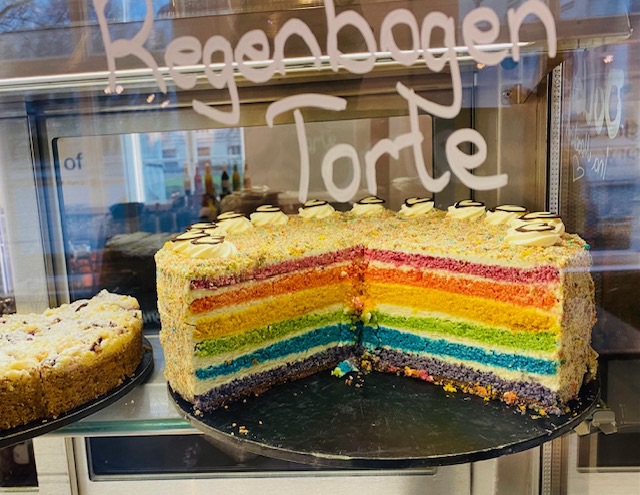
There is a sense of skill loss in watching the trends to increase comfort. We all use washing machines and maybe dishwashers. Households can save a lot of time by using those machines. Some porcelain and clothes should not be left to the machines. The need to organize traditional washing routines is almost forgotten after 1-2 generations. The same holds for many technical skills. Bicycle and car repairs or small repairs of electrical appliances are delegated to specialized repair shops. Not using or having learned these skills puts you in a form of dependency and at the risk to pay a price for specializing on other skills. Find out and focus on what you are best at. This has been the mantra of economic theory since Adam Smith. The potential value of satisfaction with an own production rather than a bought product is frequently acknowledged for baking cakes yourself rather than simply buying one in a shop. The same rationale holds for many other skills. Autonomy of own production with possibility to improve or repair are forgotten values. The have become a luxury item or a necessity for persons lacking financial spending power to buy products from others. Many skills will be lost rapidly because products have become so cheap to replace or order for home delivery. Industrial production is desperately searching for skilled persons but losing skills is pervasive at the same time. Public schools and academic curricula will not be able to stand the tide of pervasive skill loss.

Postmodernism

The grand narratives of the modern world, like modernism itself, are under serious criticism. Deconstruction of the modern way of thinking has become philosophical mainstream. Economics as a science is in the middle of the behavioural shift and changing or at least complementing its narratives. Sociology has embraced postmodern thinking in theoretical as well as empirical forms (Mirchandani, 2005). The empirical measurement focuses a lot on the groups and people who hold postmodern beliefs and values. The discussion in the social and literary sciences continue. In the arts reading on modernism and postmodernism is a must in order to understand much of contemporary art or art from the 19th and 20th century.
Bookstores in art galleries that cover long spells of history can make surprising links between historical periods of art. Books of postmodernism appear next to books on romanticism. A lot of the ideation of postmodernism rejoins romantic depiction about nature, re-naturalizing or the emotional connotations of wildlife, isolated places and stillness.
On the other hand, we are confronted with the brutal world of war, drugs and crime. Classical warfare and strategies are back in Europe with tanks and rockets killing like in previous wars. The Russian empire of a specific version of modernism strikes back as if it were to stop the postmodern turn of the 21st century. Neo-fascism tries to build on the losers of the transitions to the socio-ecological economy and society. There are manifold backlashes of modernism, but the postmodern world is under continuous construction, most of in our mindsets.

AI or I

Generative AI receives a lot of attention. One of the main issues is, to study how AI interacts with humans. The hiring decision by managers or an AI algorithm is an interesting application. According to Marie-Pierre Dargnies et al. (2022) the preference for human decisions remains strong despite reasonably unbiased performance of an algorithm. The main issue is with the transparency of the algorithmic decision-making. As a worker or as a hiring manager the preferences continue to sit with the person rather than the AI. It is a worrying outcome, however, that if the rule of gender equality is removed from the algorithm both workers and managers tend to prefer the algorithmic outcome. I interpret this as a latent preference of study participants for gender bias, which could lead them to expect a more favoured outcome in case the AI makes the decision. Knowing what decision-making rules have gone into the hiring algorithm has an impact on all persons involved.
A new managerial competence is to be able to assess tasks carefully, whether you should perform the task yourself or delegate to AI. In this sense the old question: to do the task yourself or to delegate has simply been enlarged by an additional delegation option. The decision-tree goes from (1) To delegate or not to delegate, and (2) if I want/need to delegate, should I delegate to AI or somebody in person (not allowed to use AI).
I opted to use AI for image creation rather than to take a photo myself or by one from a professional photographer. (Image creation: NEUROFLASH AI – Image-Flash 2024-1-26)

AI and We

Research is beginning to provide empirical evidence and experimental modelling results on the widespread use of generative AI. First results by Doshi and Hauser point at the individual benefits of using artificial intelligence but the widespread use of it is likely to narrow the scope of novel content. This research is particularly interesting because it deals with the micro level to macro level aggregation effects. It is fine for me to use AI. If it becomes a mass phenomenon, we expect in sum a negative outcome for society as a whole.
The example at hand deals with the capability to innovate or to come up with novel content. As more and more texts or newspapers are published with extensive use of genAI, the real element of creation will remain the domain of humans for quite some time.
In my opinion this is due to the difficulties for algorithms to differentiate between the positive and too risky negative aspects of innovative solutions. A query for AI might ask to come up with an innovative solution for auto-mobility of short distances. A human being might propose walking due to the additional health effects the AI might propose helicopter lifts. The not so stupid machine would need a lot of additional information about circumstances to generate useful solutions. Therefore it is not surprising that sometimes public transport apps propose to walk short distances rather than waiting for “delayed or unreliable services“ they provide themselves. Personal circumstances like mobility with children, other dependents or luggage are usually beyond the scope of the information base of the algorithms.
On the other hand, if the AI knows that 50.000 persons after an event want to take public transport at the same time the indication to walk or wait solves an aggregation problem of individual preferences to adapt to available capacities. Lots of issues to solve for AI and us or better yet, us and AI.
(Image creation: AI using Microsoft Dall-E Image creator: Prompt: a person with notebook in profile and in front of 5 other persons in Office with windows 26.1.2024, 8:24 PM)

Shrinkflation

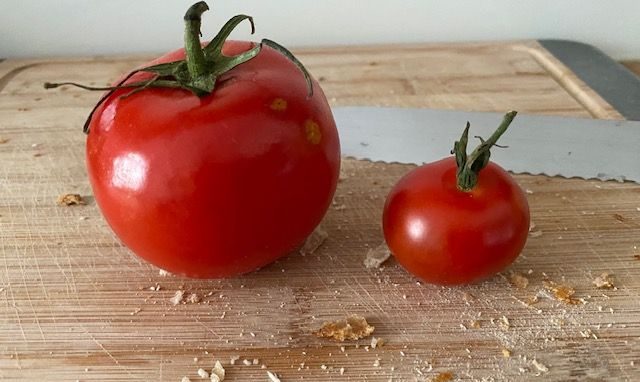
Shrinkflation is a hybrid term that combines “to shrink” with “inflation”. The trick is to keep prices at the same level for a product, but to reduce the weight or amount sold at a constant price. The intention of producers is to indirectly increase prices without touching at price tickets on products. As consumer you are likely to remember the price tag of a product, but much less the unit costs. However, the unit price is the basis for fair comparisons. In supermarkets there is an obligation to print also unit prices (€/kg or €/L) next to price labels. Comparisons allow information irrespective of package size. In shrinkflation the higher unit costs of a product will drive the official measure of inflation (Destatis, 2024). In Germany inflation for food had the top inflation rate in 2023, surpassing even price rises for energy.
On the one hand, shrinkflation is cheating on consumers to sell them less for the same price. On the other hand, oversized products that solicit higher consumption are part of the health and environmental problems we face. The obesity pandemic is part of the XXL consumption hype the food industry and supermarkets have created. In this respect, more expensive food (Eurostat info) potentially may trigger the rethinking of consumption and nutrition. “Eating better instead of less” has always been more expensive.
Besides the profit-maximising logic of shrinkflation, there is at least a small hope that behavioural changes might be triggered to consume less, to use less detergent in washing, less sugar drinks, smaller size pizza and so on. Shrinking our food intake is part of the solution for many problems. In the end cutting out most convenience food will save you a lot of money. As a side effect of such behavioural changes, eventually prices are likely to come down some time later again.

Narratives

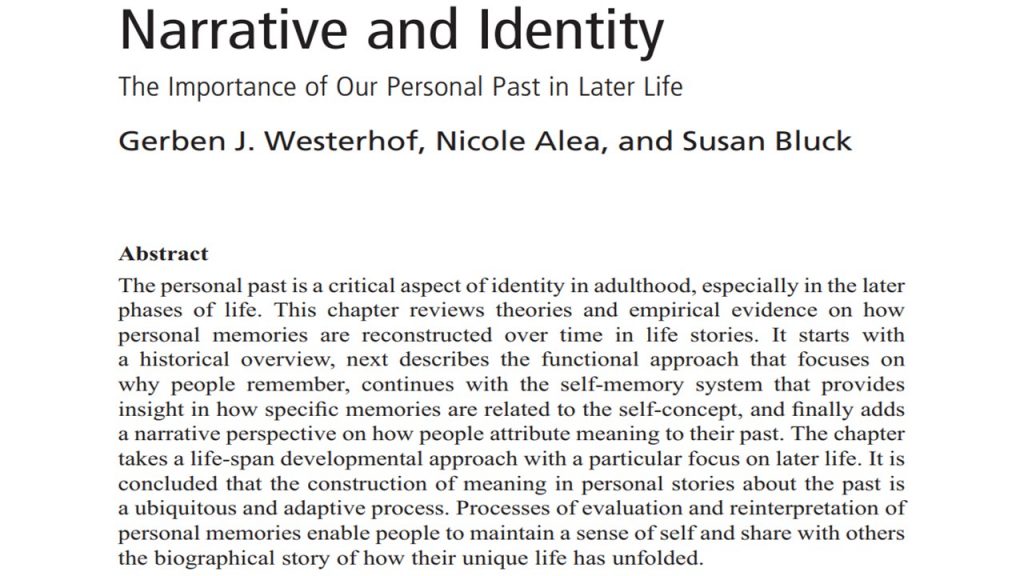
In psychology it is a long-established field to study narratives of persons as they age. To make sense of individual narratives might even be considered as one of the foundations of psychological research since its starting times. “The Cambridge handbook of cognitive aging : a life course perspective” has 2 entries that enlighten the issue of personal life stories or narratives. We have to consider the importance of our personal past to the construction and reconstruction of our personal narratives. As persons age reconstruction of narratives becomes a more frequent exercise as life experiences and new evidence continue to accumulate. The chapter on “narratives and identity” supports the view of plasticity in old age, which means that narratives and identity are an adaptive process. “Processes of evaluation and reinterpretation of personal memories enable people to maintain a sense of self”. The importance of recalling personal life events and positive self-regard is a well-established link in this research tradition. The self-memory system consists of the autobiographical memory, the self-concept and the working self as its components. It is evolving in most persons as part of the construction and reconstruction of the self, as well as narratives of it.
As persons age our brain and memory functions age as well. This starts earlier than most people expect. “Many studies in gerontology have shown that being able to remember, evaluate, and integrate personal memories and thereby dynamically maintain identity is related to mental health and well-being in later life (Westerhof et al., 2010).” (p.392). Reconstruction of narratives is a process that is hard work for our brain, therefore as people age many seem to shun away from these tasks. It is easier to clinch on to the old narratives of the self.
The chapter on emotion recognition and aging of the social brain summarises the research (p.369) by Ruffman et al. (2012, 2016) which shows that older persons were not as good as young persons to detect lies due to difficulties with emotion recognition. “Finally, we examined right-wing authoritarianism (Ruffman et al., 2016), that is, the tendency to hold conservative social attitudes (e.g., believing that women should have to promise to obey their husbands when they get married). Older adults had more pronounced right-wing attitudes than young adults, and even within the older adult group, these attitudes were entirely explained by their worse emotion recognition”.
The causal link, however, is less clear. The positivity bias in old age might be a major factor. The positivity bias describes the fact that older persons prefer to look at positive stimuli and avoid negative stimuli. The evidence is rather inconclusive about this effect. Probably persons have a positivity bias all along their life course as part of their personality traits. The other explanations of brain region decline and activation seem to receive a bit more empirical support (p.375). In any case, men seem to be even at higher risks.
Archives of personal diaries, letters, correspondence of persons are a valid additional source to study the process of the construction and reconstruction of the self. Biographical accounts of life histories serve as empirical material to analyse narratives and historical validity of narratives. The better the story, the more scepticism should be applied.