Sunny future

The use of solar panels for energy production is a standardized process with decent returns on investment. Combined with heat pumps and the potential of decentralized energy production, storage and consumption makes jointly for reducing emissions. The planning, investment and installation with digital tools allows to reap further benefits through the ease of coordination of all processes. The « All electric society » will take hold of homes and mobility. The climate and business case for this societal change is obvious, but the risk of new forms of inequality may arise between the one able to make such transitions now and the ones without the means to shoulder investments at the same time with other budget restrictions. The change has to start in our minds first before action will follow. In any case, the solar future takes hold of more and more people. Have you checked your amount of solar energy production already today?

Solar panel energy
Screenshot

Smart Heat Pumps

The potential to reduce CO2 emissions through the replacement of fossil fuels with heat pumps is huge. The technology is well known and has reached a considerable amount of maturity in the mid 2020s. Noise is much less an issue even at higher compression rates and during the use of booster functions to cater for peaks of hot water or home heating. Combined with solar energy the local production and consumption of energy turn each household into a “prosumer” of energy. Besides the initial investment you have to find capable technicians and enterprises that master the installation of the technology with the necessary care and ensure the adequate calculation of the envisaged energy needs of the household. Household and family size matter, and this is not easy to project into the future. Additional saving potentials can be harvested through the use of smart home applications. Switch off the heating before you leave or if a longer than previewed absence occurs. Just do it if you are away from home. Alternatively, just start the heating when you get on your way back home from work rather than at previously estimated, but fixed times. Smart technology is just perfect for such use cases.

testing testing

Before the installation of the new AI chatbots or other agentic AI, they need profound testing. Wise statistics are quoted with the conviction: it is all about testing, testing, testing. Any systems that build on statistical reasoning (LLMs or machine learning) will behave erratically on what is known as an area with stronger impacts of, for example, statistical outliers. On both ends of the “normal distribution” of events or reasoning the statistical models and algorithms used in AI will produce “spurious” errors or have larger error margins on such topics a bit off the 95% of usual cases.
This means, testing, testing and testing again for the programmers of such AI systems before the release to the public or enterprise specific solutions. The tendency to keep costs of testing phases low  compared to developing costs bears obvious risks to the “precautionary principle” applied in the European Union. Testing is most important to check the WEIRD bias of the most basic AI systems. In this sense AI development has become a sociological exercise as they have to deal with “selection bias” of many kinds that could have very expensive legal consequences.
(Image: Extract from Bassano, Jacopo: Abduction of Europa by Zeus, Odessa Museum treasures at exhibition in Berlin Gemäldegalerie 2025-5).

AI Workday

Our workdays have seen considerable changes throughout the last few days. The home office boom has allowed employees to work for extended hours from home. The there is an abundant literature on the effects of home office work on well-being or the work-life balance. Productivity gains could be reaped by employers and a better work-life balance was a lasting advantage for employees.
The increased use of AI specific to some occupations has introduced a new form of added  productivity for some occupations or professions, AI as complementarity, whereas other occupations suffered a higher risk of being substituted by AI applications.
Based on time diary data, the study by Wei Jiang et al. (2025) reports that users of AI have longer work time and reduced leisure time. Competitive labor markets increase the pressure to put in even higher hours of work. Nerds, just like workaholics, are likely to be drawn into excessive hours of work with increased health risks. Enterprises and consumers appear to be gaining more than the employees, who are at a higher risk of loosing out on their work-life balance over time.

Archers destroyed

In the attempt to explain modern warfare to people, the Roman and medieval languages are staging a comeback. The archers have found their way from warfare into art history and back again. George Barros explains recent defensive actions by Ukrainian military forces as the strategy to put the archers out of power rather than the arches.
Destroyed or unfit air planes can no longer launch missiles or bombs. The Russian reserves are, however, fairly numerous, but the air strikes on the modern archers have demonstrated an astonishing military intelligence on the Ukrainian side. The technological advances of the Ukrainian military services may shift the balance or raise the costs of war to Russia, considerably.

Travel Trumped

The travel and tourism sector of the U.S economy takes quite a hit from Trump‘s anti Canada and Europe tariffs and rhetoric. The Wall Street Journal (2025-6-3) reports data until May 2025  which show a 6% decline in international air travel and a 12% reduction in air arrivals from Europe (reference same period last year). Canadians seem to reduce their travels to the US as well, hitting many regions just across the long joint border. Airline bookings are an early warning indicator, but the more drastic figures are to be expected from the loss of spending tourists do not dispense in the US any more. Additionally, sizeable shares of US tourists travel to other countries due to the disgusting Trump rhetoric and spend their holiday budgets elsewhere. Trump‘s tariffs has focused a lot on redressing the trade balance of goods, but the balance of services like in tourism is worsening day by day now. The political economy of tariffs has multiple feedback effects which are quite hard to predict.

Citizen Walk

Capitals like Paris and Berlin make great efforts to improve the walkability of their cities. After decades of focus on automotive traffic and mobility and the detrimental effects on health for several generations of people, the awareness that walking citizens are part of the solution is spreading. Citizens of Paris voted in a referendum to stop circulation of cars in 500 more streets. In Berlin pedestrians unite to mobilize more people to take to the streets as well and reclaim walking space. In high density spaces like metropolitan areas it is possible to reach all major amenities within a reasonable walking distance. The more spread out suburban area, however, leve fewer options to walk and carry your shopping or do your dily commute to work while walking. Fewer cars and pharmaceutical products sold would mean less „artificial economic growth, but more healthy and happy citizens. It will take decades again to realize such visions.

Paris Gare

Train stations in metropolitan inner cities are hot spots of traffic and mobility. The number of people passing through these exchanges are impressive. Public transport systems are continuously put to the test of their capacity to handle passengers who want to get from A to B the fastest way possible. In Paris the RER lines, metro and buses to a great job in handling the affluence of passengers. The comparatively small number of passengers arriving and departing nyy taxi, however, still take a disproportionate amount of space. That’s part of the differentiation or inequality of mobility in Paris. Person‘s in need of assistance should have special access to central points of mobility like train stations. Everybody else could rely on shared modes of transportation otherwise the millions of inhabitants will not be able to get around in a comfortable way.


Memories updated

In Berlin and many other German cities it is a regular practice to scrutinize the memory inscribed into street names. In order to correct the honors given to persons with a past as fascist or responsible for mass killings street names were changed at several points in the history of the city. Streets named after battle fields, for example, are a continuous point of discussion. It is important to keep the perspectives of victims in mind. Therefore, changing street names is a little contribution to rethink the role of places and persons. Such changes are sometimes very controversial as people become accustomed to names, some might even not care much at all. Recognition and responsibility, however, have a lot of currency in historical perspective. Overpainting like in the paintings from Gerhard Richter has an important function in society and can be one way of coping with the demons of the past.

Retirement Recruitment

The debate that later retirement of seniors reduces the hiring of youth has received new attention. Paul Mohnen published a paper on the “retirement slowdown on the US youth labor market” , which demonstrates this “crowding out effect”. Moreover, the recruitment of middle aged workers is also affected, as job changes slowed down for these age groups. The surprising finding is that higher skilled youth suffers the largest reduction in employment opportunities and become “pulled” into lower skilled jobs as jo offers for lower skilled persons remained high during the observation periods (until 2017!). This evidence suggests that the well-documented firm-level effect of fewer retirement means less recruitment holds also for society as a whole. Knowing that recruitment during a recession affects young workers more than persons already in employment, the macro level effects in 2025 will be rather unfavorable for young labor market entrants. (Image Frans Hals 1625, Odessa Museum in Berlin exhibition 2025).

Draft Lottery

For decades the “intergenerational effects of the Vietnam draft on risky behaviors” has been overlooked. Deza and Mezza (2025) identified several changes in parenting styles (PS) due to existence of a draft lottery. PS like uninvolved, permissive, authoritarian become more frequent. Similarly, risky behaviors of their children like smoking, drinking and drug abuse tend to increase. According to this new evidence on an old strategy to recruit military personnel the effects are not only directly on the persons drafted, but have lasting consequences onthe next generation as well. This increased overall the burden of going as well as preparing for war in the societies concerned. In view of the Russian aggression on Ukraine territory the consequences for both countries are considerable and shall be transmitted to future generations as well. Even neighboring countries fear and feel the heat of recruitment for armed conflict.


Artist Development

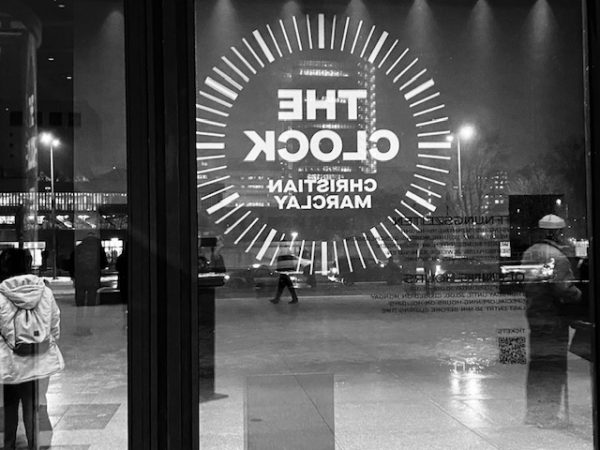
For many artists it takes years before they find their idiosyncratic style. Testing different forms of art before zooming in on a particular style of art is the  common trajectory for most artists. Maybe the art marker and collectors of art are in search of a “defining style” for an artist so the uniqueness becomes more easily identifiable. Being part of a group of artists has been beneficial as well. The “Neue Nationalgalerie” in Berlin makes this development of an artist, in this case Lygia Clark transparent through the organization of a retrospective devoted to her evolution from abstract paintings towards participative and more organic forms of art. Berlin offers to interact with the pieces at the exhibition. You become part of the exhibition and the happening of art instantaneously. The form stays the same, the persons interacting change permanently. The piece of art is never the same. Just the idea of it thrives. In the Corpo Colletivo the performers wear an overall, all of them are linked to each other and movements happen organically as a group rather than individually. This is like a tutorial in sociology as individuals move as part of a collective body and feel the embeddedness and multiple links to other persons (Image: Corpo Collectivo 1970, exhibit in Berlin 2025)

Killing fields

According to “Le Monde” dated 2025-5-26 the persons who died in the war initiated by Putin amount after 3 years to 250.000. The numb of injured soldiers would be 3-4 times as high. The loss of lives and tarnished life expectancy of persons involved in combat adds up to a huge loss for the Russian people. Being misled by political and military leaders, apparently substantial numbers of recruits for all sorts of services face the choice between the combat field or desertation. Tough choices which remind us of the moral conflict raised already during peace times if you were refusing to join the compulsory military service. Western people are better prepared for such moral dilemmas than the glorification of war in the Russian society. Of course, certainly in Germany we are thankful for the hardships the Russian army and people had to endure during the 2WW. Liberation Day would not have happened without the Soviets, Russia and Ukraine plus many other nations fighting until Nazi- Germany surrendered. The positional battles of the Great War seem to be back again enhanced with a war of drones. The killing fields for a generation of Russian troops is completely self inflicted. How many thousands Putin needs to acknowledge this cruelty? (Image exhibition by Yoko Ono Berlin Gropiusbau 2025-5).

Odessa Berlin Odessa

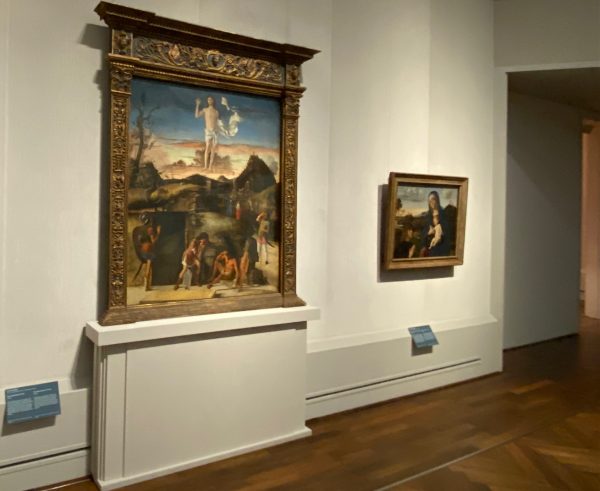
With a sense of partnership, it is possible to travel between Odessa and Berlin in the “Gemäldegalerie” in Berlin 2025. Due to the war of Putin in Ukraine the “Museum of Western and Eastern Art” in Odessa had to relocate its treasures to safe places. The Gemäldegalerie offers a chance to view the splendid collection nevertheless. The curators’ team in a spirit of “art intelligence” propose, in a splendid way, most oeuvres from Odessa next to an example by the same painter from the Berlin collection. The visitor leaves the exhibition enriched by an experience of “jumelage” (engl. sister cities) of partnerships between museums, cities and their people.
In fact, we have shared the same imagery or visual heritage in Europe for centuries . The collections of paintings ranges from the 16th -19th century art  or from Frans Hals to impressionist influences.
We shall cherish the return of the collection to Ukrainian Odessa as soon as possible. The image below shows the places of origin (yellow dots) of the art works of the Odessa collection across centuries (map from the exhibition).

Robot repairs

Robots have been used mostly in industry for assembling, transport or sorting tasks. There is also a role in disassembling to enhance circularity. To repair electric or mechanic devices there is an enhanced version needed which starts with a diagnosis of the problem. Algorithms can sort out promising from dead end routes of repairs. However, the recognition of objects into things that can be repaired and those without repair potential is a worthwhile assistance. Beyond the economic and ecological rationale for repairs, there is an emotional or nostalgic sense to it as well. Maybe, from a life course perspective any object related to the teenager years of a person qualify for nostalgic value. Even simple robots or AI-assisted objects may qualify for this in future. Artificial friends will be like tamagotchis in need of repairs.

Repairs again

Trying to repair electric or mechanic devices is confronted with multiple obstacles. Spare parts are hard to come by and many pieces needed are no longer in stock. Hence, in many instances the remaining option is to use recovery pieces from other broken or discarded devices. Whereas this is still common for repairs of vintage cars, for example, this is rather rare for consumer electronics like stereo music players or television sets. An aging clientele of the repair market is very used to a specific device and is often reluctant to change habits. 

An additional element in the repair process is access. Only in thinking repairs into the engineering and design of the device will make repairs feasible later on. An economy and business model which is based upon a high turnover as the basis for profitability has no interest in engineering for repairs later on. This makes a preservation of resources tricky. Disassembling is a necessary but not sufficient condition for the repair sector to thrive. At least the basic materials enter into a circular economy as a first step. Further steps consist in preserving the skills needed to disassemble and/or repair more. The habit „buy a new one and throw away the old one“ is hard ro change. 

Dépaysé in gallery

The installation ar the Neue Nationalgalerie in Berlin entitled „Fog Sculpture“ takes us from the sculpture garden of the Gallery into a tropical forest atmosphere. Just changing the humidity and visibility through the artificial production of fog transforms the perception of the artworks. A kind of Asian flair surrounds the western sculptures in the garden. The fog installs also a mystification whoch we know in art from the romantic painters like Caspar David Friedrich for example. All long-term followers shall appreciate the new perception of the artworks thanks to Fujiko Nakayo. It’s definitely more than old wine in new bottles. The artwork brings a more global twist to the preexisting sculptures and reminds us in Berlin even of the wrapping and unwrapping of the  Reichstag building by Jeanne-Claude Christo. We see the sculptures or architecture differently after they disappeared temporarily and reappear again.

Humanoid services

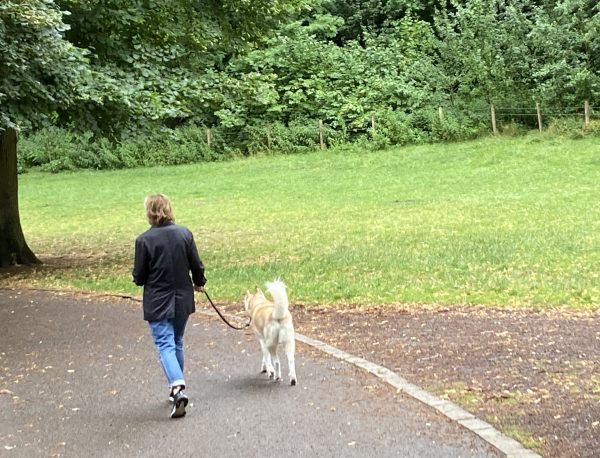
In the shadow of AI enhanced chatbots, agentic AI and generative Ai, the developers make considerable progress in robotics. The humanoid versions like from Persona AI will surround us in months, or maybe a few years from today. Investors believe it is rather sooner than later. There are many use cases for humanoids that may take over dangerous, hazardous or unhealthy tasks from humans. But even simple tasks like carrying home most of our shopping could be done for us by humanoids that follow you around the shopping mall and home. This would be a kind of personal assistant. I even thought of my humanoid robot to walk my dog on some occasions on the usual trail. 

Welcoming visitors at the doorstep could be another function to delegate in offices or even in private homes, although as a sociologist I would recommend to carefully check the sorting algorithm(s) applied to avoid unpleasant situations. The administration of medication might be another option, if only we could trust that the correct dosage would be applied. 

Maison de santé 1861 Berlin

In the middle of the 19th century Berlin was a small city. The area of Schöneberg (pritty hill) was still perceived as the rural outskirts and featured the first botanical garden next to the town center. A little bit more outside of Berlin the “Maison de santé” was founded as early as 1861 to cure mainly respiratory diseases and what later became the first private clinic proposing a new way to treat psychiatric disorders. Dr. Eduard Levinstein was the founder and the clinic had continued its operations for almost 50 years with his wife and sons taking the lead later on. Prof. Wilhelm Griesinger, known for the scientific approach of psychiatry was a proponent of the non-restrained approach to psychiatric disorders, which allowed persons move more freely while being supervised. The documents and the publication (1877) shown in the exhibition at Museum Schōneberg demonstrate the scientific approach to the treatment of addictions, most notably morphine, which had been widely used during the war of 1870 as tranquilizer and pain relief. The wave of addictions needed hospitals and clinics to treat these addictions. The “Maison de santé” had been established as a retreat and cure for other addictions as well. The memory of the early scientific approaches is an inspiring place and reminder to take care of all forms of addiction. Taking care of body and mind is still the state of the art approach today.

The Exhibition catalog is forthcoming, but the visits and material on display of interest beyond the inhabitants of the „Pritty Hill“. Exhibition catalog is forthcoming

Berlin building

Yes, 35 years after re-unification Berlin is still building at lots of places. The boom years of building hotels for tourists, offices for ministries, which were moving from Bonn to Berlin, is now followed by a „surprising“ need to have sufficient vacancies in private housing. Berlin is still growing in terms of population and, of course, this creates additional upward pressure on the housing market with particularly high increases on the rental market. In order to achieve a narrowing of the gap between demand and supply, Berlin is building higher as well as digging deeper into its sandy ground. In such huge open spaces near Südkreuz it is then feasible to explore and later exploit geothermal energy for years to come. Maybe it is not a surprise that apparently a Texas (USA) based investor has bought the ground and builds in Berlin. Drilling in Berlin for energy from underneath is a worthwhile business. Hence, drill baby drill has a new Berlin meaning to it. 

Dream together

Dream together“ is the title of the exhibition of Yoko Ono at the „Neue Nationalgalerie“ in Berlin 2025. The title is an invitation or even an incitement to dream jointly with others. We need to dream of peace on all sides or parties in a war. Start with the dream and then move on to working together on it. The participatory art projects of Yoko Ono are a recurring event in Berlin and at the Neue Nationalgalerie (Cut piece). The installation „Wish Tree for Berlin“ in front of the gallery is popular with visitors who leave hundreds of written wishes to the windy spring days. Origami folding, stone assembling or a simultaneous chessboard playing with all white pieces and fields encourage to imagine a world differently, beyond the treaded belligerent paths. For more inspiration and imagination just continue to the Martin Gropiusbau for more artworks from Ono or just watch the clouds pass by changing the lighting of the olive tree carrying lots of wishes.

Permanently anxious

„There’s a set of forces that want us to be permanently anxious“, is the phrase chosen by Tony Cokes in the exhibit just outside the „Palais Populaire“ in Berlin in 2025-5. International politics and the economic upheaval caused by Trump’s tariffs contribute to the already existing other sources of anxiety like nuclear energy and warfare. Global warming causing more extreme weather events add more man-made reasons for anxiety. The next generations will have to foot the bills we have left to them unpaid. Our current shortsightedness increases anxieties which previous generations have not known of a similar kind or in that combination. 

Community building and solidarity are ways to overcome such overwhelming anxieties. Supranational organizations like the European Union have an even stronger role to play to reassure its people with credible signs of solidarity. We are not alone in the struggle to overcome the anxiety that is creeping up around us. We are certainly stronger together than individually dealing with unspecified fears. „We shall overcome …“

Margot Friedländer memorial

Berlin has been honored by the return of Margot Friedländer who had survived the Shoa in 2010 at the age of 88. Her whole family was murdered in concentration camps by the Nazis. Ever since her return and especially after her biography had been published she was a restless ambassador in the fight against hate, exclusion and the neo-fascist movements. She has been engaged in interreligious dialogue and even through the ceremony after her death, she tried to bring together different Jewish communities in Berlin.
Irrespective of a person’s background she met everybody on an equal level.
A great example to thousands of people, she managed to meet in her life. Each time she met with pupils or students to speak about her horrific experiences she lived through the same traumatic experiences again and again, but turning this into the strength to “vaccinate” people against the deadly virus of fascism.
The day after she had been buried in her family’s grave in Berlin Weißensee people still had to queue to sign the book in her memory in the Berlin town hall. She will be remembered and missed for her unrivalled humanity and generosity. She became engaged to fight for humanity and remained an activist until her very last day at 103 years of age.

Lviv Ukraine

Small galleries can make a real difference. In Berlin the gallery “streulicht” has a selection of photos in an exhibition that portraits artist from Lviv in Ukraine. Hans Hugo Hoffmann manages in his photographs to depict the extraordinary resilience of Ukrainian creative persons who live through a protracted war of their country against the Russian aggressor. The persons embody the strength of resisting through their art work despite the wounds inflicted on their families or the people of Lviv and the whole of Ukraine due to the war. The persons portrayed try to continue their normal day to day work, knowing that nothing is normal anymore in Ukraine. “Bizarre Normality” characterizes our perspective on these artists, who are thrown into a world of events that we no longer thought might be possible in Europe. Bucha and other crimes by Russian soldiers in this Russian aggression leave traces in the faces of Ukrainian people and even beyond. We all wish that the people of Ukraine can return to “normality” as soon as possible, although we know that nothing will be normal as it was before the Russian invasion.

Non-autonomous driving

The more engineers will invest in developing autonomous driving vehicles, the more the value of the few completely non-autonomous cars will rise. A 60 years old car with manual gear changing on the steering wheel like the Peugeot 404 from 1965 (image below) demands a strong effort to steer the car around a city. Apparently, some car producers reintroduce buttons to press or switch on devices since customers seem to prefer some manual activity in addition to the touchscreen technology. Voice guidance and gestures can be helpful for some, but there are also the advantages of manual activities that keep you awake and maybe with better focus. Choice is key to suit diverse user and customer preferences.

AI-assisted

We used to create and use an artificial word to shorten explications in conversations. It is easy to understand for everyone nowadays to describe an online search as “I googled something” without further concerns about the sources used in answering a question. Apple just announced that its search engine Safari was used less than expected recently. The reason might be that more and more people search online by using AI tools or Apps that directly provide answers to their queries. ChatGTP and Perplexity are 2 AI-programs that might replace the other search engines we have gotten used to over the last decades. Particularly “how to …” queries offer reasonable instructions. In Perplexity you get an answer after you specified a little bit your query and, therefore, the answer is more likely to be right to the point offering text, images and sources. In ChatGPT you enter into a dialogue to further specify your query if unsatisfied with the first response. The judgement of an authoritative response is up to you if you want to follow up. The assistance of an AI-system cares less about the source but about the speed of response that it can provide. For sensitive questions or queries with less obvious or clear answers more interactions with the tools is necessary. The pricing and our willingness or ability to pay in cash rather than through the selling of our data for advertising will determine whether we shall “chat-it” or “plex-it” in future.

Leber JA

In Berlin Schoeneberg there is a memorial in preparation for the courageous couple of Julius and Annedore Leber. Julius Leber has been incarcerated several times by the Nazi officials, tortured and finally executed in Berlin. A link to the group of people trying to overthrow the NS regime (1944-7-20) caused his arrest and execution in January 1945. His wife Annedore published several accounts of the resistance movements, which existed during the NS regime. These people were aware of the fact that they were risking their life with such activities, but persisted nevertheless. We owe Julius and Annedore Leber a decent commemoration as we need to remember that such courageous examples existed even until the last few months of the NS dictatorship. The site allows for a building and learning center which could serve as an archive and encouragement to fight for democracy. It is less obvious than we thought it would be.

Local history

In Berlin and many other big cities in Germany like Munich and Hamburg there are local history projects which tell the stories of specific places or a house linked to liberation day or deportation or courageous acts during the Nazi  grip on Germany and terror across Europe. The initiative « Denkmal am Ort » has become a kind of citizen science project which brings people together to raise awareness again for the cruelties committed under the dictatorship of Hitler and the fascist political movements. Remembrance is not a passive form it can take many active forms as well by simply trying to find an answer to the question what happened during the 30s, 40 and 1950s in the house you are currently living in? Access to archives of cities and small towns can tell very surprising stories about local history. It is a great inter generational experience as well and sometimes the unspoken history turns into a great conversation about history and responsibilities. History is everywhere you just need to keep your eyes and mind open.

Technology maturation

Technology has its own time of maturation. The time for wind power generation was quite lengthy compared to some innovation cycles in information technologies. Maybe, due to the fact that large wind turbines had only big enterprises or public monopolies as potential clients who were already heavily invested in even bigger nuclear energy projects caused the slow pace of development of this technology. In Germany just like in Denmark, Sweden and the USA the first larger research projects took off in the mid or late 1970s. The technology is explained by Erich Hau in a comprehensive way including the early days like the « Growian » test wind turbine in Germany (extract of image below). Despite the fact that major engineering difficulties were overcome already in the early 80s, the economic and legal challenges took much longer to resolve. Nowadays, we have an additional case of energy sovereignty to add to the cost-effectiveness of power generation from winds offshore and onshore. In the coming years we are likely to see more and more decentral power generation from wind on roof tops or small poles to complement solar energy during cloudy but windy weather or at night. Just like the sunshine we shall praise the windy days for their power generation potential.

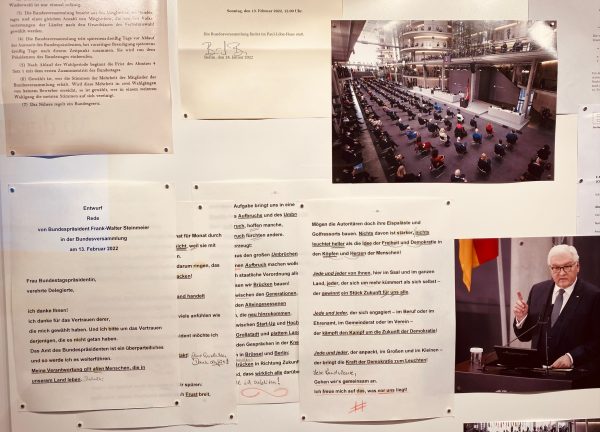
Constitutional Responsibility

The memory of horrors caused by Nazi-led Germany before and during the 2nd World War is our constitutional obligation in the Federal Republic of Germany since its beginnings in 1948. 80 years after the unconditional surrender this has become a state responsibility. Since the shift of tone introduced by Richard von Weizäcker on 8th of May 1985 framing the end of the 2nd WW as liberation day in Europe and Germany. On the same day, 40 years later, the top 5 political instances of democracy in Germany, president, chancellor, presidents of the parliament (1st chanber), the council of the regions (2nd chamber) as well as the constitutional court. The constitutional and moral responsibility of the crimes is not reserved to a presidential address, but all pilars of democracy in Germany committed to the narrative of a liberation of Germans and Europeans at the end of the 2WW. It is a truly European topic to celebrate the end of war jointly in all countries. This is even more the case as the memories of the last survivors of the Shoa in Europe is less transmitted by the rare survivors until today due to very old age. The impressive unity of the top constitutional powers sets a the path for a far reaching renewal of the acknowledgement of a specific constitutional responsibility to counter extremist tendencies. The speeches by Frank-Walter Steinmeier and Julia Klöckner in the Bundestag (Link in German) were remarkable in explaining in plain language, why we are happy about this liberation also in Germany. The emphasis of the end of pervasive and endless oppression and suffering caused by the Nazi-regime are an essential part of this feeling of liberation. With this commemoration Germany today has become even more a European nation which takes its historical responsibility seriously.