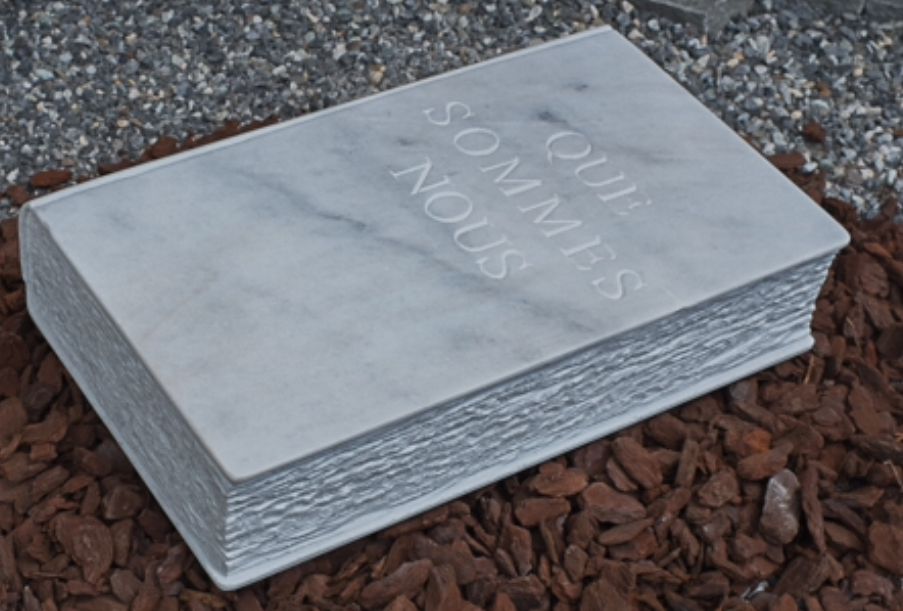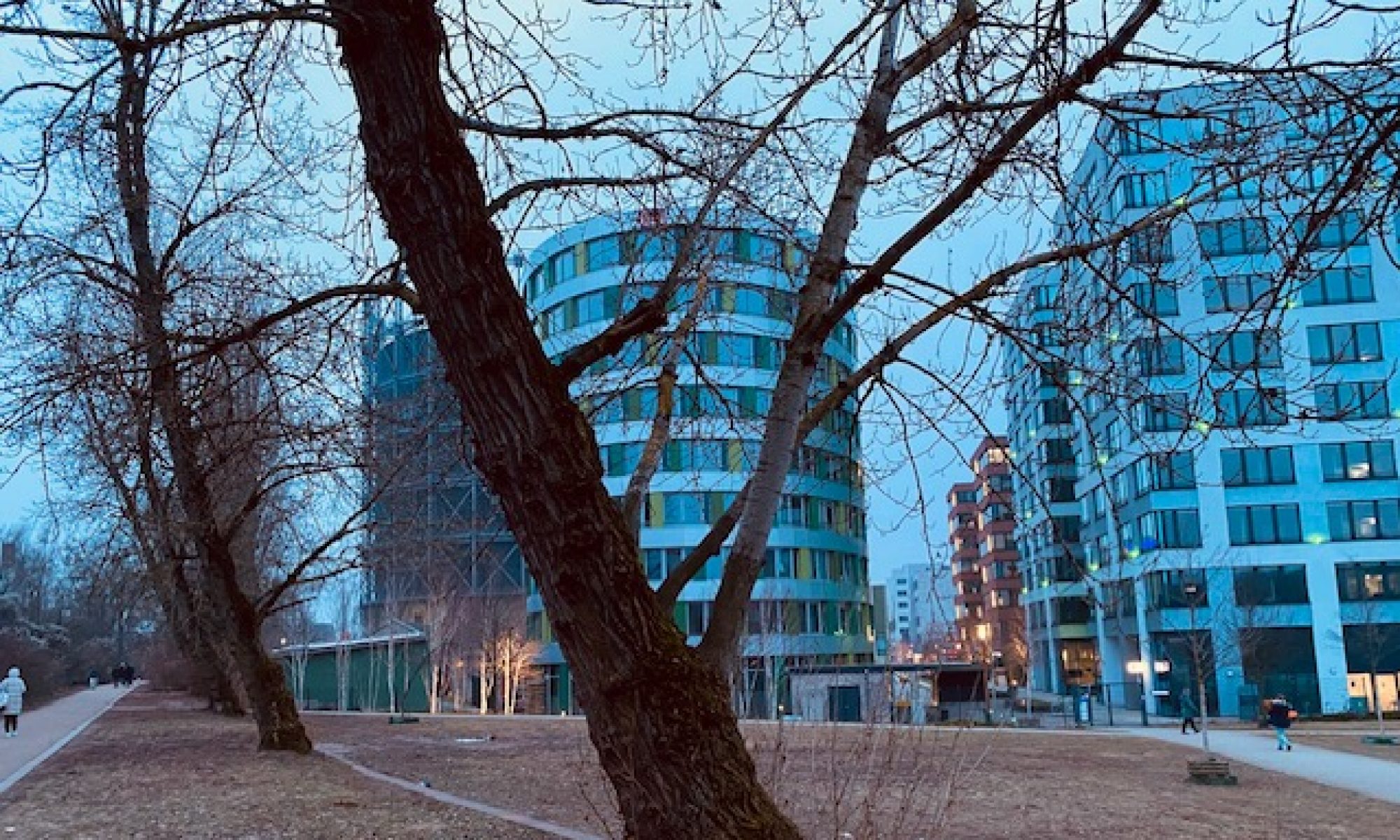

Sometimes people believe they can catch a bit of fame, if they live in a prominent neighborhood. Next to a famous person or the glamor surrounding such a place is inspiring. In Berlin the honor or fame is transmitted for example with the street names of composers. Everybody knows Johann Sebastian Bach and around Christmas time many of his compositions will be performed again. Directly next to Bach street we find Flotow street. It needs a bit of info about music and music history to identify the honor for Flotow to appear next to Bach. Well, Berlin you are „wunderbar“. You have made my day just on one of the first few days of the direct train connection between Paris and Berlin started. We grow together in small steps. 
Reconciliation
European history is a long history of atrocities committed against humanity. The Documentation Centre for Displacement, Expulsion, Reconciliation in Berlin (Image below) captures this history in a comprehensive manner. We are quickly overwhelmed by this weight of history and the implications this has for the understanding of the people on the globe. This relatively new learning centre has, beyond the memorable permanent and temporary exhibitions, a room of silence to recover from the hard work of remembrance, always in view of reconciliation.
The library allows personal search and research of migration documents and biographies. All centuries have their history of displacements, but the Nazi terror surpassed all prior records and forced millions into displacement or death. We are still working on this heritage and the enlightenment of how these atrocities could take place. Full consciousness of the terror and horror of the 30s and 40s is necessary to guard against the many attempts to falsify historical events or discard the sorrow of millions of people and their families.
Reconciliation remains a continuous challenge. A large part of diplomacy has to deal with reconciliation beyond concerns of daily affairs. It is not just a matter for head of states and days-off during a year. Stillness helps to deal with the challenge, especially if it is very difficult to find adequate words. 
On Woke-ability
The past particle of “to awake” is “woke“. As early as the 1960s the term woke has appeared in a New York Times article to reflect the idea that in the African-American History movement you woke up to a new movement, leaving behind discriminatory practice and rhetoric. The definition of woke in dictionaries refers to an awareness of social facts and injustices. Additionally, the use of woke has implied a need to act upon injustices due to social and/or ethnic origin. Elements of the woke movement were the use of more general non-discriminatory terms like people of color (POC) in official documents and revisions of textbooks for pupils. Subsequently, the application of the term woke spread to other social concerns like the discrimination of LGTBQ+ people in many societies.
The underlying concern was and still is (1) to recognize the discrimination and disadvantages faced by many groups in society and (2) a call for changing the way we talk about it and (3) a shift of policies to counter social injustices. Societies differ in the capacity of “woke-ability”, i.e. the capability to address social inequalities of various types including intersectionality. Societies have never simply been only homogenous. Heterogeneity, plurality and complexity are much better suited to represent societies, regions or countries. It is our willingness to deal with these complexities in an open way which includes the “woke-ability” of social phenomena. Acknowdge a social problem and act upon it. Change the way we talk about a problem and the discoursive practice in general are important steps to address old and new social problems. For example, over the last 50years the discourse with respect to handicapped persons has evolved and the Paris 2024 Paralympics have made this clear to the public on a global scale.
(Image: Installation of Daniel Boyd in the Martin Gropius Bau, Berlin 2023)

On Temporality
Time is passing, or is it? We tend to confound time, with passing of time or an occurrence at a specific point in time. Time has a static use, which refers to a date of birth or date of death. Time refers to durations like the lifetime or time in office of a person or a political leader. In most such cases time is considered as a continuous and linear process. The concept of temporality questions these common perspectives on time to allow additional time perspectives in the description and understanding of time.
Temporality is linked to a more flexible view on the periodization of history. The time before and after the 12 years of Nazi-terror will then be part of the extended periodization of the Nazi-Regime in Germany and Europe. Similarly, temporality widens the perspective on social phenomena by linking historical events to the time before and maybe even to what follows, seen as a consequence of the temporal and spacial co-evolution.
A deviation from the static view of time and a rigid periodization of fascism allows to study the Russian male dominated political authoritarianism as a new wave of fascism in Europe, which negates the right of existence of the state of Ukraine in its neighborhood.
Temporality expresses the need to go beyond a simplel periodization to include a spacial dimension in the defintion of time, much like modern physics does in relativity theory. Temporality, therefore, opens up a “thought space” beyond just the timing of events, which may challenge many of our day-to-day experiences. Cultures with a different understanding of time or the pace of time become a “sound board” for our way of considering and being captured in a time space. Probably many artists are forerunners in playing with time and the way time is “treating” them. Most of them face(d) hardship during their lifetime, but have an extended “after life” in terms of reputation. Some contribute to the perodization in the arts and of their time. They all shape(d) temporality.
(Image: extract from Hans Bol, 1593 Ring Jousing in front of a pond inan imaginary city, MRBAB, Brussels)

On Complexity
The famous quote from Marc Bloch on complexity with reference to history states that history is always more complex than a single perspective or interpretation suggests. Therefore, it is advisable to consider several perspectives on the same subject and, maybe, add another one. In maths the term complexity is probably primarily understood in the sense of complex numbers that go well beyond the arithmetic of counting. Many dimensions of a complex problem might, first of all, necessitate a thick description of the problem to then identify (scientific) disciplines that might contribute to disentangle the intermingled lot. Most of the time it is assumed that a single discipline could resolve the issue, but as in the example from Marc Bloch on complexity in historical research, different perspectives like the cubist art movement practiced a complex approach to painting and depicting a figure. Accept complexity as the rule rather than the exception and here we are in the middle of today. Unfortunately, too many people want to escape from the complexity around us by pretending to have easy answers to complex issues. (Image: Le Penseur by Rodin, background paintings by Monet, Berlin Alte Nationalgalerie, 2024)

History’s Weight
The artist Damien Deroubaix is currently exposed at the BNF.fr in its historic site Richelieu. Together with and next to some of the historic treasures of the BNF collections the unique exhibition allows to experience history’s weight on our current existence. The work of Deroubaix is following and pursuing historic art trajectories with a special historical and ethical consciousness. Techniques of art are insensitive to the moral compass of the painter in history. The collections of the BNF like all major European collections have to handle their colonial past and immoral depictions throughout history. Deroubaix accomplished to liberate techniques of art of their colonial linkages and imagination of emperors focusing on humanitarian values. War is horror, in the past and in the present. Genocide in Rwanda is war crime and dealing with the memories of people an honorable way to look forward conscious of the past. Hybrid forms of art allow multiple contextualizations of his work. In the Galerie Mansart and Pigott of the BNF the historical embedding enriches the art and vice versa. Art allows us to rise beyond the ashes mankind has and continues to inflict on us. (Images: extracts of Damien Deroubaix at BNF, Paris 2024)


Nazi SS Terror
The permanent exhibition „Topography of Terror“ in the middle of Berlin is always a place that receives a lot of attention from tourists. This is great news. The central location is certainly part of the success story. The Brandenburg Gate and the boulevard„Unter den Linden“ nearby allow to combine historic interests and site seeing. Many groups from schools gain a visual impression of the terrorism the Nazi dictatorship and its para-military organizations have exercised during the years 1933-1945. The years after the 1st World war until the full dictatorship were crucial to attempt to stem the Nazi tide rolling across Germany from the original Munich-based headquarters. The information on the „Establishment of the Führer‘s Dictatorship“ (image below) is a warning to all of is today to guard against the beginnings of similarly extreme movements and parties today. We shall always remember and we shall never surrender.

Fiscal Union
European Integration is slow and hard to come by. For others it is moving too fast (Brexit). Cultural diversity is a real asset of the EU. The economy or the economies are powerful on an international scale. Nevertheless, the diversity concerning the tolerance of fiscal deficits is still widely spread across the Member States of the EU (see image below). Some states seem to play it cool and run relatively high deficits compared to the EU averages. In OECD comparisons most of the above average fiscal deficits are closer to or even below OECD averages over time (link to pdf-file OECD, 2024). Within the EU differences in government expenditure as % of GDP or the indicator of Gross public debt according to the Maastricht Criteria range from 20% to 160% as percentage of GDP. This entails a different level of resilience to future crises. After we managed to leave the previous 3 crises (financial, Covid-19, energy) it is time to prepare for what might come next in terms of challenges. Preparing public deficits to be able to soften economic shocks is essential to be able to sustain yourself and support others. We seem to be a bit off-target to coordinate fiscal deficits across the Union. Eastern and Northern countries have suffienct scope to support expansionist fiscal policies, be it in the realm of a defence union or to address climate change. Southern Europe will find it more difficult to raise additional funds to prepare now for future challenges. Fiscal deficits might even be not only an economic phenomenon, but a cultural one as well. If we compare Japan with a deficit running at 240% with South Korea with 50% Asia is showing even larger diversity in terms of fiscal preparedness.
An economist’s stance on fiscal policy and fiscal union might depend much more on her/his region or country of origin than economists might want to believe.
Images: OECD Economic Surveys: Belgium 2024, OECD Publishing, Paris, https://doi.org/10.1787/c671124e-en. p.17. 
Painter Sociologist
In going to a gallery and exhibition of paintings from the 17th century (Gemäldegalerie Berlin) you do not really expect to attend a class of sociology. However, this is exactly what the Flemish painter Frans Hals does with his paintings of various genres of society of his time. His sociological categories are for example unmarried young persons, married couples or pensioners living in a shared home. Other social categories of interest to him are a caregiver or, more common for the time, persons from noble or wealthy families. His painting „The Regents of the old men’s Almshouse” (ca 1660), the male pensioners home is one of his last paintings when he himself was already about 80 years old. Similar to a College of students the elderly home was run by a house father and house mother who took care of the daily living. The paintings of Frans Hals covered the entire life course with a cross-section perspective of society at his time. From few of his supporters he painted even several images moving towards a kind of longitudinal perspective on a person’s life course. Certainly, with “Oude-mannenhuis” (image below) he was interested not only in individual life courses, but of the conditions, forms or images of aging at his time. He probably was one of the first to challenge the negative stereotypes of aging.

Paris libéré
It is with great pleasure to follow how Paris commemorates the liberation of Paris from Nazi-Germany 80 years ago. (Quote from De Gaulle “Paris libéré”.) On the 25th of August 1944 the city of Paris was finally liberated by French armies and the support of the local resistance movement. Similar to the journey of the Olympic flame on the way to Paris, we can follow each city celebrating the liberation from the occupants. Beginning with the landing in the Normandy of the Allied troops, the chasing of the enemy has been a matter of time, but still incurred huge human losses. More than 4 years of Nazi symbols in Paris were finally brought to an end and celebrations on the streets became a symbol for the enormous relief this liberation has meant to the population of Paris, France and hope to many neighbouring, but still occupied territories.
Several documentaries on television and radio allow to empathize with the joy of this time. Enduring the hardships imposed and, for many, risking their lives in clandestine networks of the resistance were honoured by the success of the liberation of the city without the massive destruction, which was to be expected.
A book edited by Ulla Plener (2007) highlights the supporting role played by some women originally from Germany to support the French Resistance movement. It still is not common to understand the retreat of Nazi-Germany also in Germany as the progressive liberation of the country from the terrors of a dictatorship.

Art or Profession
In political science it is a long tradition to discuss, whether politics is an art or a profession. The idealist tradition, going back as far as Plato in ancient Greek history of ideas, puts the exercise of politics near the exercise of a divine art to do justice. Much later in the history of ideas Max Weber rather bluntly defined politics as a profession (original in German) that requires to master a set of competences.
Recent elections in Europe (EU, France, UK, Belgium) and around the globe (India, USA) in 2024 add interesting case studies to the old question. Is politics an art or a profession?
In modern politics the life course or life cycle of a politician consists of at least 2 phases: (1) the electoral campaign before and (2) the potential of governing or opposition. Each phase requires a different set of competences. In phase 1 it is important to propose a new or different ideal from the previous government. Charismatic presentation of an ideal set of policies is asked for. In phase 2 it is required of the politician to forge compromises, either within the own political party or beyond boundaries of political parties. Certainly, in multi-level governance systems like the European Union additional forms of coalition building across countries is required, intercultural competence or language skills are an advantage here.
The 2 phases of the life cycle of a politician require different sets of skills. Charisma as mentioned by Plato and Weber can get a politician into power and charismatic leadership can get you through a lot of coalition building. On the other hand, modern campaigning in repeated elections is a specialized competence that resembles marketing expertise as well as “reading of statistics” and in-depth analyses of shifting or stable preferences of electorates and to succinct conclusions on this basis. Running a political party or a parliamentary group is yet another leadership skill just like communication skills that, beyond many prejudices, can be learned.
In a nutshell. Politics is an art and a profession. The art consists in the variable combination of different sets of competences. Art requires competences just as professions can be turned into art. Welcome to the hybrid world of modern politics. (Image extract from MAD Paris, Picasso, Schiaparelli) 
Women Advisors
Contrary to many men and clergy advising noble governors, many of them famous as womanizers, there is a long tradition of women as advisors as well. The first woman that received high reputation as advisor is “Christine de Pizan“. She was born in Italy and migrated to France with her father who was a scientist and advisor to “Charles V” as medical doctor and astrologist, but who died soon after the move to the French court. With the access to a unique library at the time Christine de Pizan benefited from the best of knowledge and her literary and scientific competences made her famous later on. She could even be compared to Clausewitz as a well known writer on war strategies, but has a much broader literary reach compared over centuries.
Christine de Pizan became a writer in her own right, publishing under her own name in the late 14th century already and not only in literary work, but in fields previously thought to be domains of male writers only. One of her writings “Livre des fais d’armes et de chevalerie” is a testimony of her political and strategic thinking and advice. It remains a unique piece of a woman as advisor in military affairs published in 1410. The translation into “Alemannisch” (1460) highlights the importance of her strategic advice beyond France.
Her literary excellence has been widely appreciated not the least in her praise of Jeanne d’Arc in her “Ditiè”, the poem in honor of Jeanne d’Arc. (source with translation). Christine de Pizan also wrote on peace (Le livre de la paix” 1412 and the “Livre du chemin de longue étude“, today we would translate it as a book on lifelong learning.
(Source: Zimmermann, Margarete, 2005: Minervas jüngere Schwester: Die politische Schrifstellerin Christine de Pizan, Stabi Berlin, KulturStiftung der Länder Patrimonia 265 und SPK.
(Image: Extrait Christine de Pizan im Gespräch mit Minerva. BNF, Paris, Ms. fr 603, fol.21r) 
Broken Promises
In a library catalogue, the entry of « broken promises « returns more than 3000 times that the title has been used. « Promises kept » is almost as popular. A rapid inspection of titles reveals that the former titles suggest more factual analyses, whereas the latter is frequently used in the form of an imperative in combination with “should be kept”. The book by Fritz Bartel “The Triumph of Boken Promises …” (2022) demonstrates the importance of the concept of broken promises in the social sciences. The rivalry between socialism, capitalism and the rise of neoliberalism is strongly influenced by the way they handle the breaking of promises made to their respective societies. The promises of increasing wealth and wellbeing have been part of all political regimes. To keep these promises is a completely different story. Especially since the first and second oil crises and many other kinds of crises, it has become much harder to keep these promises. Working hours, retirement ages or minimum wages are all at risk to no longer live up to the promises made in earlier periods. This has put welfare states under pressure that millions of voters perceive politics as a “game” of broken promises. Socialist political regimes like Russia are ready to use physical violence to shut up people that remind leaders of these broken promises. In democracies the ballot box is often used to sanction governments that do not live up to expectations of previous promises. A lot is about public infrastructure which is failing people. Migration, education, social and labor reforms are on top of the political agenda if it comes down to broken promises. The elections of the European Parliament gave many a chance to express their discontent about various broken promises. Maybe democracy is better in providing forms of letting off steam early and protracted protests rather than the Russian way to suppress any critical analysis, let alone opposition movements. Just like the move from industrial production to services as production models, with AI we are likely to see similar problems and probably also broken promises. The challenge is huge and promises should be made with an eye of what promises could be kept.

Adaptive Expectations
In economics it is important to understand the concept of adaptive expectations. We all form expectations about prices and inflation, but there is more than just simple expectations. These expectations guide our behaviors in many domains. If we expect a drastic price change for goods and/or services we shall most likely modify our behavior in response. We might want to advance a purchase to take advantage of currently lower prices in the expectation of higher costs later on. Most people would follow the price changes on a regular basis and adapt their expectations according to the updated information. It is an important process as there are millions of people who do this and this process drives price levels in many countries. In Europe we would like to see not only inflation, but also expectations about inflation to be around the target level of 2% per year. After the high price rises of energy and food (Putin’s war) as well as the disrupted supply chains (Covid-19 crisis) we were unsure, whether we would have to adapt our expectations for the coming years. The credit crunch in the last few years forced people to adapt spending plans and expenditures. We seem to have overcome these major crises due to rapid adaptive expectations. The crucial mechanism to achieve this is a timely and open communication of changes. Media have a role to play to not only spread the information, but to explain underlying reasons. This contributes to a widespread understanding of basic economic principles that helps countries to navigate stormy weather. It is like players of chess who adapt their strategy after the other player has acted or not according to their expectations. It’s simple, isn‘t it?

Schinkel Winkel
Was wäre Berlin ohne Schinkel. Die Berlinerin sagt sogar, „in jedem Winkel steht ein Schinkel“. Das trifft das historische Berlin schon recht gut. Am Charlottenburger Schloss mit seinem schönen rechteckigen Parkanlagen, ganz nah, steht das sogenannte „Schinkel Palais“, genauer heißt es das Neuer Pavillon. Wenn Könige reisen ließen sie schon mal ganz gerne eine Kopie einer schönen Architektur in ihrem Park anfertigen. Das Vorbild eines italienischen Palazzos war hinreichend eindrucksvoll, um Schinkel mit einem Nachbau zu beauftragen. Viele rechte Winkel ließ der Schinkel mauern. Die verhältnismäßig kleinen Innenräume sind heute mit zeitgenössischen Bildern ausstaffiert. Da darf der Caspar David Friedrich natürlich nicht fehlen. 200 Jahre nach Beginn des Bauens am Schinkel Pavillon lässt sich noch recht gut sozusagen in die Epoche eintauchen. In einem etwas abgelegenen Winkel vom großen Schloss lässt sich somit die Zeitreise architektonisch Fortsetzen und mit weiteren Kunstgegenständen verknüpfen. Es ergibt sich so eine „dichte Beschreibung“ der Berlin prägenden Epoche.

Time Perception
There are many different angles from which to look at time. Of course, we all do it several times a day or during boring meetings. The study by Ma, Cameron and Wiener (2024) highlights the bi-directional link of perceived time and memorability. Visual stimuli alter our perception of time. Watching a video we all make the experience that the perceived length of the time spent watching varies according to content and maybe only the cutting technique applied to shorten the perceived length. Similarly it has been demonstrated that looking for longer at an image and grasp the meaning or implicit story we tend to remember the image for longer. In courts it is a usual procedure to question the memory capacity of persons and the sources of bias. The study by Ma et al. demonstrates the impact of the size of the scene, how cluttered it is and aspects of memorability in visual perception. Our memories are co-determined by these factors. The other direction of causality i.e. that memorability determines the time perception seems equally at work. This apparent undetermined element, so far, calls for additional care when analyzing recall from memory. Memory is not only selective in terms of content, it also is subject to the impact of all sorts of visual stimuli.
Time can be many things. For humans it is everything but exact. In science we measure time with ever more exactitude and try to standardize time on the moon now. In addition to exact time, humans have perceived time and subjective versions and even concepts of time. About time to take time more seriously. 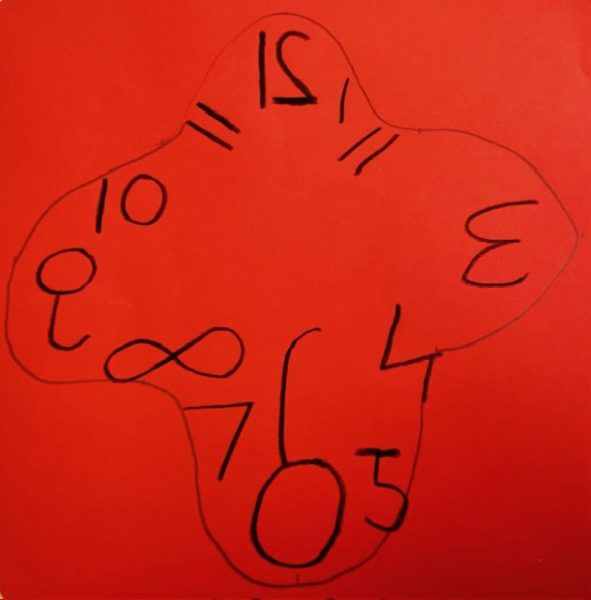
Family Kafka
100 years after Franz Kafka’s death nearly all facets of his life and writings have been analyzed. The archives of the editor Wagenbach and the publishing house have now opened an exhibition at the “Stabi Ost” in Berlin adding a family picture book description of Kafka’s life (Curator Hans-Gerd Koch). This is of interest because Kafka himself had written an extensive letter to his father (Brief an den Vater) in which he tries to understand his intricate relationship with his father and other family members.
Nowadays, some people would try to analyze Kafka’s life through the parapsychological technique of family constellations. The far-reaching and pan-European family networks of the Kafka (father) and Löwy (mother) families were more than just an excellent source of inspiration. 2 younger brothers died in their first year. 3 younger sisters followed more traditional evolutionary patterns within families. The television series on Kafka’s life add to the understanding of his sources of inspiration and “parallel worlds” he created and lived in. The exceptional “fictionalization” of his own life and existence in the spirit of André Breton’s surrealism remains a milestone in the history of literature.
Kafka himself thought he was not really “instagrammable”at the time, but his image has reached and still reaches millions of people (Link to Picture archive). He himself would probably have defended the thesis that the most powerful images are within us. … and they are hard to escape from.
(Image from Exposition in Staatsbibliothek Berlin 2024-4, QR-code links to reading in originals!) 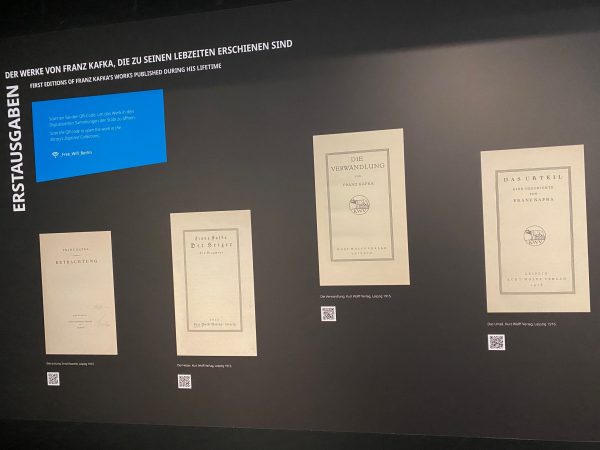
L’Albatros
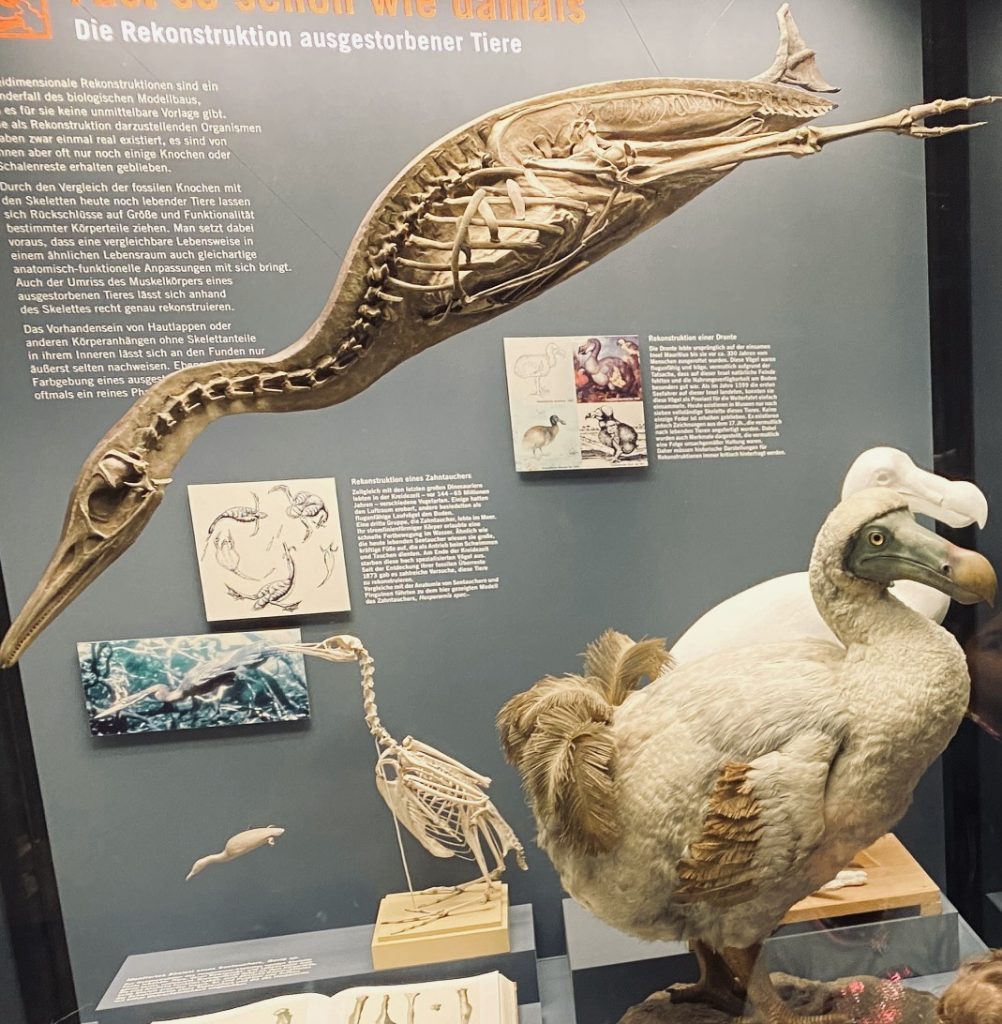
Charles Baudelaire has immortalized the albatross in his poem entitled “L’Albatros”. For me it appears like a poem about the beauty of the sea and sea life. The marvelous creatures that populate the sea and its surroundings sometimes seem strange to us. The albatross with its large wings unable to move properly on earth is one of these special animals. They are threatened by human beings in their very survival up to extinction even. A dedicated website to “Les fleurs du mal” with multiple English translations of the same poem may give us the impression that all those who translated the poem wanted to feel this little moment of sublimation like a poet just forgetting for a little while the weight of our earthly existence. The gospel tells us a similar story of life up in the air. It must be so much better to be free and not to be bound to restrictions of gravity. As gods would prefer to stay away from earth just somewhere up in space. The albatross and the sea keep teaching us lessons beyond their physical appearance. (Image bird “dodo” now extinct, model in Berlin Natural History Museum 2024)
Mehr vom Meer
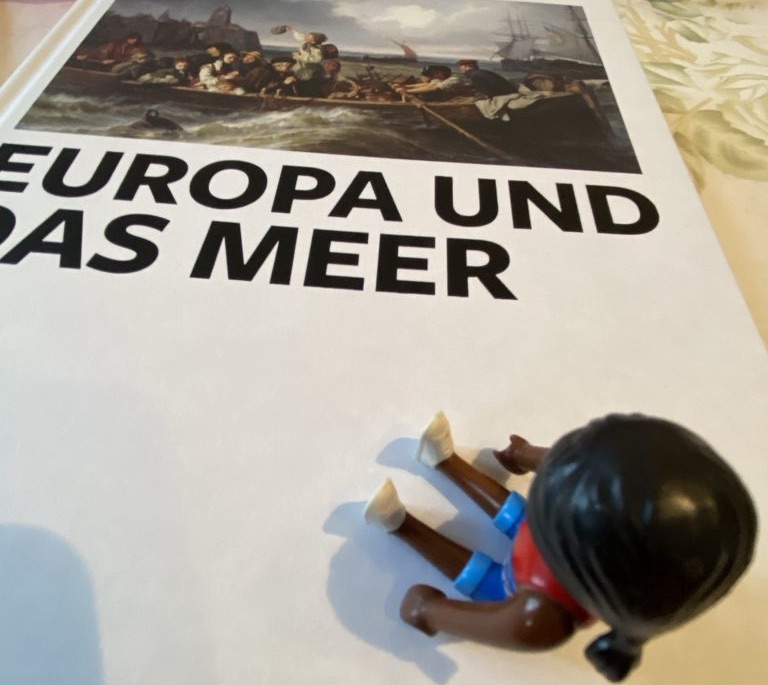
Wir sollten uns mehr um das Meer kümmern. Länder ohne Küsten finden meistens wenig Gründe, warum sie sich um das Meer bemühen sollten. Es ist doch so weit weg. Weit gefehlt. Erderwärmung erhöht die Meerestemperaturen und das wiederum beeinflusst massgeblich die Regenfälle im Inneren der Kontinente. Wir sitzen buchstäblich alle zusammen in einem Boot. Historisch betrachtet war das Meer mindestens seit der Antike Teil des machtpolitischen Kalküls der Beherrschung der Welt und der sie Bewohnenden. Wirtschaftliche Interessen waren ebenfalls Bestandteil der Erkundung und Eroberung des Meeresraums. Die Hansestädte in Europa bieten dazu noch heute gute Beispiele. Nach dem Sklavenhandel sind heute die Überseekabel und Rohstoffe des Meeres die begehrten Schätze des Meeres. Der Artenreichtum der Tiefsee wird erst seit kurzer Zeit intensiver erforscht. Externalisieren von Kosten des Umweltschutzes zu Lasten unserer Meere hat noch wenig Berücksichtigung in Wirtschaft und Gesellschaft gefunden. Tourismus- und Migrationsströme zum Meer, auf dem Meer und über das Meer stellen uns vor große Herausforderungen. Wir werden sicherlich mehr über das Meer reden müssen, und das ist keine Mär. Image aus „Europa und das Meer“ (DHM).
Disappeared
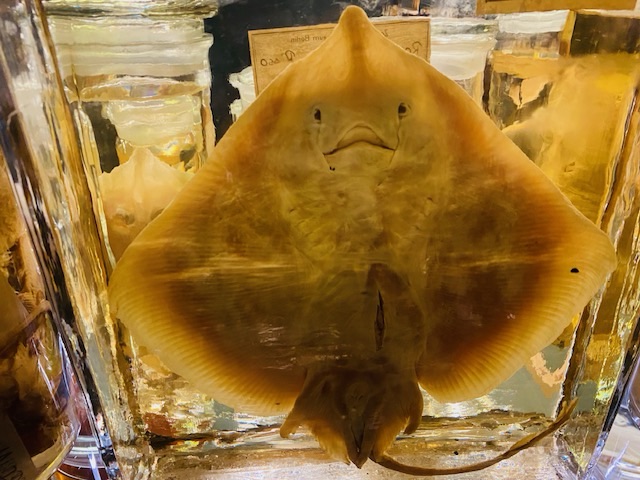
We talk a lot in abstract terms of the loss of biodiversity. In the Museums of Natural History, like the one in Berlin, we can follow the trajectory of extinction of species. The dinosaurs are for most children the greatest attraction. No surprise, they are the biggest ones we have had on our planet. But there is a huge collection of disappeared species represented in the museums which we admire as a lost treasure or species threatened with extinction. Evolution had also created this rather big bird-like creature of the “dodo”. It couldn’t fly anymore and was inhabiting the splendid island of Mauritius. Hungry colonists passing have most likely literally eaten up this rather defenseless animal. Many other extinct species can be admired now only in museums and children feel naturally attached to some species that seem to have human expressions. Panda bears and gorillas rank high on such a list, but also some fish, especially if they smile or look at you straight into your eyes. This should help us take biodiversity and biodegradation more seriously. Children feel intuitively attracted to animals as natural companions. Something we have lost as adults and most of do not even realize this as a deficiency. The Nobel price winning author frm Mauritius has published a collection of short stories „Avers“ which captures the spirit of the island and the loss of species. J.M.G.Le Clézio seems to look at us through the eyes of children or a disappeared species. Magic moments are an escape as well as reason for hope.
Symbol
What is it that makes an object a symbol? Probably, it is the widely shared perception of the meaning of a symbol that turns an object into a symbol. The etymology of the word symbol refers back to the Greek word σύμβολον. The earliest philosophical refer back to the Greek philosopher Aristoteles who deals with symbols when he writes about interpretations. Written words have become powerful symbols in the ancient world. We still have them all around us today. The interpretations of the words as symbols, however, may change considerably over time. Some symbols keep their designation and significance over centuries. Maps are well known to contain lots of symbols for roads, railways, tunnels or height. We learn about these symbols and interpret them in a specific societal context. Science is making ample use of symbols, e.g. chemistry. Different cultures define and apply their own symbols. Colonialism has been a form to impose symbols upon other societies. Throughout history symbols of power have changed as well. Each of those topics is an interesting field of application in itself. Young generations create their own symbols to establish a specific cultural identity or subculture. Urban spaces have been invaded by graffiti that tend to spread symbols as messages or symbols for their own sake.
Sociology has taken up the challenge to identify “status symbols” of groups of society. Possession of gold and silver have long ago been symbols of being rich. Maybe, even today such easily visible symbols play a role in how a person’s role is perceived in societies. Not only for priests etc. dresses have been applied as a symbol. Modern fashion is full of symbols as well. Interpretation of the meaning or even no meaning is an act of becoming conscious of the world around you. From the seriousness of symbols, we have come to the playing around with symbols as expressions of ourselves.
No matter whether we use the word, like water, we all know the chemical symbol H20. An image or art work using the symbol in whatever form will be decoded by us accordingly. However, the meaning we attach to water depends on the environment as well as specific context we (or the artists) are using it in. Cross-cultural competences consist in the awareness that symbols grow out of contexts and need to be interpreted accordingly. It needs a lot of openness, willingness to learn about differences and careful consideration in our everyday world to handle symbols. Doing culture is doing symbols.(Image of art work by Anderegg, Andi taken in 2016)