
In the field of medicine we move more and more towards precision medicine. Previously, the term of personalized medicine was used which suggested to a certain degree that a personalization might be feasible. The budget constraints have forced us to change the term to avoid unrealistic, untenable promises. In the field of cardiology scientific advances advocate to shift from a risk-based model of treatment to a causal benefit model. (Kohli-Lynch et al. 2024 Link). Long-term benefits of a treatment are more promising, if the treatment addresses the causal mechanisms at work. It is wide spread practice to deal with general risk profiles as guidelines as the precision medicine based on a causal benefit model is far more laborious since to search the causal mechanism at work requires additional testing of hypotheses. This becomes immediately clear if genetic causes enter into consideration. Nevertheless, medical research advances more and more in this direction. Genetic testing has been shown to be useful in analyzing and treating issues like sudden cardiac arrest (in survivors). We are somehow aware that genetics may play a role here, but we shall need a lot of additional studies to make the causal benefit model a feasible option for widespread applications. Targeting research in this field will offer new avenues for precision medicine in the 2020s.





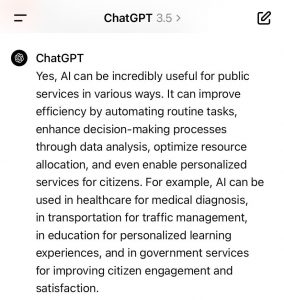 The AI ChatGPT is advocating AI for the PS for mainly 4 reasons: (1) efficiency purposes; (2) personalisation of services; (3) citizen engagement; (4) citizen satisfaction. (See image below). The perspective of employees of the public services is not really part of the answer by ChatGPT. This is a more ambiguous part of the answer and would probably need more space and additional explicit prompts to solicit an explicit answer on the issue. With all the know issues of concern of AI like gender bias or biased data as input, the introduction of AI in public services has to be accompanied by a thorough monitoring process. The legal limits to applications of AI are more severe in public services as the production of official documents is subject to additional security concerns.
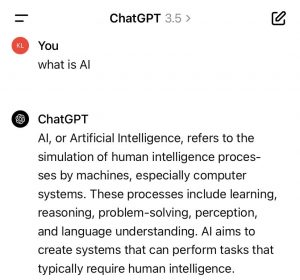 (See image). ChatGPT provides a more careful definition as the “crowd” or networked intelligence of Wikipedia. AI only “refers to the simulation” of HI processes by machines”. Examples of such HI processes include the solving of problems and understanding of language. In doing this AI creates systems and performs tasks that usually or until now required HI. There seems to be a technological openness embedded in the definition of AI by AI that is not bound to legal restrictions of its use. The learning systems approach might or might not allow to respect the restrictions set to the systems by HI. Or, do such systems also learn how to circumvent the restrictions set by HI systems to limit AI systems? For the time being we test the boundaries of such systems in multiple fields of application from autonomous driving systems, video surveillance, marketing tools or public services. Potentials as well as risks will be defined in more detail in this process of technological development. Society has to accompany this process with high priority since fundamental human rights are at issue. Potentials for assistance of humans are equally large. The balance will be crucial.