

In the beginning and middle of the 2020s the social promise to younger generations has been broken. The latest figures from the USA reveal that 2 million students (WSJ 2025-6-25 A3) who have financed their studies and potential social mobility by taking out a substantial loan are very likely to default on their credits. This observation was less a surprise to labor market analysts as the stalling of student hiring in many countries has happened for several years now. The more surprising finding is that the Wall Street Journal 2025-6-25 has been reporting on this. Banks or universities who are highly exposed to this kind of risk will themselves become downgraded for their credit rating. Higher interests for universities means higher fees and higher student loans eventually. The social promise to reach higher status and earnings through higher education as the social promise of the meritocratic society becomes an illusion. Investors in student housing might also find the sector less juicy for them. Students and their parents were taken hostage by an excessive commercialization and commodification od education. Lifelong learning is a still a promising route to revitalize the social promise.



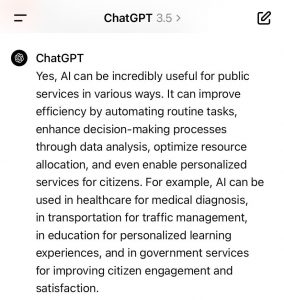 The AI ChatGPT is advocating AI for the PS for mainly 4 reasons: (1) efficiency purposes; (2) personalisation of services; (3) citizen engagement; (4) citizen satisfaction. (See image below). The perspective of employees of the public services is not really part of the answer by ChatGPT. This is a more ambiguous part of the answer and would probably need more space and additional explicit prompts to solicit an explicit answer on the issue. With all the know issues of concern of AI like gender bias or biased data as input, the introduction of AI in public services has to be accompanied by a thorough monitoring process. The legal limits to applications of AI are more severe in public services as the production of official documents is subject to additional security concerns.
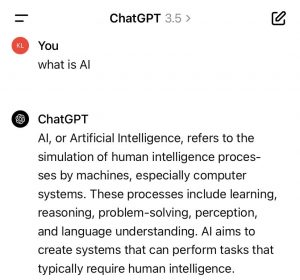 (See image). ChatGPT provides a more careful definition as the “crowd” or networked intelligence of Wikipedia. AI only “refers to the simulation” of HI processes by machines”. Examples of such HI processes include the solving of problems and understanding of language. In doing this AI creates systems and performs tasks that usually or until now required HI. There seems to be a technological openness embedded in the definition of AI by AI that is not bound to legal restrictions of its use. The learning systems approach might or might not allow to respect the restrictions set to the systems by HI. Or, do such systems also learn how to circumvent the restrictions set by HI systems to limit AI systems? For the time being we test the boundaries of such systems in multiple fields of application from autonomous driving systems, video surveillance, marketing tools or public services. Potentials as well as risks will be defined in more detail in this process of technological development. Society has to accompany this process with high priority since fundamental human rights are at issue. Potentials for assistance of humans are equally large. The balance will be crucial.