
Inequality is a hugely important topic for societies. Inequality has many different dimensions and differential longitudinal patterns. New data in this field of social research are helpful to inform on possible ways to prevent increasing inequality. At the same time, it is important to reflect on factors that may reduce inequality in and between societies. Inequality in health is both an outcome of inequality experienced during previous stages of the life course as well as a factor in causing inequality in the evolution of the life course later on. Disentangling the factors is a difficult research issue.
A first descriptive pattern across Europe allows to get a snapshot impression of the status quo as a first indication of what health inequality looks like. Cancer is a major cause of mortality across Europe and by 2045 it is estimated to be the leading cause of mortality.
Without precisely analyzing the causal factors the overview across European countries allows to give a first impression on fields that need more policy attention and more in depth studies. The European Cancer Inequalities Registry and the ECIR Data Tool is based on data from 2019 (Link). The overview matrix by employment status reveals the highest prevalence of smoking among the unemployed (followed by the employed, not shown in figure) and the frequency of alcohol consumption is highest among the employed. Low physical activity is mostly prevalent among the retired. This has consequences for cancer and gives hints to how an intensified prevention may work.
The OECD report (Link) based on these data and additional country case studies and policy data base reiterates the known prevention recommendations: Reduce smoking, alcohol consumption, air pollution as well as more physical activity. The dimensions of inequality are gender, age, employment status and most of years spent in education. The curing of cancer also suffers from inequities as to the amount of and access to screening of cancer. Cost coverage and shortages in medical personnel add to multiple sources of inequality in treatment of cancer within countries by regions and between nation states. The Lancet Public Health editorial contributes to the spread of the awareness among scientists and the medical profession.
(Image: ECIR data tool download 2024-2-22) 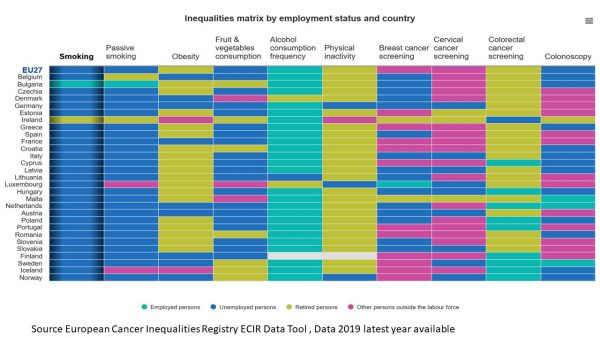
Satellites
Every now and again satellites make headlines. In international politics the “Sputnik moment” of 1957 was such a key defining moment. Russia sending a satellite into space set off a massive investment programme in the United States to counter a potential threat from Russia coming from space. In 2024 we discuss again the next ratcheting up of in a race of armament threatening the earth from space. Russia is believed to enable satellites to carry a nuclear bomb that would orbit around the earth and could lead to mass destruction of satellites that nowadays enable navigation, communication and monitoring what is happening on earth.
As beyond the state-owned satellite networks there has been a private satellite network that assisted Ukraine to defend itself against the Russian aggression, we probably are about to witness the extension of warfare on earth into space. In addition to the so-called cyberwar, which threatens computer-based systems with viruses, ransomware or break-downs, we may face new kinds of threats. We shall have to consider this as part of modern warfare.
Since the late 1960s there exists an international agreement not to use space for nuclear arms. However, Russia does no longer seem to respect its commitment to this. A further escalation of the war of Russia in Ukraine with “conventional” weapons carries the risk to set off another arms race including the earths orbit. This is no science-fiction or whistle blowing, but based on a high-level report and press coverage by the New York Times on 2024-2-17 (Link).
The outrageous implication of such a massive explosion in space is that its implications of the globe on parts of the world and people not being a party in the war will suffer most likely as much as the opposed nations. The food shortages due to Russia’s aggression caused people in Africa to suffer or even die of hunger. Satellite outages of a massive scale will have severe consequences as well.
Information and communication systems have proven to be determining the outcome of a war. This has been one lesson of more than two hundred years of studying military strategies since Clausewitz. Space and satellites have apparently not contributed to improve the understanding of each other, but only the communication within the respective communication bubbles. Maybe artists can help us to overcome the danger of escalation. (Image: “Afrogalactica” by Kapwani Kiwanga 2011: calogue of exhibition “The length of the horizon” Wolfsburg and Copenhagen 2023). 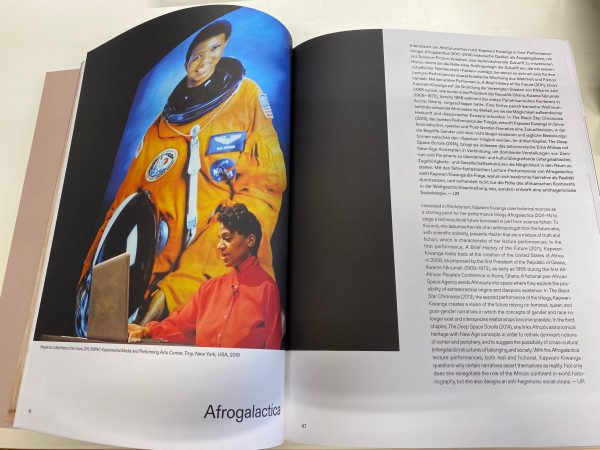
Paper and Pastel
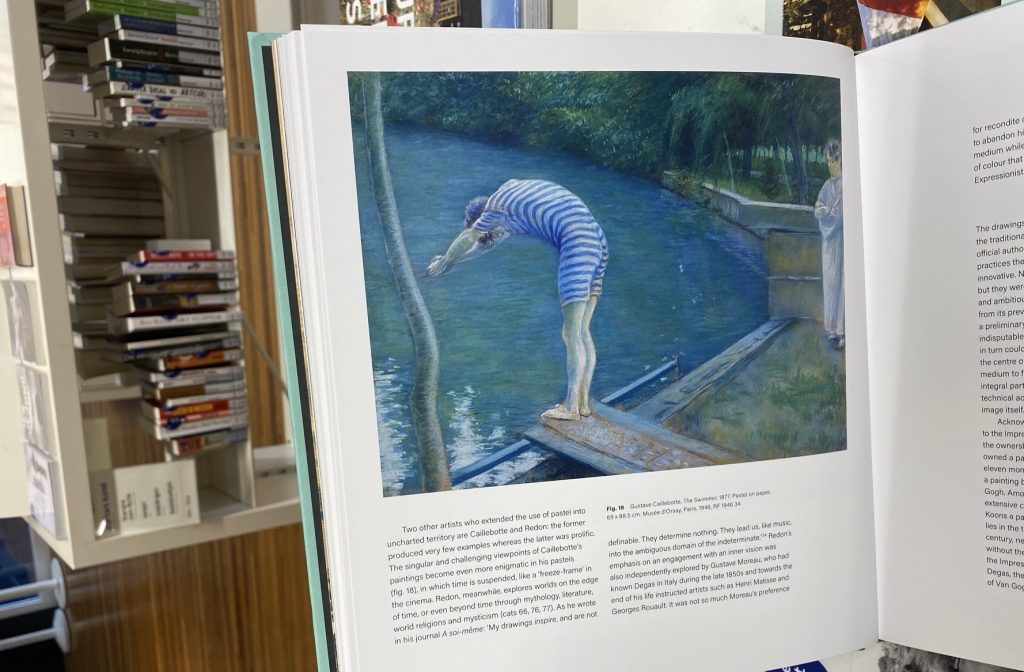
Sometimes the art is in the material. At least this could be a rapid conclusion of the exhibition presented in London at the Royal Academy of Art in 2024-1. From the informative Catalogue the importance of material is demonstrated. The ease of taking your equipment with you, like a sketchbook and out into nature have been an important feature of the impressionists’ movement. With artists challenging traditional techniques of painting and paintings as such even the apparently less noble material as paper had become a statement of being different from the established art academies making use of more noble materials. The impressionists made a convincing point with their additional use of materials accessible to all. Capture the moment and capture your very own impression of it. This is one way to immortalize the emotion and essence of the scene. In the catalogue of the exhibition I spotted “The Swimmer” drawn by Caillebotte with pastel on paper. Freezing the moment, freezing the motion and emotion is evident here, too. Testing different materials is part of the journey to find your artistic impression, expression or materialization of imagination. The ways and means are manifold.
Gas Reduction
Gas consumption in the EU has been reduced by about 20% since the beginning of Russia’s war on Ukraine. This is a considerable accomplishment and has been sustained for 2 years now. The major element in this has been the reduction of gas consumption in industry, but also households have successfully managed to reduce heating of rooms and water with gas.
Diversification of provision with sizable increases in the provision by the U.S.A is another element in the beginning of a trajectory of gas reduction in Europe. Germany as a major consumer of this type of energy supply is also making strides in shifting consumption. This is my short summary of the report by IEEFA.org in 2024-1. All electric devices like heat pumps could speed up the gas reduction further according to the policy recommendation by IEEFA in 2024-2 reducing costs of living and CO2 emissions further.
Data from Eurostat allow to compare monthly data across Member States. The overall trend is a market decrease with differential patterns of refilling supply capacities. Big countries in the EU made and continue to make a real difference compared to previous years (see table below). 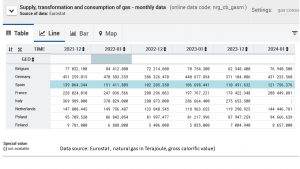 The comparison of December and January figures across years reflect the months with high sensitivity of the public for heat and cold. Further reductions of gas consumption is feasible due to the mild winter months of 23/24 which allow to reduce heating costs for many households and offices. Good news for the planet and hopefully a move in the right direction to shift away from heating with gas.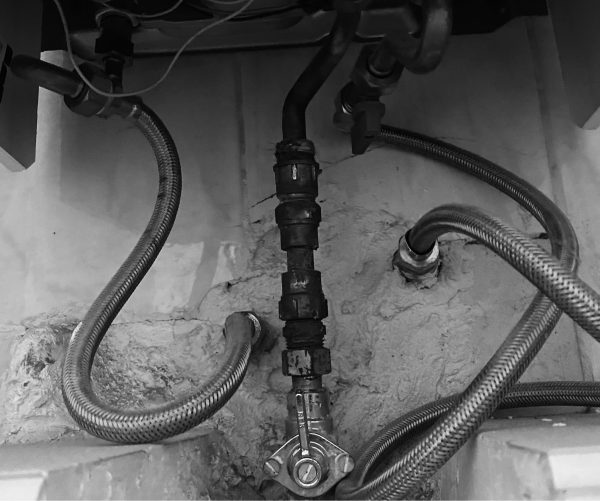
Processed food
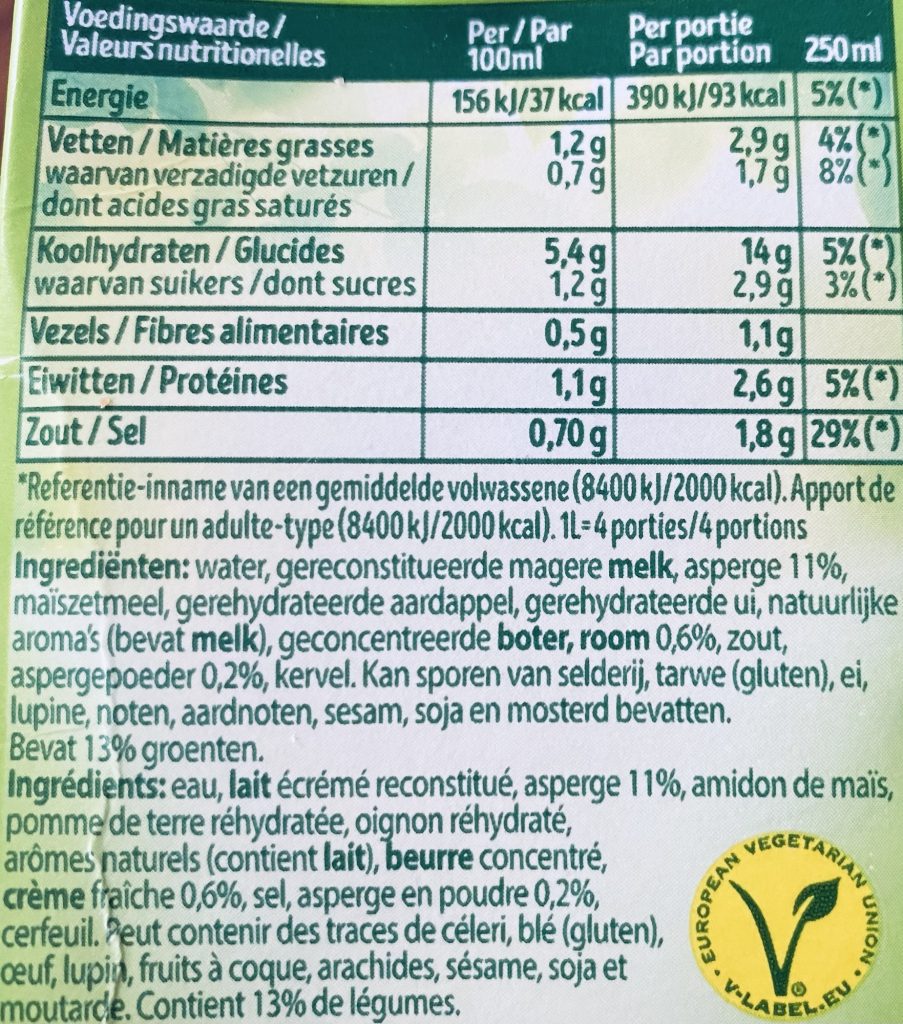
We eat a lot of pre-processed food. Our busy work schedules allow us to take only short breaks for meals in order to get more work done while in office or at work in general. The intensification of work has reached the next level and we move from pre-processed food to ultra-processed foods (UPFs). In medical journals and nutrition recommendations the warnings to not eat too much ultra-processed foods are abundant. The signs of obesity in societies reach higher levels from year to year. Especially younger people seem to be at higher risks to consume a lot of ultra-processed foods. Freisling et al. highlight the “risk of multimorbidity of cancer and cardiometabolic diseases” due to UPFs. The discussion between scientists is a lot on which UPFs are most harmful (beyond animal origin or and artificially sweetened beverages) and/or whether it is the combination of UPFs that additionally increases the danger of UPFs. Preventing the “too much of each” is probably the safest recommendation. Being able to read the nutrition information on the labels is already a difficult task. Just making the information abundant and very small print discourages most efforts to compare across products. Learning about basic human needs like food has never been more difficult. Combined with “shrinkflation” we have a hard time to make informed choices of what to buy and eat. There are many hurdles to overcome for a healthy meal.
Wage indexation
Currently inflation increases rapidly in many countries. Yes, Argentine. The Euro-zone and EEA have mastered the peak of inflation due to shifting away from Russian dependency and cheap prices for energy and dealt with carry-on effects related to high energy inputs. The annual rate of inflation calculated for January 2024 has returned in the Euro-area to 2.8 % close to the European Central Bank target of 2% (compare figure below). Inflation puts wages under pressure, because household with little savings have a very hard time to cope with sudden price increases. For society as a whole, inflation raises many questions of differential impact of inflation on different parts of society. Savings become devalued, but debt might become easier to be repaid in so-called real terms.
Wage earners suffer in terms of lower purchasing power unless in subsequent wage negotiations pay rises can be achieved. This then depends of negotiation power of groups or sectors of the economy. Trade unions have to enter into tough negotiations and conflicts to even regain the same status quo previously achieved in wage negotiations. A series of conflicts and economic readjustments by more or less powerful sectors or representation comes into play.
All this is happening in a year of a series of national and regional elections as well as the European Parliament election in June. Political turbulance and the rise of extremists might be a result of a lack of taking into account the needs of lower wage groups who are likely to feel the full blast of the high inflation previously still today. Wage indexation as in Belgium, which fixes wages to the rise in inflation previously takes out most of the explosive power of a sudden rise in inflation at the risk of an upward wage-price spiral. The recent inflation figures for Belgium, however, show that this is not the case. An overshooting has been followed by an undershooting of the Euro-zone inflation. The political disturbance and risk of redistribution to more powerful groups in society can be limited through general wage indexation or indexation of for example just minimum wages.
The Russian caused spike in inflation has been successfully mastered in the EU. The political economy of redistribution through inflation will remain an important element unless wage indexation is used in more countries to escape populists’ and extremists’ voices.  (Image Eurostat data and ESTATEC app)
Election Re-election
Politics is a lot about decision making, coalition building and communication strategies. Therefore, there have been well established election and re-election cycles in all democracies, even the so-called illiberal pseudo-democracies. The time span between elections is itself a constituent part of democratic practice. 4 years of office for an elected parliamentarian seems to be common sense across many countries. More intensive participation and election schedules have advantages in tighter checks and balances, but may have disadvantages with respect to democratic fatigue, i.e. the time and effort needed to stay informed and cast votes. “Liquid democracy” is a concept of decision making which requires highly engaged persons willing to get involved beyond average commitments. Delegation to politicians within parties and parliaments remains an effective version of democratic practice. Checks against corruption and illegal practices is a necessary condition of each system of delegation. Rapidly changing governments are similarly perceived as a risk to democracies as the repeated call to the ballot box might be unsettling more than calming the spirits.
Berlin in 2024 (like 2023) provides another lesson on the sense of elections and re-elections. The repetition of parts of the federal election in parts of Berlin was required by the constitutional court. Due to failures in correct provision of access to voting and voting material results might have been biased. According to an online reporting by the local radio station (rbb24) based on the official electoral statistics, the participation in the re-election decreased from 75% to 51% in the 455 out of 2.256 districts that repeated the election. There seems to be a high level of democratic fatigue in these districts where the re-election in general accounts of participation in elections marks a low point in achievement. It appears worthwhile to question the judicial decision to repeat the election to the drastic reduction of representativity of the re-election. In statistical terms we trade one form of bias against another form of bias with an unclear overall outcome.
Organising elections is a professional task and requires specific competences. As this is at the heart of democracies, we need to improve our organisation and surveillance of this fundamental democratic process. Repetition seems to be worse than other second or third best solutions. Investing in democracy starts also at the ballot box. Electronic voting is not a panacea, but might be part of the solution. (Image source: Landeswahlleiter Berlin, left: Erststimmenmehrheit, right Wahlbeteiligung, combined election + re-election) 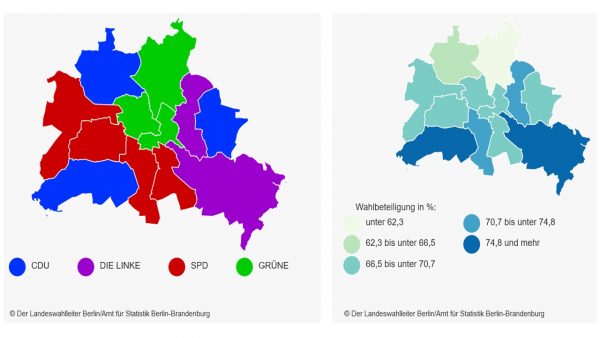
Peaceful aggression
It is the merit of youth to try out and get away with new things. The peace movements of the 60s and 70s have had their origin in peaceful actions or sit-ins that managed to raise awareness of aggressive foreign policies of the U.S. and allies. The aim of peaceful meeting was to have an impact on government policies by not being aggressive towards anybody. The political force stems from the power of peaceful persuasion by not forcing persons of other opinions. We are many and we think differently.
The climate activists of 2023 have chosen a different route before abolishing their so-called peaceful activism. This form of protest consists in reaching media attention by blocking road circulation at critical intersections. It turned out to be perceived as an aggression for many persons much unlike the peaceful actions from decades before, which were also sit-ins, but in areas with no or little traffic.
Similar to the distinction in freedom from violence versus freedom to do something. The notion of aggression has 2 orientations. Not being aggressive towards somebody or something could be understood as peaceful aggression if the activity or non-activity has an effect on other persons as if they suffered a form of aggression. In the eyes of the spectator the peaceful road blocks may have a violent impact. Reactions might follow accordingly in a spiral of violence rather than the proclaimed peaceful impact. There is, therefore, a fundamental difference between the peaceful peace movements and the “peaceful aggression” of many of the climate activists blocking roads. Rather than spreading peace, the outcome is a rather violent reaction against perceived unacceptable hindrance to do something.
To meet in a church in the presence of priests (2023-9-23, 12 apostles in Berlin-Tiergarten) does not change the thrust of the campaign, which I coin as peaceful aggression. Therein lies the eventual failure to reach more popular support for the cause and the action of the self-proclaimed “last generation”. In ratcheting up the spiral of aggression, the movement contributed to the rising frustration of persons with no or only very difficult alternatives to their means of transportation. Aggressive opponents of the movement received undue media attention and, probably, hardened the opposition to the climate cause.
In analogy to cold versus hot war, we have entered a period with peaceful aggression versus aggressive aggression. Difficult times for peaceful peace movements. 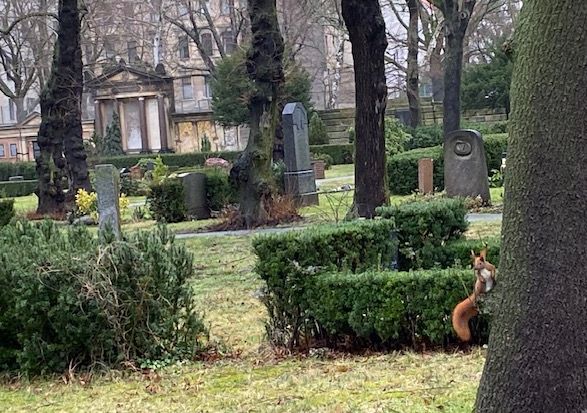
Digital organising
Since the digital innovations continue to broaden our scope of how to organise, we have to make conscious choices which way to choose. The traditional form of sending out newsletters and waiting for responses is still a feature that is prevalent across Europe. Most organisations have shifted to digital plus physical versions by now, just like newspapers. Young organisations by founding year have started or shifted to digital only for speed of delivery, CO2 and cost saving mainly. We may derive a first dimension of organising between the digital and physical. 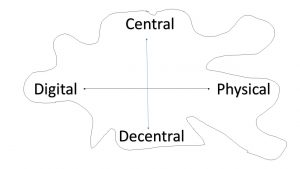
A second dimension consists in the central versus decentral forms of organising. Similar to the franchise principle of organising companies, organisations have a choice to keep a central structure with varying degrees of freedom at the regional, sectoral or local level. Organisation theory is helpful in this respect. Various hybrid forms are equally possible. Centralised in financial aspects, but scope for local decisions on content.
Bohn et al. (2023) define digital organising as “collective purposeful alignment and distributed action fostered through digital technologies”. Centralisation and/or Decentralization become a matter of conscious choice. The processes of datafication and connectification, whereby every bit of information becomes a data point and any electronically enabled device can be connected with each other. Organisations now have a choice of how to organize including digital organising. The opportunities are within the space opened up by the 2 dimensions (figure below). A specific subject matter may require more physical presence and maybe centralised structure, but digital only forms with highly decentralised forms are powerful tools in the 21st century. New as well as established social movements may well take advantage of these digital technologies as well. (Image: Digital Organising 2024 Protest Berlin). 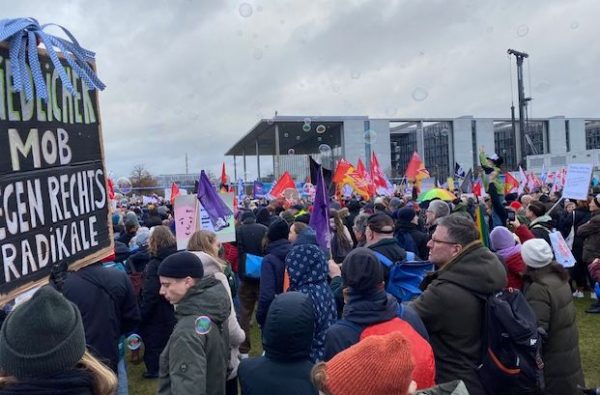
Spring has Sprung
In Europe it is expected that spring follows winter. The closer you move to the equator the more you find days equally long in winter and summer. In Northern Europe we have marked differences in terms of light between winter and summer. In January and February 2024 we had a very mild winter. As of 15th of February we had 15° C in Brussels and the first few blossoms showing up. Climate change is undeniable and the call for action to intervene urgently become louder and louder. Why is it so difficult to take action? Well, there are many vested interests and countries that hope to benefit from climate change. In simple economic theory this is not a problem as long as those who gain from climate change would compensate those who lose from it. However, if the total sum of losses is so much bigger than the sum a few will gain, the global balance sheet will deteriorate rapidly.
Monitoring climate change and the shifts in national and global wealth are part of the scientific endeavour. Rising inequalities on a national as well as global scale will create numerous new challenges which are difficult to forecast due to complex feedback and reinforcement loops. It would be wise to apply the precaution principle in this respect as well, but this seems to be hardly understood, let alone, to be followed.
Sometimes it needs a cold winter, unusual flooding or a bad harvest to acknowledge to value and apply the precautionary principle in the following years. Only, this time it might be fundamentally different, because climate change is irreversible for generations to come. Early blossoms in winter as precursor of spring are nice, but we have mixed feelings considering the impact on irreversible climate change. (Image Brussels 2024-2-15) 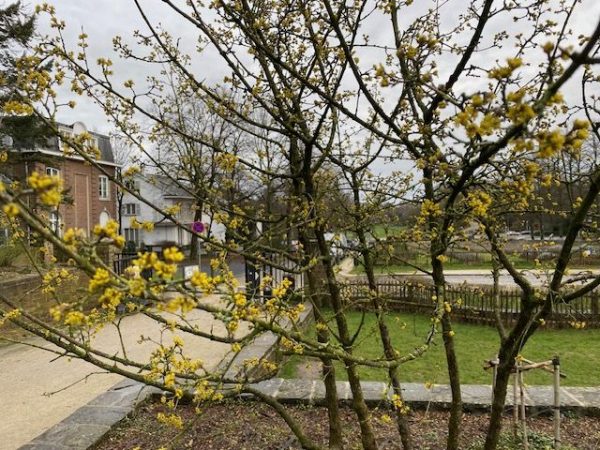
West Europe
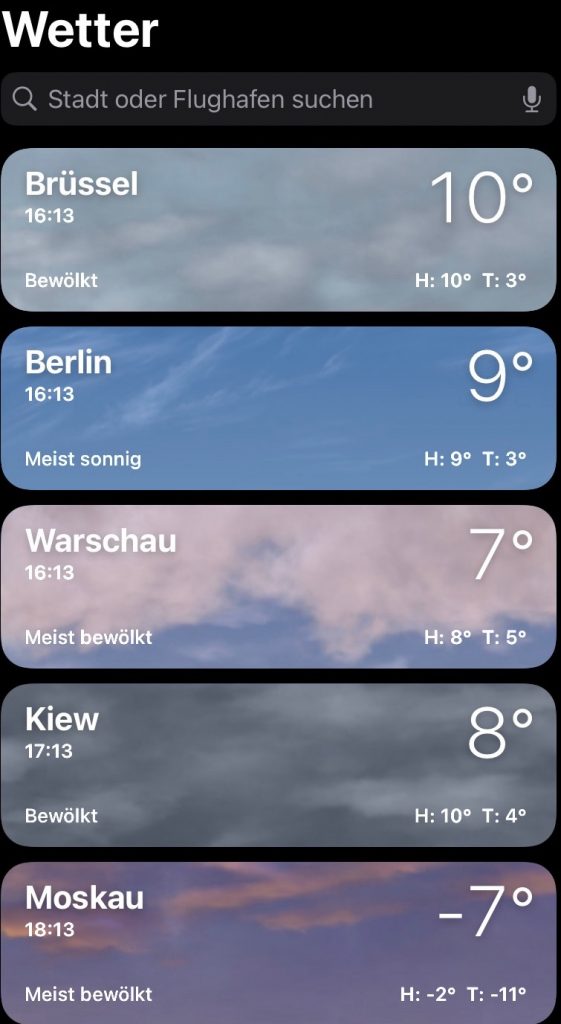
There has been a shift of political borders in Eastern Europe. Russia has been trying to shift its border further to the West by brutal force attacking Ukraine. Political defence and military action have managed to preserve western values in Ukraine. On the 13th of February 2024 the meteorological data confirm a clear belonging of Ukraine to the western climatic conditions. Temperatures in Kiev are very similar to the western hemisphere and very different from the cold in Moscow. This is just a little detail or coincidence but it bears a nice resemblance to the political weather currently in Europe. It is by all means much colder in Moscow than in western Europe. The time and the climate are a changing.
Stroke
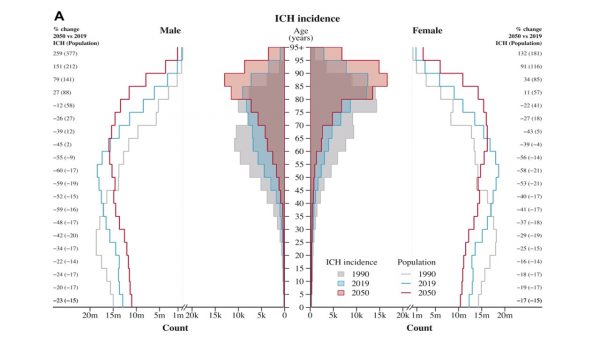
A stroke is a very serious medical incident. The NIH defines it in easy language as the the moment in which “blood flow to the brain is blocked or there is sudden bleeding in the brain“. Thanks to a European HORIZON project forecasting models are produced to estimate the likely incidence until the year 2050 by age and gender within Europe. The good news is major regional imbalances of incidence and mortality have been reduced and will likely be reduced across Europe. The challenge remains the aging of societies which necessitates to address the issue of strokes in each single region of the European Union. We know that the shorter the time to treat a stroke immediately after its occurrence, the better the survival chances and the better the prognosis for (partial) recovery.
In the US the widespread use of blood thinners which tripled over 30 years has not lead to the reduction of intracerebral hemorrhage (Link to studies). High blood pressure and arhythmic heart beat are major causes of this often disabling medical event. The study by Wafa et al. (2024) uses age-pyramids to demonstrate the effect that as European societies are aging the incidence of intracerebral haemorrhage occurs with increasing age and even more so for women than men of 80 years and older.
Prevention of high blood pressure through walking or careful endurance exercise seems even more indicated for an aging society.
Image below from Wafa et al. (2024), The Lancet Regional Health, Europe.
Greedflation
The teaching of economics and socioeconomic policies has to deal with the topics around inflation and economic inequality for centuries. Greedflation has become a newly coined term for the rise of inflation due to greedy firms who use a window of opportunity to achieve extra profit margins or windfall profits. At a time of perceived price rises in many sectors, sectors that have no cost increases might still try to push prices higher simply because almost everybody else does so. Higher profits then show up in the reporting season of enterprises quoted at the stock exchange and the increase in inequality between wage earners and shareholders will rise. Greedflation is a summary term for it. The ECB European Central Bank has mentioned this and Reuters has reported on it as well end of June 2023. Since then a wait and see strategy has been adopted. Now in February 2024 we witness the wider spread of extraordinary profits of big firms not only in the fossil energy sector but also bog banks. The economies and societies suffer huge losses and a massive redistribution of capital. Subsidies introduced to lower the shock of the coronavirus crisis and the Russian aggression are unpopular to be scaled back. Employees and their trade unions have a hard time negotiating adequate wage increases whereas most companies use the momentum of seemingly general price rises to push profit margins. The translation of this mechanism to the political economy risks to jeopardize the support for capitalism and market forces in general. Another wave of increasing inequality endangers the survival of democratic societies. Countries with only a short experience of the functioning of market economies are at a particular risk. Germany’s decline into dictatorship in the 1930s after the severe economic crisis should be remembered as a major threat. Greedflation is a very serious and very real threat which we have to address with economic and social policies rather than waiting until the European elections have passed. Time to act, the thinking has been done. Evidence accumulates to make the political case.
Skill loss
There is a sense of skill loss in watching the trends to increase comfort. We all use washing machines and maybe dishwashers. Households can save a lot of time by using those machines. Some porcelain and clothes should not be left to the machines. The need to organize traditional washing routines is almost forgotten after 1-2 generations. The same holds for many technical skills. Bicycle and car repairs or small repairs of electrical appliances are delegated to specialized repair shops. Not using or having learned these skills puts you in a form of dependency and at the risk to pay a price for specializing on other skills. Find out and focus on what you are best at. This has been the mantra of economic theory since Adam Smith. The potential value of satisfaction with an own production rather than a bought product is frequently acknowledged for baking cakes yourself rather than simply buying one in a shop. The same rationale holds for many other skills. Autonomy of own production with possibility to improve or repair are forgotten values. The have become a luxury item or a necessity for persons lacking financial spending power to buy products from others. Many skills will be lost rapidly because products have become so cheap to replace or order for home delivery. Industrial production is desperately searching for skilled persons but losing skills is pervasive at the same time. Public schools and academic curricula will not be able to stand the tide of pervasive skill loss.
NS München
The documentation centre in Munich of the National Socialist time and crimes has an encompassing collection of documents on display. As the prime centre of the Fascist movement in Germany in the 1920s and early 1930s Munich was the home to party elites from the first months of the movement that became the epicentre of the dehumanizing policies we can follow throughout Europe (Topography of Terror, Berlin). The historical research in both documentation centres complement each other in many respects. Understanding the beginnings of the Fascist movement remains important to today. Fascist movements need to be stopped before terror even against neighbours takes hold. Records of the evolution of membership, men’s and women’s movements later on, attacks of the parliamentary system all have to be taken into account to be able to stem the Fascist tide at that time and today again.
“Materializing” is the current exhibition, which can be visited in part online. How can we deal with the “Shoah“? Polish artist have a long experience to cope and deal with the unimaginable horrors, the Nazis and the “Wehrmacht” committed in Poland.
Memories have to find a place, a piece, a word, a sound or an emotion to materialize. In that sense yesterday joins today and is preserved as learning and warning for tomorrow.
In addition to the much discussed “Wehrmachtsausstellung“, the work by Jochen Böhler provides ample evidence to debunk the myths of war without crime. This holds for the past and for the present. (Source: Böhler, 2019, S. 59-68, Die Wehrmacht und die Verbrechen an der Zivilbevölkerung während des deutschen Überfalls auf Polen 1939, Image below). 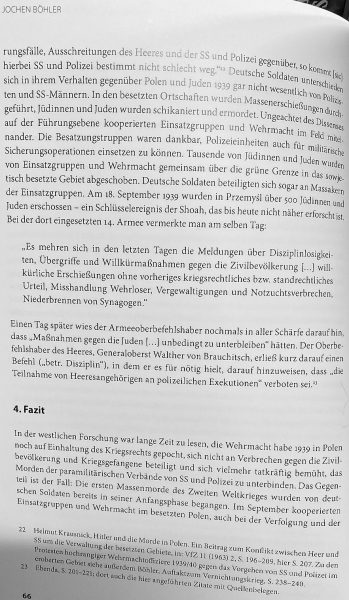
Topography of Terror
The documentation centre “Topography of Terror” in the middle of Berlin is easy to reach. The “Potsdamer Platz” is nearby and so is the “Kulturforum” with its galeries, museums and the “Berliner Philharmonie”. The documentation centre gives easy access to the historical evolution of Nazi-dictatorship from the earl beginnings, the horrific terror spread across Europe and first insights into the prosecution of criminal acts in the immediate post-war period. The Beyond the exhibition with audio-guide there is an easily accessible specialized library for personal or scientific research. The accompanying program of book presentations and discussions (image below) complements the busy show rooms. The external “walk through history” allows to grasp the main proceedings of the terror regime.
For special interest or research questions it is a very useful starting point. Hours in the library have to complement the research. Good to see that so many students walk through the documentation centre not only in groups from the neighbouring schools. The interest to understand when and how the terror started will allow us to better guard against those right-wing extremists who use a lot of techniques of propaganda well known and exposed in this documentation centre of the terror of the Nazi-regime. 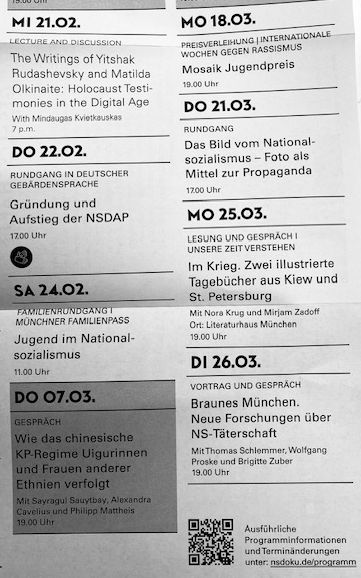
Timeless Values
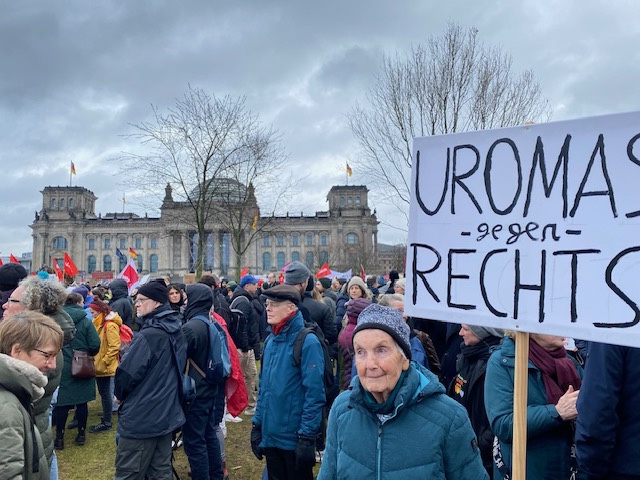
The declaration of human rights is more than 200 years old. However, the need to stand up for the defense of these rights needs many people to act accordingly. Political parties and courts are not strong enough to be the only defendants of democracy and human values. Solidarity across generations is another part of the struggle to defend democracy. In addition to the broad movement of “Omas gegen rechts”, the age distribution has been further enlarged with the “Uromas gegen rechts”. This most likely the generation with first hand life experiences from Nazi Germany and they should have reached an enlightened view of the horrors caused by the Nazi-regime. Unfortunately there are still some who continue to be prisoners in a fascist “brown” cage of mischievous memories. The great grandmother who was present at the demonstration was clear in her statement to stand up against right-wing extremism. (Image: With the permission of the lady I am happy to have evidence of the presence of super-agers at the demonstration in Berlin).
Fighting Fascists
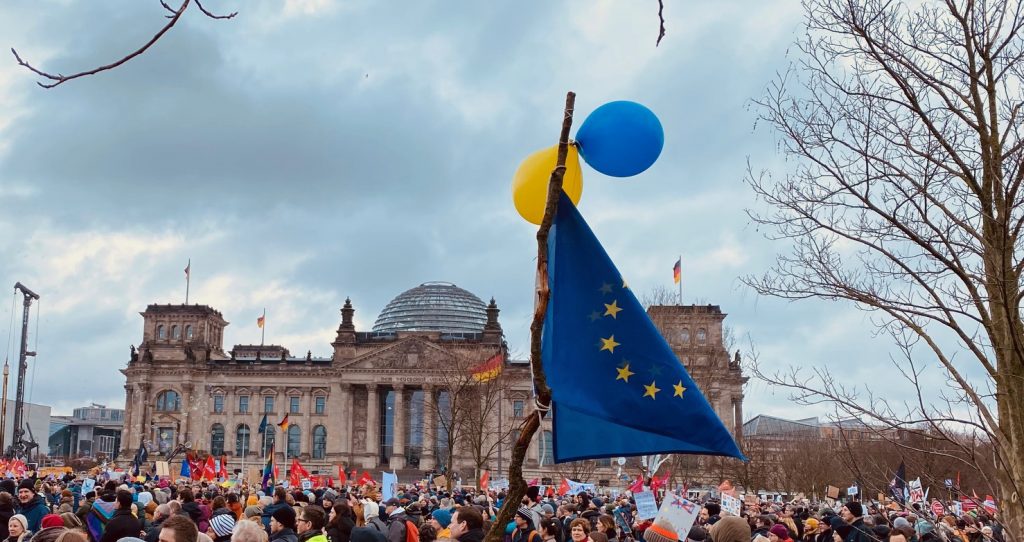
On february 3rd 2024 Berlin has seen the Parliament (Bundestag in the old Reichstag building) surrounded by young and old to raise their voice against the rise of right wing extremism in Germany. The broad alliance against extremism finds grassroots support from a very broad and diverse community. 1700 organizations have joined forces to send a strong signal that they are ready to act against the inhuman propaganda and persistent hate speech. The creativity to express the discontent in clear messages is impressive. Civil society is showing that diversity offers multiple benefits to find new ways to unite people. Great that European flags and balloons in Ukrainian colors where present as well. A movement of solidarity was felt with these people and that provides a strong message for the months ahead with so many elections taking place at the local, regional, national and European levels.
Memory Flashes
The title of the exhibition in the Museum of Photography in Berlin was “Flashes of Memory”. The collaboration of the Kunstbibliothek with the “Yad Vashem – The World Holocaust Remembrance Center” prepared a photographic memorial of the murder of 6 million of human beings with Jewish origin or family ties. The images represented in the exhibition constitute a carefully curated selection of the photos taken as part of Nazi propaganda, the secretly produced photos by inmates and the Sowjet and American soldiers who prepared documentation of the horrors. It becomes clear throughout the different sections of the exhibition that the motivation of the photographer introduces more than just an individual perspective on the scene.
In the age of fake news and fake images it becomes more and more important to be able to read and interpret photos, taking into account the motivation of the photographer and its influence on the photo taken. In order to limit the spread of mischievous representation of the past, it is good to know that the use of AI as image creation does not allow with simple prompts to produce false documentation. It needs more sophistication and more human intervention to trick the algorithms. Additional use of photoshop will, however, increase the risks of abuses. Hence, it will be more important as of now to be able to differentiate images according to sources and authors. Our trust in photos has been shattered, and this is an important lesson in itself. It is a huge task for schools and adult learning to re-build the competence to distrust photos and images at first, then deconstruct the messages and motivations.
“Flashes of memory” is in some way linked to the “struggle of memory” exhibition. Both, obviously deal with the way historical events are and have to be present in our “collective” memory. Memories come back in flashes, sometimes, certainly for victims. Conscious and unconscious selections of images might come back at times and haunt victims for years. The correction of biased messages, is an important task for historians, social scientists and artists alike. It is all too easy and common to forget (Luhmann, 1996 Reality of mass media) and the difference between “Documentation” and “Decoration” (Lewis, 2001) or simply illustration needs to be scrutinised always anew. “Bildung” has some common roots (only four letters really) with “Bilder” in German language. It may be “une liaison dangereuse”, but the spurious link can also be turned into an educational or learning approach.
A permanent exhibition based on the material used in the exhibition would be a real asset to accompany and learn about the flashes of memory. A reading list of literature was also available at the exhibition (see image below) encouraging to dig deeper into this immensely important topic. 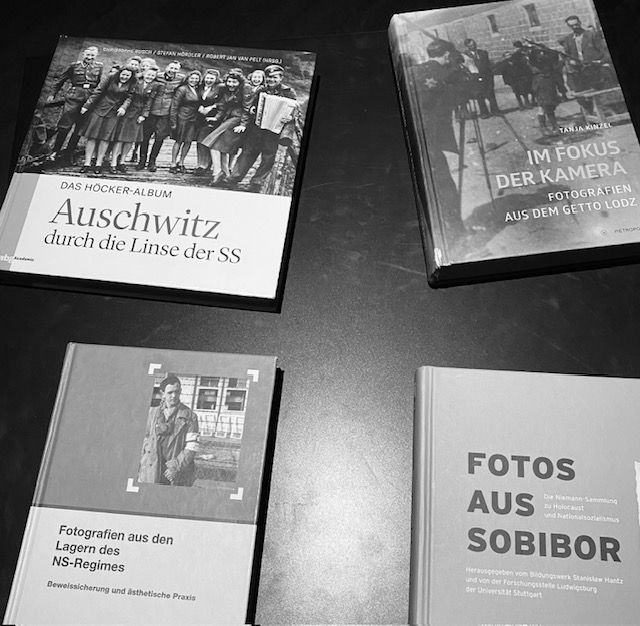
Postmodernism
The grand narratives of the modern world, like modernism itself, are under serious criticism. Deconstruction of the modern way of thinking has become philosophical mainstream. Economics as a science is in the middle of the behavioural shift and changing or at least complementing its narratives. Sociology has embraced postmodern thinking in theoretical as well as empirical forms (Mirchandani, 2005). The empirical measurement focuses a lot on the groups and people who hold postmodern beliefs and values. The discussion in the social and literary sciences continue. In the arts reading on modernism and postmodernism is a must in order to understand much of contemporary art or art from the 19th and 20th century.
Bookstores in art galleries that cover long spells of history can make surprising links between historical periods of art. Books of postmodernism appear next to books on romanticism. A lot of the ideation of postmodernism rejoins romantic depiction about nature, re-naturalizing or the emotional connotations of wildlife, isolated places and stillness.
On the other hand, we are confronted with the brutal world of war, drugs and crime. Classical warfare and strategies are back in Europe with tanks and rockets killing like in previous wars. The Russian empire of a specific version of modernism strikes back as if it were to stop the postmodern turn of the 21st century. Neo-fascism tries to build on the losers of the transitions to the socio-ecological economy and society. There are manifold backlashes of modernism, but the postmodern world is under continuous construction, most of in our mindsets. 
Zwang durch Terror
Durch den Terror der Willkürherrschaft mit rassistischer Doktrin wurde aus Zwangsarbeit eine lebensgefährliche Arbeit. Überzogene Sanktionen bei Diebstahl, Plünderung oder Sabotage wurden von den Nazis mit öffentlichen Hinrichtungen (Erhängen, Gruppenerschießung oder Guillotine) geahndet (siehe Katalog zur Ausstellung Alltag Zwangsarbeit S.44-45). Straflager und Verlegung in Konzentrationslager gehörten ebenfalls zur regelmäßigen Erfahrung.
Die Zwangslage der dort zur Arbeit gezwungenen Menschen ist kaum vorstellbar und fassbar in unserem System der Beschreibung von Arbeit. Totale Subordination kann vielleicht in Ansätzen verdeutlichen wie diese Situation auf die Personen gewirkt haben muss. Fluchtversuche waren fast ausgeschlossen. Selbst die Verbindung zu den meist deutschen Frauen in Fabriken war unter hohe Strafe gestellt und intime Verhältnisse (bezeichnet als Rassenschändung) wurden für beide Seiten lebensbedrohlich oder endeten für die Zwangsarbeiter oft tödlich. Der Terror in dieser Zeit bestand in der kontinuierlichen Gefahr und Angst tatsächlich oder vermeintlich eine Anklage zu erhalten, die unkontrollierbare, weil selbstherrliche, Strafen nach sich ziehen konnte.
Image: Ausstellung Alltag Zwangsarbeit 2024-1 in Dokumentationszentrum NS-Zwangsarbeit, Berlin Schöneweide. 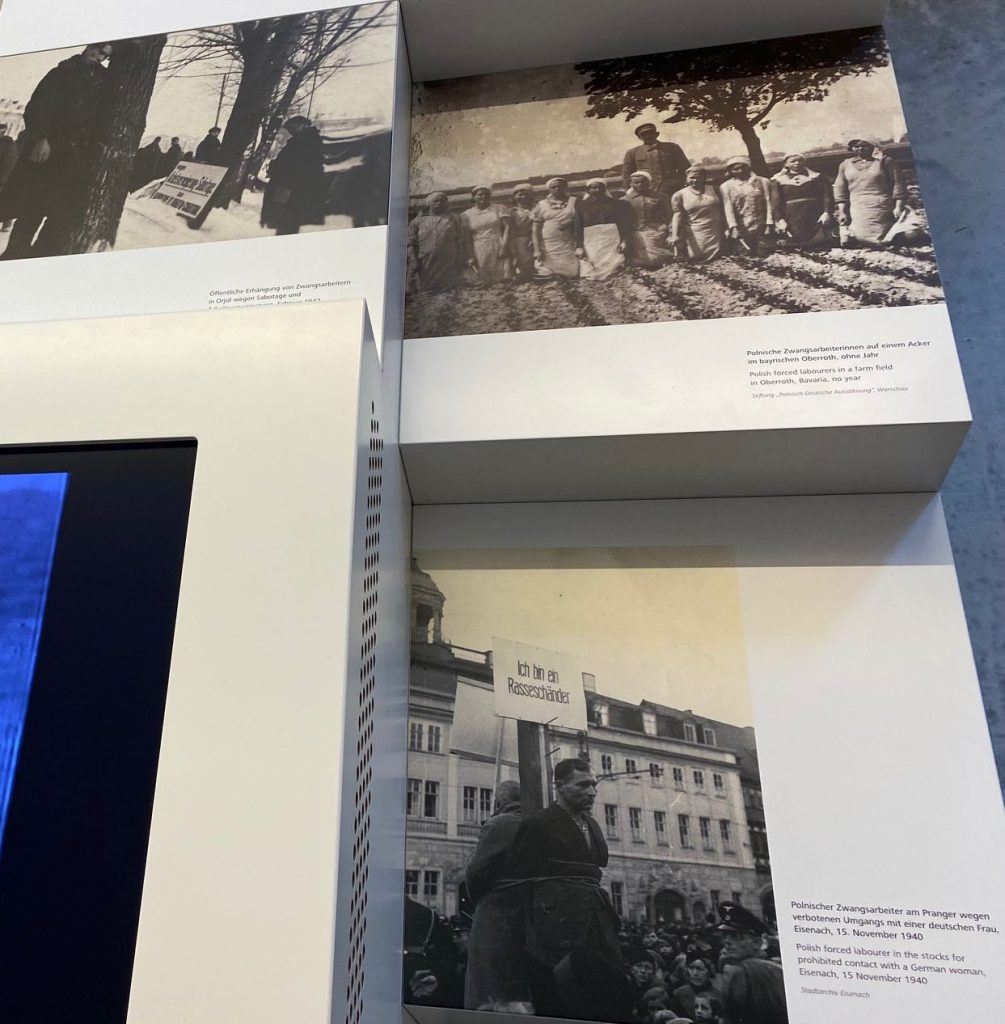
Zwangsarbeit
Die Annäherung an das Thema Zwangsarbeit ist nicht einfach. Auch heute prangern wir zu Recht Zwangsarbeit egal wo auf der Welt an. Die mit weitem Abstand grausamste und umfangreichste Durchführung von Zwangsarbeit haben die Nazis in Deutschland und von ihnen besetzten Gebieten vollzogen. Neben den Schrecken der Konzentrationslager mit dem millionenfachen Mord an Menschen jüdischer Abstammung ist die Aufarbeitung der Verbrechen in Zusammenhang mit der Zwangsarbeit lange in den Hintergrund getreten. Selbst die Zeitzeugen wie Francois Cavanna (2020, S. 10-11) vertraten die Ansicht, dass im Vergleich zu den Ermordungen und Kriegsopfern ihre Erfahrungen und Leiden im Zusammenhang mit der Zwangsarbeit in den Hintergrund traten. („… cela me rendit plus modéré dans l’expression de mes souffrances. … nous ne pouvons que fermer notre gueule. Ce que je fais. »).
Neben der systematischen Ermordungsmaschine der Konzentrationslager in der NS-Zeit verdient das millionenfache Leid und die Terrordrohungen und Anwendungen der Nazi gegenüber den ZwangsarbeiterInnen eine angemessene Bedeutung. Das Dokumentationszentrum NS Zwangsarbeit in Berlin Schöneweide bietet dafür eine hervorragende Ausgangsbasis. Die Ausstellung ist für alle Altersgruppen geeignet. Behutsamer Einstieg für Schulklassen ab der 5. Klasse und zum Nachdenken anregend für Erwachsene mit Informations- und Lerninteresse. Das Ausstellungskonzept mit seinen vielfältigen biografischen Materialien von Zeitzeugen erleichtert, neben der Faktenfülle, einen emotionalen Zugang zum Thema. Online lässt sich beispielsweise die Verteilung der Zwangsrekrutierten die Arbeitsdienst leisten mussten je nach Stadtviertel oder sogar Straße verfolgen (Link Datenbank und Map).
Die Löhne für deutsche ArbeiterInnen und Ost-ArbeiterInnen aus den osteuropäischen besetzten Gebieten waren fast zehnmal höher. Die in westlichen Besatzungsgebieten zwangsverpflichteten Personen oder selbst anfänglich mit scheinbar höheren Löhnen als vor Ort (Organisation Todt) üblich angeworbene Personen erfuhren die spätere Abwertung ihrer Entlohnung. Es bleibt die Betonung auf Zwang, Terror und Einschüchterung bei der Zwangsarbeit meistens in menschenunwürdigen Massenbaracken aus industrieller Massenproduktion. Einstieg in die Erfahrung: NS Zwangsarbeit Dokumenteationszentrum. 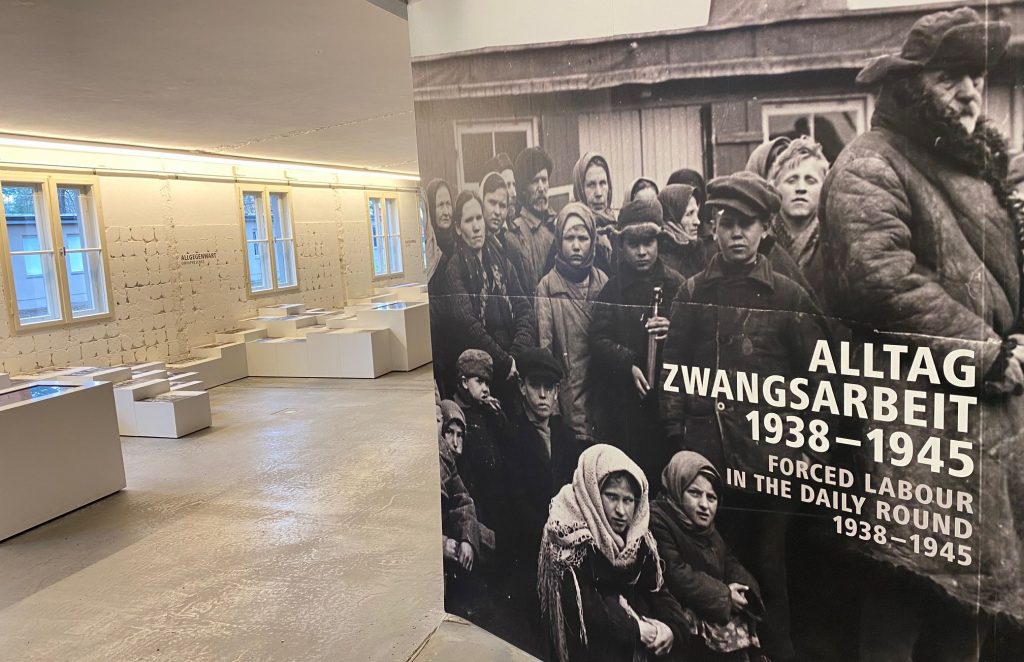
Shrinkflation
Shrinkflation is a hybrid term that combines “to shrink” with “inflation”. The trick is to keep prices at the same level for a product, but to reduce the weight or amount sold at a constant price. The intention of producers is to indirectly increase prices without touching at price tickets on products. As consumer you are likely to remember the price tag of a product, but much less the unit costs. However, the unit price is the basis for fair comparisons. In supermarkets there is an obligation to print also unit prices (€/kg or €/L) next to price labels. Comparisons allow information irrespective of package size. In shrinkflation the higher unit costs of a product will drive the official measure of inflation (Destatis, 2024). In Germany inflation for food had the top inflation rate in 2023, surpassing even price rises for energy.
On the one hand, shrinkflation is cheating on consumers to sell them less for the same price. On the other hand, oversized products that solicit higher consumption are part of the health and environmental problems we face. The obesity pandemic is part of the XXL consumption hype the food industry and supermarkets have created. In this respect, more expensive food (Eurostat info) potentially may trigger the rethinking of consumption and nutrition. “Eating better instead of less” has always been more expensive.
Besides the profit-maximising logic of shrinkflation, there is at least a small hope that behavioural changes might be triggered to consume less, to use less detergent in washing, less sugar drinks, smaller size pizza and so on. Shrinking our food intake is part of the solution for many problems. In the end cutting out most convenience food will save you a lot of money. As a side effect of such behavioural changes, eventually prices are likely to come down some time later again. 
Clausewitz 3
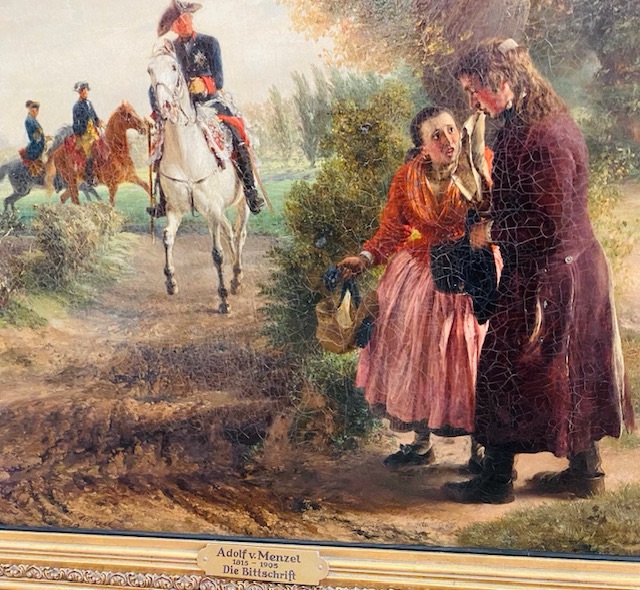
As the Russian aggression in Ukraine continues it is interesting to re-read Clausewitz again. In his major work on strategy in warfare we rediscover lots of strategies that Putin’s army applies in the war against Ukraine. But equally, the successful defence strategy of Ukraine with a sizable difference in the size of the army, they both let us better understand the theoretical considerations and relevance of Clausewitz until today. For example,the overriding importance of the size of an army in comparison to the opponent was discarded by Clausewitz (p.111-112) already. He refers to the battles at Rossbach and Leuthen in the Seven Years’ War 1756-1763. Frederic the Great won 2 battles despite having armies of half the size or even less at his disposal (Tempelhoff). Training and morale of the armies is an important part of the explanation of a later outcome. In terms of strategy Clausewitz mentions surprise and wit in chapters as well. The next 3 chapters are devoted to (in modern words) distribution and mobility of forces in space and across time including additionally a strategic reserve. The “classical warfare” which Clausewitz transforms into a theory of warfare is followed with horrific resemblance by Putin’s Russia in the 21st century. “War is an instrument of politics” writes Clausewitz 200 years ago (p. 467-8).
The painters or theorists that attempted to go beyond this rationale have had a hard time to convince politicians otherwise. The idea that law and courts will replace the atrocious power play of nations is silenced again for some years, only to come back with more force eventually.
(Image Extract from Nationalgalerie and Digital Collection of Gemäldegalerie 2024-1 by Adolphe Menzel “Ansprache Friedrich des Großen an seine Generale vor der Schlacht bei Leuthen 1757) unvollendet. 
Ideal City
Ideal City
Even beyond humans the issue of what constitutes the ideal city is a matter of historical as well as experimental significance. Science has recently uncovered a city like organization of habitats in the Amazon region (Link Science.org). The organization of the Greek city states has been the model for the development of democratic ideation. The Roman imperialism has thrived through the splendor of its cities and city lifestyle. No surprise that this continues to be a constant concern for humanity.
Rapid urbanization continues in Africa and Asia. Europe also struggles to keep pace with infrastructure development in every growing cities. Whereas the ideal city in the early Italian Renaissance was imagined without trees, we witness a renewed interest to bring back nature-like environments and architecture back into cities. Combining the best of 2 worlds seems possible. Redesigning inner cities remains a continuous challenge. It is much more than thinking about bricks and mortar. It is mostly about how we want to live, work and communicate together. Therefore, it concerns all of us. Paintings help us along in our ideation about where and how we want to live together. The linear views of the Renaissance appear hardly convenient after the experience of the 20th century.
(Image Gemäldegalerie Berlin, 2024-1, Raum XVIII, Ident Nr. 1615 “Ideal city” from ca 1490 attributed to Francesco di Giogio Martini and next to well-known ideal “Venus” painting by Sandro Botticelli 1490). 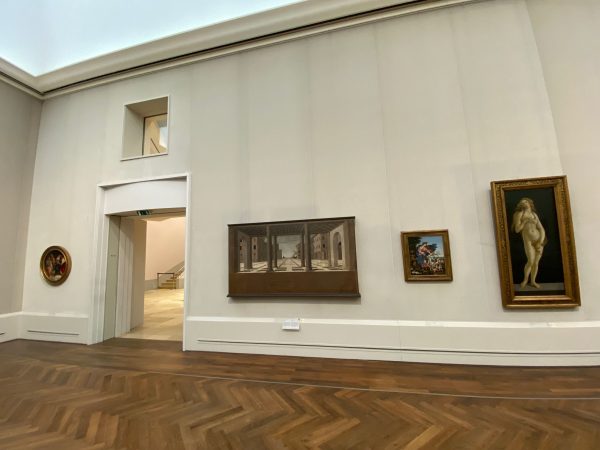
Flotow CH
Noch 20 Jahre nach seinem Tod wurde Friedrich von Flotow recht prominent aufgeführt. Im Stadt- und Aktien- Theater der Stadt St. Gallen stand seine Oper “Martha” an einem Mittwoch 26.4.1905 auf dem Programm (Anfang 8 Uhr präzis), gefolgt von Mozarts Zauberflöte 2 Tage später. Was für eine Konkurrenz. Das Plakat zur Aufführung ist in der Digitalen Bibliothek der Kunstbibliothek in Berlin anzusehen (Link).
Die Geschichte des Theaters in St. Gallen ist aus ökonomischen, gesellschaftlichen und architektonischen Gründen interessant. Das Tagblatt berichtete in 2007 über den Abriss der historischen Städte und den sehr verspäteten Neubau einer moderneren, größeren und wirtschaftlicheren Spielstätte. Damals zu Beginn des 20. Jahrhunderts schon standen populäre Werke wie die Martha und die Zauberflöte auf dem Spielplan. Die Aktionäre des Stadt- und Aktien- Theaters der Stadt St. Gallen haben wohl schon immer etwas mehr auf das Geld geschaut, auch wenn es um Kunst geht. Mehr Zuschauende und Zuhörende ist demokratisch und nebenbei gut für’s Geschäft. Der Abriss war beklagenswerter Weise im Jahr 1971. Ein Neubau an anderem Ort startete bereits 1968. Dieser Bau musste ebenfalls nach 40 Jahren Spielzeit grundsaniert oder abgerissen werden. Heute findet sich darin ein lebhaftes Programm mit Musicals als ausgezeichnetem Schwerpunkt und beispielsweise des Theaterstücks „Gott“ von Ferdinand von Schirach . Die Stadt und die Aktionäre sind wohl aus der finanziellen Verantwortung, aber das Kanton St.Gallen und der Lotteriefond sind eingesprungen. 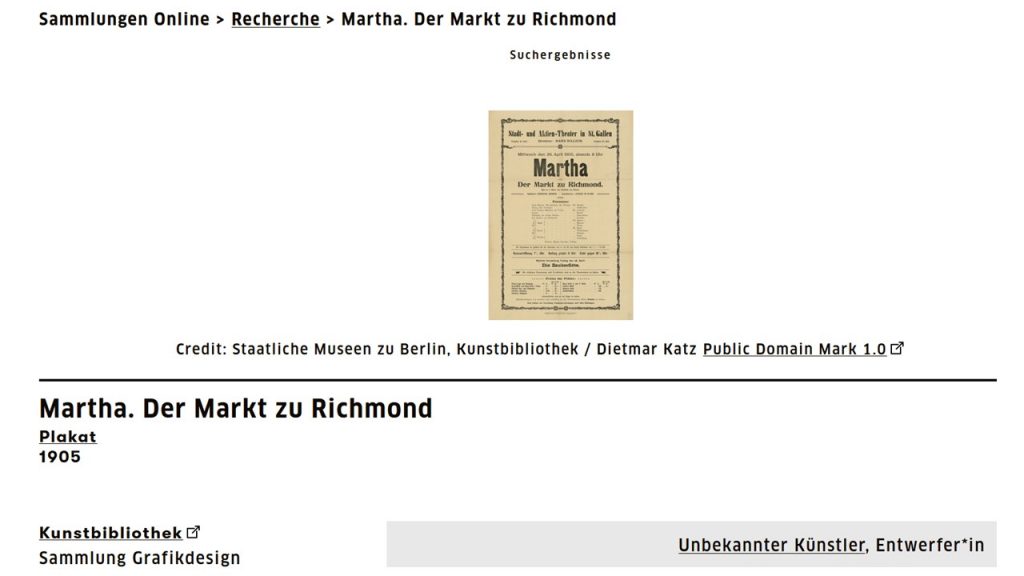 Bildquelle und Großansicht Kunstbibliothek SPK Berlin.
100 x 100
It is the horrible tragedy that Hamas terrorists after more than 100 days hold still more than 100 hostages. We shall never forget. Just like the terrorists taking hostages 51 years ago during the Munich Olympic games 1972. I believe it is about time to remember Winston Churchill’s famous words with a few changes, if I maybe allowed: “We shall never surrender. We shall fight terrorists on land and on sea. We shall fight them in the air and underground, in space if we need to.” This is part of not forgetting terror and staying alert to looming risks. For some the painful memories last their whole life long. Others, far too many, just forget, or worse, deny the facts. 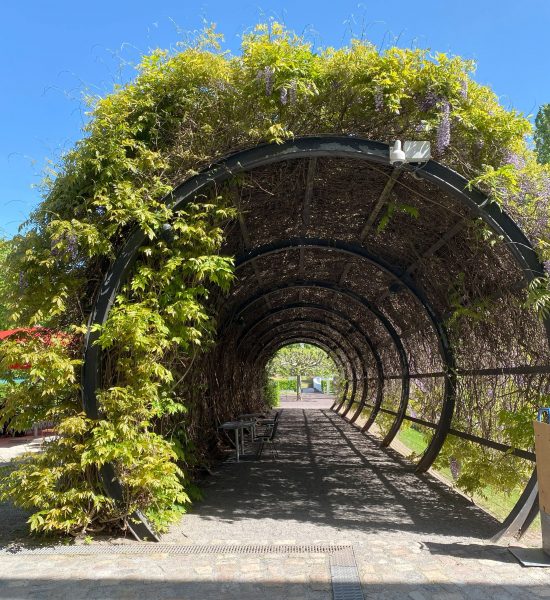
Poster Design
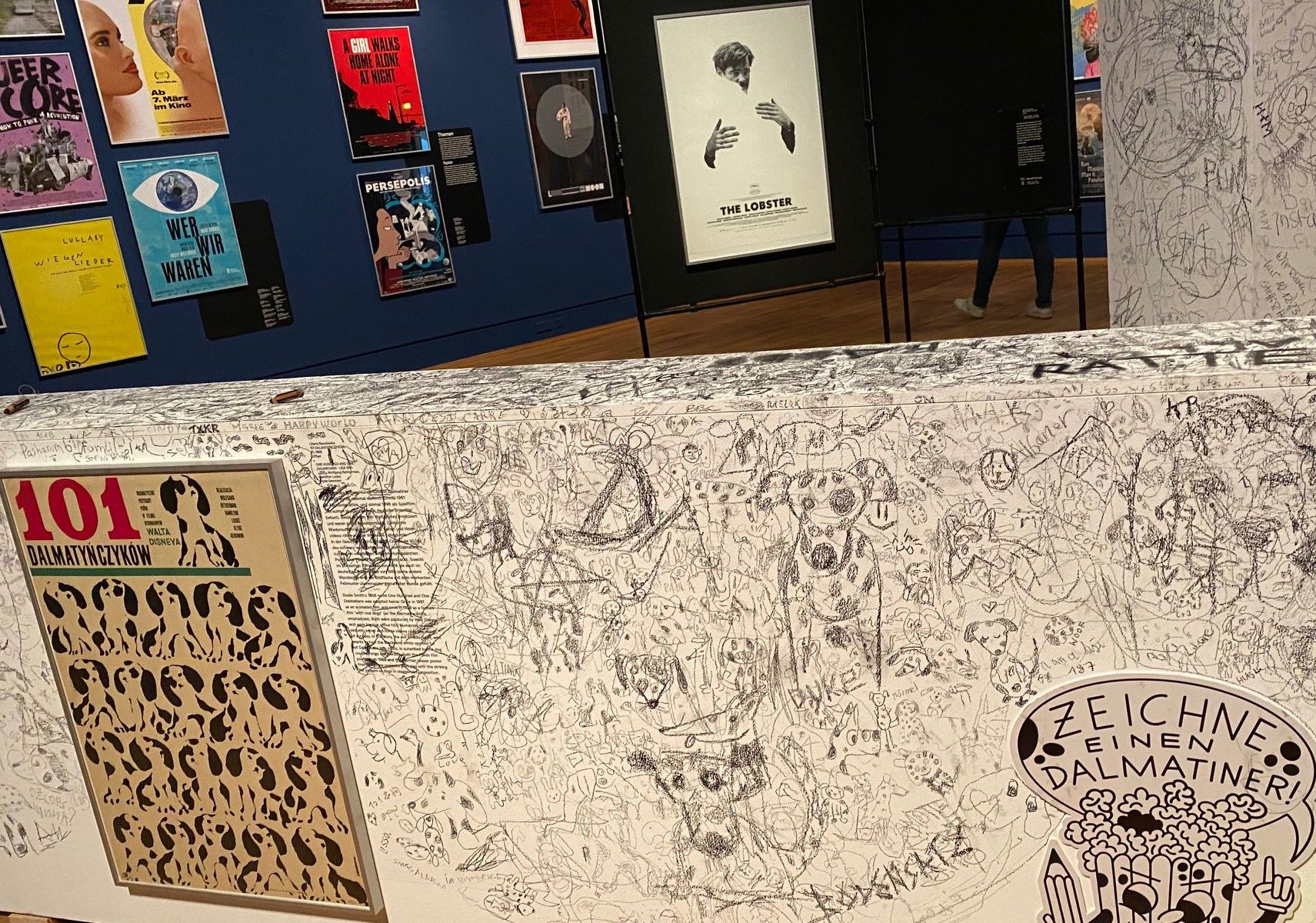
The effective use of posters in visual communication is a specific craft. Artists have been associated with poster design for more than a century. Cinemas continue this practice. For each movie produced there is an announcement posted in print or digital form. In combination with the Berlinale 2024 film festival the Kunstbibliothek in Berlin shows milestones of the history of movies and their representations in form of posters. Besides the historical approach there are many hints how to interpret the design language of posters throughout the 20th century. The encouragement to try to produce one yourself not only reserved to children is an additional activating feature of the exhibition (Link here). Cats and dogs will always catch attention and the playful approach chosen might be a start into a graphic design interest. Overall the exhibition offers a low threshold entry into the world of art and design. Instagramable image on posters evolved into short preview clips, just like instagram paved the way to tiktok video clips. In retrospect posters also provide shortcuts for our memories to recall whole movies that have accompanied us growing up and growing older.
Water fountain
We are lucky that in Berlin not all water fountains have disappeared from the public space. Some might remember that in schools it was usual to have a source of water free of charge for refreshments during breaks. Others cherish public places where there was a water fountain nearby.
Rather than looking where to buy refreshments, usually in plastic bottles nowadays, it was easy to hydrate yourself or the whole family from such a public source. Of course, these sources became the enemies of private companies cashing in extra profit margins the higher your urgency for water is. Hygiene is manageable, if a little bit of care is exercised. In periods of droughts such sources become an asset beyond the benefits for human beings (see image below, bees refreshing). In France, a law which prescribes that public institutions who receive visitors have to offer a point of access to fresh, drinkable water, is badly respected (Link to study). The result is more water in plastic bottles and the transport of those to inner cities. Plastic bottles contain thousands of micro- as well as nanoparticles of plastic which we are likely to digest (LINK to PNAS study). Having your own device ready to be refilled from a public source in inner cities is a healthy alternative.
Sustainability science has studied the issues and delivers solutions. It is societies and policies that have to (re-) implement these solutions. Here again we are back to political science and public health coordinators to raise awareness for these “blue solutions”. 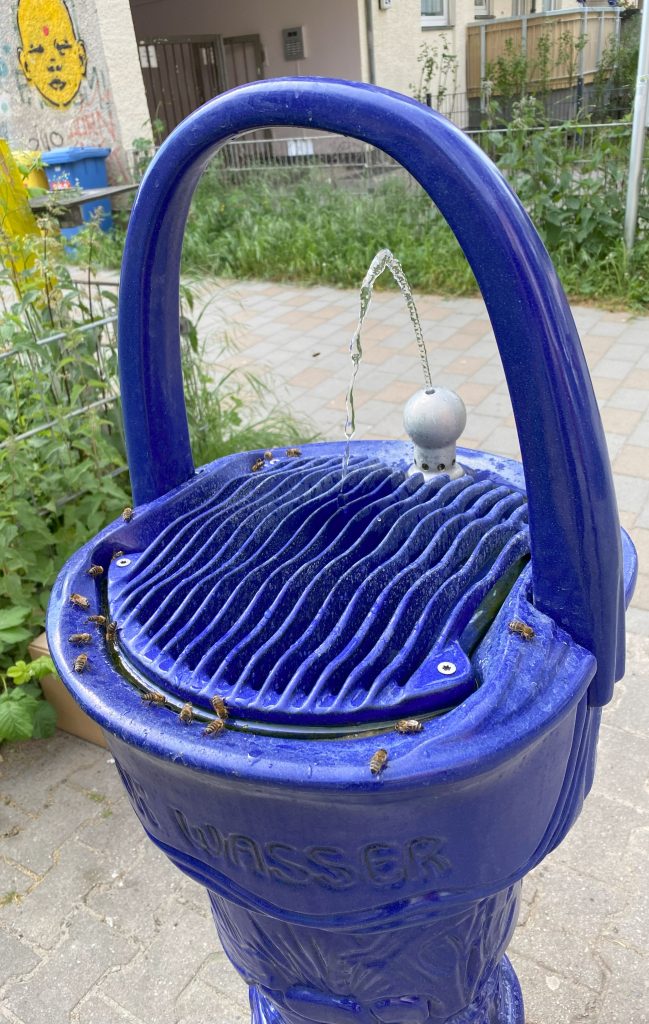
Ethics of posterity
We have not inherited the earth from our ancestors; we are borrowing it from our descendants. (native American saying). Adeline Johns-Putra (2019) states this early in her book on “Climate change and the novel.” Her concern is how to think and write about the ethics of posterity. Approaches of ethics in the sense of parental care (for the planet) or motherhood environmentalism do not suffice in view of overpopulation of our planet. Shifting our identity away from toxic production and consumption is advocated in many novels. Science and science fiction offer many dystopian examples.
De Shalit (1995) wrote early on why posterity matters. It is not the standard of living of contemporaries that matters but we should consider ourselves as a part of a transgenerational community. The time horizon of our decisions matters. In pursuing arguments by John Rawls who re-established a contractionalist perspective on justice, we have to include future generations into our contractual obligations. Following this approach we might arrive at Brundtland’s perspective on the ethics of posterity which is called sufficientarianism in opposition to simple utilitarianism. In sufficientarianism we owe future generations a just and decent living or at least the possibility to have similar starting conditions. Shifting beyond the apocalyptic view of environmental disasters Adeline Johns-Putra (2019) brings to the forefront that we have to substantially lengthen our time horizon both for consequences of climate change and for dealing with it, albeit the fact that most destructive practices operate much faster than the re-establishing of greater biodiversity.
P.S.:Thanks to the curators of the Lese Lounge Staatsbibliothek Berlin for ease of access to the literature.
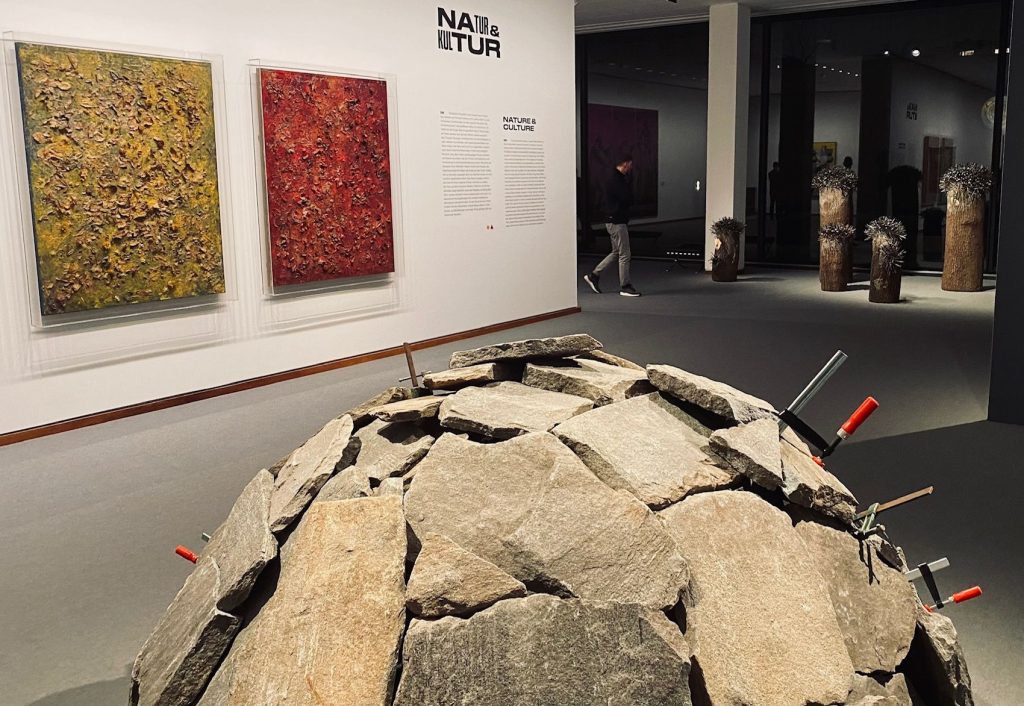
(Image: Natur & Kultur in “Extreme tension: Art between Politics and Society” Collection of the Nationalgalerie 1945-2000“. 2024-1)