
Jede/r hat so seine Assoziationen mit Li_be. Für eine kleine Gruppe von Literaturbegeisterten steht Li-Be seit langem für das Literaturhaus Berlin. Das war nun ebenfalls, anlässlich des Tag des Offenen Denkmals, im September 2023, als solches zu besichtigen. Zentral am Ku’damm plaziert, in der benachbarten Fasanenstraße, liegt diese geschichtsträchtige Villa in mitten eines kleinen Gartens. Trotz wechselvoller Geschichte konnte die Villa als Ganzes erhalten werden, nachdem der Denkmalschutz Veränderungen untersagt hatte. Das Haus der Li-Be hat wirklich alles gesehen, was Leute sich unter Liebe so vorstellen und wahrscheinlich noch einiges mehr. Nach den familiären Nutzungen der Gründerzeit, wurde in den wilden 20er Jahren dort ein russischer und ein arabischer Studentenclub eingerichtet in Verbindung mit der Humboldt-Stiftung, die sich auch heute noch um den wissenschaftlichen Austausch bemüht. Das Rote Kreuz hatte eine erfolgreiche Suppenküche dort in der unmittelbaren Nachkriegszeit betrieben. In den 60er Jahren war es ein Nachtlokal, aber auch einige Jahre ein Studio für modernen Tanz von Manja Chmiél, einer Schülerin von Mary Wigman. Die heutige Nutzung hat weiterhin viel mit Liebe zu tun. Lesungen und Workshops laden laufend ein, sich mit Literatur zu befassen. Der Zeit angemessen finden sich in den Archiven des Literaturhauses zahlreiche Prominente AutorInnen, die Lesungen dort abgehalten haben. Starke Frauen bildeten dabei seit den Anfängen als Literaturhaus einen Schwerpunkt. Nobelpreisträgerinnen gehören zu den Vorleserinnen seit geraumer Zeit. Annie Ernaud und Herta Müller traten schon lange vor den Nobelpreisen dort auf. Toni Morrison und Olga Tokarczuk im Jahr der Preisverleihung oder kurz danach. Ein wahrlich toller Ort und dennoch keineswegs mit BesucherInnen überlaufen. Es bleibt eben so eine Sache mit der Liebe, auch im Li-Be. 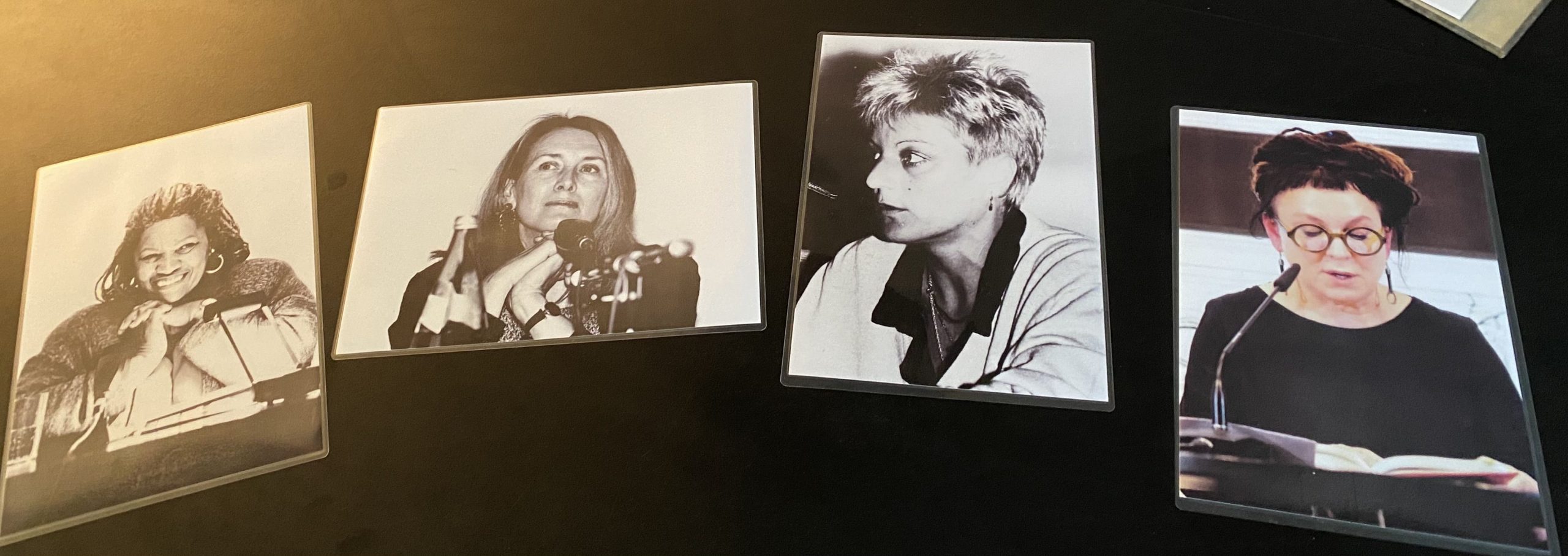

Widmann
Jörg Widmann hat seinen Einstand bei den Berliner Philharmonikern als „Composer in Residence“ gegeben. Die Schwester, Carolin Widmann interpretierte das Violinkonzert Nr. 2 von Jörg Widmann als Solistin. Das war ein ganz besonderer Abend. Die Widmanns haben doch tatsächlich gemeinsam die Einführung in das Programm des Abends mitgestaltet, eine ¾ Stunde vor dem Konzert im großen Saal der Philharmonie. Mit Begeisterung haben die beiden Geschwister von der gemeinsamen Zeit der Entdeckungen rund um die Violine in ihrer Kindheit erzählt. Damit wird die faszinierende kindlich, unschuldige, nahezu naive unbedarfte Herangehensweise an das Instrument verdeutlicht, die so charakteristisch ist für den Anfang des Violinkonzerts. Die Entdeckung eines Klangkörpers (vom einzelnen Instrument bis zum Tutti) geht aber rasch weiter zu einer Demonstration der vielfältigen Gefühls- und Virtuositätsregister der Violine. Paganini lässt grüßen, könnte man meinen.
Kaum klingt eine virtuose Passage an, da hinterfragt der Komponist die eigene Begeisterung. Ist das nicht einfach nur Akrobatik, um dem Publikum zu gefallen? Zweifel stellen sich ein und etwas Distanz zum gefälligen Wohlklang. Reflektierte Virtuosität, der Soziologe würde vielleicht auch reflexive Virtuosität als kompositorisches Element verwenden wollen. Notation von Musik und Klängen hat seit dem wohltemperierten Klavier relativ feste Vorgaben. Daran hat sich Jörg Widmann zu 98 Prozent wohl gehalten. Die anfängliche Erkundung des Klangkörpers Violine lässt sich aber nur anders notieren. Innovativ, mit mehr Raum für Interpretation in der Aufführungspraxis. Das betonte so auch die Schwester, die nun wirklich dem Komponisten sehr eng verbunden ist. Interessant war daher ihr Kommentar, dass diese Anfangsstelle für sie gleichsam die größte Herausforderung darstellt.
Die folgende „Fantasie für Klarinette solo“ von Jörg Widmann passte daher gut zu dieser Erkundungsreise von Instrumenten des Symphonieorchesters. Die Klarinette hat in allen Musikepochen und Stilrichtungen ihren Platz behauptet. All diese Anklänge lassen sich in dem Solo, welches der Komponist selbst dargeboten hat, wiederfinden.
Nach dieser aufregenden Reise durch die Jahrhunderte der Musikgeschichte stand die „Reformationssymphonie“ von Felix Mendelssohn-Bartholdy auf dem Programm. Spannend war die Umsetzung „dieser Art von Teufelsaustreibung“ (Worte von Jörg Widmann) mit dem „2. jüdischen“ Satz und dem „3. protestantischen“ Satz der Symphonie in denen Felix Mendelssohn-Bartholdy seine beiden Wurzeln in den Gesängen und Liturgien in Andeutungen aufnimmt. Mit Klängen und Fängen der ausgehenden Romantik wurden wir in den weiteren Abend entlassen, samt Eindrücken aus der Ausstellung zu der Entstehung (60 Jahre) und der Architektur der Berliner Philharmonie und dem Scharoun Ensemble (40 Jahre) der Gebäude einschließlich der Stabi West. Das Mendelssohn Archiv hat in der benachbarten Stabi West einen kleinen, feinen Ausstellungsraum mitten im großen Lesesaal. So haben wir einen umfassenden Rundblick und Ausblick genießen können, die dem Kulturforum in eindrücklicher, dennoch unaufdringlicher Weise, eine hervorragende Stellung einräumen.
(Image: Jörg Widmann jenseits des Schattens von Furtwängler 2023-9-9)
Denkmal
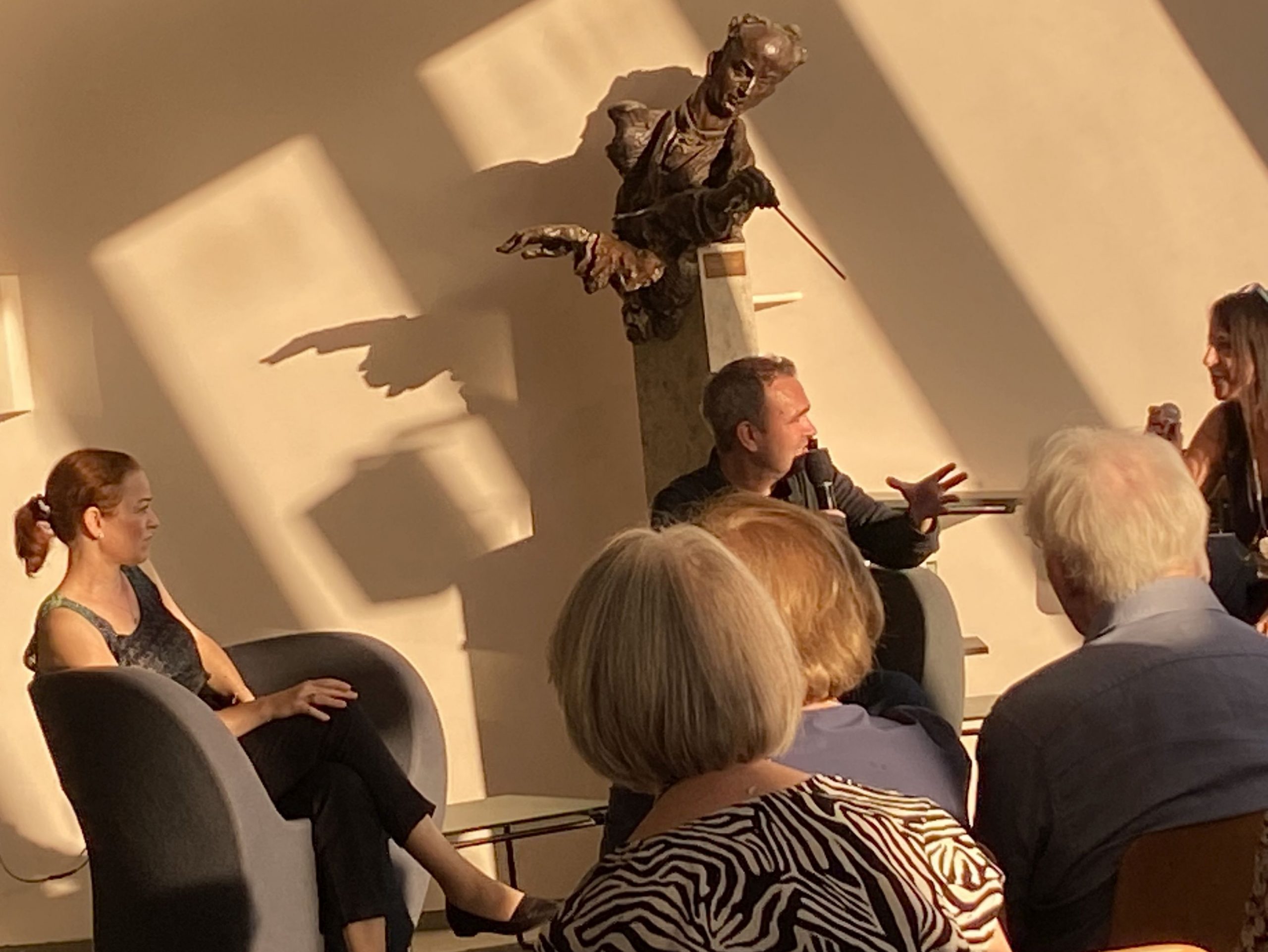
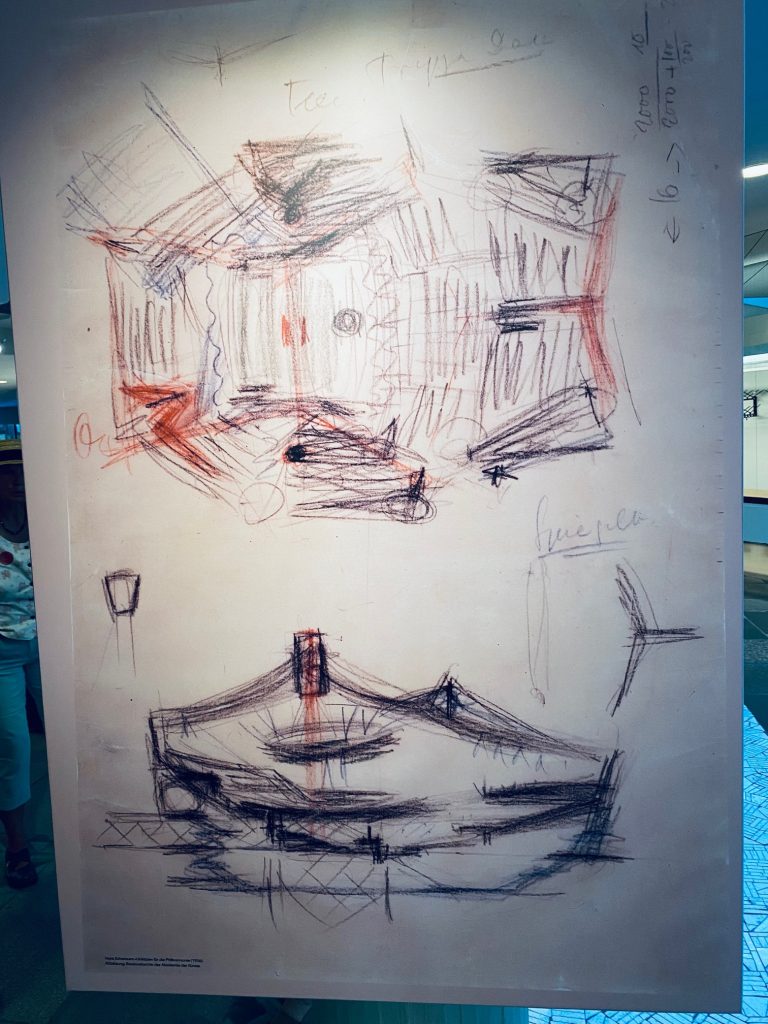
Jedes Jahr gibt es die hervorragende Möglichkeit am Tag des offenen Denkmals, historisch wertvolle Gebäude und Anlagen zu besichtigen. An heißen Tagen, wie in 2023, sind Altbauten oder klimatisierte Räumlichkeiten besonders bevorzugt. Die Philharmonie hat erneut die Möglichkeit geboten ohne langwierige Voranmeldung, spontan vorbeizukommen und an einer Führung teilzunehmen. Das von Hans Scharoun entworfene Gebäude samt seiner akustischen Spitzfindigkeiten bietet spannende Einblicke. Stille, Sound und Noise in einem Gebäude und Konzertsaal will sorgfältig geplant sein. Kompromisse mit verfügbaren finanziellen Mitteln und Planungsverfahren gehören zur baulichen Realisierung, wie eventuell zu den Kompositionen, die dort aufgeführt werden. Heute erscheint uns die gelungene Akustik als historischer Meilenstein. Ebenso die Form des Konzertsaals mit Plätzen hinter dem Orchester, aber auf das Gesicht der Dirigierenden bietet einzigartige Einblicke in die Praxis der Aufführung. Für 10 Minuten war selbst bei der Führung zufällig ein Zuschauen bei der Generalprobe der Berliner Philharmoniker von weitem erlaubt. Komponist und Dirigent Jörg Widmann probte noch Ausschnitte aus der am Abend aufzuführenden Werke. Selbst hoch unter dem Dach der Philharmonie konnten die leisen Ansagen des Dirigenten leicht verstanden werden. Akustische Meisterleistung der Architekten. Wer hätte gedacht, dass Anfang der 60er Jahre eine solche Glanzleistung möglich war, im Berlin, das gerade erst durch die Mauer getrennt werden sollte und dann geteilt überleben musste.
Corrupt-2
New scientific evidence on corruption and stereotypes about corruption reveals surprising behavioural responses. Social psychologist classified corruption as a behavioural trait of a person. The new evidence of a study that includes country-specific stereotypes into a corruption experiment shows there are always two sides to consider: the corrupted as well as the corrupting person. Both hold stereotypes about the likelihood another person (from a specific country background) is likely to accept a bribe.
Using a widely accepted index from Transparency International on corruption in countries the experiment uses real payouts to test the probability that a person from country X is trying to bribe a person from country Y. Rather than a personal trait, the study finds that many persons become “conditionally corrupt”. This describes the behaviour to offer a bribe to a person occurs more often if you believe the probability that the person accepts corruption is high. Dorrough, Köbis et al. (Link publication) is cited in “nautilus” explaining this by, quote, “when in Rome, do as the Romans do”. Additionally, the stereotypes on corruption prevalence leads people to act more on what they believe is common practice rather than what is the basic legal or ethical standard.
From behavioural ethics we know the urge of people to find justifications for their unethical behaviour to themselves or to others. This is called “justified ethicality”.
Following this rationale, it will be easier to accept a bribe, if the person originates from a high reputation of corruption. In order to correct for such bias due to stereotypes it is important to pursue corruption vigorously and, just as important, communicate a lot about this behavioural change so that stereotypes begin to change in the mindsets of other persons as well. There are many ways to Rome and some turn out to be quite long. 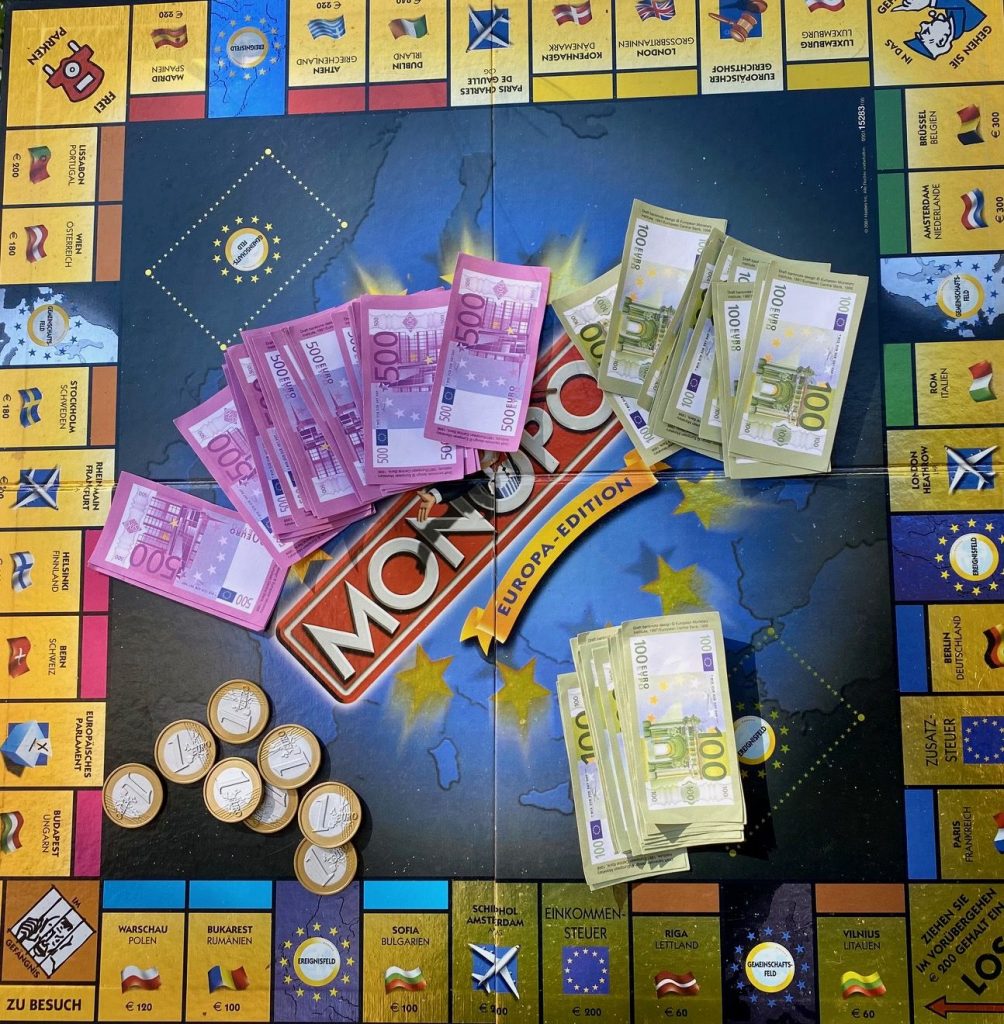
Silence
In the modern world places of silence have become rare. During the industrialisation noise has become a synonym for modernism. Many people even celebrate noisy engines as an image of strength or horse power. In the wake of the 21st century is has become evident that this co-evolution has made us sick and whole cities suffer from the abundant sources of noise.
Can we talk about silence? No, wrong approach, but we can write or realise images dealing with silence. Yes, surely. Spiritual locations often build on the mystic experience that silence might incur. Measuring silence in physics is a lot more complicated. Sound has several forms of measurement. Also, silence is probably experienced by most of us as a relative concept. Compared to a noisy atmosphere we might appreciate less noisy situations as more or less silent already.
Therefore, a reasonable, but evasive definition of silence is the absence of noise. Depending on our auditive capabilities different persons will define silence at different levels. Sound near us blends into sound in the background and vice versa.
Temporality plays an important role. In complete silence we might imagine even to be dead. Otherwise, some distant vibes or vibrations will reach us and potentially stimulate our senses. Silence works as a bridge between two atmospheric impressions. It creates a feeling of expectation for something still unknown. Silence is underrated as our smart phone attempts to disrupt silence as much as possible to draw our attention to messages or reminders. Hence, silence is about to be turned into a new status symbol. Practice of meditation, listening to isolate and subsequently to discard sound, has become an advanced level competence, not only for musicians. Feel free to be silent and see what happens around you. It is easy in locations of supposed spirituality or in most libraries. Almost everywhere else you have a hard time to experience a silent atmosphere.
The composer John Cage made silence the title of one of his quite well known pieces. The willingness to pay for the entry to the silent concert might be surprising although the listening experience is unique to each location and diversity of audience. Composing silence remains a challenge, making noise is easy. (Image: NASA/ESA Hubble Space Telescope, extract of Link) 
Write, write, write
A poster announcing the “internationales literaturfestival berlin 2023” prints in big letters: “Read, read, read, … 14 times”. This is a quote from Werner Herzog when he was asked what makes a good filmmaker. The message from Manjeet Mann to the young audience at Berlin added to this: “write, write, write”. At least this was my impression as a summary of the talk and her short readings from her novel in verse “The crossing”.
The lecture hall of the “Stabi” was packed with students from high-school who felt at ease with the English language presentation and talk. The host Shiva Mesgarian managed to get the crowd of students to ask questions in the huge lecture theatre.  Manjeet was giving a lot of insights into writing, editing, motivation and the difficulty to give a voice to persons from marginalized backgrounds. In her case as a person of colour herself, born and raised in England with additional links to India, she took issue with the topic of refugees. Living in Folkestone (Kent), she is confronted with people crossing the Channel on a daily basis.
Her book “The crossing” is actually building bridges between countries and continents. Her entertaining way to talk about her hard work as writer motivates, inspires and encourages young persons to pick up their pencil and/or notebook to start writing. Just don’t stop. Journaling helps. Take your emotions of an issue seriously, then work on it. Give characters a voice who have not received much attention. Go out and interview persons to get authentic input.
It is not about appropriation of a story. It is about meeting and exchanging with marginalised persons. Return your written pieces to those “sensitive readers”, whose story you attempt to develop. All this takes time. Re-writing is an important element as well. “Having written the story for yourself, you then re-write it for the readers”. Edit, clarify, sharpen, blur, attend to detail – all this helps the reader to follow and enjoy. These were the messages to all the students who were grateful for advice as the new season of essay writing in school, university and beyond is about to start. 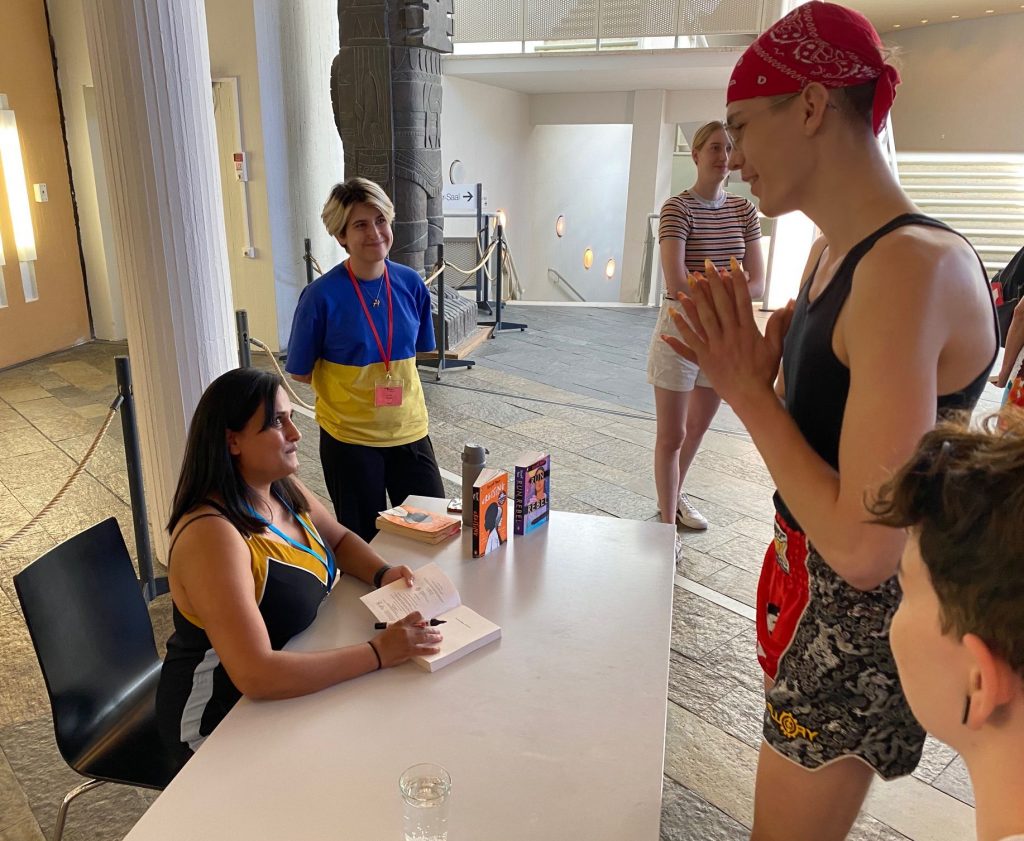
Poetic Coffee Break
The rather stiff and rigid structure of the “Staatsbibliothek” in Berlin does not yet have a reputation to be a place of poetry, translation of poetry and recitals. This is about to change. As a student, researcher or lecturer I would have adored to see my library proposing a poetic coffee break. I would have gone for the necessary break in the afternoon, the coffee and, okay why not, a poetic experience. This time it was different. The organisers, “ilb and Stabi” got together and Ursula Jäcker together with Michael Bucher presented poetry from Shakespeare (Sonnet) in English followed by the German translation by Wolf Biermann.
Translating poetry is a very tricky thing. Just try it yourself and you will be full of admiration for the admirable work of translators of words, sentiments, rhyme and rhythms. The presentation of Biermann’s comments on his own work on translating Shakespeare’s sonnets gave interesting additional information on the short and precise English original and the longer, somehow fat translations into German (Biermann’s words). Thanks for the indication that Biermann deviated from the Shakespearean “iambic pentameter” to add a sixth foot most of the time (to be checked OMG). The choice of numbers 6, 18, 27, 66, 73, 76, 121, 147, 154 from the Shakespeare Sonnets were witty and entertaining for a coffee break. For example, from 27:
“And keep my drooping eyelids open wide,
Looking on darkness which the blind do see:…”
Also, from 76:
“Why write I still all one, ever the same,
And keep invention in a noted weed,
That every word doth almost tell my name,
Showing their birth, and where they did proceed?”
More than 400 years ago, these rhymes were drafted and still today writers and learners, at the Stabi and beyond, can somehow identify with the intricacies of the process of creative writing.
More of this, we need, today and for tomorrow. THX. 
Ozone
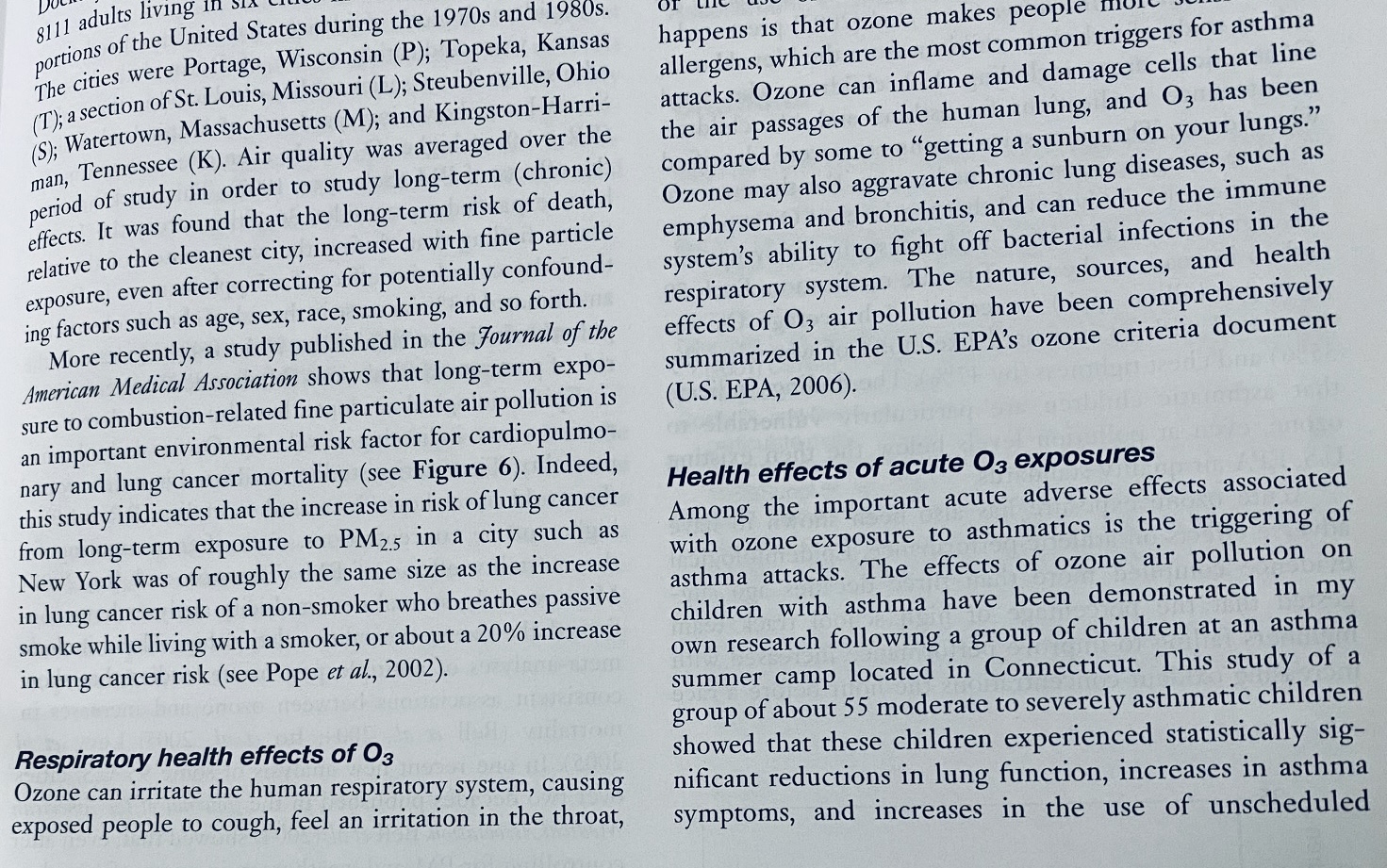
Ozone (O3) has a rather mixed reputation. High up in the stratosphere it protects us from too much radiation from the sun, but down on earth in our respiratory environment it causes and amplifies respiratory difficulties. Hence, it is very important to differentiate the 2 different layers and differential effects of concentrations of ozone in the air. A forthcoming study in the Lancet Regional Health Europe (Nov. 2023) by Tianyu Zhao et al. demonstrates the long-term, negative effect of higher concentrations of Ozone on lung function. The prospective cohort study followed individuals in multiple states and locations over 20 years and corrects estimated effects for other environmental effects (fine particles PM 2.5 pollution) and green environment. Faster decline in spirometric lung function is highly likely to be caused by higher ambient ozone concentrations. The study is based on 3000+ observations from 17 centres in 8 countries in Europe. Older persons in the range from 35 to 55 had a steeper decline in ozone-related decline in lung functions.
This is rather bad news for older persons living in inner cities where both ozone concentrations, mainly in summer, heat and micro-particles cumulate. Similarly, areas with frequent so-called inversion micro-climate, (a layer of cold air on top of SMOG blocks the renewal of air for extended periods) face particular health risks. Professions that work long durations outside in the sun or the exercise of sports during high ozone day-time run higher risks for a deterioration of their lung functions in the long-run. The medical evidence is there now, also for Europe, what had been shown already for the US before.
It is time to adapt our lifestyle to these health risks. High effort physical work outside should start as early as possible in the morning hours or even before sun rise. Staying indoors is highly recommendable for older persons and persons with reduced lung functions (asthma risks) during such periods of high ozone concentrations. Like it or not, even wearing a mask outside, when it is sunny and hot would be preferential, but is rather inconvenient. We need to shift airing living rooms or offices without climatization to early morning hours rather than ambient temperatures in the afternoon, when ozone peaks are prevalent.
These effects and remedies have been known for some time, but the evidence is much more compelling now (Zhao et al. 2023). Climate change in form of global and local warming, particularly in inner cities, will only exacerbate these effects in the coming years. Prevention measures need to be considered in public health measures as well as urban planning. We can do it, if we want to. Start now to benefit from the effects a decade later or for the benefit of younger generations. (Image: Int. Encycl. of public health, p.702). 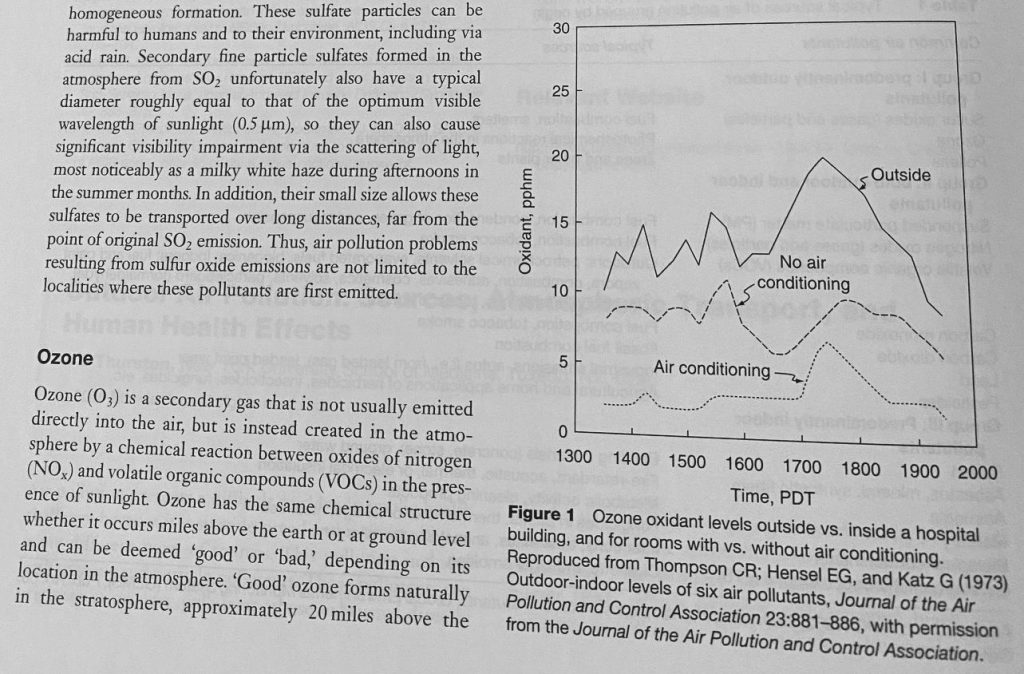
Princess
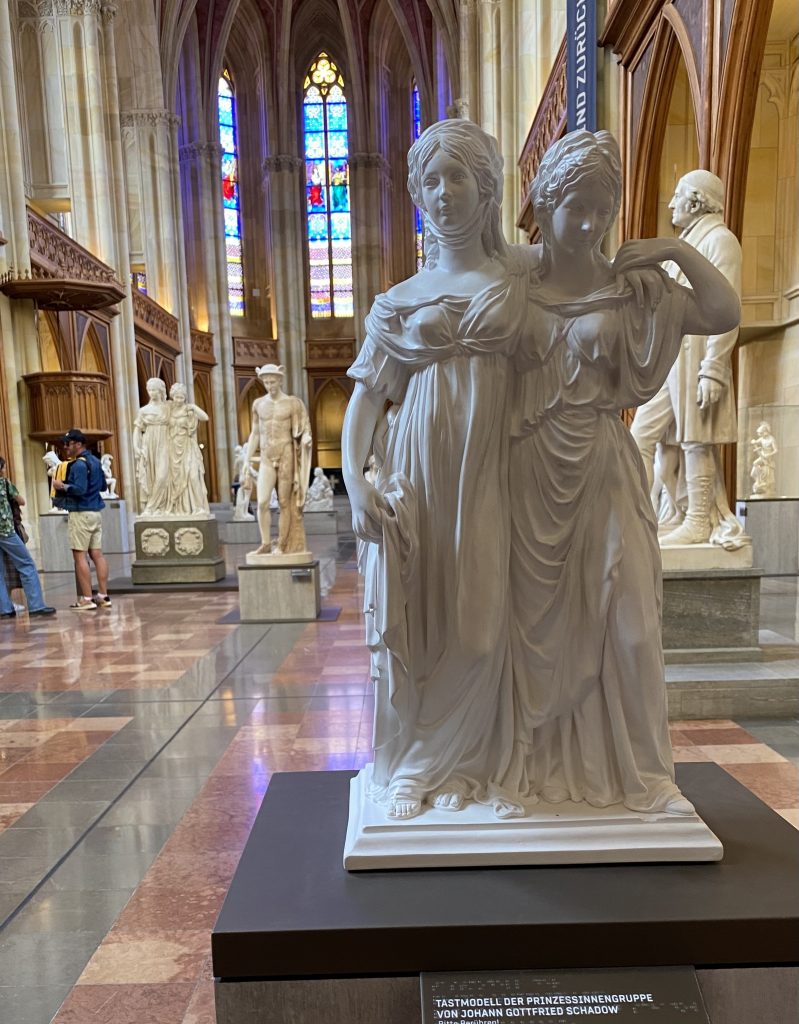
Berlin is proud to present its princesses after a marvelous lifting. Yes, in the middle of the barbie hype, Berlin exposes two of its princesses of the late 18th century. And you can touch them, if you like or dare to. They don’t bite. I have not seen anybody kissing them either, except for a Spanish football president. All this is happening in the Museum Church Friedrichswerder designed by architect Schinkel an built until 1830s. The grouping of the two sisters was unusual for the time and only the inscription at the bottom introduces the distinction that Louisa on the left is the princess heriting the throne. Frederica on the right is wearing a different foot wear, considered less noble. The privilige to touch the princesses applies only to the smaller copy in front of the image below with “Braille inscription”. The original is further behind. Of course, this one is protected against unwanted contact with the masses or “followers”. At the time “follower” still had a different meaning from today.
Bogenspannerin
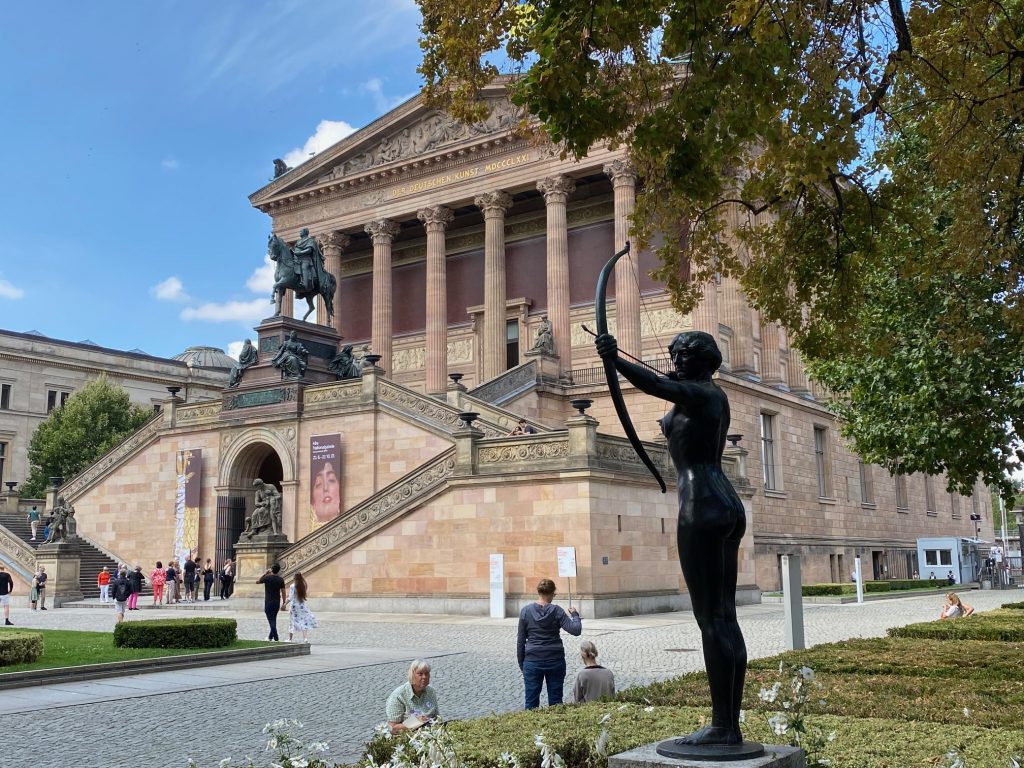
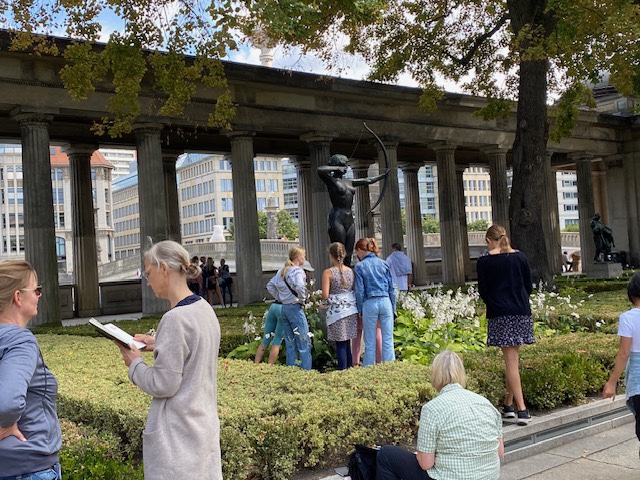
Seit der Antike sind Bogenschützen und Archer ein Thema der Künste. Meistens ist die männliche Repräsentation die dominierende Variante. In Berlin lässt aber auch seit langem eine starke weibliche Realisierung bewundern. Nahe dem Pergamon Museum und der Alten Nationalgalerie steht die Statue der Bogenspannerin. Die Zielrichtung geht Richtung Hedwigsdom, als ob der Kampf zwischen Kunst und Religion ein andauernder wäre. Erfahrene Stadtzeichnerinnen, aber auch Jugendliche fühlen sich dadurch angeregt. Kunstschaffende können einen nachhaltigen Einfluss haben. Innerhalb Berlins ist nicht nur die Vielfalt der Kulturen zu bestaunen, sondern auch der Wettbewerb der Künste um Aufmerksamkeit. Da werden nach Regierungswechseln oft viele Bögen gespannt. Bleibt abzuwarten, wen es alles dieses Mal treffen wird.
Energy Ethics
Around the topic of energy there many ethical issues that urgently need sorting out. Carlos Diaz-Rodriguez and co-authors have provided a sound basis for such ethical considerations. To leave the disastrous path of energy provision through polluting fossil fuels and, additionally very risky, nuclear energy, they propose a departure from the principles and values that have guided us into a dead end. In their opinion we suffer from a mistaken belief to be able to control in extremis, through scientific methods, the forces of nature. In ethics this mistaken belief has roots in religious beliefs that mankind is mandated to make the earth subordinate to its own will. The authors propose to overcome this old paradigm with a new paradigm. This builds on the (1) “precautionary principle”, (2) justice as equity, (3) protection and the (4) principle of responsibility.
Most European readers of philosophy and social science are familiar with these principles. The virtue of the paper is to expose and juxtapose these principles in a clear format and a stringent application to the ethics of energy (production as well as consumption of it).
The precautionary principle is part of the European treaty on the functioning of the European Union Art. 191, but its implementation on energy issues reveals that it is a tiger without teeth. Younger generations across the globe are right to claim a more forceful implementation of this principle.
The perspective of justice as equity is bringing in later born generations as well into the balance costs and benefits of “cheap energy today” but huge costs of dismantling, repairing, stocking deferred to the future.
The protection principle refers to the loss of biodiversity and exploiting resources in areas of world heritage, for example.
The principle of responsibility goes beyond the judicial and economic principle that the person, company or state causing damage through exploitation of resources, and in producing energy with it, has to pay for repairing those damages.
As this is hard to achieve in real terms, there is an urgent need to reiterate the responsibility principle at all levels. Despite the inefficiencies of legal systems, the international legal order in particular, there is no way around than to insist on responsibility from the individual behaviour, company strategic goals as well as objectives set by nation states and international organisations. The Paris agreement and all COP XY conferences only prove the fact that irresponsibility continues to be a guiding principle.
Maximalist positions as well as continuing like decades before is failing people on earth. Organising a discourse on these ethical issues is a first step, but we have to be able to address negationists as well.
The missing principle so far is the solidarity principle. Without a firm commitment to intergenerational and international solidarity we shall remain unable to solve the ethical puzzle. It is high time to organise solidarity related to the field of energy.
(Image: “The fallen tree of knowledge” by Fabrice Samyn. Exposition in Yerres, France 2021-11) 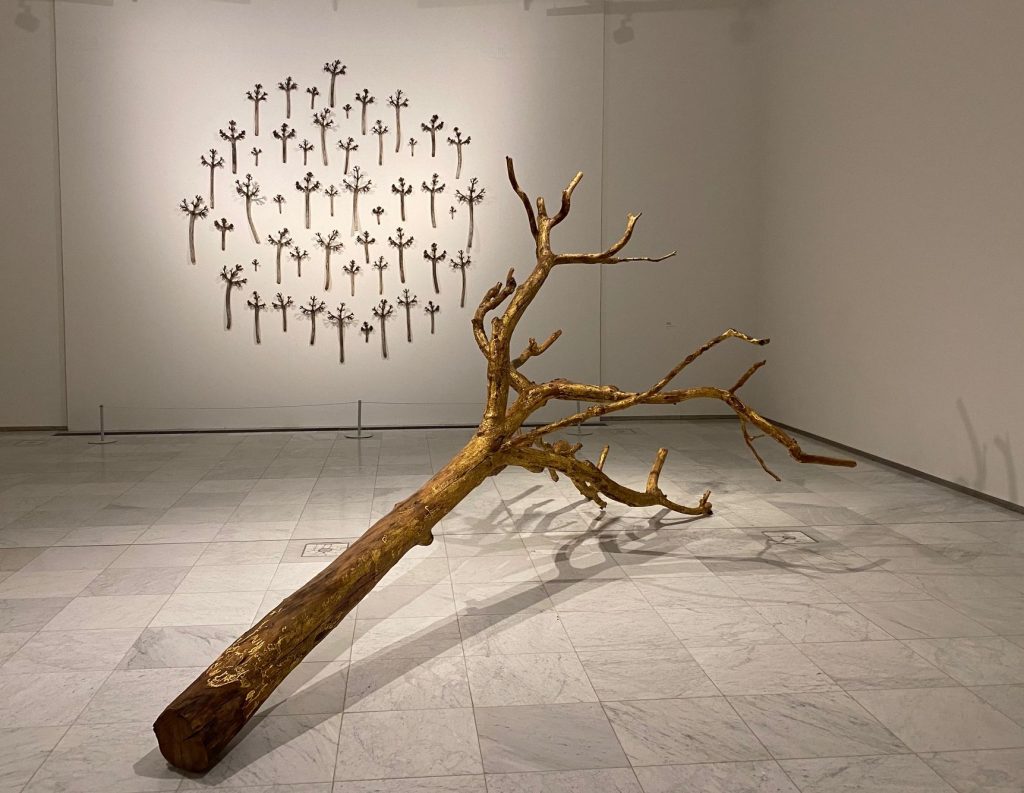
Energy Food
For more than a decade now researchers have shown the link between energy prices and food prices. At first sight this might seem surprising. In traditional or romantic associations with growing food, there is no link between the cost of energy and food production. Growing crops in your garden does not need more than sunlight, soil and water. Yes, that was long ago. Industrial production of food is heavily relying on energy to heat, feed and water plants or animals. Additionally, the supply chains have become far more distant, which increases the CO2 footprint even further. Therefore, it is no longer surprising that a great number of econometric studies confirm the close link of energy prices and subsequent pressure on food prices. This is not restricted to Europe, but has reached global contamination.
Enjoying seasonal local food is a double catch solution. You grow according to local weather conditions and use traditional conservation methods, if the crop is exceeding your demand at that time. Providing heating for animals to increase productivity or quality of products appears to be one of the most wasteful ways to further increase the spiralling up of energy and food prices.
In agricultural science there is a lot of research into the “energy intake” of animals to better grow or produce more milk etc. This is the expensive intermediary step using energy to produce energy intake for animals rather than humans. It is surprising that we take so many years to address these well-known linkages that have turned to serious problems after Russia’s war on Ukraine. Agriculture and farmers can be part of the solution rather than a problem themselves, if the link of energy consumption and food prices is taken seriously. 
10000
In France 100.000 is associated with Monsieur 100.000 Volt Gilbert Bécaud due to his dynamic singing and performance style. Since August 2023 we now have an additional association with the number 10.000. Ten thousand m3 was the size of stones that came down from the mountains near the popular skiing resorts in the French Alps (Le Monde Link+video). To visualize the amount, a back of the envelope calculation with a standard container size of 25 m3 returns 400 loads of lorries to be removed from hard to access landscapes. Count this into the costs of running ski resorts.
A study in the scientific journal “Nature Climate Change” in 2023 highlighted the increasing risks to European skiing sites. Same holds for the Alpes in Switzerland. Some areas relying on water resources to create artifical snow do so in less and less safe areas. Costs accrue to communities who benefit only indirectly from the skiing hype, celebrating 100 years of Olympic skiing next year. After all it is big business to sell or lend equipment, provide hotels and meals for all those sports women and men.
The so-called collateral damage is probably even worse. Interrupted railways, bridges, motorways and traffic in general becomes a severe disruption for quite some time adding to the total costs of having fun in winter. Is it worth it? A tricky question to ask in a referendum. We shall have to revise our past decisions to expand skiing resorts in light of the new evidence of higher risks and costs involved. A book on 10.000 years of history of glaciers is full of side-effects of glaciers melting away, which cause instability to valleys on the sidelines. In the most recent break-up of rocks it is actually more the access to the skiing resorts that was blocked, but this demonstrates to all: passing this area now, is not without serious side-effects. 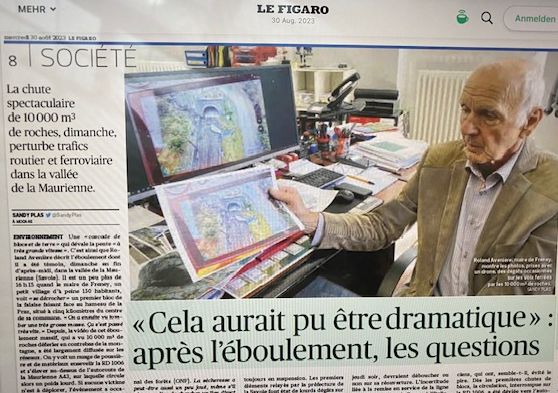
Everyday objects
If you were wondering whether everyday objects can be a piece of art, then the exhibition at the “Neue Nationalgalerie Berlin” is for you. Isa Genzken challenges our traditional view of everyday objects through small transformations of these objects. At first sight you “only” see something utterly familiar to you. A window, a radio, a rose or a wheelchair are immediately recognisable. However, all objects have a little twist to them causing some alienation, questioning or finding new connections. This is the stimulating experience of a visit of the exhibition. The booklet gives an informative overview of choice of sculptures chosen for the exhibition. Walking around in the spacious entry forum allows to appreciate the objects from many angles and in different lighting including twilight. Allow yourself to be challenged. Distancing your perspective beyond the obvious object you recognise broadens our vision of what we see and how we perceive it. The huge pink rose in front of the gallery overshadows even the monumental appearance of the Neue Nationalgalerie. In memoriam “Rosa Luxemburg” and Karl Liebknecht who were murdered not far away, near the “Landwehrkanal” in 1919.
Some visitors might like the skyscraper models she created to remind us that “design catastrophe” with the usual high rising buildings are pervasive around the world. Sculpture as architecture or architecture as sculpture has been her forward looking work from 2008 “Ground Zero – Hospital”.
With the construction work in full swing in the neighbourhood of the gallery with the design of a barn (Scheune) we understand the choice of the artist as a timely reminder that Berlin could be more daring in the architectural design. 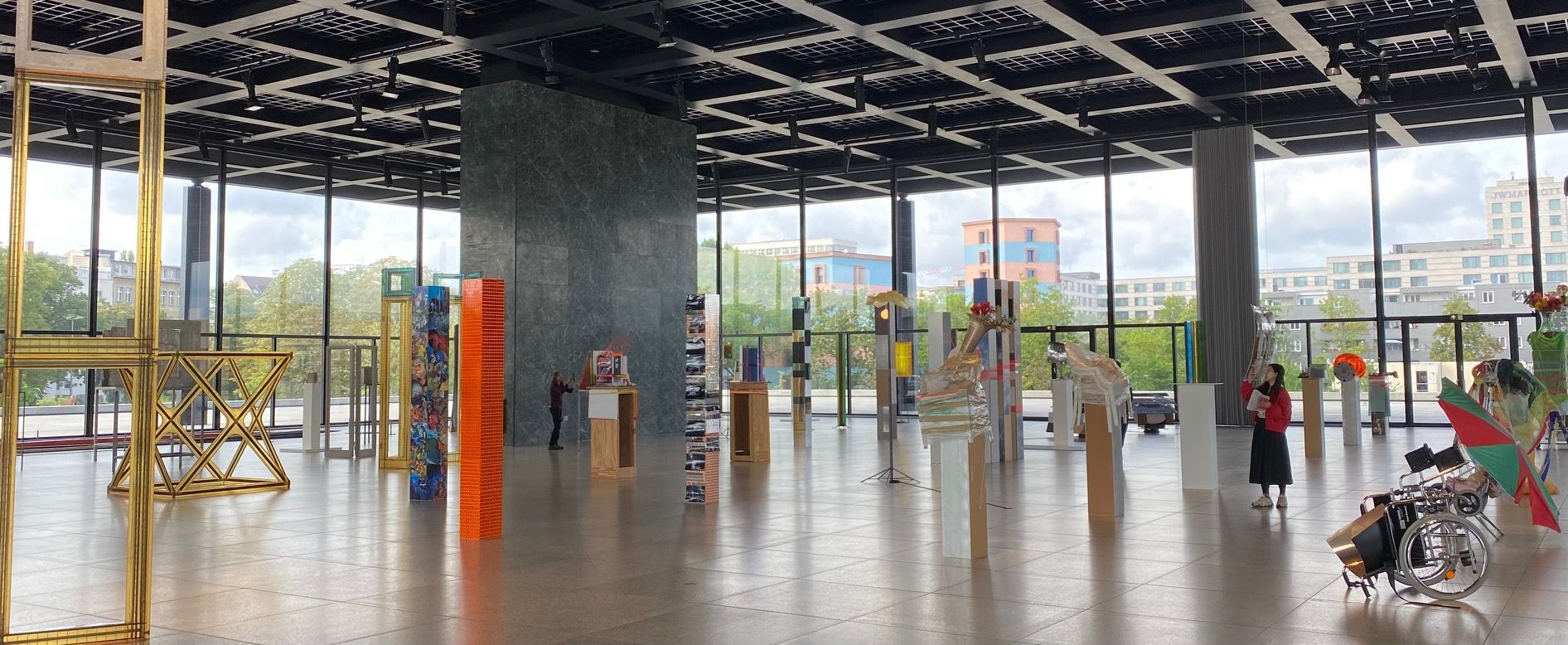
Smart watch
Das Handgelenk hat noch viel Platz für elektronische Geräte. Vom preiswerten Schrittzähler bis zur smart watch und intelligenten Armreifen oder sogar Ringen gibt es dort viel Potential für Innovation. Jenseits der Schritte werden mittels vielfältiger Sensoren eine Fülle von Daten erfasst. Datenschützer erschaudern geradezu. Das Potential für medizinische und soziologische Auswertungen dieser Daten ist immens. Vergleichbar mit einer elektronischen Waage, die Knochenmasse, Wasser und Muskeln erfasst erlauben die smarten Uhren noch mit Ungenauigkeiten, aber stetig besser werdend, kardiologische Werte und Schlafrhythmus zu erfassen. 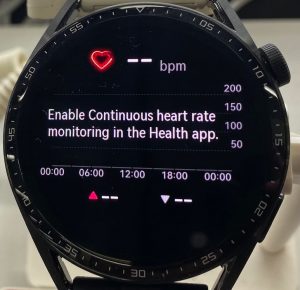
Mit Daten von tausenden bald Millionen Datenlieferanten lassen sich wichtige Studien zur Früherkennung von Gesundheitsrisiken durchführen. Plötzlicher Herzstillstand ist eines der immer noch wenig aufgeklärten Phänomene. Die Studie im LANCET digital health hat solche Daten ausgewertet und kommt zu der Schlussfolgerung, dass dyspnoea für Frauen und Männer der größten Risikofaktoren darstellt. Für Frauen wird Entwarnung gegeben für Diaphoresis, exzessives Schwitzen, aber nicht für Männer. Letztere sollten Schmerzen in der Brust ebenfalls ernst nehmen. Daten sammeln kann durchaus Leben retten. 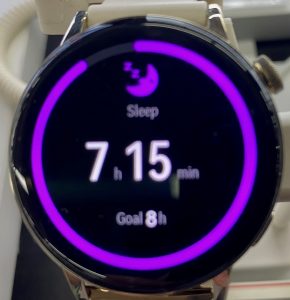
Dennoch droht dem Gesundheitswesen eventuell eine Welle an falsch positiven Selbsteinweisungen in der Notaufnahme der Krankenhäuser. Darauf sind wir noch wenig vorbereitet, inklusive der möglichen rechtlichen und finanziellen Konsequenzen. “Big brothers are smart watching you”. Müssen Ärzte die smarte Evidenz berücksichtigen, etwa so wie eine Patientenverfügung? Was wenn plötzlich der Notarzt unaufgefordert an der Tür klingelt? Wer hat meine Uhr gehackt, … , singt das Paulchen Panther jetzt.
Stabi locker
Die Staatsbibliothek Berlin in der Potsdamerstraße macht sich mal richtig locker. Neben all dem gebundenen und gebündeltem Wissen gibt es eine kleine, etwas versteckte Ecke in der richtig gechillt werden kann. Mit aktuellen Tageszeitungen in Papier und online lässt sich gut pausieren. Eine tolle Aussicht gibt es zusätzlich. Selbst eine vorübergehende Schließung wegen überfälliger Sanierung wird die Stabi bei den Wissbegierigen eine wichtige Location vermissen lassen (fehlende Bücher).
Neben Wissensmaschine ist die Stabi eine Lernanstalt erster Klasse. Die Anzahl der mitgebrachten dicken Gesetzbüchern samt Kommentaren lassen einen immer wieder staunen über den Mangel an stillen Lernorten an Universitäten und in Privatwohnungen. Die richtige Lernumgebung befördert den Ansporn, noch eine extra Meile zu gehen. Wissbegierig ja, aber es braucht auch viel Durchhaltevermögen bei ständig wachsenden Ablenkungsmöglichkeiten. Gemeinsam, einsam, allein mit sich und dem Wissen lässt sich vorzüglich dicke Bretter bohren. Das ist ein wichtiger Teil, das Lernen zu lernen. Kunst am Bau und im Bau gibt es gratis dazu. Die Nähe zur Ablenkungsindustrie am Potsdamer Platz, Kinos, Spielbank und Fresstempel kann da getrost auf ihre späteren Opfer warten. Mit Regionalzügen und S-Bahn kommt man von dort rasch wieder weit weg. 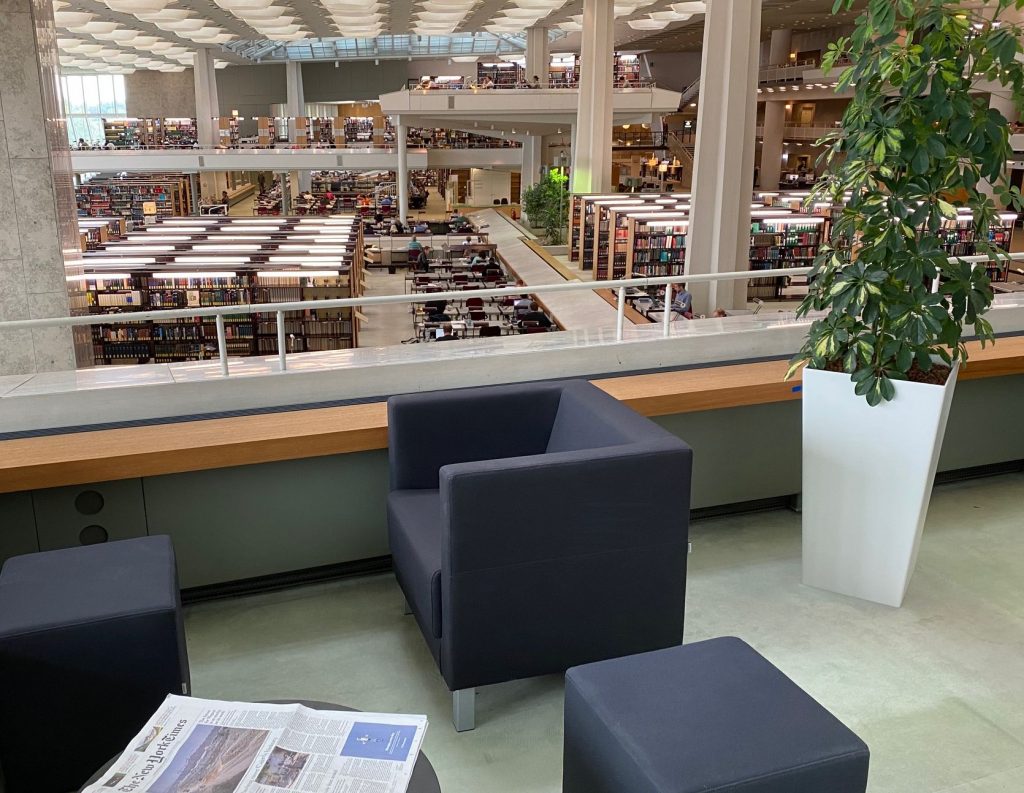
Barbie explore
The film on Barbie after more than 60 years of the first puppets to arrive on the market is a huge money spinning exercise. Hitting more than 1 billion $ is really a huge box office success. More interesting even is the banning of the film in some countries like Algeria. This gives the film an interesting subversive touch to it, which we in the Western countries no longer see as something special. Emancipated women pose a threat to authoritarian regimes.
However, we see in the stereotypes of beauty-driven dolls not that much of an emancipatory chance. To view emancipation independent of the looks of a person is another interesting twist to the role in stereotypes of beauty. It is not only fun to play around with stereotypes, that is mostly, if you are not negatively affected by them (age, gender, ethnicity, extraordinary persons). A nice task for sociology and psychology to explain the working of stereotypes in society and possible remedies. Tolerance is a competence that needs to be learned and updated continuously, from early age onwards.
Therefore, the website created by the US Design Agency Rvnway offers an entertaining way to play around and learn about stereotypes. Perceived, generalized beauty or gender roles can be explored using the tool. Maybe some see themselves differently after such explorations. Everybody is a model. This is the message. www.bairbie.me will let you explore other formats of yourself. After 3-D rendering and printing your children or grandchildren will decide what role they would like you to play in their playfull, or virtual “real” life. I suppose many of us will be up for a big surprise. Go on and imagine in 4D. In the age of selfies all around us, all the time, we believe we are very modern, but the artists of the 19th and 20th century following all great painters before, frequently started their careers with an “autoportrait” or “Selbstbildnis” or series of those as they were aging. 




More Design
How about a subject like Design in school. Rather than the same old boring teaching manuals in art, music, economics or social science, young learners have always been attracted to making things by themselves. The theoretical context is then coming to the subjects and objects more naturally. Economics as market design, design social security for platform workers, sound or furniture design could bring in the creative potential of the learners. Lessons learned through subsequent applications or realizations of prototypes allows the link of theory and practice. A school garden would even be a fantastic cross-discipline learning opportunity.
The most difficult part is probably to find competent coaches to guide the learners exploring and designing. The world is not perfect, so why should learners not be confronted with imperfections in learning set-ups. The most fun part in science is when experiments go wrong, hopefully not too badly though. Catching learners by their curiosity is very likely to get them hooked on more thorny scientific questions as well. Across Europe holidays are coming to an end and millions of pupils go back to their benches and rigid curricula. We should really care more about the next generation.
Europa Meer
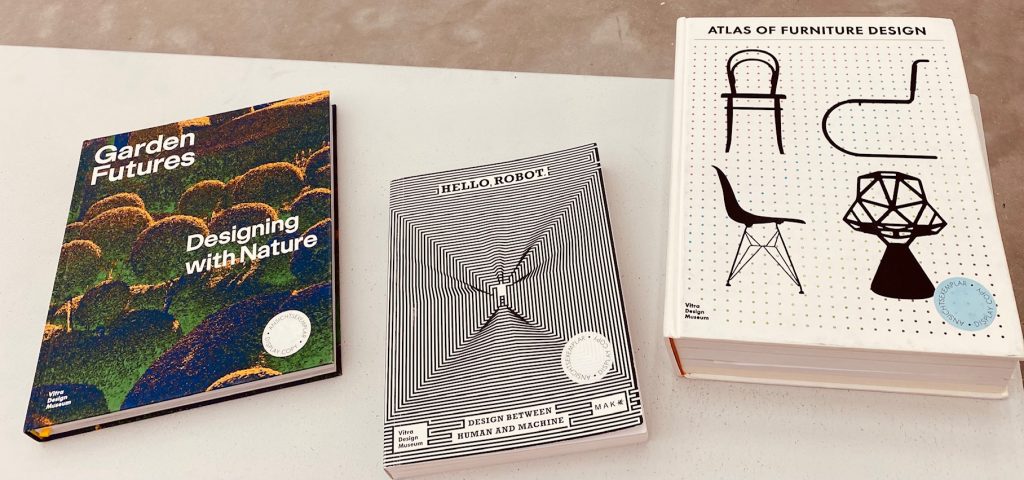
Europa und das Meer, so lautet der Titel eines Buches und Katalogs zu einer Ausstellung des Deutschen Historischen Museums (DHM) aus dem Jahr 2018. In 2023 im August sind die Zeitungen voll mit Artikeln über Meererwärmung und die schwerwiegenden Folgen für Menschheit und Bio-diversität. Die Geschichte der Beziehung zwischen Europa und dem Meer ist leidvoll und euphorisch zugleich. Alljährlich zur Sommerszeit wird das Mittelmeer von Wellen mit Touristen überspült die „over-tourism“ erleiden müssen. Menschen sind oft eine in Massen, aber nicht in Maßen, auftretende Spezies. Das Meer spielt zusätzlich eine faszinierende, verheißungsvolle Anziehungskraft aus. Europa sieht sich zudem gerne noch als Dreh- und Angelpunkt der Weltgeschichte.
Der Ausstellungskatalog enthält lesenswerte Beiträge von der Antike übers Mittelalter bis in die Neuzeit. Die Thematisierung von Herrschafts- und Handelsräumen , Brückenschlagen und Grenzziehungen, Meer als Ressource bis hin zum Sehnsuchts- und Imaginationsort bieten eine originelle Herangehensweise. Schon 2018 enthielt der Katalog einen Beitrag zum Massengrab Mittelmeer sowie zum Sehnsuchtsort Hafenmetropole Odessa.
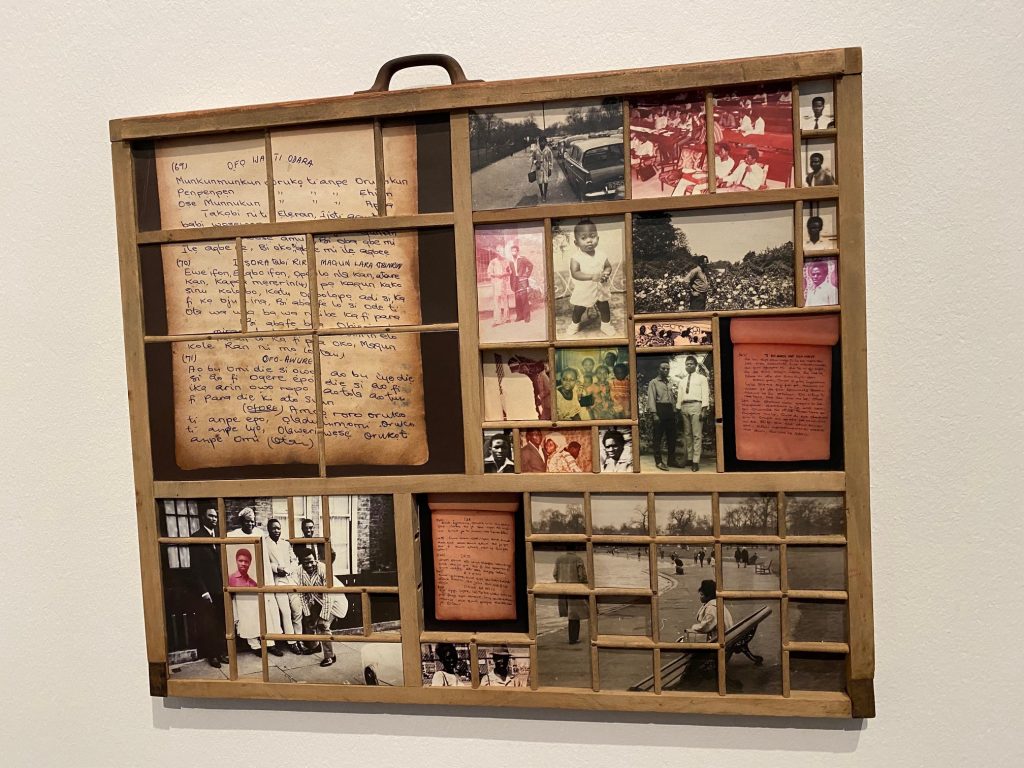
Migration in ferne Länder samt der Verheißung eines vermeintlich besseren Lebens sind so alt wie die Menschheit. Die Weite des Meeres suggeriert zusätzlich die Möglichkeit des Neuanfangs und Althergebrachtes, hinter sich zu lassen. Freiwillig oder gezwungen, das ist dabei oft die entscheidende, unterscheidende Frage.
Politicians and Literature
Biographies as well as autobiographies of politicians receive a lot of attention. Even spouses of politicians or artists benefit from this sensational effect (Obama). But beyond these ex-post or after-office effects, it is more interesting to look at what literature or authors have had an impact on the life and, maybe, office of presidents. So-called literary couples or specific relationships between artists or authors can reveal interesting additional information to understand “what made these personalities”.
In “Le Monde” there is a series of articles devoted to such relationships. It is a kind of romantic summer reading satisfying nosy looks into the private lives of politicians and other celebrities of a more intellectual kind. On the 25th of August 2023 it was the turn of the relationship between Francois Mitterrand and Marguerite Duras entitled … “menteurs sublimes, forcément”.
Their long-standing relationship had in common to cover-up some of their failures in the Nazi-occupied France.
Post-war each person had more than just sympathy for the other person’s accomplishments. The interesting feature to accept advice and criticism from the other person is rare for highly exposed persons. Relationships between artists and presidents are somehow tricky for both. As artist you can get instrumentalised by power rather quickly. As politician you run the risk to open-up too much, as they are rarely unobserved. Paparazzi or other agents go a long way to get or make up a good story. “Tell me what you read, and I tell you who you are”. The relationship between literature, politics and politicians will never be easy. It remains good stuff for literature and cinema. 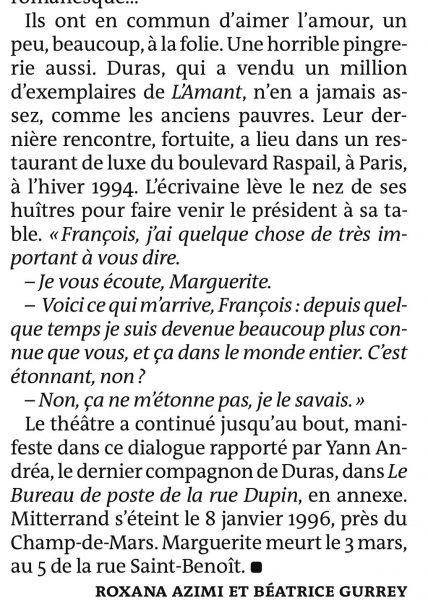
2023-8-24
Das Datum ist mit dem Gedenktag der Unabhängigkeitserklärung der Ukraine verbunden. Gerade die Aggressionen Russlands wollen diese Unabhängigkeit zurückdrehen. Das wird nur mit viel Kraft und Ausdauer gelingen können. 18 Monate im Krieg mit Russland war uns unvorstellbar. Wir werden unablässig unterstützen müssen, damit die Freiheit und Unabhängigkeit aller Teile der Ukraine wieder hergestellt werden kann.
Das Datum sorgt für zusätzliches Gedenken. Jetzt beginnt die Einleitung von durch Atomkraftwerke verunreinigtes Wasser in Fukushima. Das, was nie passieren sollte, hat sich doch als Tatsache bewiesen. Verunreinigtes Kühlwasser wird auf die Welt verteilt durch Einleitung in den Ozean. Private oder nationale Profite werden eingestrichen, aber die Kosten eines GAU (größter anzunehmender Unfall) werden auf die Weltgemeinschaft verteilt.
Ein Tag zuvor hat Indien, anders als Russland, seine Raumkapsel auf dem Mond ohne Bruchlandung aufgesetzt. Großmachtstatus verlangt auch überdurchschnittliches wissenschaftliches Engagement. Das lässt sich mit einer Mondmission sicherlich demonstrieren. Neue Demonstrationen von Unabhängigkeit durch große oder wirtschaftlich erstarkte Staaten werden eine multipolare Weltordnung befördern. Das passiert nicht von heute auf morgen. Es könnten sich vielfältigere Verhandlungsmöglichkeiten auf internationaler Ebene eröffnen. Noch mehr Geduld in der Diplomatie wird nötig sein. Gleichzeitig ergeben sich aber auch größere wirtschaftliche Druckmittel auf Staaten, die internationales Recht verletzen.
Calendar Time
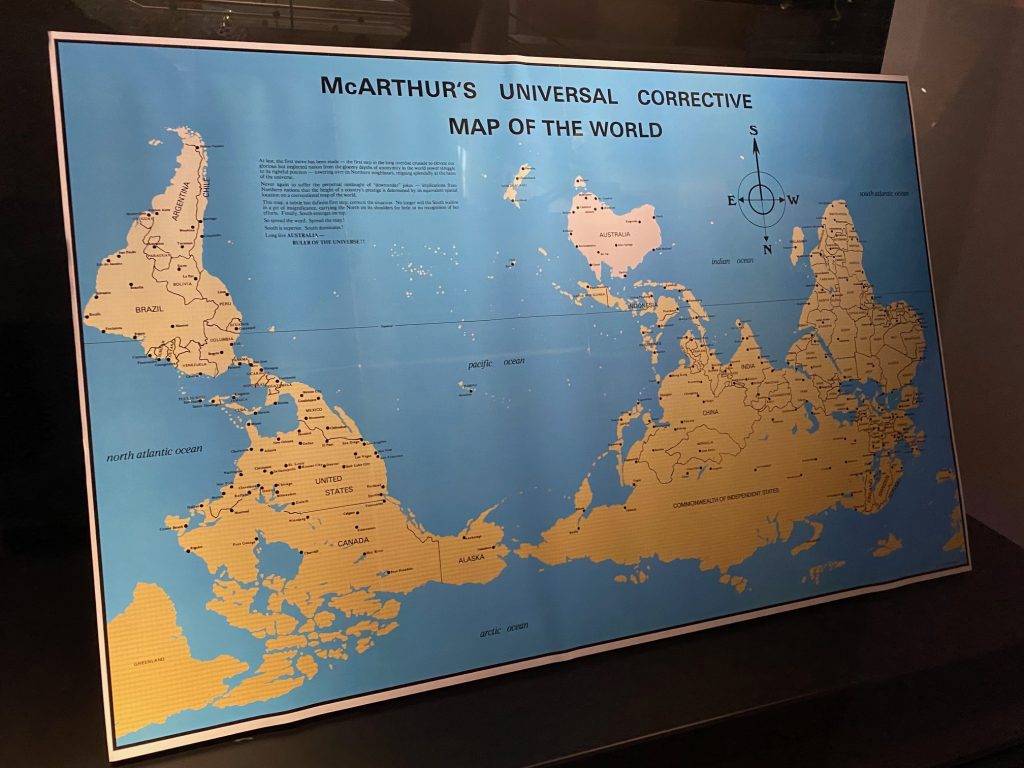
We all use calendars to organize our time almost unconsciously. This is helpful to organize and synchronize our time together. Working time, family and individual time tend to use the same time structure to facilitate community. Work arrangements depend a lot on a common method to structure time. The work-life balance hinges a lot on synchronization of calendars and joint time slots. Towards the end of the annual vacation period in Europe the annualized change of calendars is still common practice despite most people going digital. Annual overviews allow to allocate and potentially synchronize calendars for major events or periods (next break, period devoted to learning, family planning etc.). A cleavage that differentiated Europe in the analogous times was that some countries like Germany use(d) chronological calendars running from 1st of January until 31st of December and counting calendar weeks (1-52). Many other countries have long ago moved on to “functionalist” calendars running based on the school year from 1st of September to 31st of August each year. Different planning horizons appear to be the obvious outcome. Whereas the former might focus on the planning of the end of the calendar year 2023, the latter functionalist calendars begin to structure the new year-long period 2023-24 including the next summer break towards the end of the next schooling year.
In France you start end of August 2023 to plan ahead until end of August 2024. This comprises the Olympic games in Paris 2024. Don’t worry, most tickets are sold out already and attributed through lotteries. When people in Germany start to buy calendars for 2024 and organize a printed calendar, this occurs traditionally around Christmas time and New Year’s celebrations.
Specific professions follow their own calendar time. Academic years or accounting years may well differ from the other annualised organisation of time through calendars. Of course, religions have established their own calendars just as migrating birds or French revolutionaries in the 18th century. Meteorological calendars or sensor-based structuring of annual sequences of seasons like in trees, plants or insects add to the impression of the existence of multiple clocks. 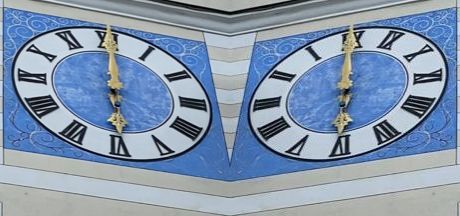
A de-synchronisation of these multiple calendars increases the need to coordinate societies within or society and the economy, religion or ecology. I liked my printed calendars over the years. Now I shall print different versions for different countries and functions. I still wonder, if my life got easier or more complex. Probably, it has only become easier to organise complexity and diversity. Clock 6 video
Corbusier ZH
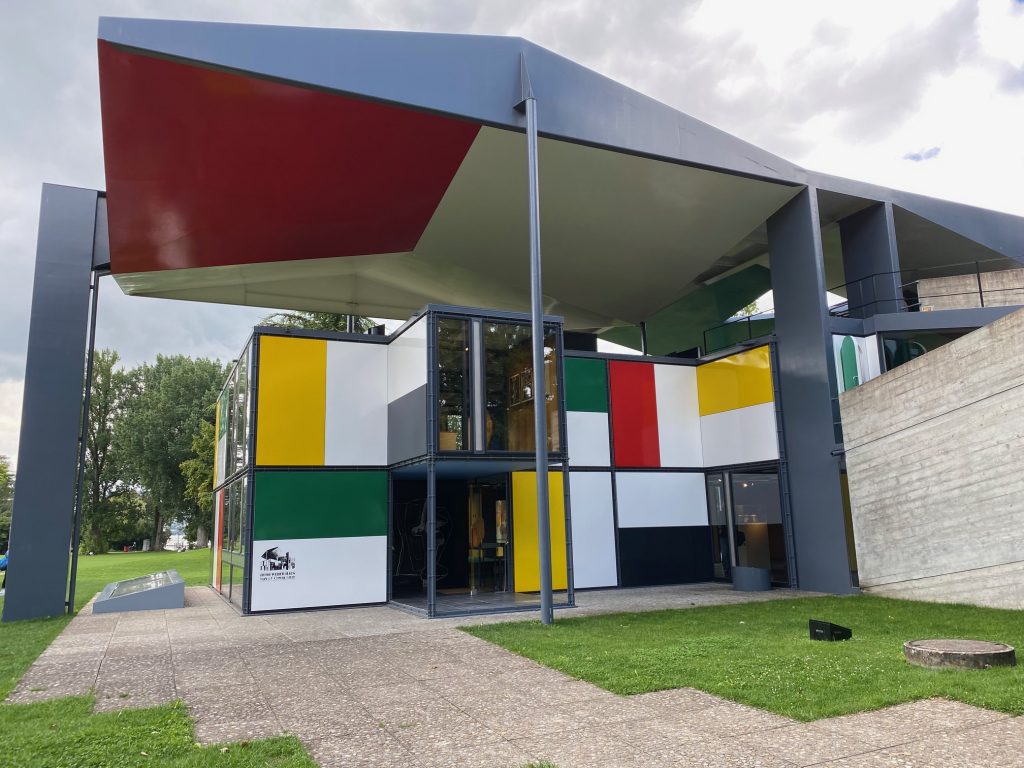
Realizations based on the theory of architecture by Le Corbusier are always worthy of visit. Passing through Zurich (CH) allows to discover another fine example of a villa he designed in the neighborhood of the old town. Within walking distance from the lake Zurich the spacious building allows just like the Paris example for an exhibition of art work within the villa. Horizontally stretched windows and a terrace on the roof make these villas look very modern. Rooftop bars and restaurants just stage a revival in inner cities as cool locations. Le Corbusier anticipated this long ago. Theories can have a long half value time of lasting.
The materials applied in the realizations were obviously less durable. This is the reason why the villa had been closed for renovations for many years. The reopening now shows the splendid views from inside out as well as from the outside. Colors are especially interesting in this example. Nothing is left to or build by chance. The Design language is spelled out in each detail down to door handles. An ongoing exhibition about the deterioration of materials and in some cases even toxic materials helps to understand the necessity to be aware of material science in construction. This makes visits even more informative. The confrontation of vision and sustainability becomes an additional topic also for the theory of architecture.
Stilfindung
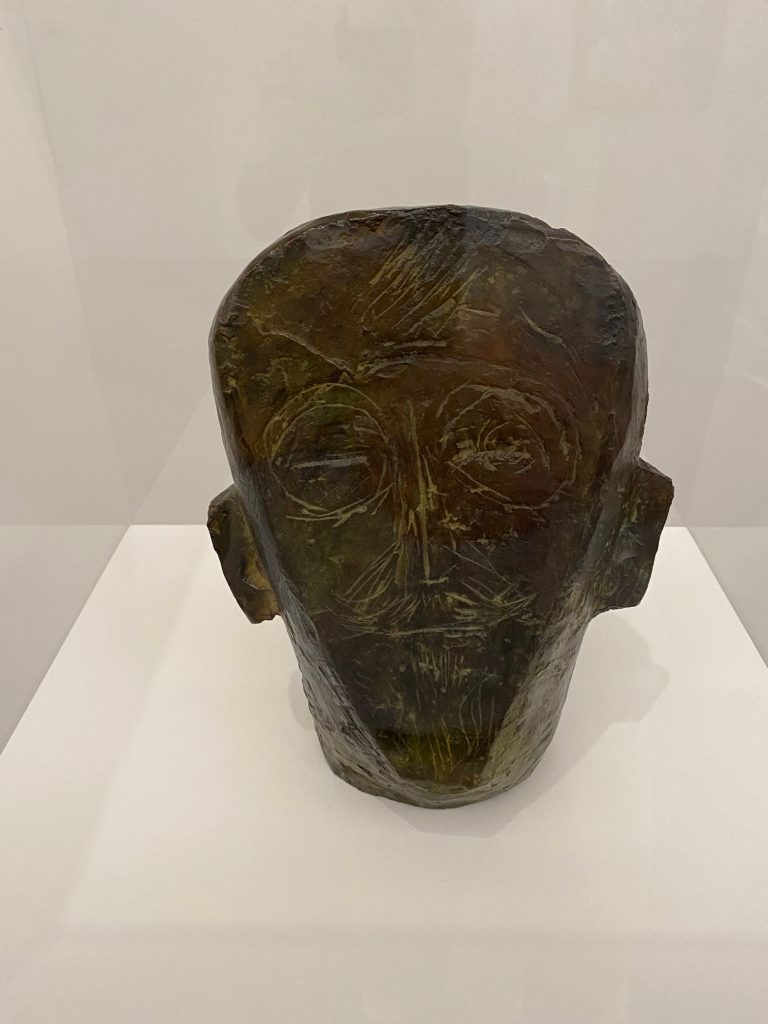
Kunstschaffende brauchen Jahre, oft auch Jahrzehnte, um ihren eigenen Stil zu finden. Das ist durchaus ein schwieriges Unterfangen. Frühes Ausprobieren verschiedener Kunstrichtungen ist dabei so etwas wie ein Experimentieren mit unterschiedlichen Werkzeugen. Da hilft es enorm, wenn schon einmal ein reichlich bestückter Werkzeugkasten im Elternhaus vorhanden ist. Das war in der Künstlerfamilie der Giacomettis der Fall. Der kleine Alberto hat mit Vater Giovannis Tinten, Federn, Ölfarben und Pinseln früh angefangen, sich auszuprobieren. Eltern, der kleine Bruder, Landschaften, Posen vieler Verwandten und Bekannten sowie jegliche Gegenstände wurden zu Objekten des Skizzierens für den Jugendlichen. Schule war nicht wirklich interessant, selbst die École des beaux arts in Paris erweiterte zwar sein Repertoire an Techniken und Sichtweisen, aber auf dem Weg der Selbstfindung scheint es nur eine Passage gewesen zu sein. Auf dem Weg der Abstraktion hat Paris allerdings die Kreativität stimuliert. Seine Skulpturen von Köpfen der Familie haben sich verallgemeinert, hin zum Universellen. Weit über seine Heimat hinaus sagen die Skulpturen des späteren Albertos uns etwas über Menschheit und Menschheitsgeschichte. Den Weg zu verstehen, den der „L‘homme qui marche“ bis zu seiner Verwirklichung beschritten hat, ist in der Ausstellung im Bündner Kunsthaus nachvollziehbar. Vielleicht mehr ein Lehrstück in Pädagogik und Kunstpädagogik, als in grandiosen Werken der Giacomettis. Welch ein Glück, dass sich Alberto von den Stilrichtungen anderer abgesetzt hat und einfach sein eigenes Ding gemacht hat. Beruf und Berufung können nahe beieinander liegen. Das ist die gute pädagogische Message.
Diplomatin
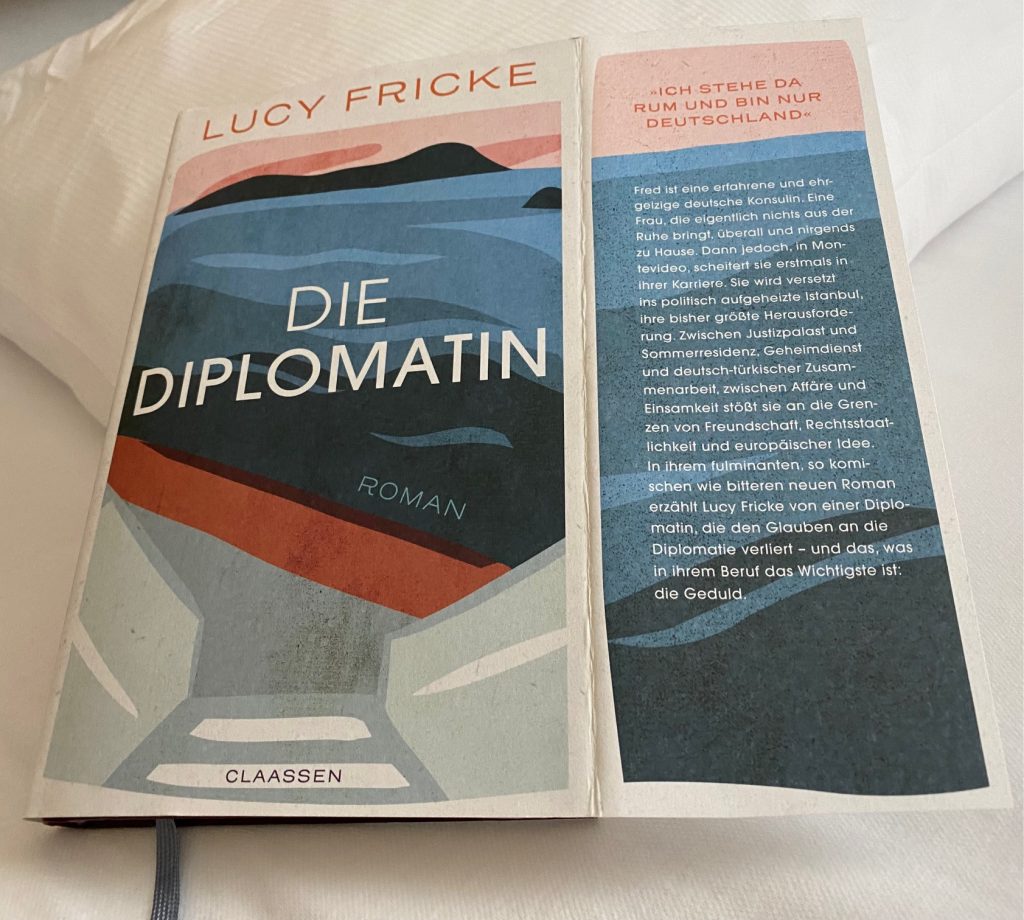
Der Roman von Lucy Fricke über Diplomatie und Diplomaten ergänzt in recht unterhaltsamer Weise die eher trockene und abstrakte Literatur zur internationalen Politik. Gute Bettlektüre für den politisch interessierten Menschen, der gerade im Urlaub ist. Diplomatie schläft nicht und macht wenig Urlaub. Urlauber dagegen machen den Diplomaten oft ganz schön zu schaffen. Die geduldigen Mittel und Wege der Diplomatie sind nun wirklich nicht jeder Frau oder Manns Sache. Wenn sich Emotionen einmischen wird die diplomatische Herausforderung zu einem nahezu unauflöslichen Konflikt. Diskretion und Verschwiegenheit sind elementar in diesem Beruf. Geduldsproben an der Tagesordnung, ständig und bei allen Dienstgeschäften. Ein nachvollziehbarer Einstieg in diese Berufswelt in Form eines Romans sollte Pflichtlektüre für alle sein, die sich diesem Berufsfeld oder der Aufgabe annehmen wollen. Gut, dass es eine Diplomatin beschreibt. Das gibt eine erfrischende neue Perspektive. Vielleicht auch Anregung über eine feministische Aussenpolitik nachzudenken.
Wenig beleuchtet werden die politischen Umstände, die nur als Staffagen für die Erzählungen herhalten müssen. Taksim Platz samt Wasserwerfer interessiert wohl nur am Rande. Das ist schade, weil es verpasste Gelegenheiten sind, Menschenrechtsverletzungen zumindest kurz anzusprechen. So kratzt die Erzählung nur an der Oberfläche von Personen und dem wirklichen Geschäft der Diplomatie. Aktion in den Vordergrund zustellen ist gut für die Story und Verfilmungen, aber der Kern der Diplomatie muss anders aussehen. Etwas Heimaturlaub konfrontiert die Diplomatin dann erneut mit der weitreichenden Gleichgültigkeit gegenüber der diplomatischen Arbeit. Leben organisieren und Aufräumen bleiben auch im Privatleben der Diplomatin eine Herausforderung der Work-life balance.
Lotte
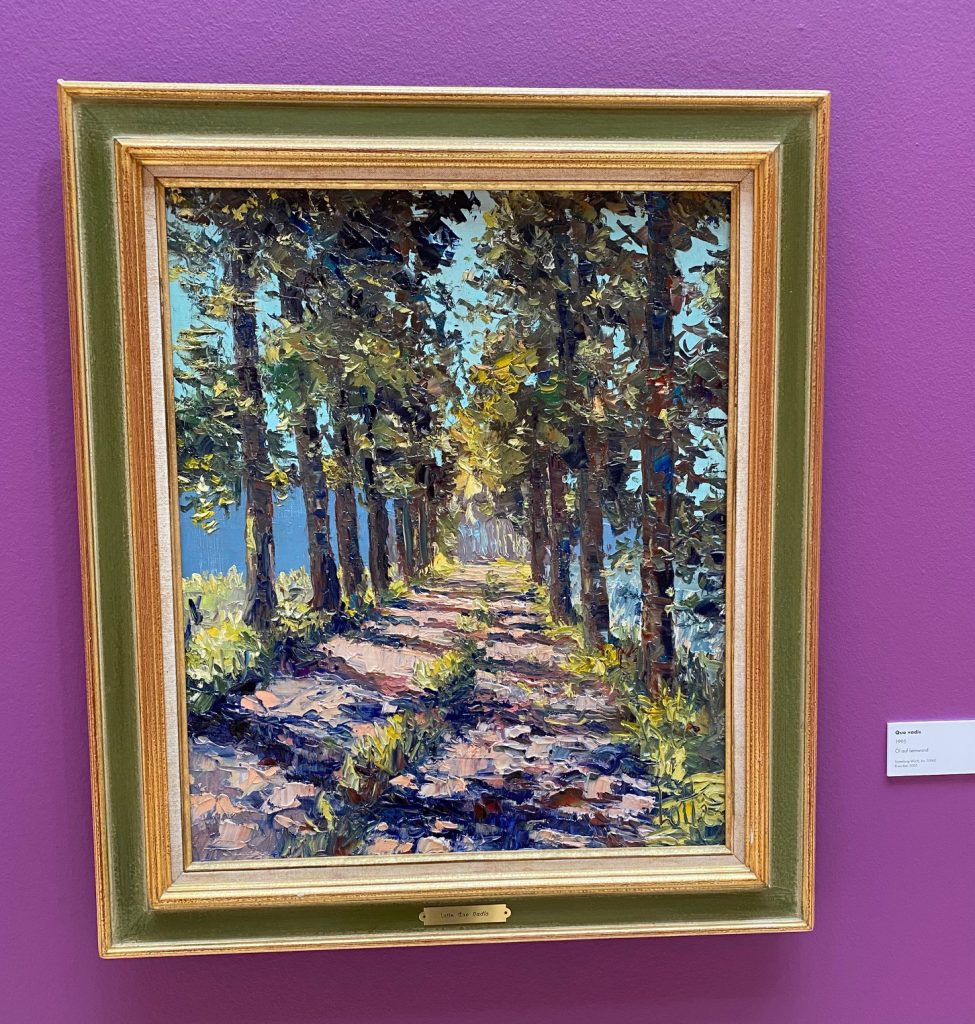
Im Forum Würth in Chur lässt sich in 2023 eine erfrischende Ergänzung zu der ebenfalls in Chur zu besuchenden Ausstellung der männlich dominierten Giacometti Familiensammlung erleben. Lotte, die Malerin, hat ein umfangreiches Werk von erlebten Landschaften hinterlassen. Dem Mäzen Würth ist es gelungen, einen bedeutenden Kontrapunkt zu setzen mit seiner Wertschätzung durch den Ankauf einer großen Sammlung. Weg von der bloßen Darstellung von Frauen durch Männer, hin zu Sichtweisen von Frauen. Im Begleittext zur Ausstellung wird treffend von einer Art bildlichem Reisetagebuch gesprochen. Ein Thema das den Kunst und kulturellen Diskurs in Chur seit Jahrzehnten beschäftigt. Aus der Gegenüberstellung zu den Giacometti Werken ergibt sich die Jahrtausende alte Frage des „l’homme qui marche“ und diese war und ist: „quo vadis“. Das ist denn auch der Titel eines im impressionistischen Stil ausgearbeitetes Gemälde von Lotte. Es ist gut in Szene gesetzt, auf violettem Hintergrund. Mäzene können Impulse geben, die dem oft beliebig erscheinenden Kunstmarkt emanzipatorische Anstöße geben. Kostenloser Besuch im Forum für reisende Familien besser als jeder Stopp an der Tankstelle, obwohl wir vor Ort richtig vollgetankt haben, im übertragenen Sinne.
Giacometti
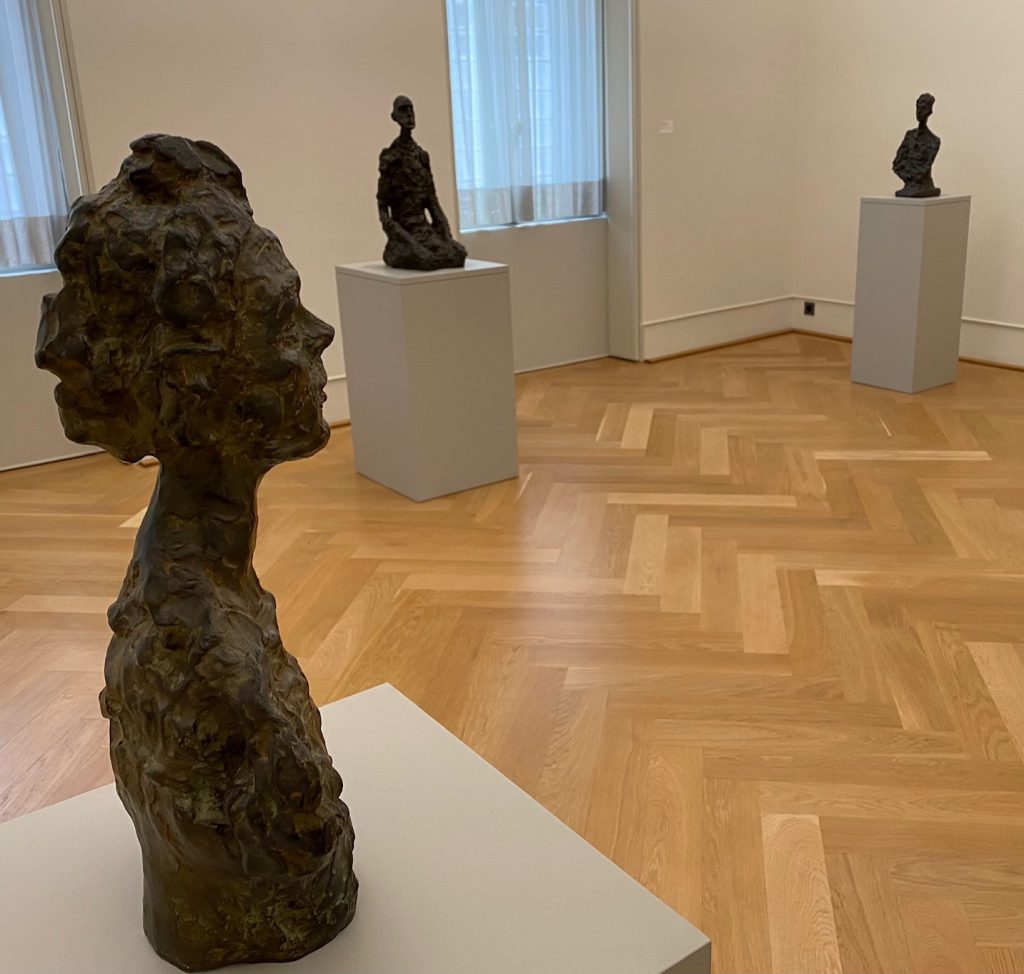
For everyone who enjoys a good walk, with or without dog, Alberto Giacometti is an artist of interest. The world-famous statue “L’homme qui marche” can be admired in several places. Chur (CH) is the artist’s place of death. The most prestigious galleries in Switzerland all have one or several of his art works. In the Bündner Museum in Chur three sculptures of women are perfectly put into correspondence in one exposition room. Eli and Anette from the years 1961 and 1965 talk to Francine with her arms closed in front (title: buste d’une femme). The latter one is from 1962, but was only finished and released as sculpture in 1966, the year of his death or departure. This seems to close a wide circle of creation in the life course of this itinerating artist. Walking the exhibition from sculpture to sculpture is a first step towards meditation walks. Awareness of the stories of the personalities involved widens our horizons. Alberto Giacometti is one of the many artists from the family of the Giacomettis. In the museum in Chur the other family members are well represented, too. Women artists seem to be missing there, probably this needs additional generations.
Reformation
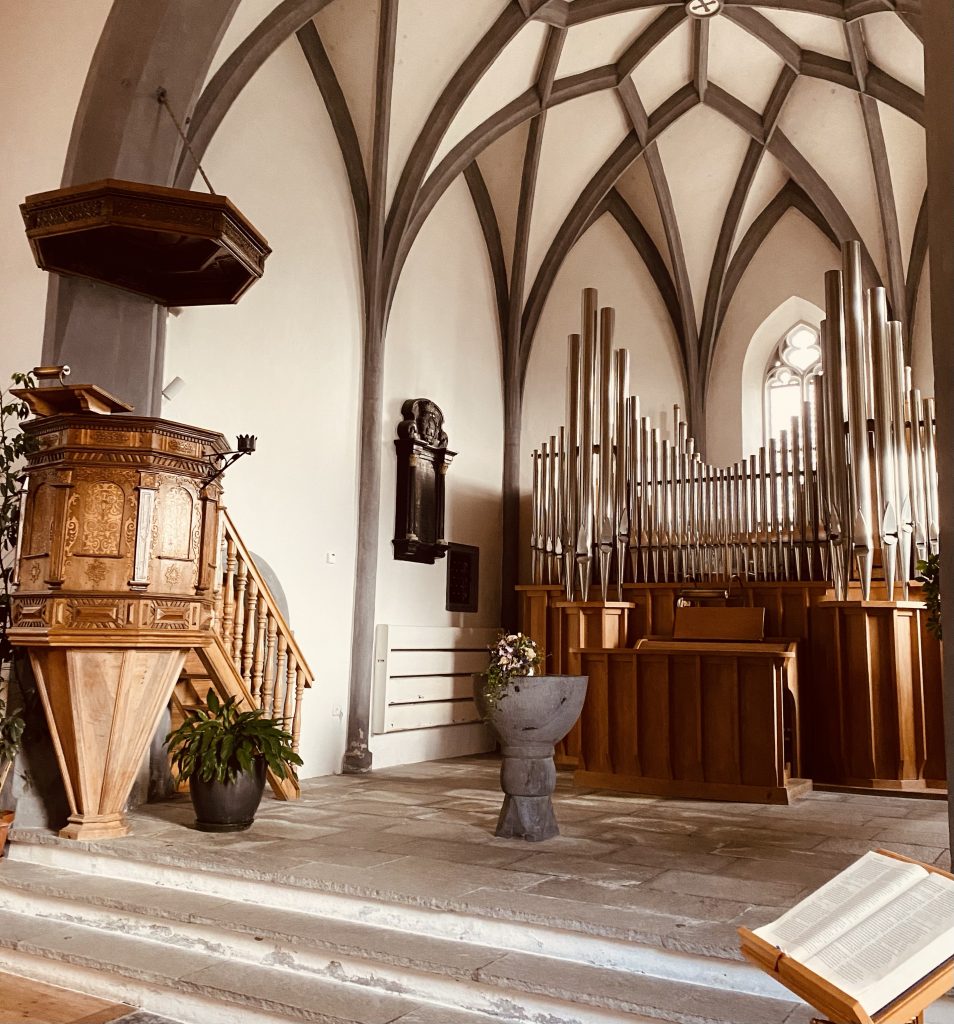
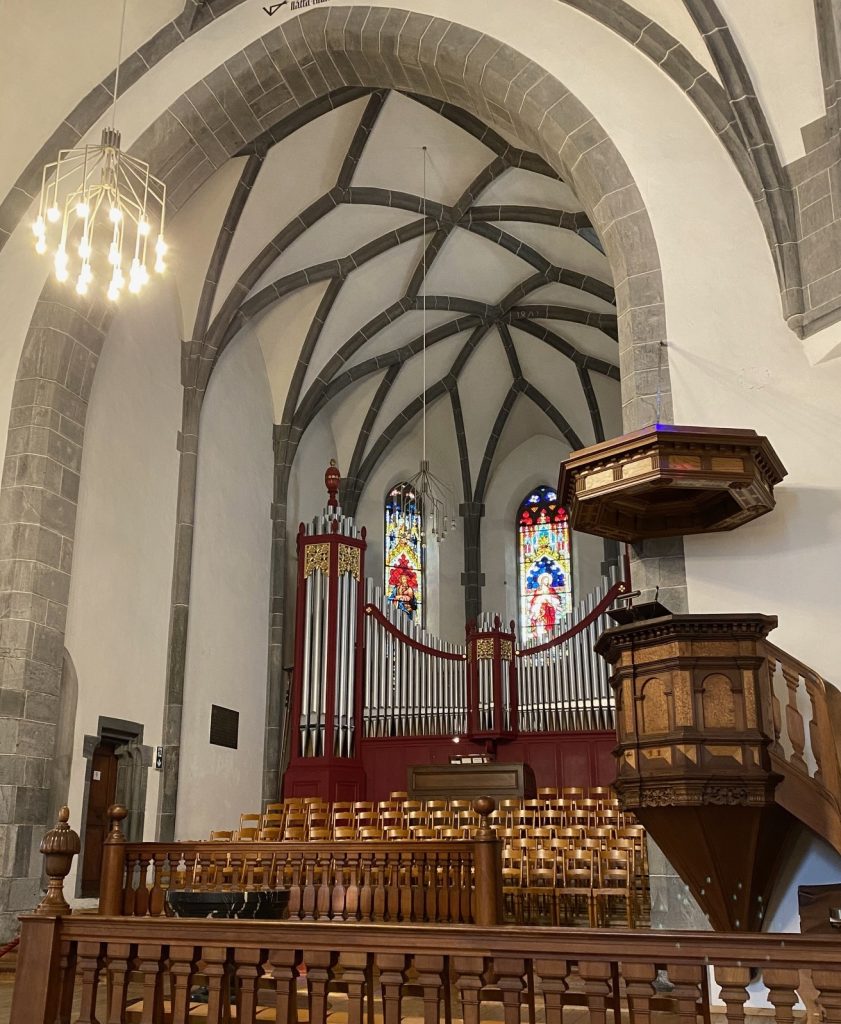
Die Reformation vor 500 Jahren war fantastisch. Die schweizer Stadt Chur hat dabei ihre eigene 500 Jahr Gedenken und Geschichte der Reformation. Jetzt steht uns die Reformation der Reformation bevor. Wie wird die aussehen? In einer kleinen Kirche im Kanton Graubünden, nein diese Geschichte beginnt mal nicht im Stall, steht bereits eine Orgel im Zentrum des kirchlichen Geschehens hinter dem Taufbecken. Vor 7 Jahren spielte selbst ein Mitglied der Berliner Philharmoniker, Albrecht Mayer, ein Kammerkonzert dort. Musikalische Aufführungen oder kleine Theaterstücke,wie Krippenspiele zu Weihnachten kennen die meisten, aber wer kann die historischen Kulturgüter innerhalb einer Kirche noch erkennen und ihre Bedeutung im historischen Kontext erklären. Ein Taufbecken ist schon eine krasse Idee, umrahmt von diesen finsteren Bildern und oft Fenstern.
Die Reformation der Reformation beginnt vielleicht mit dem Öffnen und der musealen oder musikalischen Verwendung, das heißt Erfahren und Erläutern der Architektur sowie des Licht-, Klang- und Raumerlebnisses im historischen Ort. Die angebotenen Weiterbildungen zum Kirchenführer mit Denkmalschutzkomponente sind ein innovatives und zukunftsweisendes Konzept. Es könnte viel kirchliches Personal auf die Reformation der Reformation vorbereiten und weitere Interessierte ansprechen. Die Banken haben zuerst ihre Filialen brutal aus dem ländlichen Raum abgezogen. Bei den kirchlichen Vertretern hoffen wir auf eine menschenwürdigere Reformation der Reformation.
Drowning
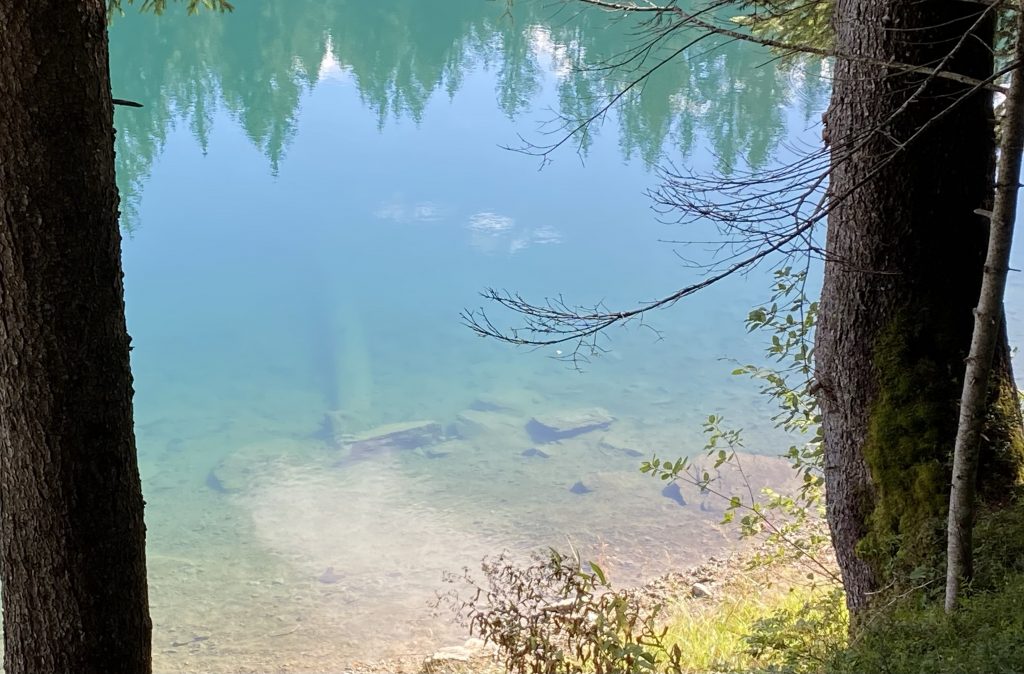
Drowning is a largely underestimated risk. 2.5 million people die of drowning in 10 years according to the WHO. low and middle income countries have the highest drowning rates. However, remedies like teaching how to swim and to assess drowning risks at an early age can make a huge difference. Flooding as natural disaster causes high numbers of casualties, but even in such extreme weather conditions survival strategies involve drowning prevention.
Even in the richest countries drowning is still a reality. Life guards cannot prevent the most irresponsible behavior like drinking alcohol, taking drugs and drowning risks. Overestimating one’s own swimming capabilities is yet another reason for drowning in wealthy countries. Try floating your body with as little movement as possible and you slowly enhance your capabilities to survive in dangerous water conditions. This increases your self-confidence to master tricky situations. Panic in water is surely not helpful. Learning how to help others in danger is for well-trained rescuers or professionals.
Too big
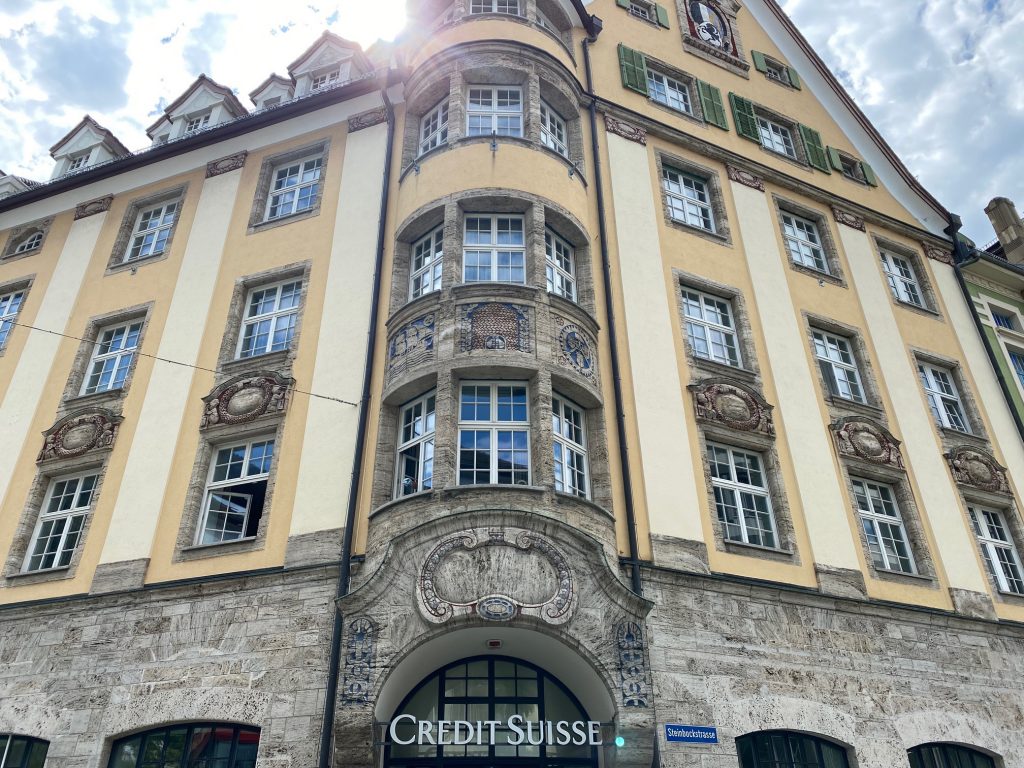
Too big to fail. We all thought that after the financial crisis some fifteen years ago, we would not deal with the same kind of problems again. The banking sector in Switzerland has proven us wrong. One of the 2 big banks Credit Suisse in Switzerland was about to default and asked for 170 billion state guarantee middle of March 2023. Only after a forced merger with the other big bank UBS (which was rescued in 2008 already) and the huge state guarantee the solvency of the even bigger bank was re-established. Tax payers were expected to foot the bill. Less than 6 months later the Finance Minister Karin Keller-Sutter announced that there is no longer a risk for tax payers to pay for the mismanagement of the bankers involved. This is a relief for the political system which is going to the polls next year.
Many unresolved questions remain. Financial market supervision is faulty to say the least. Banking left to bankers as controllers is risky. Apparently fines do not work only prohibition to exercise similar functions (internationally) again is likely to be effective (NZZ 2023-8-9 S.19). Other remedies lie in a complete overhaul of the governance system of banks and beyond. Supervisory boards should in theory be able to assess the risks incurred by the management board. Failure to do so has no consequences for them either. Representatives of the employees in the board is likely to introduce more longer term concerns into decision-making. Saving jobs is a valuable goal not necessarily in the interest of investment bankers. Capitalism is at high risk of survival and with it our democratic systems. It was not a bank in Niger that got into trouble, but at a major European financial center. Too big to fail in a tiny country still sends shivers throughout Europe. And the other big bank is growing even bigger now, probably un-savable now. If I had a bucket of Swiss Franks, I would rather sell them.